
Type & Discipline
Milieu therapy is a treatment modality rooted in psychiatry and psychiatric nursing that uses the total social and physical environment of a treatment setting as the primary therapeutic agent 3. Rather than locating change in a single weekly session with one clinician, it treats the daily life of a ward, unit, or residence — its routines, rules, relationships, and even mundane activities like bathing and eating — as deliberately structured opportunities for therapeutic learning 2. The community itself is the intervention, and group dynamics, peer feedback, and modeling substitute for, or augment, traditional therapist-directed approaches 1. It belongs to the broader family of the therapeutic community, the model from which it descends and with which it shares most of its core assumptions 6. LLM
Because milieu therapy is environmental and team-delivered, it is most often found in residential and inpatient contexts where staff can shape the setting around the clock, and it is delivered by interdisciplinary teams rather than a lone provider 1. This makes it less a discrete technique a clinician “does” in a room and more a treatment philosophy that organizes an entire setting. LLM
Creators & Lineage
The therapeutic community tradition that gave rise to milieu therapy grew out of nineteenth-century humanitarian reforms in psychiatric care, including Philippe Pinel’s advocacy for humane treatment and William Tuke’s Quaker-influenced moral treatment 6. After World War I, “living-and-learning” communities such as Homer Lane’s Little Commonwealth experimented with shared decision-making among residents 6. The decisive developments came during and after World War II at British military hospitals, where the practical principles of the therapeutic community were demonstrated 6.
The term “therapeutic community” was coined by Thomas Main in his 1946 paper “The hospital as a therapeutic institution,” and Maxwell Jones subsequently developed the concept further in Britain 6. The approach drew explicitly on systems theory, organization theory, and psychoanalytic practice, framing clients as active participants in their own and one another’s treatment rather than passive recipients of care 6. This intellectual lineage — psychodynamic ideas about relationships and the unconscious, behavioral and social-learning ideas about modeling and reinforcement, and a structural view of institutions — is what milieu therapy inherits and operationalizes in the design of a unit’s daily life 1. LLM
Core Principles
Contemporary descriptions of milieu therapy converge on a small set of guiding principles. The environment must provide a safe, stable, and adaptive structure so that people feel secure enough to learn and change 1. Care is delivered by interdisciplinary teams who collaborate on comprehensive treatment plans 1. Mutual respect is central: staff and participants alike are treated with dignity, and decisions are not strictly hierarchical 1. Responsibility and a degree of power are shared across the community, which is intended to build participants’ confidence in managing future stressors 1. Finally, peer dynamics are harnessed deliberately, because group interactions naturally generate feedback and modeling opportunities 1.
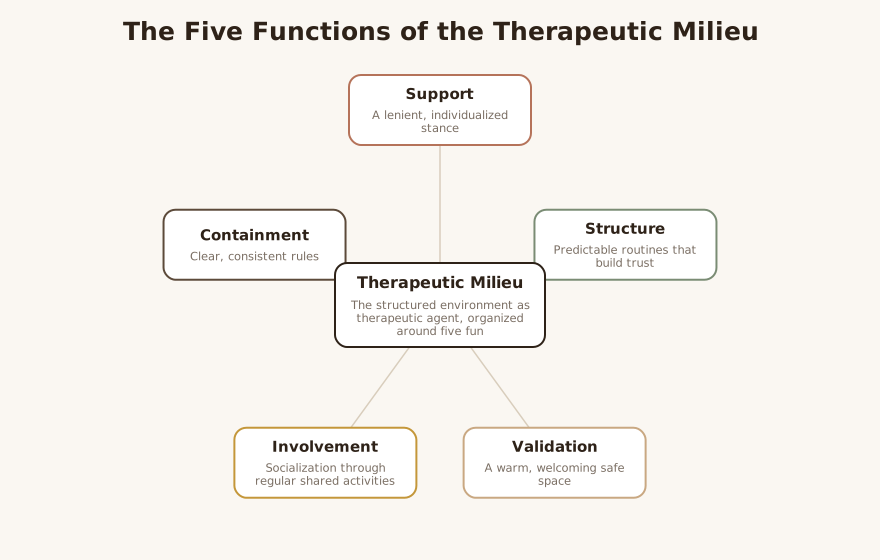
A widely used clinical framing organizes the milieu around five functions: support, structure, validation, involvement, and containment 2. Support refers to a lenient, individualized stance; structure to predictable routines that build trust; validation to a warm, welcoming safe space; involvement to socialization through regular shared activities; and containment to clear, consistent rules 2. In the therapeutic-community version of these ideas, additional emphasis falls on democratization — residents actively share in decision-making — communalism, a culture of inquiry that sustains continuous reflection and feedback, and a living-learning framework in which every interaction is treated as educational 6. LLM
LLM-generated illustrative example (not a guideline): On a residential unit, a missed morning community meeting is not handled as a private infraction but raised in the next group, where peers and staff reflect together on what got in the way — turning a logistical slip into shared material for the “culture of inquiry.” LLM
Interventions & Techniques
In practice, milieu interventions begin with shaping the physical and temporal environment. A studied program for inpatients with schizophrenia included environmental modification — removing hazardous objects to ensure safety — and structured ward activities organized into daily schedules for routines, exercise, meals, and recreation 4. Staff technique centered on effective patient interaction through active listening and positive reinforcement of adaptive behaviors, and the program extended to caregiver education that taught family members about conflict triggers and effective communication 4.
Beyond any single program, the core “techniques” are the deliberate use of everyday life. Daily activities, group dynamics, and peer communication are arranged so that participants set treatment goals, make personal decisions, and learn adaptive responses to real-world challenges that arise naturally within the setting 1. More senior or established members are expected to model appropriate behavior for newer ones, and patients are expected to hold one another to the community’s rules 3. In some therapeutic-community implementations, this peer accountability is strong enough that rule violations can carry consequences for bystanders who were aware and did not intervene 3. LLM
Evidence Base
Milieu therapy is best described as established in the sense that it is long-standing and widely practiced as a standard organizing approach in inpatient and residential settings, not in the sense that it rests on a deep base of rigorous controlled trials 3. The honest picture is that high-quality comparative evidence is limited and dated. LLM
The clearest quantitative signal comes from a single quasi-experimental study of 100 inpatients with schizophrenia, in which 50 received milieu therapy plus routine care and 50 received routine care alone 4. The milieu group showed statistically significant reductions in aggressive behavior (F = 4.61, p < 0.004), self-harm behavior (F = 11.92, p < 0.001), and rule-breaking behavior (F = 6.94, p < 0.001) across assessments from baseline through day 15 4. The authors themselves note important limitations: a small sample, convenience rather than random sampling, no long-term follow-up, and observation limited to eight hours daily rather than around the clock 4. In the broader therapeutic-community literature, effectiveness has been demonstrated particularly for drug-using offenders with co-occurring mental health problems 6.
Reported benefits across explainer sources include symptom reduction, improved coping skills, increased self-mastery, a greater sense of security, and motivation from direct community feedback 1. These are plausible and clinically familiar, but clinicians should weight them as practice wisdom and limited primary data rather than as conclusions from a mature trial literature. LLM
Populations & Indications
Milieu therapy is applied across a range of populations, most prominently inpatient psychiatric patients and people with severe mental illness, where the structured environment can reduce conflict and dangerous behavior 4. It is used with schizophrenia and other serious mental illnesses as a primary focus 2. Explainer sources describe its application to eating disorders, addiction, and behavioral disorders 1.
Adolescents in residential treatment and children in treatment settings are also served, where the living-learning environment and peer modeling map naturally onto developmental needs 1. Among people with substance use disorders, the therapeutic-community version of the model is well represented, particularly the hierarchical US residential approach and modified formats used in criminal-justice settings 6. The common thread across indications is that the person is in, or can be placed in, a setting where staff can shape the surrounding environment continuously. LLM
Problems-for-Work
- Behavioral and emotional dysregulation, self-harm, and aggression: The structured milieu directly targets conflict and containment, with measured reductions in aggression, self-harm, and rule-breaking on an inpatient unit 4. A clinician can use predictable routines and consistent rules (the structure and containment functions) to lower the situational triggers for dysregulation 2. LLM
- Schizophrenia and severe mental illness: Environmental safety modifications and structured ward activity provide stability for patients whose symptoms make unstructured environments overwhelming 4. LLM
- Substance use disorders: Peer accountability and communalism are leveraged so that recovery is reinforced by the whole community, especially in residential therapeutic-community formats 6. LLM
- Personality disorders, conduct disorder, and social skills deficits: Real-time peer feedback and senior-member modeling let interpersonal patterns surface and be reworked in vivo rather than only in retrospect 3. LLM
- Eating disorders: Shared meals and daily routines become structured therapeutic activities within the milieu rather than private struggles 2. LLM
Contraindications, Cautions & Cultural Humility
The most frequently cited limitation is the transition problem: individuals often struggle to maintain learned organizational and coping skills after treatment ends, and environmental or staffing changes can cause setbacks for those with persistent illness without continued support 2. This makes explicit aftercare planning essential rather than optional 1. A second caution is structural: staff can be left vulnerable under inadequate staffing ratios, and the therapeutic value of the milieu degrades when the environment is not adequately resourced 1.
A further caution concerns the strong peer-accountability features of some therapeutic-community implementations, where bystanders who do not intervene in rule violations may face consequences 3. Such collective-consequence norms can be experienced as coercive or shaming, and require careful, culturally attuned facilitation so that “reality confrontation” does not become punitive. LLM Because the milieu encodes norms about authority, family, emotional expression, and communal responsibility, clinicians should hold those norms with humility and adapt them to the cultural backgrounds of the people in the setting rather than treating one community’s culture as universal. LLM The medication-free orientation present in some classic therapeutic-community descriptions should also not be over-generalized: contemporary milieu care commonly coexists with appropriate pharmacological treatment, as in the studied schizophrenia program that combined milieu therapy with routine care 4.
Treatment-Plan Suggestions & SMART Objectives
| Goal | SMART objective (example) | Mechanism |
|---|---|---|
| Reduce aggressive incidents | Patient has zero physical-aggression incidents over a 7-day period by discharge | Structure and containment: predictable routine plus consistent rules 4 |
| Reduce self-harm behavior | Patient reports and uses an alternative coping skill in 3 of 3 logged urges over 2 weeks | Support and validation within a safe environment 2 |
| Improve participation in community | Patient attends and contributes to ≥90% of scheduled community meetings over 14 days | Involvement: socialization through regular shared activity 2 |
| Strengthen peer accountability | Patient gives and receives constructive peer feedback in group ≥2x per week for 3 weeks | Communalism and culture of inquiry 6 |
| Build daily structure | Patient independently follows the posted daily schedule for 5 consecutive days | Living-learning framework with predictable routine 1 |
| Improve coping skills | Patient demonstrates 2 new coping strategies in real ward situations within 3 weeks | Skill practice through naturally arising challenges 1 |
| Plan for transition | Patient and team complete a written aftercare and relapse-prevention plan before discharge | Mitigates the documented post-discharge maintenance problem 2 |
Common Misconceptions
A first misconception is that milieu therapy is simply “the patient being on a nice unit” — a passive backdrop rather than an intervention; in fact it requires deliberate environmental modification, structured activity, and trained staff interaction to function as treatment 4. A second is that it is therapist-directed in the conventional sense; the model intentionally distributes responsibility and decision-making across the community and relies heavily on peer dynamics 1. A third is that it is inherently anti-medication: although some classic therapeutic-community descriptions emphasized psychosocial, medication-free environments 3, contemporary milieu care is routinely combined with pharmacotherapy and routine medical care 4. A fourth misconception is that gains transfer automatically to life after discharge; the literature is explicit that maintenance is fragile and depends on aftercare 2. LLM
Training & Certification
There is no single credential that certifies a clinician as a “milieu therapist” described in the provided sources; rather, milieu therapy is delivered by interdisciplinary teams of professionals from various healthcare fields who collaborate on treatment plans 1. LLM In practice this means competence is built within a setting and a team — nursing, psychiatry, psychology, social work, and allied staff — learning to apply the shared principles of structure, support, validation, involvement, and containment consistently across shifts 2. LLM For clinicians moving into therapeutic-community work specifically, familiarity with its founding principles of democratization, communalism, and the culture of inquiry, and with its psychoanalytic and systems-theory roots, is the relevant knowledge base 6. LLM
Key Terms
- Milieu: The social environment one lives or works in; in this model, the total environment used as the therapeutic agent 3.
- Therapeutic community: The parent model in which the community functions as treatment, coined by Thomas Main in 1946 and developed by Maxwell Jones 6.
- Containment: The function of clear, consistent rules that keep the environment and its members safe 2.
- Structure: Predictable routines that build trust 2.
- Support, validation, involvement: Lenient individualized care, a warm safe space, and socialization through regular activity, respectively 2.
- Democratization: Active resident participation in decision-making, reducing dependence on staff hierarchy 6.
- Communalism: Shared responsibility for the daily functioning of the community 6.
- Living-learning environment: A setting where every interaction is treated as educational 6.
Resources & Further Reading
▶ Watch — a video introduction to this concept:
- What Is Milieu Therapy? How It Works, Guiding Principles & More (Healthline)
- Milieu Therapy: Importance, Benefits, Limitations, and More (WebMD)
- Milieu therapy (Wikipedia)
- Effectiveness of Milieu Therapy in reducing conflicts and containment rates among schizophrenia patients (PMC)
- An Historical Overview of Milieu Therapy (ResearchGate)
- Therapeutic community (Wikipedia)
Reflective / Supervision Questions
- Which of the five milieu functions — support, structure, validation, involvement, containment — is currently weakest on your unit, and what one concrete change would strengthen it 2? LLM
- How do your peer-accountability norms land for clients from different cultural backgrounds, and where might “reality confrontation” tip into shame 3? LLM
- Given that post-discharge maintenance is fragile, how robust is your aftercare planning, and at what point in admission does it begin 2? LLM
- When staffing is thin, what parts of the milieu degrade first, and how do you protect both clients and staff 1? LLM
- Are you and your team treating the environment as an active intervention with explicit goals, or has it drifted into a passive backdrop 4? LLM
1: Healthline. What Is Milieu Therapy? How It Works, Guiding Principles & More. https://www.healthline.com/health/mental-health/milieu-therapy 2: WebMD. Milieu Therapy: Importance, Benefits, Limitations, and More. https://www.webmd.com/mental-health/what-is-milieu-therapy 3: Wikipedia. Milieu therapy. https://en.wikipedia.org/wiki/Milieu_therapy 4: Effectiveness of Milieu Therapy in reducing conflicts and containment rates among schizophrenia patients. PMC7871472. https://www.ncbi.nlm.nih.gov/pmc/articles/PMC7871472/ 6: Wikipedia. Therapeutic community. https://en.wikipedia.org/wiki/Therapeutic_community