
Type & Discipline
Moral treatment is not a manualized therapy you will find in a treatment-protocol library; it is a framework and reform philosophy from the history of psychiatry, and it belongs to the family of asylum reform. LLM It emerged during the late-18th-century Enlightenment as a deliberate, humanitarian reaction against the brutal handling of psychiatric patients, who had commonly been subjected to whipping, beating, bloodletting, starvation, and chaining, and who were frequently regarded as wild animals rather than as sick people. 3 The French term coined for it, traitement moral, deliberately blended psychological and ethical dimensions of care rather than narrowly medical ones. 3
For practicing clinicians, the value of studying moral treatment is conceptual rather than procedural. LLM It is the historical taproot of several ideas you use every day: that environment is therapeutic, that occupation and routine organize a disordered mind, that dignity and relationship are themselves active ingredients, and that people with serious mental illness retain rationality and moral strength worth cultivating. 3 Understanding it well requires reading it inside the medical community and the 19th-century society that produced it, rather than romanticizing it, a caution made explicitly in the occupational-therapy literature that traces its own roots to this movement. 7
Creators & Lineage
The framework has several near-simultaneous parents working in different countries, which is itself a clue that it answered a broadly felt need. LLM In France, Philippe Pinel (1745–1826) became senior physician at Bicêtre in 1793 and then chief physician at the Salpêtrière, where he practiced what came to be called moral treatment: close contact with and careful observation of patients, lengthy conversations to build detailed case histories, and the replacement of bloodletting and purging with psychological understanding. 6 Pinel classified mental illness into categories and is credited with reorienting psychiatry toward humane care, replacing dark cells with brighter rooms and permitting outdoor exercise. 1
The popular image of Pinel personally striking the chains from patients is largely a myth. LLM The custodian Jean-Baptiste Pussin removed the iron shackles at Bicêtre in 1797, after Pinel had already moved on, and Pinel later removed chains at the Salpêtrière with Pussin’s assistance; the dramatic Bicêtre liberation scene appears to have been embellished by Pinel’s son and his student Esquirol to suit a biological-psychiatry narrative. 6 The substance of the method—a strict, nonviolent, nonmedical management—was in fact something Pinel observed in Pussin and adopted. 6
In England, William Tuke (1732–1822), a York Quaker merchant, founded The Retreat in York after learning of a fellow Quaker’s mistreatment in an asylum, opening a deliberately small community of roughly thirty residents in a quiet country house combining rest, talk, and manual work. 13 Tuke’s biography frames him as a founder of the modern mental asylum, pioneering “a new humane method of treating mental illness” that avoided the brutality of the commonplace asylum and emphasized living in community, participation in daily activities, and the elimination of brutal institutional practices. 2 His grandson Daniel Hack Tuke (1827–1895) documented and propagated the reform through textbooks that carried its influence into Britain and America. 1
The lineage continued across the Atlantic. Benjamin Rush became an early American advocate, though his practice remained transitional—he favored hospital treatment away from urban stress yet still used bloodletting and mechanical restraints. 4 Dorothea Dix championed the cause from 1841 onward, insisting on spacious, well-ventilated facilities with beautiful grounds and helping establish dozens of state hospitals. 34 From this lineage—History of Psychiatry into milieu-based and humanistic care models—descend the therapeutic community and milieu therapy traditions clinicians recognize today. LLM
Core Principles
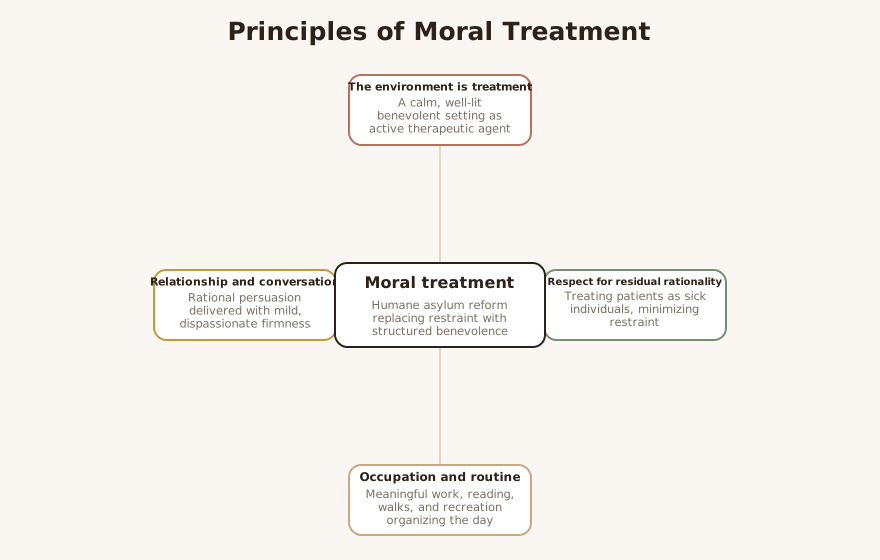
Strip away the period detail and a coherent set of principles remains, several of which map directly onto contemporary inpatient and community practice. LLM
First, the environment is treatment. Moral treatment held that a structured, calm, well-lit, well-ventilated benevolent setting was not merely a backdrop but an active therapeutic agent, which is why reformers replaced dungeons with sunny rooms and pastoral grounds. 34
Second, respect for residual rationality and moral strength. Patients were treated as sick individuals deserving sympathy rather than dangerous madmen, with the explicit aim of minimizing restraint while cultivating rationality and self-control. 36
Third, occupation and routine. Meaningful work, light manual labor, reading, walks, and recreation were central, organizing the day and engaging the person—the very feature the occupational-therapy field later claimed as its origin. 47
Fourth, relationship and conversation as method. Pinel personally explored patients’ problems and worked through delusional beliefs by rational persuasion, advocating “a mild, conciliating treatment rendered effective by steady and dispassionate firmness.” 1
Fifth, scale and individualization. The Retreat’s small size—under thirty residents—was a deliberate design choice enabling individualized care, a point worth holding onto given what overcrowding later did to the model. 34
Interventions & Techniques
Because moral treatment predates the operationalized-intervention era, its “techniques” are described as practices rather than protocols. LLM The recurring elements across France and England were: structured daily occupation, including light manual labor and productive work 4; reading and intellectual engagement 4; walks, exercise, and access to grounds and fresh air 14; pleasant conversation and recreation 4; and therapeutic dialogue aimed at understanding the patient’s perspective and gently correcting delusional beliefs through reasoned persuasion. 1
Behavioral structure was part of the package: reward-based systems were used to encourage self-restraint and socially adaptive conduct, with the goal of having patients internalize control rather than have it imposed by chains. 3 The removal of physical restraint and punishment was itself an intervention, paired with a calm, orderly milieu and a benevolent but firm staff posture. 31
LLM-generated illustrative example (not a guideline): A modern analogue on an inpatient unit might be a clinician who, rather than escalating to seclusion when a withdrawn, demoralized patient refuses to leave their room, builds a graded daily structure—a short morning walk, a brief gardening task, a scheduled one-to-one conversation—and frames participation as restoring the patient’s own sense of competence and dignity. LLM
Evidence Base
Honesty here is essential: moral treatment has no modern evidence base. LLM Its maturity is historical, and its outcome data do not meet contemporary standards. Initial recovery statistics in the early-to-mid 19th century appeared promising and fueled the movement’s optimism, peaking in the 1840s and 1850s. 34 However, those early cure figures were later criticized for conflating new admissions with repeat admissions, inflating apparent success. 3 Reported cure rates declined from the 1830s onward, particularly sharply in the second half of the century, a decline that correlated with institutional expansion and overcrowding rather than with any disproof of the method itself. 3
The historiography also warns against accepting the heroic origin story uncritically. LLM The Bicêtre unchaining was at least partly mythologized 6, and scholars argue that moral treatment can only be properly appraised within the social and medical context that produced and then abandoned it, not as a timeless intervention with portable efficacy. 7 The practical takeaway for clinicians: treat moral treatment as the historical and ethical ancestor of environment-and-relationship-based care, not as an evidence-backed modality. Its descendants—milieu therapy, the therapeutic community, and recovery-oriented care—are where you should look for contemporary evidence. LLM
Populations & Indications
Historically, moral treatment was applied to people with serious mental illness in residential and institutional settings—the populations who would today be described as psychiatric inpatients, institutionalized populations, and residents of therapeutic communities. 34 The framework’s enduring conceptual indications, translated into modern terms, center on conditions where structure, dignity, occupation, and relationship are plausibly active ingredients. LLM
These include serious mental illness and psychosis, where a calm, predictable, low-stimulation but engaging milieu remains clinically relevant 3; agitation and behavioral disturbance, where the original aim of substituting self-restraint and routine for physical restraint still resonates 3; and—perhaps most directly transferable—the institutionalization effects, demoralization, and loss of dignity and autonomy that accompany prolonged inpatient or custodial care. LLM On this last point the historical record is itself the cautionary evidence: when the small, individualized retreat became the overcrowded warehouse, the populations it was meant to help were harmed by the very institutions built in its name. 34
Problems-for-Work
Framing moral treatment’s principles as concrete problems-for-work helps translate a 200-year-old philosophy into something usable in a care plan. LLM
- Demoralization. A client who has lost hope and a sense of agency after a long admission can be engaged through graded meaningful occupation and respectful relationship, the core of the moral-treatment stance. 4LLM
- Loss of dignity and autonomy. For an institutionalized client, work centers on restoring choice, privacy, and respectful address—operationalizing the principle that patients are persons deserving sympathy, not objects of control. 6LLM
- Agitation / behavioral disturbance. Rather than defaulting to restraint, the plan builds environmental calm, predictable routine, and reward for self-regulation, echoing the original substitution of internalized control for chains. 3LLM
- Institutionalization effects. A client who has become passive and dependent is re-activated through structured daily occupation and community participation, the antidote moral treatment proposed and that overcrowding later destroyed. 34LLM
Contraindications, Cautions & Cultural Humility
The first caution is that moral treatment is a historical framework, not a stand-alone evidence-based treatment; it should never displace indicated pharmacological or psychotherapeutic care for psychosis, mood, or other disorders. LLM Its language and assumptions are of their time. The word “moral” did not mean what it means now—it referenced psychological and ethical engagement, not a judgment that mental illness is a moral failing—and clinicians should be careful not to import a blaming connotation. 3
There are real ethical hazards baked into the original model. LLM The reward-and-internalized-control machinery 3 can shade into coercion and behavioral control dressed up as benevolence, and the “firmness” Pinel paired with mildness 1 can be misused to justify paternalism. The movement also carried the cultural baggage of its era; in the United States it became entangled with industrialization, immigration anxiety, and ultimately the eugenics movement, which favored segregation over cure and helped corrupt the model. 4 A culturally humble reading keeps what is portable—dignity, occupation, environment, relationship—while rejecting paternalism, moralizing, and any echo of social control or exclusion. LLM And because the field’s own origin myths have been embellished 6, clinicians should hold the inspirational narrative lightly and the principles seriously. 7
Treatment-Plan Suggestions & SMART Objectives
The table below adapts moral-treatment principles into contemporary, recovery-oriented language. These are illustrative, not prescriptive, and should be embedded within an indicated evidence-based modality. LLM
| Goal | SMART objective (example) | Mechanism |
|---|---|---|
| Restore daily structure | Client will participate in a co-created daily activity schedule with at least 3 occupational blocks per day for 5 of 7 days over 4 weeks | Occupation and routine organize disordered functioning 47 |
| Rebuild sense of agency | Client will independently choose and initiate one meaningful occupational task per day, logged for 3 of 5 weekdays over 6 weeks | Respect for residual rationality and self-direction 6 |
| Reduce reliance on external restraint | Client will use a self-identified calming routine instead of escalation in at least 2 documented instances of agitation over 4 weeks | Internalized self-restraint replacing imposed control 3 |
| Counter demoralization | Client will identify and report one experience of competence or accomplishment per session for 6 consecutive sessions | Dignity and mastery as active therapeutic agents 4 |
| Increase social engagement | Client will attend and remain for the full duration of 2 community/milieu activities per week for 4 weeks | Community participation counters institutionalization effects 23 |
| Improve therapeutic alliance | Client will engage in a scheduled one-to-one conversation focused on personal concerns weekly for 8 weeks | Relationship and dialogue as method 1 |
| Use environment for regulation | Client will access calming, low-stimulation environmental supports (walk outdoors, quiet space) at least once daily for 4 weeks | Environment as treatment 34 |
Common Misconceptions
“Pinel single-handedly freed the patients from their chains.” This is the field’s most durable legend. The actual unchaining at Bicêtre was carried out by Pussin in 1797 after Pinel had left, and the dramatic scene appears to have been embellished by Pinel’s son and Esquirol; Pinel adopted the nonviolent method he observed in Pussin. 6
“Moral treatment means treating mental illness as a moral failing.” The opposite is true. “Moral” here denoted psychological and ethical engagement, and the movement explicitly rejected viewing patients as culpable or as animals, insisting they were sick people deserving care. 3
“It was proven effective.” Early cure rates were promising but methodologically flawed—conflating new and repeat admissions—and declined steeply as the century progressed; the model has no modern evidence base. 3
“It failed because the idea was wrong.” The historical record points elsewhere: overcrowding, misuse of asylums, industrialization, immigration pressure, the rise of eugenic segregation, and the shift of treatment into the psychoanalyst’s office eroded the model, not a disproof of its principles. 34
Training & Certification
There is no certification in moral treatment; it is a historical framework, not a credentialed modality. LLM Clinicians encounter it as foundational content in the history of psychiatry, psychiatric nursing, social work, and especially occupational therapy, which explicitly traces its professional origins to moral treatment’s emphasis on occupation. 7 The practical path to applying its spirit today runs through training in its living descendants—milieu therapy, therapeutic-community practice, and recovery-oriented care—where contemporary competencies and supervision structures exist. LLM
Key Terms
- Traitement moral / moral treatment — the Enlightenment-era humane framework substituting routine, occupation, respect, and a benevolent environment for restraint and brutality. 3
- The Retreat (York Retreat) — William Tuke’s small Quaker residential community (founded 1790s, ~30 residents) emphasizing rest, talk, and manual work. 13
- Milieu as treatment — the principle that the structured environment itself is therapeutic, a direct ancestor of milieu therapy. 34
- Self-restraint — internalized behavioral control cultivated through routine and reward, meant to replace mechanical restraint. 3
- Demoralization — loss of hope and agency, a key problem-for-work the framework addresses through occupation and dignity. LLM
- Institutionalization effects — the passivity, dependency, and dignity loss produced by custodial care, which moral treatment aimed to prevent and which overcrowding later worsened. 34
Resources & Further Reading
▶ Watch — a video introduction to this concept:
- The beginnings of humane psychiatry: Pinel and the Tukes (Hektoen International)
- A biography of William Tuke (1732–1822): Founder of the modern mental asylum (PubMed)
- Moral treatment (Wikipedia)
- Moral Treatment (VCU Social Welfare History Project)
- Philippe Pinel (Wikipedia)
- Moral treatment: contexts considered (PubMed)
Reflective / Supervision Questions
- Where in my own practice do I treat the environment as an active therapeutic agent, and where do I default to it as mere backdrop? LLM
- When a client is agitated, how do I distinguish cultivating self-restraint from exercising control over them—and how would the client experience the difference? LLM
- Moral treatment’s small scale was essential to its success and its overcrowding fatal to it; what does my caseload or unit’s capacity do to the dignity and individualization I can actually offer? LLM
- The movement’s heroic origin story was partly myth. What inspiring narratives in my own clinical tradition might I be accepting uncritically? LLM
- What in this 200-year-old framework is genuinely portable—dignity, occupation, relationship—and what is era-bound baggage I should consciously leave behind? LLM