
Mastery Learning is one of the most durable ideas in educational psychology, and it rests on a claim that is quietly radical for clinicians as much as for teachers: that under the right conditions, the vast majority of learners can reach a high standard of competence, and the variable that should bend is time, not the standard. 1 In a clinical caseload this maps onto a recurring frustration—the client who can recite a coping skill but cannot deploy it, the supervisee who understands a protocol but freezes when asked to run it, the patient who “knows” the psychoeducation but whose behavior never changes. LLM Mastery Learning reframes those gaps not as evidence of incapacity but as evidence that the conditions for mastery—sufficient time, frequent feedback, and corrective instruction—were not yet met. 1LLM
Type & Discipline
Mastery Learning is an instructional framework and design philosophy, not a treatment or therapy. 1 It originates in educational psychology and belongs to the broader family of instructional design, alongside related approaches such as competency-based education and programmed instruction. 1 Its defining feature is structural: learners must demonstrate a specified level of mastery, commonly 80-90% on a knowledge check, of prerequisite material before advancing to new content. 16 For the clinician, it functions as a scaffolding heuristic that organizes how learning content is sequenced and verified, and any clinical use sits inside an established modality—for example, psychoeducation and skills training within psychotherapy, or structured clinical supervision—rather than standing alone as a billable intervention. LLM
Creators & Lineage
The intellectual lineage of Mastery Learning runs back to early-twentieth-century experiments in individualized, self-paced schooling, most notably the 1920s Winnetka Plan associated with Carleton Washburne and the laboratory-school work of Henry Morrison at the University of Chicago, both of which let students progress at their own pace but lacked the supporting structures to scale. 1 The modern framework was given its theoretical engine by John B. Carroll, whose 1963 Model of School Learning argued that aptitude is better understood as the amount of time a learner needs to reach a criterion, rather than as a fixed ceiling on what they can achieve. 15
Benjamin Bloom formalized the approach as “Learning for Mastery” in 1968, building directly on Carroll’s model and arguing that if students receive optimal instruction and sufficient time, more than ninety percent could attain successful, rewarding learning. 1 Bloom identified a set of alterable variables—aptitude, quality of instruction, the learner’s ability to understand instruction, perseverance, and time allowed—as the levers that determine outcomes. 1 A parallel higher-education variant, the Personalized System of Instruction (the Keller Plan), was developed by Fred Keller around 1967, grounding self-paced, unit-perfection learning explicitly in reinforcement principles. 1 This connects Mastery Learning to its behaviorist roots in operant conditioning and to programmed instruction, while Bloom’s own taxonomy of educational objectives supplies the complementary vocabulary for specifying what mastery of a given level actually looks like. 1LLM In recent decades Thomas Guskey has been the framework’s most prominent steward, revisiting Bloom’s model to argue for its relevance to closing achievement gaps. 4
Core Principles
The foundational principle is an inversion of the traditional instructional logic. 1 Conventional teaching holds time constant—everyone gets the same number of weeks—and lets achievement vary, producing the familiar bell curve of outcomes. 1 Mastery Learning reverses this: it holds the achievement standard constant and lets the time each learner needs vary, so that the distribution of mastery narrows rather than spreads. 16
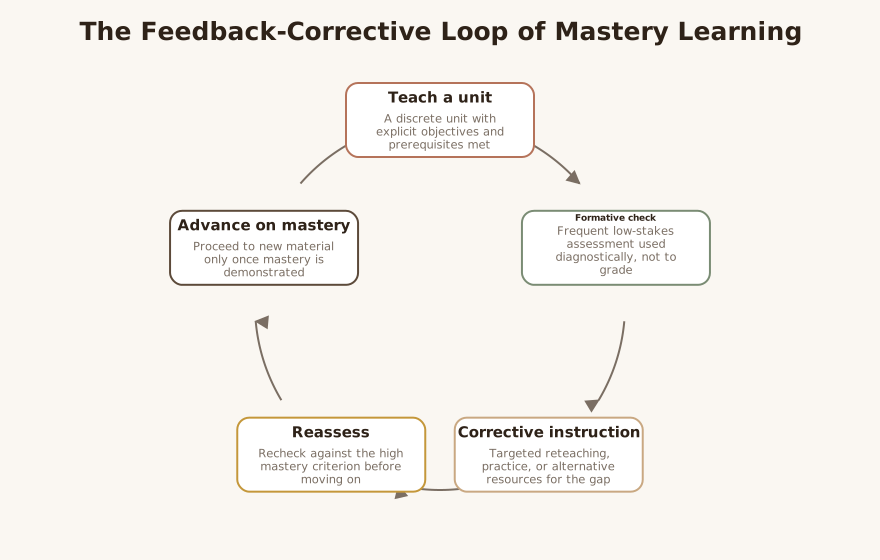
The second principle is that learning is broken into a sequence of discrete, manageable units, each with explicit objectives, and that a learner does not move to the next unit until the current one is mastered. 6 The third is the central role of formative assessment: frequent, low-stakes checks—quizzes, exit tickets, brief demonstrations—used diagnostically to locate exactly where understanding breaks down, rather than to grade or rank. 56 The fourth, and arguably the most distinctive, is the feedback-corrective process: when a formative check reveals a gap, the learner receives targeted corrective instruction—a different explanation, additional practice, an alternative resource—and is then reassessed, while learners who have already reached mastery move to enrichment activities. 15 Underlying all of this is the criterion-referenced stance: success is defined against a fixed standard of competence, typically 80-90% or higher, not against the performance of peers. 16 Bloom’s wager was that most learners can reach that criterion if these conditions are reliably supplied. 1
Interventions & Techniques
Because Mastery Learning is a framework rather than a therapy, “techniques” here means structured ways to embed its logic inside recognized clinical and training activities. LLM The first is unitizing the learning content: rather than delivering a diagnosis explanation or a skills curriculum in one undifferentiated block, the clinician breaks it into small ordered units, each with a clear, observable objective. 6LLM The second is building in formative checks—asking the client to demonstrate, in their own words or in vivo, that they have grasped the prior step before adding the next—so that the clinician is verifying mastery rather than assuming it. 5LLM
The third technique is the feedback-corrective loop: when a check reveals a gap, the clinician does not simply repeat the original explanation but offers a genuinely different route—a metaphor, a worksheet, a role-play, a between-session rehearsal—and then re-checks. 15 The fourth is flexible pacing: explicitly granting the learner the time they need to reach criterion, which for the anxious or self-doubting client can itself be therapeutic, because it removes the threat of being left behind. 1LLM A fifth, drawn from the higher-education Keller-Plan variant, is unit-perfection with reinforcement—celebrating attainment of each unit as a discrete success to build momentum and self-efficacy. 1LLM
LLM-generated illustrative example (not a guideline): A clinician teaching distress-tolerance breaks the work into units: name the skill, recognize the cue to use it, rehearse it calm, then deploy it under mild stress. The client easily reaches criterion on naming and recognizing but, on a formative check, cannot use the skill when mildly activated. Rather than moving on, the clinician treats this as a feedback-corrective moment—adding a paced-breathing prompt card and an in-session graded rehearsal—and only advances to real-world deployment once the client demonstrates the skill under stress. LLM
Evidence Base
Mastery Learning is an established framework, and the maturity label refers to its decades of adoption and a substantial education research base, not to validation as a clinical treatment. 14 On the educational side the evidence is genuinely strong: a meta-analysis of 46 studies found positive effects on achievement, retention of learned material, involvement in learning, and student affect, with an average effect size of roughly 0.59. 1 Higher mastery thresholds have been associated with greater gains on examinations. 1
The framework’s most famous empirical landmark is Bloom’s “2 sigma” finding from 1984. 2 Bloom reported that students taught with one-to-one tutoring plus mastery learning performed about two standard deviations better than conventionally taught students—the average tutored student outperforming 98% of the control group—while group-based mastery learning with feedback-correction produced roughly a one-sigma improvement, lifting the average student to about the 84th percentile. 2 The empirical comparison underlying this work, including Anania’s experimental studies of conventional, mastery-learning, and tutorial conditions, is the primary-source basis for these effect-size claims. 3 Bloom framed the “2 sigma problem” as the challenge of finding scalable group methods as effective as individual tutoring, treating learner failure as an instructional problem rather than a fixed deficit. 2
Honesty about the evidence also requires noting its limits. Critics have pointed out that many mastery-learning studies used experimenter-designed tests rather than standardized measures, and a four-year study by Arlin (1984) found no evidence that the learning-rate gap between students vanishes over time, contradicting one of Bloom’s stronger predictions. 1 The model’s core tension is structural: if achievement is held constant, time must vary, yet most real settings hold time constant, so implementation in fixed-schedule environments is genuinely difficult. 1 Estimates suggest a full mastery approach can require 20-40% more time. 6 Critically for clinicians, there are no controlled trials showing that applying Mastery Learning improves symptoms, because it is an instructional framework and has not been studied as a therapy; its clinical value is structural and pragmatic, extrapolated from its educational track record. LLM
Populations & Indications
The framework was developed for students and educators, who remain its primary population. 15 Within clinical and training contexts, several groups map onto it naturally. LLM Children and adolescents in educational settings are an obvious fit, particularly where treatment planning intersects with academic objectives and achievement gaps. 4 Adult learners are well served whenever the therapeutic task involves deliberate acquisition of knowledge or skill—psychoeducation about a diagnosis, learning an emotion-regulation procedure, or building a concrete behavioral competency. LLM
People with learning disabilities or learning difficulties may benefit from the framework’s most humane feature: the explicit decoupling of competence from speed, so that needing more time is built into the design rather than treated as failure. 1LLM Trainees and clinical supervisees are perhaps the cleanest non-educational application, where graded units, mastery checks, and corrective feedback structure competency development. LLM Skill-acquisition learners more broadly—anyone working toward a procedural competency—are indicated, because the framework was built precisely to ensure that a foundational skill is solid before a dependent one is layered on top. 1LLM
Problems-for-Work
Several presenting and training problems map cleanly onto Mastery Learning. LLM For academic underachievement and achievement gaps, the framework’s central thesis—that gaps reflect insufficient time and corrective feedback rather than fixed ability—directly informs how a clinician supports a struggling student and frames the problem for the family. 4 For skill deficits and procedural skill acquisition, the unit-by-unit, master-before-advancing logic exposes exactly which prerequisite is missing, so remediation is targeted rather than diffuse. 16
For learning difficulties and knowledge retention deficits, the feedback-corrective loop and criterion threshold guard against the common error of moving on after a single exposure, and the education evidence specifically links the approach to better retention. 15 For low self-efficacy in learning, performance anxiety, and test anxiety, the framework’s reframing of failure as an instructional condition rather than a personal verdict, combined with flexible pacing and frequent low-stakes success, can lower the threat value of evaluation. 1LLM For motivation and engagement problems, the steady accumulation of mastered units provides repeated, concrete experiences of competence that fuel continued effort. 6LLM
LLM-generated illustrative example (not a guideline): A college student presents with test anxiety and a conviction that they are “just bad at math.” Working within a cognitive-behavioral frame, the clinician borrows mastery-learning structure: they help the student break the material into small units, use brief self-quizzes as non-threatening formative checks, and treat each missed item as a signal for a different explanation rather than proof of incapacity. As the student accumulates mastered units at their own pace, the catastrophic “I can’t do this” belief weakens and pre-exam anxiety falls. LLM
Contraindications, Cautions & Cultural Humility
As a conceptual and structural framework, Mastery Learning has no contraindications in the pharmacological sense; the cautions concern misapplication. LLM The first is rigidity about the criterion: insisting on a high mastery threshold in a setting that genuinely cannot supply the extra time the model requires can set a learner up to feel stuck or to fall behind, reproducing the very failure experience the approach is meant to prevent. 1LLM The second is mistaking a clean instructional logic for a therapy; the framework sequences learning, but it does not address the relational, emotional, or systemic drivers that often underlie a client’s “learning” problem, and treating it as a complete intervention would be a clinical error. LLM
A third caution concerns the behaviorist heritage: an over-mechanical, drill-and-check application can feel dehumanizing and can privilege easily testable knowledge over deeper understanding—a criticism leveled at some real-world programs that emphasized passing checks over genuine comprehension. 1 Cultural humility matters because the framework was developed within a Western, formal-schooling tradition with specific assumptions about individual achievement, standardized criteria, and the value of speed and measurable mastery. 1LLM What counts as competence, how feedback is best delivered, and whether individual pacing or collaborative learning is culturally normative all vary, and the clinician should adapt the structure to the client’s learning history, language, and context rather than imposing a single standard. LLM
Treatment-Plan Suggestions & SMART Objectives
The mastery-learning structure is a practical engine for writing measurable objectives within a broader treatment or training plan. LLM The examples below are illustrative templates to adapt, not prescriptions. LLM
| Goal | SMART objective (example) | Mechanism |
|---|---|---|
| Establish a prerequisite skill before advancing | Within 2 sessions, client will demonstrate one grounding skill to an 80% accuracy criterion before new skills are introduced | Master-before-advance sequencing of prerequisites 1 |
| Build durable retention of psychoeducation | Over 3 sessions, client will pass a brief formative check on the cognitive model on two consecutive occasions before moving to behavioral work | Formative assessment plus criterion threshold supports retention 5 |
| Close a specific skill gap via corrective feedback | When a skill check is failed, clinician and client will apply one alternative teaching route and re-check within the same session, on 100% of identified gaps | Feedback-corrective loop targets the exact breakdown 1 |
| Reduce evaluation-related anxiety | Over 4 weeks, client will complete weekly low-stakes self-quizzes and reframe each missed item as a correction cue, logging anxiety pre/post (target 2+ point drop on 0-10) | Failure recast as instructional condition, not verdict 1 |
| Pace learning to the individual | Across treatment, client will advance to each new unit only upon meeting criterion, with time-to-mastery recorded rather than capped | Holding standard constant while varying time 1 |
| Raise self-efficacy through unit successes | Within 6 weeks, client will complete and mark as mastered at least one learning unit per week for 4 consecutive weeks | Accumulated unit-perfection builds momentum and efficacy 6 |
| Advance a supervisee’s competency | Within one quarter, supervisee will reach a defined mastery criterion on a manualized intervention via graded units and corrective feedback before independent delivery | Mastery sequencing applied to clinical training 4 |
Common Misconceptions
A first misconception is that Mastery Learning simply means “high standards” or “no one passes without an A”; in fact its core move is to hold the standard constant while expanding time and corrective support, which is the opposite of a sink-or-swim high bar. 1 A second is that it is identical to self-paced study; Bloom’s group-based Learning for Mastery and Keller’s individualized Personalized System of Instruction are distinct models, and the group variant retains a shared, teacher-led structure. 1 A third is that mastery learning equals one-to-one tutoring and therefore produces the famous 2-sigma effect; tutoring achieved about two sigma, whereas group mastery learning achieved roughly one sigma, and Bloom’s whole point was the gap between them. 2
A fourth misconception is that the framework is empirically settled and universally effective; the evidence is positive but real critiques exist around test design, the durability of effects, and the substantial extra time required. 1 A fifth, most relevant clinically, is that Mastery Learning is itself an evidence-based therapy; it is an instructional framework with no clinical outcome trials, and its value in treatment is organizational rather than curative. LLM
Training & Certification
There is no certification in Mastery Learning and no credential required to use it, because it is a public, widely disseminated educational framework rather than a proprietary clinical method. LLM Clinicians most often encounter it through graduate coursework in education, instructional design, or clinical supervision, and through the primary literature. 5 The anchor texts are Bloom’s “Learning for Mastery” and Carroll’s Model of School Learning for the theory, Anania’s experimental studies for the empirical comparisons, and Guskey’s contemporary revisiting of the model for application to achievement gaps. 134 Authoritative summaries suitable for clinical adaptation are available through school-psychology and instructional-design references. 56 No formal training is needed to apply the framework ethically within one’s existing scope of practice, since the clinical service delivered remains the underlying psychotherapy, psychoeducation, or supervision. LLM
Key Terms
- Mastery criterion: The fixed standard of competence, commonly 80-90% or higher, a learner must reach before advancing. 16
- Formative assessment: Frequent, low-stakes diagnostic checks used to locate where understanding breaks down, not to grade. 56
- Feedback-corrective process: Providing a different, targeted form of instruction after a failed check, then reassessing. 15
- Learning for Mastery (LFM): Bloom’s 1968 group-based classroom model of mastery learning. 1
- Personalized System of Instruction (Keller Plan): Keller’s individualized, self-paced, reinforcement-based higher-education variant. 1
- Carroll’s Model of School Learning: The 1963 model recasting aptitude as the time a learner needs to reach criterion. 15
- 2 sigma problem: Bloom’s challenge to find scalable group methods as effective as the two-standard-deviation gain from one-to-one tutoring. 2
- Enrichment activities: Extension work for learners who have already reached mastery while others receive correction. 1
Resources & Further Reading
▶ Watch — a video introduction to this concept:
- Mastery learning (Wikipedia)
- Bloom’s 2 sigma problem (Wikipedia)
- Anania (1983), The influence of instructional conditions on student learning and achievement (PDF)
- Guskey, Closing Achievement Gaps: Revisiting Benjamin S. Bloom’s ‘Learning for Mastery’ (ResearchGate)
- Mastery Learning (iResearchNet, School Psychology)
- Mastery Learning: Bloom’s Model for Ensuring Every Learner (Structural Learning)
Reflective / Supervision Questions
- When a client “knows” the psychoeducation but their behavior has not changed, am I treating that as a fixed limitation, or as a signal that the conditions for mastery—time, feedback, correction—were not yet met? 1LLM
- Where in my current work am I moving a client or supervisee to the next step before confirming they have actually mastered the prerequisite? 1LLM
- When a formative check fails, do I offer a genuinely different route, or do I just repeat the same explanation more slowly? 5LLM
- Am I borrowing the mechanical, drill-and-check surface of mastery learning while neglecting the relational and emotional drivers of the learning problem? LLM
- Does my setting realistically afford the extra time this approach requires, and if not, how do I adapt the criterion without setting the learner up to feel left behind? 1LLM
- How does my use of fixed mastery criteria and individual pacing fit—or clash with—this client’s cultural and educational background? LLM