
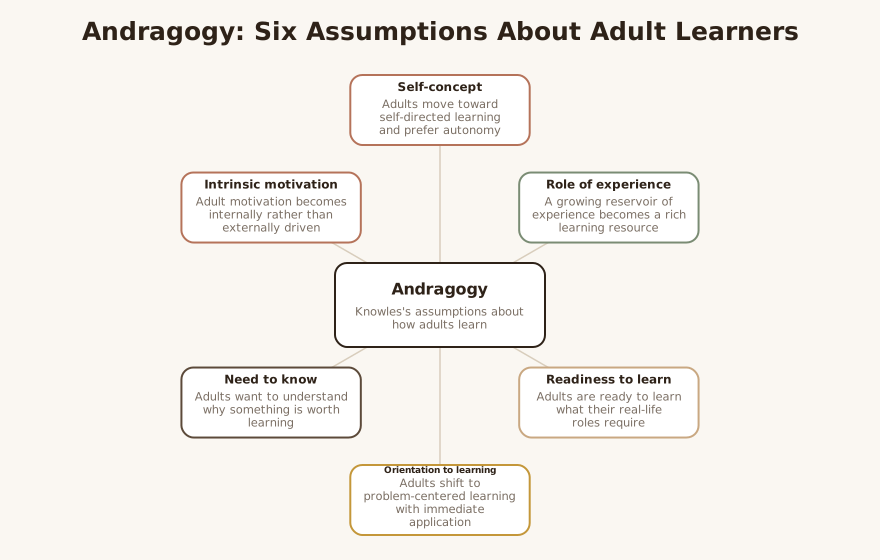
Andragogy is the most widely cited organizing framework for how adults learn, and it shows up constantly in clinical work even when we do not name it — every time we deliver psychoeducation, teach a coping skill, run a group, or supervise a trainee, we are making implicit assumptions about how adult learning works. LLM This article distills andragogy for practicing therapists: what it claims, what the evidence actually supports, and how to operationalize it inside recognized treatment without overselling it. LLM
Type & Discipline
Andragogy is a theory — more precisely, a set of assumptions — originating in adult education rather than in clinical psychology. 1 Malcolm Knowles defined it as “the art and science of helping adults learn,” explicitly contrasting it with pedagogy, the art and science of teaching children. 1 It belongs to the broader family of adult learning theory and overlaps heavily with constructivist and experiential traditions of education. 5
A definitional caveat matters for clinicians: scholars have long debated whether andragogy is a theory of learning, a theory of teaching, or simply prescriptive guidelines for practice, and its assumptions function as both descriptive and prescriptive statements, which creates genuine conceptual ambiguity. 1 For our purposes it is most usefully treated as a delivery framework — a structured way to design and deliver learning to adults — rather than as a falsifiable psychological theory. LLM
Creators & Lineage
The framework is associated almost entirely with Malcolm Shepherd Knowles (1913–1997), the central figure in twentieth-century American adult education. 1 Although the term “andragogy” had appeared sporadically in European writing since the 1830s, Knowles popularized it for English-language audiences beginning around 1970. 1 His intellectual lineage runs through his mentor Eduard Lindeman, his doctoral influence Cyril O. Houle, and — most relevant to therapists — the humanistic psychology of Carl Rogers, whose client-centered, self-actualizing orientation is clearly visible in andragogy’s emphasis on learner autonomy. 1
The key texts trace a clear arc: Informal Adult Education (1950), The Modern Practice of Adult Education (1970, originally subtitled “Andragogy versus Pedagogy”), The Adult Learner (1973), and Self-Directed Learning (1975). 1 The Adult Learner, now maintained as a co-authored “definitive classic” with Holton and Swanson, remains the canonical reference text. 2 Knowles’s own framework is the direct parent of the self-directed learning literature, and it sits alongside Kolb’s experiential learning as a sibling within constructivist adult education. 1
Core Principles
In its mature form, andragogy rests on six assumptions about adult learners. 3 These are sometimes described as the “original four” plus two later additions, but the modern consolidated list is the one most useful to clinicians. 5
- Self-concept. As people mature, they move from dependent toward self-directed personalities and prefer autonomy over their own learning. 1
- Role of experience. Maturation creates “a growing reservoir of experience” that becomes a rich resource for learning. 1
- Readiness to learn. Adults become ready to learn what they need to know to cope with their real-life roles and tasks. 1
- Orientation to learning. Adults shift from subject-centered toward problem-centered learning, wanting immediate rather than postponed application. 1
- Need to know. Adults want to understand why something is worth learning before they invest in it. 3
- Intrinsic motivation. Adult motivation becomes internally driven — self-esteem, job satisfaction, quality of life — rather than externally imposed. 1
A more recent elaboration, the “Andragogy in Practice” model, situates these six core principles inside two additional rings: the goals and purposes of the learning, and individual plus situational differences among learners. 3 That framing is clinically valuable because it acknowledges that the assumptions are not absolutes — they are moderated by context and by the particular person in front of you. 3
Interventions & Techniques
Andragogy translates into a set of concrete instructional moves rather than a discrete protocol. LLM The standard techniques include: involving learners in setting goals and choosing content; explaining the why before the what; using prior experience deliberately through case discussion and peer sharing; tying every topic to an immediate, real-world task; and structuring activity around problems rather than abstract subject matter. 5
Practical delivery tips drawn from instructional design include explaining relevance up front, favoring task-focused activities over rote memorization, accommodating a wide range of experience levels, treating mistakes as supported self-discovery, providing flexible self-paced pathways, and building in hands-on practice or simulation. 5 In healthcare and professional training, these are operationalized as experiential methods that assess readiness, promote self-reflection, and deliberately balance didactic content with interactive activity. 3
LLM-generated illustrative example (not a guideline): A clinician teaching diaphragmatic breathing to an adult client with panic does not open with respiratory physiology. They first ask what the client hopes to change (“I want to drive on the highway again”), connect the skill to that goal (need to know + readiness), draw on a time the client already self-soothed (experience), practice in session, and send the client to test it in a real situation by next visit (problem-centered, immediate application). LLM
Evidence Base
Honesty about maturity is essential here. Andragogy is established in the sense that it is foundational, durable, and near-universally cited in adult education — but its empirical validation is comparatively modest, and its status as a rigorous theory is contested. 1 Knowles himself blended humanistic psychology with behaviorist elements such as learning contracts and behavioral objectives, producing internal tensions that critics have flagged. 1
The strongest critiques are worth knowing. Hartree argued the model conflates description and prescription. 1 Spear and Mocker found that self-directed learners often do not pre-plan; instead they select from whatever limited options happen to occur in their environment. 1 Brookfield argued that genuine self-direction requires both authentic learner control and access to a full range of resources — conditions he called “as much political as pedagogical.” 1 Jarvis observed that Knowles’s formulations lack “a sharp critical edge” and tend to list characteristics rather than interrogate them theoretically. 1 These concerns continue to be examined in current scholarship reassessing andragogy’s contemporary potential. 4
Where empirical work exists, it is generally evaluative rather than experimental. A 2024 evaluation applying andragogy to biomedical team-science workshops found that roughly 85% of 605 qualitative responses mapped onto at least one andragogical principle, with satisfaction ratings of 4.2–4.4 on 5-point scales. 3 The authors candidly noted that their instrument was not designed for andragogy, requiring post-hoc analysis, and that generalizability to other contexts remains open. 3 In short: andragogy is a well-supported design heuristic with face validity and broad uptake, not an intervention with a randomized-controlled-trial evidence base. LLM
Populations & Indications
Andragogy applies to any adult learner, and several clinical populations map onto it directly. 1 For clients in psychoeducation, the framework explains why didactic lecturing underperforms and why relevance-first delivery engages. 5 For trainees and supervisees, it provides the rationale for self-directed, experience-anchored supervision rather than top-down instruction. 1 For clinicians in continuing education, problem-centered, immediately applicable formats outperform abstract content. 3 For group therapy participants, peer experience-sharing is not a digression but a core andragogical mechanism. 5 The assumptions are most apt with adults who have accumulated relevant life or role experience and who are oriented toward solving a present problem. 1
Problems-for-Work
Andragogy is a useful lens for several recurring clinical targets. LLM
- Psychoeducation engagement. Lead with the client’s stated problem and explain relevance before content, leveraging the need-to-know and orientation principles. 3
- Treatment adherence. Frame homework as the client’s own problem-solving experiment rather than an assignment, recruiting self-concept and intrinsic motivation. 1
- Skill acquisition. Use hands-on practice, simulation, and task-focused activity rather than verbal description alone. 5
- Motivation for change. Anchor in internal drivers — self-esteem, quality of life, role functioning — consistent with the intrinsic-motivation assumption. 1
- Self-efficacy. Treat errors as supported self-discovery and build flexible, self-paced pathways so adults experience mastery. 5
- Health literacy. Connect information to immediate life roles and tasks so it is retained and used, not merely heard. 1
LLM-generated illustrative example (not a guideline): In a relapse-prevention group, instead of presenting a slide on the “stages of change,” the facilitator asks members to map their own most recent lapse, then has peers compare what helped — using accumulated experience and problem-centered orientation to do the teaching. LLM
Contraindications, Cautions & Cultural Humility
Andragogy has no “contraindications” in the pharmacologic sense, but it has limits worth respecting. LLM Its assumption of autonomous self-direction may not hold for adults who are acutely unwell, cognitively impaired, in crisis, or culturally oriented toward more directive, expert-led instruction — and Spear and Mocker’s finding that learners often work from constrained options is a useful corrective to over-romanticizing self-direction. 1
The framework has been criticized as individualistic, emphasizing personal learning over social and structural context. 1 Brookfield’s point that real self-direction depends on access to resources — and is partly a political condition — translates directly to health equity: a client cannot “self-direct” their recovery without access to care, time, and support. 1 Cultural humility therefore means checking whether your assumption of learner autonomy fits this client’s values and constraints, and being willing to provide more scaffolding when warranted. LLM The “individual and situational differences” ring of the Andragogy in Practice model is the built-in reminder to adapt rather than apply the principles mechanically. 3
Treatment-Plan Suggestions & SMART Objectives
| Goal | SMART objective (example) | Mechanism |
|---|---|---|
| Increase psychoeducation engagement | Client will articulate, in their own words, the personal relevance of one coping skill by session 3 | Need-to-know; orientation to learning 3 |
| Improve homework adherence | Client will design and complete one self-chosen between-session experiment weekly for 4 weeks | Self-concept; intrinsic motivation 1 |
| Build a target coping skill | Client will demonstrate paced breathing in session and report 3 real-world uses within 2 weeks | Problem-centered, experiential practice 5 |
| Strengthen change motivation | Client will identify 2 internal reasons (e.g., role functioning, self-esteem) for change by session 2 | Intrinsic motivation 1 |
| Increase self-efficacy | Client will complete a graded, self-paced task ladder, reframing 1 setback as learning, over 6 weeks | Supported self-discovery 5 |
| Improve health literacy | Client will connect each new concept to a current life role and restate it accurately by session 4 | Readiness; immediate application 1 |
| Enhance supervisee competence | Supervisee will self-diagnose 2 learning needs and bring case material addressing them monthly | Self-directed learning model 1 |
Common Misconceptions
A frequent error is treating andragogy as a proven learning theory with strong experimental backing; it is better understood as an influential and contested set of assumptions whose empirical base is modest. 1 A second misconception is that pedagogy is “for children” and andragogy “for adults” as fixed categories — but even Knowles’s own later work treated them as situational points on a continuum rather than a hard population divide, and the distinction remains debated. 1 A third is equating “self-directed” with “unsupported”: evidence suggests adults often self-direct within constrained environments and still benefit from structure. 1 Finally, clinicians sometimes assume that experience-based learning means simply allowing discussion; the principle is that the facilitator must deliberately recruit prior experience as a resource. 5
Training & Certification
There is no certifying body or credential for “andragogy”; it is a body of knowledge rather than a licensed practice. LLM Competence is acquired through the foundational literature — most directly The Adult Learner by Knowles, Holton, and Swanson — and through applied instructional-design training in adult education contexts. 2 For clinicians, the practical path is to integrate andragogical design into the continuing-education and supervision formats you already deliver, and to study the applied models such as Andragogy in Practice that show how the principles map onto professional and healthcare education. 3
Key Terms
- Andragogy — “the art and science of helping adults learn,” contrasted with pedagogy. 1
- Pedagogy — the art and science of teaching children; in andragogy’s framing, the directive, teacher-led model. 1
- Self-directed learning — a process in which individuals take initiative in diagnosing needs, formulating goals, identifying resources, choosing strategies, and evaluating outcomes. 1
- Need to know — the adult learner’s requirement to understand why learning matters before engaging. 3
- Problem-centered orientation — preference for learning organized around real problems with immediate application rather than abstract subjects. 1
- Andragogy in Practice model — a framework nesting the six core principles within goals/purposes and individual/situational differences. 3
Resources & Further Reading
▶ Watch — a video introduction to this concept:
- Malcolm Knowles, informal adult education, self-direction and andragogy (infed.org) 1
- The Adult Learner: The Definitive Classic in Adult Education and Human Resource Development (Knowles, Holton & Swanson) 2
- Andragogy in Practice: Applying a Theoretical Framework (PMC) 3
- Andragogy: Past and Present Potential (Clair, 2024) 4
- The Adult Learning Theory — Andragogy — of Malcolm Knowles (eLearning Industry) 5
- Adult Learning Theory / Andragogy Explained (video) 6
Reflective / Supervision Questions
- Where in my current psychoeducation do I lead with content before establishing the client’s “need to know”? LLM
- Am I treating self-direction as a fixed client trait, or am I adjusting scaffolding to the client’s acuity, culture, and resources? LLM
- How deliberately do I recruit a client’s or supervisee’s prior experience as a teaching resource versus simply allowing it to surface? LLM
- When a client struggles with adherence, am I framing tasks as their own problem-solving experiments or as my assignments? LLM
- For supervisees: how am I helping them diagnose their own learning needs rather than only delivering my agenda? 1
- Am I overclaiming an evidence base for the learning method I use, and would my documentation hold up as a recognized billable modality? LLM