
Type & Discipline
Spaced repetition, the applied use of the spacing effect, is a learning technique rather than a therapy or a school of thought 6. The spacing effect is the robust finding that distributing study or practice across separated intervals produces far better long-term retention than the same amount of study massed together in a single block, the pattern most people call cramming 4. The phenomenon belongs to cognitive psychology and the science of human memory and learning, within the family of distributed-practice effects 2. It is a property of how memory works, not a model of personality or pathology, and its clinical value is operational: it tells a clinician when to deliver and rehearse material so that it survives, which is a different question from what to teach or why a problem exists LLM. For the practicing therapist its relevance is twofold — it governs whether psychoeducation and coping skills are still available to a client weeks later, and it underwrites established memory-rehabilitation techniques for clients with cognitive impairment LLM. Like other learning techniques, it is best used inside an established clinical framework rather than as a stand-alone treatment LLM.
Creators & Lineage
The lineage begins with Hermann Ebbinghaus, who first identified the spacing effect 6. In his 1885 monograph Über das Gedächtnis (On Memory), Ebbinghaus used himself as the sole experimental subject, memorizing lists of nonsense syllables, and documented that repetitions distributed across time reduced the probability of forgetting more effectively than repetitions packed together 6. The same work produced his famous account of how memory decays over time, the foundation on which all later forgetting and retention research was built 6. The spacing effect is thus one of the oldest continuously replicated findings in experimental psychology LLM.
The modern lineage runs through the experimental psychology of memory, where the effect has been confirmed across more than a century of studies and consolidated in large quantitative reviews 2. Harold Pashler, Nicholas Cepeda, and colleagues produced the field’s definitive synthesis, aggregating hundreds of experiments to map how the spacing of repetitions interacts with the delay until a memory is needed 2. A later strand, represented by reviews of spacing over long timescales, connects the behavioral effect to the neuroscience of memory consolidation and reconsolidation, proposing a biological mechanism for why separated repetitions are superior 3. In applied and educational settings the same principle generates the everyday tools of distributed practice — flashcard schedules, cumulative exams, and spaced-repetition software — that operationalize Ebbinghaus’s discovery for learners 6.
The clinical branch of the lineage sits within cognitive psychology’s translation into rehabilitation LLM. The technique of spaced retrieval, used in cognitive remediation and dementia care, applies the spacing principle directly to clients with memory impairment, and it sits alongside related learning methods such as errorless learning and the structured rehearsal of behavioral skills training LLM. These applied descendants share the same root insight: memory is built by the timing of practice, not only its quantity 2.
Core Principles
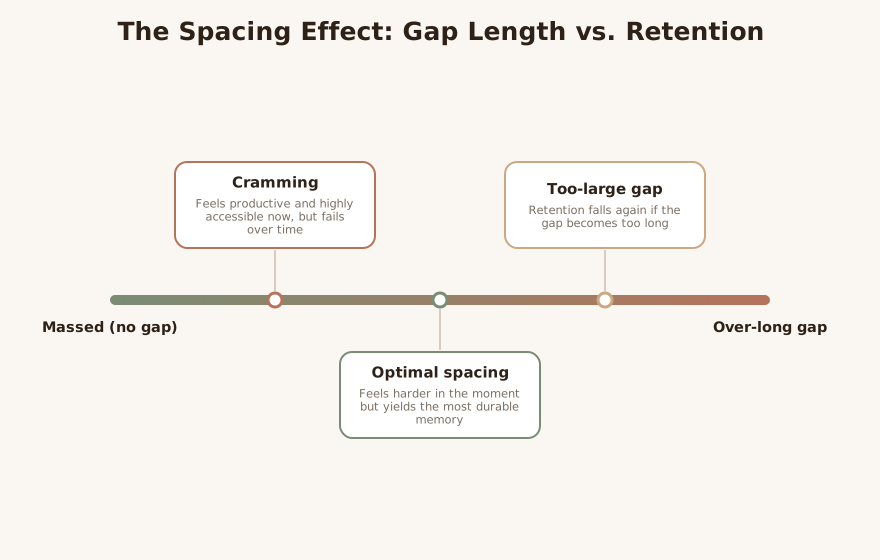
The central principle is that the temporal distribution of practice, holding total practice constant, is itself a powerful determinant of retention 4. Two presentations of the same material separated by a gap are remembered far better at a later test than two presentations back to back, even though the learner spent the same effort 4. This is why cramming feels productive — material is highly accessible immediately — yet fails over the timescales that matter, while spaced study feels harder in the moment but yields durable memory 4. The subjective ease of massed practice is, in effect, a trap LLM.
A second principle is that spacing and the retention interval operate jointly: the best gap between repetitions depends on how long the memory must last 2. The large quantitative synthesis of distributed practice found that the inter-study interval producing maximal final retention increases as the retention interval increases — short gaps suffice when the test is soon, longer gaps are required when the memory must survive for weeks or months 2. This relationship follows an inverted-U: retention first rises as the gap lengthens, then falls if the gap becomes too long, so there is an optimal spacing rather than a “longer is always better” rule 3.
A third principle gives that optimum concrete shape LLM. In one review, a seven-day retention delay was best served by a roughly three-day gap between sessions, whereas a thirty-five-day delay was best served by a gap of around eight days, illustrating that the ideal spacing scales up with the required durability of the memory 3. A fourth principle concerns mechanism: the leading consolidation account holds that a longer gap allows a memory more time to consolidate, so that the next repetition triggers a more effective reconsolidation, deepening the trace 3. The practical upshot for any teacher or clinician is that the schedule of repetition is a design variable to be set deliberately, not left to chance LLM.
Interventions & Techniques
In applied use the spacing effect takes a few recognizable forms LLM. The most basic is distributed practice itself: breaking the same total study into multiple sessions separated by gaps, rather than one long block, which is the direct behavioral expression of the effect 5. A second is expanding-interval rehearsal, in which material is reviewed at progressively longer gaps — minutes, then hours, then days — so that each successful recall stretches the interval before the next, the logic embodied in flashcard and spaced-repetition software 6. A third, common in education, is cumulative review: interleaving and revisiting older material within later sessions, as cumulative exams force learners to do, so that earlier content is repeatedly re-encountered across time 6.
For clinicians the most directly relevant applied technique is spaced retrieval (also called spaced-retrieval training), used in cognitive rehabilitation LLM. Here a client is asked to recall a target piece of information — a name, a safety step, a coping instruction — at gradually expanding intervals, so that the spacing effect is harnessed to lay down a durable memory even in the presence of impairment LLM. Spaced retrieval pairs the timing principle of spacing with the act of active recall, which is a related but distinct memory phenomenon, the testing effect 4. It is worth keeping the two ideas separate: the spacing effect concerns when practice happens, while the testing effect concerns whether the practice involves retrieving rather than re-reading; spaced retrieval deliberately combines both 4.
The clinical contribution is to schedule whatever a client must remember — psychoeducation, a relapse-prevention plan, a grounding sequence — so that it is revisited across separated sessions rather than delivered once and assumed retained LLM. This may mean briefly revisiting last week’s skill at the start of a session, assigning short spaced practice between sessions, and re-testing key material at lengthening intervals as it consolidates LLM.
LLM-generated illustrative example (not a guideline): A clinician teaching a client a paced-breathing protocol does not rely on a single thorough explanation. Instead they introduce it, have the client practice briefly, revisit and rehearse it at the start of the next session a week later, and then check recall again two and four weeks on, lengthening the gap each time the client succeeds. The skill is far more likely to be available during an actual panic episode than if it had been taught once. LLM
Evidence Base
The maturity of the spacing effect is best described as established — indeed it is one of the most robust and frequently replicated findings in the entire science of learning 2. The definitive quantitative synthesis of distributed practice aggregated 839 assessments drawn from 317 experiments across 184 articles, an unusually deep evidentiary base, and confirmed that spaced practice reliably outperforms massed practice and that spacing interacts systematically with the retention interval 2. The consistency is striking: in reviewed memory tasks, spaced practice beat massed practice in 259 of 271 comparisons, a near-uniform direction of effect 6. The phenomenon has held since Ebbinghaus’s original demonstration in 1885 and across more than a century of subsequent work 6.
The evidence also extends, more cautiously, beyond simple verbal recall LLM. Reviews of spacing over long timescales report that spacing benefits the retention of learning across both adults and children, and benefits skill learning in adults, while noting that effects can vary by domain and age 3. The reconsolidation account gives the effect a plausible neurobiological mechanism rather than leaving it as a bare regularity 3. Applied demonstrations — improved foreign-language retention with long inter-session gaps, better mathematics performance with interleaved rather than blocked problems — show the principle transferring to meaningful real-world material 6.
Honesty requires clear limits on the clinical reach of this evidence LLM. The bulk of the foundational evidence comes from verbal-recall and educational tasks in unimpaired learners, not from clinical trials in the populations a therapist treats 2. The claim that scheduling psychoeducation or coping-skill practice on a spaced timetable will improve clinical outcomes is a reasoned extrapolation from a strong basic-science finding, not a directly demonstrated clinical result, and it should be presented as such LLM. Where the principle has been turned into a defined clinical technique — spaced retrieval in cognitive rehabilitation — it has its own applied literature, but the general spacing effect itself is a property of memory rather than a manualized, disorder-specific treatment with its own outcome trials LLM.
Populations & Indications
The spacing effect is relevant wherever a client must retain something, which is to say almost universally, but several populations make it especially pertinent LLM. Students and learners are the original and best-evidenced population, in whom distributed practice reliably outperforms cramming and supports durable acquisition 6. Clients learning coping skills in psychotherapy are a natural clinical application: skills taught once and never revisited are subject to the same forgetting curve as any other material, so spacing their rehearsal across sessions is a principled way to keep them available when needed LLM.
People with mild cognitive impairment, older adults, and others in cognitive rehabilitation are populations in which the spacing principle has been deliberately operationalized through spaced-retrieval training, which uses expanding recall intervals to build durable memories despite impairment LLM. People with attention-deficit/hyperactivity disorder may benefit because distributed, shorter practice sessions fit attentional capacity better than long massed blocks, and because spacing reduces reliance on the in-the-moment sustained effort that is hardest for them — though this is an applied inference from the general principle rather than a population-specific finding in the provided evidence LLM. Across all of these the technique is an adjunct that shapes how material is delivered and rehearsed, not a diagnosis-specific intervention LLM.
Problems-for-Work
Psychoeducation retention. The clearest clinical application is ensuring that what is explained in session is still understood weeks later; spacing the delivery and review of psychoeducation, rather than front-loading it in one session, fits the joint spacing-by-retention-interval finding and protects the material against forgetting 2.
Skill acquisition deficits. Coping skills, communication scripts, and behavioral routines are learned material and decay like any other; distributing their practice across separated sessions and assigning brief spaced between-session rehearsal supports durable acquisition 5.
Memory impairment and mild cognitive impairment. For clients with memory difficulty, spaced retrieval applies the spacing principle directly, asking the client to recall target information at expanding intervals to build a usable memory despite impairment LLM.
Relapse prevention. A relapse-prevention plan that is written once and filed away is unlikely to be accessible at the moment of risk; revisiting and re-rehearsing its key steps at lengthening intervals applies the spacing effect to keep the plan retrievable when craving or crisis arrives LLM.
Learning difficulties and cognitive decline. Where acquisition or retention is compromised, the deliberate use of distributed practice and expanding-interval rehearsal is a low-cost way to give material more chances to consolidate across time, consistent with the consolidation account of why spacing works 3.
LLM-generated illustrative example (not a guideline): A clinician working with an older client in early cognitive decline wants the client to reliably remember a three-step plan for what to do when they feel disoriented. Rather than rehearsing it ten times in one session, the clinician has the client recall the steps after thirty seconds, then after a few minutes, then at the end of the session, then by phone the next day, and again the following week — expanding the gap each time recall succeeds. LLM
Contraindications, Cautions & Cultural Humility
Because the spacing effect is a learning technique rather than a treatment, it carries little intrinsic risk, and the cautions concern misapplication rather than harm from the idea itself LLM. The first caution is against over-claiming: the strong evidence is for basic retention in mostly unimpaired learners, so a clinician should treat the application to coping-skill durability or relapse-plan retention as a sensible extrapolation, not a proven clinical effect, and should not promise outcomes the evidence does not support LLM. Second, spacing is not a substitute for the content of treatment; scheduling rehearsal well does nothing if the material itself is wrong for the client, and the technique can create a false sense of rigor if it is used to drill unhelpful or culturally mismatched material LLM.
Third, the optimal schedule is not one-size-fits-all: the best gap depends on how long the memory must last and on the individual, so a clinician should adjust intervals to the client’s capacity rather than impose a fixed regimen, particularly for clients with significant cognitive impairment for whom too-long gaps may exceed what can be bridged 3. Cultural humility enters in how rehearsal and “homework” are framed: between-session practice, recall testing, and the implicit classroom metaphor may land very differently across clients, some of whom may experience repeated testing as evaluative or shaming LLM. The clinician should introduce spaced practice collaboratively, explain its rationale, frame recall attempts as low-stakes and supportive rather than as quizzes, and adapt the format to what fits the person and their context LLM.
Treatment-Plan Suggestions & SMART Objectives
| Goal | SMART objective (example) | Mechanism |
|---|---|---|
| Retain psychoeducation about the presenting problem | Client correctly restates 3 core psychoeducation points at a review 3 weeks after they are first taught | Spacing delivery across sessions aligns gap with retention interval 2 |
| Make a newly taught coping skill durable | Client demonstrates the skill from memory at sessions in weeks 1, 2, and 4 without re-teaching | Distributed practice across separated sessions builds long-term retention 4 |
| Keep a relapse-prevention plan accessible | Client recalls the plan’s key steps unaided at expanding intervals (1 day, 1 week, 1 month) | Expanding-interval rehearsal repeatedly re-encounters the plan over time 6 |
| Support memory in mild cognitive impairment | Client recalls a target safety routine after expanding gaps across 4 sessions of spaced retrieval | Spaced retrieval harnesses spacing plus active recall despite impairment 3 |
| Fit practice to attentional capacity (ADHD) | Client completes 3 short spaced practice blocks per week rather than one long block | Shorter distributed sessions reduce reliance on sustained in-the-moment effort 5 |
| Strengthen between-session skill rehearsal | Client logs brief spaced practice on 4 of 7 days for 3 weeks | Distributing the same practice over time outperforms massing it 4 |
| Consolidate material over a longer horizon | Client reviews target content at gaps that lengthen as recall succeeds over 5 weeks | Longer gaps allow consolidation, making each repetition’s reconsolidation more effective 3 |
Common Misconceptions
A frequent error is treating cramming as merely a less-disciplined version of spaced study rather than a qualitatively inferior strategy; massed practice produces strong immediate access but poor long-term retention, so its apparent productivity is misleading 4. A second misconception is that “more spacing is always better”; in fact retention follows an inverted-U, with an optimal gap beyond which longer spacing begins to hurt, so the schedule must be matched to how long the memory must last 3. A third is that the spacing effect and the testing effect are the same thing; spacing concerns when practice occurs, whereas testing concerns whether practice involves active recall, and although clinical techniques like spaced retrieval combine them, they are distinct phenomena 4.
A fourth misconception is that spacing is only about rote memorization of facts; the evidence shows benefits for skill learning and for applied material such as language and mathematics, not just isolated word lists 6. A fifth, important for clinicians, is that simply spacing material guarantees a clinical result; the robust evidence is for basic retention, and the leap to improved therapy outcomes is a reasonable extrapolation that has not been established as a manualized treatment effect LLM. Finally, some assume the effect is fragile or laboratory-bound; in reality it is among the most consistently replicated findings in the field, holding in the large majority of comparisons across more than a century 6.
Training & Certification
There is no certification or credential specific to the spacing effect, because it is a property of memory and a learning technique rather than a practice modality LLM. Clinicians typically encounter it within cognitive psychology, educational psychology, or the science-of-learning literature, and through the primary and review sources that define it — Ebbinghaus’s original work and the modern quantitative syntheses of distributed practice 26. Accessible explainer summaries lay out the everyday logic and the related lag and testing effects clearly enough for most conceptual use 45.
For competent clinical application, the relevant training lives inside the established methods the technique fits within LLM. Spaced retrieval is taught as part of cognitive rehabilitation and cognitive remediation training, where it sits alongside errorless learning and other memory-support methods; the structured rehearsal of coping skills is part of behavioral skills training and the homework practices of cognitive behavioral therapies, each with its own training routes LLM. The most useful preparation is therefore to understand the spacing principle well enough to schedule rehearsal deliberately while building credentialed skill in the rehabilitation and behavioral methods that carry it LLM.
Key Terms
Spacing effect: the finding that, for the same total amount of study, repetitions distributed across separated intervals produce better long-term retention than repetitions massed together 4.
Spaced repetition / distributed practice: the applied technique of breaking study or practice into multiple sessions separated by gaps rather than a single block 5.
Massed practice (cramming): studying material in one concentrated block, which yields strong immediate access but comparatively poor long-term retention 4.
Inter-study interval (ISI): the gap between successive presentations or practice sessions of the same material, whose optimal length increases as the required retention interval lengthens 2.
Retention interval: the delay between the last practice and the moment the memory is needed; spacing interacts jointly with this interval to determine retention 2.
Lag effect: the related finding that, within distributed practice, more widely spaced repetitions generally aid retention, following a U-shaped relationship up to an optimum 4.
Testing effect: the distinct phenomenon that actively recalling information improves retention more than re-studying it; spaced retrieval combines this with the spacing effect 4.
Spaced retrieval: a cognitive-rehabilitation technique in which a client recalls target information at expanding intervals, applying the spacing principle to build durable memory despite impairment LLM.
Reconsolidation account: the explanation that a longer gap lets a memory consolidate further, so that the next repetition induces more effective reconsolidation and a stronger trace 3.
Resources & Further Reading
▶ Watch — a video introduction to this concept:
- Distributed practice in verbal recall tasks: A review and quantitative synthesis (Cepeda, Pashler, Vul, Wixted & Rohrer, 2006) — PubMed
- Cepeda et al. 2006 — full-text PDF
- Spacing Repetitions Over Long Timescales: A Review and a Reconsolidation Explanation (Frontiers in Psychology, 2017)
- Spacing Effect — The Decision Lab
- Cognitive Science of Learning: Spaced Repetition (Distributed Practice) — Justin Math
- Spacing effect — Wikipedia
Reflective / Supervision Questions
- When you teach a client a coping skill, how do you currently ensure it is still retrievable weeks later, and where could deliberate spaced rehearsal replace teaching it once and assuming it stuck? LLM
- How would you decide the spacing schedule for a particular client, given that the optimal gap depends on how long the memory must last and on the client’s cognitive capacity? 3
- For a client with memory impairment, how would you set up an expanding-interval spaced-retrieval plan, and how would you keep early gaps short enough that recall succeeds? LLM
- How do you frame recall attempts and between-session practice so they feel supportive rather than like a quiz, particularly for clients who may experience testing as evaluative or shaming? LLM
- Where are you at risk of over-claiming — treating the strong basic-science evidence for retention as if it were proven evidence that spacing improves clinical outcomes? 2
- How do you keep the distinction between the spacing effect and the testing effect clear in your own practice, given that techniques like spaced retrieval deliberately combine them? 4