
Type & Discipline
Jungian typology is a theory within personality psychology and analytical psychology that proposes people differ along a small number of innate orientations of consciousness 3. The Myers-Briggs Type Indicator (MBTI) is the most widely used self-report operationalization of that theory, sorting respondents into 16 four-letter types via questionnaire 5. As a discipline matter, this material sits at the intersection of personality assessment, trait theory, and the depth-psychological lineage of Carl Jung 3. For clinicians it is important to hold a dual frame: Jung’s typology is a clinical-philosophical model of mind, while the MBTI is a commercial psychometric instrument with its own evidentiary track record 4. The two are related but should not be treated as interchangeable, and neither was designed as a diagnostic tool 5.
Creators & Lineage
The conceptual root is Carl Jung’s 1921 book Psychological Types, published in German by Rascher Verlag, translated to English in 1923, and later catalogued as Volume 6 of The Collected Works of C. G. Jung 3. Jung developed the framework partly to reconcile the competing theories of Freud and Adler, concluding that a person’s psychological type shapes and limits their judgment 3. The typology was meant to reflect the genuine heterogeneity of human beings and to counteract theories that assumed psychological uniformity 2.
The MBTI itself was built by two laypeople rather than academic psychologists. Katharine Cook Briggs began personality research in 1917 and, after encountering Jung’s work, recognized its alignment with her own four-temperament thinking 4. Her daughter Isabel Briggs Myers, who had no formal psychology training, apprenticed with a bank personnel officer to learn psychometric methods and developed the indicator during World War II to help women entering the industrial workforce identify suitable jobs 4. The handbook appeared in 1944, was republished as the Myers-Briggs Type Indicator in 1956, and was adopted by the Educational Testing Service in 1962 4. Its lineage thus runs from Jungian analytical psychology into mid-century vocational psychometrics, parallel to (but distinct from) the academic trait-theory tradition that produced the Five-Factor Model 1.
Core Principles
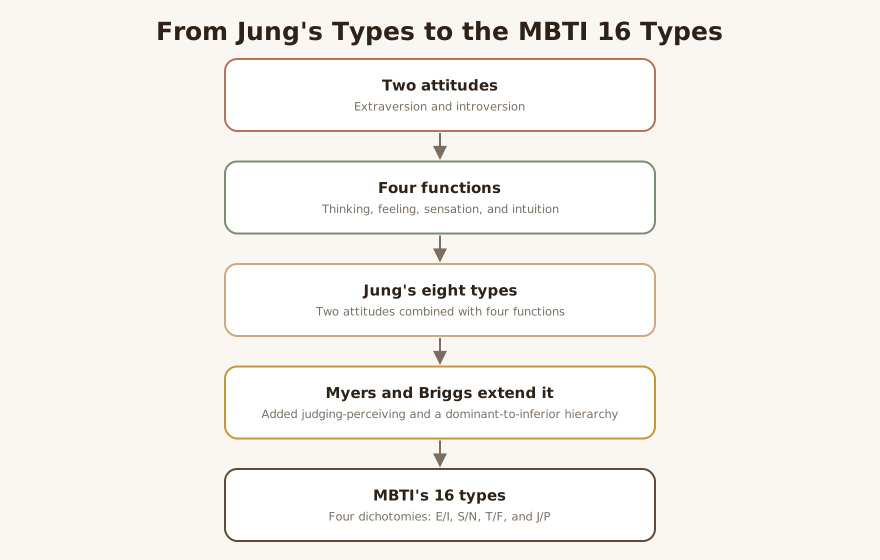
Jung described two fundamental attitudes: extraversion, in which energy and ultimate value rest in the external object, and introversion, in which subjective and inner psychological processes are the center of interest 2. Onto these attitudes he mapped four functions: thinking and feeling, which he called rational (judging) functions, and sensation and intuition, which he called irrational (perceiving) functions 3. Thinking connects information logically and feeling evaluates by subjective values; sensation registers physical stimuli and intuition perceives unseen associations and possibilities 3. Jung held that one function tends to dominate consciousness while its opposite is repressed into the unconscious, creating a characteristic tension 3. Combining two attitudes with four functions yields Jung’s eight primary types 3.
Myers and Briggs extended this scaffolding. They added the judging-perceiving (J/P) dimension and proposed a hierarchy of dominant, auxiliary, tertiary, and inferior functions, with the inferior function emerging under stress 4. The MBTI’s four dichotomies are extraversion/introversion (E/I), sensing/intuition (S/N), thinking/feeling (T/F), and judging/perceiving (J/P) 4. A central, often unstated assumption is that all 16 types are equally valuable, each with its own strengths and blind spots, which is part of what makes the instrument feel non-judgmental and palatable in applied settings 5. Clinically, the most useful Jungian principle may be the developmental one: psychological health involves accepting and integrating repressed or inferior functions rather than rigidly identifying with one’s dominant type 2.
Interventions & Techniques
The MBTI is administered as a self-report questionnaire; the official version takes roughly 20-45 minutes and is intended to be administered and interpreted by a certified professional rather than self-scored from a free online clone 5. Each respondent receives one letter from each of the four pairs, producing a code such as INTJ or ESFP 4. In practice, the “intervention” is the feedback conversation, not the form itself LLM.
Typical applied uses include self-understanding and personal development, career guidance and alignment, improving team communication and dynamics, and relationship-building or conflict resolution 5. In a therapy room, a clinician might use type language as a shared vocabulary for how a client takes in information and makes decisions, then anchor that to concrete relational or occupational dilemmas LLM. The Jungian developmental move, distinct from simple sorting, is to explore the client’s inferior function and the situations that activate it under stress, treating type as a starting hypothesis about defenses and blind spots rather than a fixed label 2.
LLM-generated illustrative example (not a guideline): A clinician working with a self-identified “thinking-dominant” client who reports feeling blindsided by emotional outbursts at home might frame those episodes as the eruption of an under-developed feeling function under stress, using the type vocabulary to externalize and normalize the pattern before doing the actual affect-regulation work in CBT or an emotion-focused frame LLM.
Evidence Base
The honest summary is that the framework is established in the sense of being culturally ubiquitous and theoretically elaborated, but psychometrically weak as a categorical measuring instrument 4. Test-retest reliability is a major problem: large numbers of respondents, reported between roughly 39% and 76%, obtain a different type classification when retaking the indicator after only about five weeks, and only around half retain the same overall type within nine months 4. Because each dichotomy is scored as a cutoff, a person answering 11 of 20 items toward extraversion gets the same “E” as someone answering all 20, which makes near-threshold scores especially unstable 6.
The deeper structural critique is that personality dimensions are continuous, with people being more or less extraverted rather than categorically one or the other, yet the MBTI forces these continua into either/or boxes 6. Scores tend to distribute normally rather than bimodally, which contradicts the existence of discrete types and instead supports a dimensional view 4. Formal evaluations of MBTI theory conclude that the instrument’s structure and claims do not hold up well against psychometric standards and that dimensional models such as the Five-Factor Model are better supported 1. The MBTI shows limited predictive validity for job performance and other outcomes, its own manual discourages using it for hiring, and a 1991 National Academy of Sciences review found insufficient evidence to support its use in career counseling 4. Jung’s original functions, for their part, were not derived from controlled studies 5. Clinicians should therefore treat type results as conversation material, not as measurement-grade data LLM.
Populations & Indications
The instrument is used most heavily with adults in non-clinical, developmental contexts 5. Common populations include working adults pursuing self-understanding or career alignment, teams and organizations seeking better communication, couples, and students or emerging adults navigating early identity and vocational questions 5. Its scale of use is large: roughly two million assessments occur annually, with thousands of businesses, colleges, and government agencies employing it 4. Indications, properly bounded, are educational and reflective rather than therapeutic: building a shared language for individual differences, normalizing variation in communication style, and prompting curiosity about one’s own preferences 6. For career counseling clients specifically, the framework can open conversation about fit and energy, but it should not be the basis of a placement decision given the absence of supporting evidence 4.
Problems-for-Work
- Interpersonal and communication difficulties: Type language can give a couple or colleagues a non-blaming way to describe why one partner wants concrete detail (sensing) while the other talks in possibilities (intuition) 5. The clinical value is the de-personalizing reframe, not the accuracy of the label LLM.
- Relationship conflict: The article literature explicitly warns against using MBTI to judge couple compatibility, so it is better used to map differing decision styles than to predict whether a pairing will work 6.
- Career indecision: Type can seed exploration of what kinds of activities feel energizing, while the clinician keeps the National Academy of Sciences caution in view and refuses to let the result dictate a vocational choice 4.
- Self-understanding deficits: The framework’s strongest defensible use is structured self-reflection, provided the administrator cautions against over-interpretation 6.
- Workplace conflict: Team applications can improve mutual understanding of working styles, but should be decoupled from hiring or promotion decisions, which the manual itself discourages 4.
- Identity confusion: With emerging adults, type can be a scaffold for articulating preferences; the Jungian developmental lens reframes “I don’t know who I am” as an invitation to integrate under-used functions rather than to find one true label 2.
Contraindications, Cautions & Cultural Humility
The MBTI should not be used for hiring decisions or clinical diagnosis, and it is not a substitute for validated diagnostic assessment 5. Using it for high-stakes selection, premarital compatibility verdicts, or career placement runs directly against the evidence and against the instrument’s own manual 6. Free online versions lack standardized validation and show especially poor reliability, so a result a client brings from the internet should be held loosely 5.
Results may also feel uncannily accurate simply because type descriptions are general and flattering, a dynamic clinicians should name rather than reinforce 5. From a cultural-humility standpoint, the dichotomous categories were built from a mid-twentieth-century Western frame and were not derived from controlled, cross-cultural study, so a clinician should avoid implying that any preference, attitude, or function is more mature or valuable than another, and should attend to how cultural context shapes whether traits like extraversion or directness are even adaptive LLM. Type should never be used to constrain a client’s self-concept or to explain away symptoms that warrant proper assessment LLM.
Treatment-Plan Suggestions & SMART Objectives
| Goal | SMART objective (example) | Mechanism |
|---|---|---|
| Improve self-understanding | Client will articulate two personal preferences and one stress-activated blind spot in session within 4 weeks | Structured self-reflection prompted by type vocabulary 6 |
| Reduce relationship conflict | Couple will identify and rehearse one communication accommodation for differing decision styles by session 6 | Externalizing differences as style rather than fault 5 |
| Address career indecision | Client will explore three roles aligned with self-reported energizing activities and list pros/cons within 8 weeks | Reflective vocational exploration, not placement testing 4 |
| Decrease workplace conflict | Team members will each name one colleague’s working-style strength in a facilitated session within 30 days | Shared language for individual differences 5 |
| Support identity clarification | Emerging-adult client will describe one under-used function and a small experiment to develop it within 4 weeks | Jungian integration of inferior function 2 |
| Normalize emotional variation | Client will reframe one recent conflict using non-judgmental preference language by session 3 | Reduced self-criticism via “all types equally valuable” framing 5 |
| Increase psychological flexibility | Client will practice one behavior associated with their non-dominant preference twice weekly for 6 weeks | Developmental integration of repressed functions 2 |
Common Misconceptions
A frequent misconception is that the MBTI measures discrete, real-world categories; in fact scores distribute continuously, and “types” are cutoffs imposed on spectra 4. A second is that a person’s type is stable; the high rate of reclassification on retest shows otherwise for many people 4. A third is that the instrument predicts job performance or career success, which the evidence does not support and the manual itself disclaims 4. A fourth is that strong personal resonance proves validity, when general, agreeable descriptions tend to feel personally accurate to almost anyone 5. Finally, clinicians sometimes conflate Jung’s original eight-type, function-based theory with the 16-type MBTI, but the MBTI added the J/P dimension and a function hierarchy that Jung did not specify in that form 4.
Training & Certification
The official MBTI is intended to be administered and interpreted by a certified professional, and free or unofficial online versions are not equivalent and lack standardized validation 5. For the underlying Jungian theory, primary engagement means reading Psychological Types (Collected Works Volume 6) and the analytical-psychology literature that situates typology within Jung’s broader model of individuation 2. Clinicians who choose to use type material should pair any administration credential with the psychometric literacy to communicate the instrument’s limits honestly, rather than presenting type as settled measurement 1.
Key Terms
- Attitude: Jung’s two orientations of consciousness, extraversion (energy toward the object) and introversion (energy toward the inner subjective world) 2.
- Function: One of four mental operations, thinking, feeling, sensation, intuition, split into rational/judging (thinking, feeling) and irrational/perceiving (sensation, intuition) 3.
- Dominant and inferior function: The function that leads consciousness versus its repressed opposite, which can erupt under stress 3.
- Dichotomy: Each of the MBTI’s four either/or scales, E/I, S/N, T/F, J/P 4.
- Type code: The four-letter result combining one preference per dichotomy, e.g., INTJ 4.
- Function hierarchy: Myers and Briggs’s ordering of dominant, auxiliary, tertiary, and inferior functions 4.
- Test-retest reliability: Consistency of results on repeated administration, notably low for the MBTI 4.
Resources & Further Reading
▶ Watch — a video introduction to this concept:
- Stein, R., & Swan, A. B. (2019). Evaluating the validity of MBTI theory. Social and Personality Psychology Compass
- Volume 6: Psychological Types - IAAP (Collected Works abstract)
- Psychological Types - Wikipedia
- Myers-Briggs Type Indicator - Wikipedia
- Myers-Briggs Type Indicator (MBTI) - Simply Psychology
- The Truth About Myers-Briggs Types - Psychology Today
Reflective / Supervision Questions
- When a client brings an MBTI result, am I treating it as conversation material or implicitly as measurement-grade data, and how would I notice the difference in my own language? LLM
- How do I respond when a client finds their type description deeply validating, given that general descriptions tend to feel personally accurate? 5
- Where might I be tempted to let a type code stand in for proper diagnostic assessment, and what is my safeguard against that drift? LLM
- Am I honoring the Jungian developmental goal of integrating under-used functions, or am I reinforcing a static label? 2
- How do I keep type work clearly subordinate to a recognized, evidence-based modality and to the client’s actual treatment goals? LLM
- In what ways do the instrument’s Western, mid-century origins shape its categories, and how do I hold that with cultural humility across diverse clients? LLM