
Type & Discipline
Intolerance of uncertainty (IU) is a construct in clinical psychology rather than a treatment modality in its own right LLM. It is most usefully understood as a dispositional, trait-like characteristic: a tendency to react negatively on emotional, cognitive, and behavioral levels to uncertain or ambiguous situations 1. Clinically, it is described as a phobia-like aversion to unpredictability that impairs functioning, arising when a person holds negative beliefs about uncertainty and its implications and then works to avoid or control it 4. Within the contemporary literature, IU sits in the family of transdiagnostic constructs — psychological vulnerabilities that cut across diagnostic boundaries rather than belonging to a single disorder 1. For the practicing therapist, the practical consequence of this classification is that IU is something you assess and target, not something you deliver; it becomes a lens that reorganizes how you understand worry, compulsions, and avoidance across several presentations at once LLM.
Creators & Lineage
The systematic study of IU as a measurable clinical construct began with the development of the original Intolerance of Uncertainty Scale by Freeston and colleagues, a 27-item self-report instrument that gave the field a way to quantify the disposition 1. The construct was then elaborated and made central to a model of generalized anxiety disorder (GAD) through the work of Michel Dugas and Robert Ladouceur, who positioned IU as the engine driving pathological worry 1. A pivotal observation from this lineage is that, over the course of treatment, changes in IU often preceded changes in worry, suggesting IU operates upstream of the symptom rather than alongside it 1. The measurement tradition advanced further when Carleton, Norton, and Asmundson produced the abbreviated 12-item version (the IUS-12) with two interpretable subscales, prospective anxiety and inhibitory anxiety, which has become the workhorse instrument for both research and clinical screening 1. More recently, the construct was carried into Barlow’s transdiagnostic tradition, where Boswell and colleagues examined IU as a common factor across the emotional disorders and a target of unified treatment 3.
Core Principles
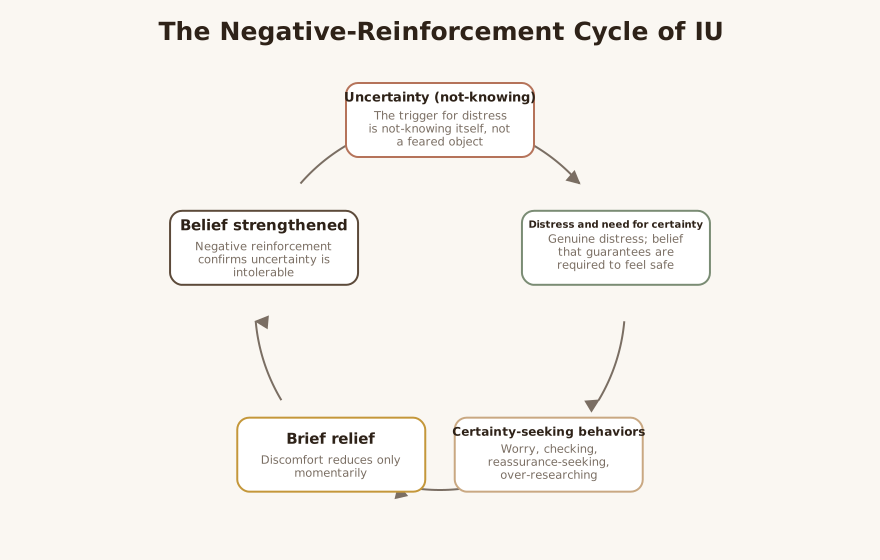
The central claim of the IU framework is that the trigger for distress is not a specific feared object but the experience of not-knowing itself LLM. Uncertainty is a normal and unavoidable feature of life — we can never be completely certain about what will happen next — yet people high in IU experience genuine distress in this ordinary condition and believe they require guarantees in order to feel safe 45. Two related dimensions are clinically useful. Prospective anxiety captures the forward-looking, approach-oriented distress about future uncertainty (“I need to know what is going to happen”), while inhibitory anxiety captures the paralysis and behavioral freezing that uncertainty provokes (“I can’t act until I’m sure”) 1. A defining principle is that IU is associated more strongly with worry than competing constructs, and worry is best understood as a downstream attempt to mentally resolve the unresolvable 1. Crucially, the behaviors people use to manufacture certainty — worry, checking, reassurance-seeking, over-researching — are negatively reinforced: they reduce discomfort briefly while strengthening the underlying belief that uncertainty is intolerable 3.
Interventions & Techniques
Because IU is a target rather than a therapy, it is addressed through established cognitive and behavioral methods retuned toward uncertainty itself LLM. Treatment typically opens with psychoeducation that names IU, normalizes uncertainty as a universal condition, and helps the client map their own characteristic responses to not-knowing 4. Cognitive work then challenges inflated threat estimates and the metabeliefs that life must be predictable, often using cognitive restructuring and behavioral experiments that test what actually happens when certainty is not secured 1. The behavioral core is exposure to uncertainty: deliberately reducing or dropping the safety behaviors — reassurance-seeking, repeated checking, exhaustive information-gathering, over-planning, and avoidance — that the client uses to escape ambiguity 45. Acceptance-oriented strategies complement this, inviting the client to allow the emotional response to uncertainty rather than discharge it, including mindfulness and present-focus practices and “urge surfing” the impulse to seek certainty 15. Patient-facing psychoeducation resources reinforce these same moves between sessions 6.
LLM-generated illustrative example (not a guideline): A client who texts their partner repeatedly to confirm “we’re okay” might, after psychoeducation, agree to a graded experiment: delay the first reassurance text by ten minutes, then thirty, then skip it, tracking their anxiety curve each time to learn experientially that the distress crests and falls without the certainty-seeking behavior LLM.
Evidence Base
The maturity of the IU literature is best described as established, with the important caveat that different strands of evidence are at different stages LLM. The correlational and cross-sectional base is strong and consistent: IU is elevated across GAD, OCD, social anxiety, panic, depression, and eating disorders, and it rises with comorbidity, such that people carrying multiple diagnoses report higher IU than those with one 1. The treatment-response evidence is also encouraging. In a transdiagnostic sample treated with the Unified Protocol, IU dropped from pre- to post-treatment with a medium-to-large effect (d = 0.73), did not change across a 16-week waitlist, and — most informatively — change in IU predicted both post-treatment anxiety severity (β = .60) and depression severity (β = .58) regardless of principal diagnosis 3. Where the evidence is still maturing is causality: whether IU is a genuine causal mechanism that produces anxiety, or a correlate that travels with it, has been the explicit subject of systematic review focused on causality and temporal precedence 2. The honest clinical reading is that IU is a robust and treatment-sensitive target whose causal status is supported by temporal-precedence observations but not yet fully settled 12.
Populations & Indications
IU is indicated as an assessment and treatment focus across a wider band of presentations than its GAD origins might suggest LLM. It is most established in GAD and OCD, where need-for-certainty drives worry and compulsions respectively, but it is also elevated in social anxiety disorder, panic disorder, depression, health anxiety, and eating disorders 14. Notably, patients with panic disorder can show IU scores comparable to those with GAD, and the presence or absence of a specific diagnosis has shown no significant effect on baseline IU level — a pattern consistent with its transdiagnostic status 3. In depression, rumination appears to serve a function parallel to worry in GAD, which may help explain the high GAD–depression comorbidity through shared IU processes 3. IU has additionally been linked to autism spectrum conditions, where difficulty tolerating unpredictability is a recognized source of distress 5. The construct is therefore worth screening whenever worry, checking, or reassurance-seeking dominate the clinical picture, irrespective of the formal diagnostic label LLM.
Problems-for-Work
IU translates into several concrete, observable problems that can be named in a treatment plan LLM. Pathological worry is the attempt to foresee and pre-solve every negative possibility, and it is the problem most tightly coupled to IU 1. Compulsive checking — locks, appliances, emails, the body — seeks certainty that a feared outcome has been prevented 45. Reassurance-seeking outsources the demand for certainty to other people through repeated requests for confirmation 5. Excessive information-seeking shows up as hours of research or symptom-Googling aimed at eliminating doubt 45. Avoidance and procrastination keep the client inside the known and safe and away from tasks with unpredictable outcomes 5. Need for control drives rigid routines and over-planning as a way to manage the discomfort of ambiguity 4.
LLM-generated illustrative example (not a guideline): A client with health anxiety who spends two hours nightly researching a benign symptom is, functionally, performing an information-seeking safety behavior; framing it as a problem-for-work lets clinician and client target the certainty-seeking directly rather than debating the medical content of each new worry LLM.
Contraindications, Cautions & Cultural Humility
IU is a construct, not a procedure, so it carries no formal contraindications, but several cautions apply to how it is used LLM. Uncertainty exposure should be paced and collaborative; pushing a client to “just tolerate not knowing” without adequate psychoeducation and a shared rationale risks reproducing the very threat the work is meant to address 4. Clinicians should distinguish adaptive caution from pathological IU — some checking and planning is appropriate, and the target is the rigid, distress-driven, functionally impairing variant, not all prudence 5. Cultural humility matters because tolerance for ambiguity, the value placed on predictability, and the meaning of reassurance-seeking within families and communities vary, and what looks like excessive certainty-seeking in one context may be a culturally normative or materially adaptive response to a genuinely unpredictable environment LLM. Where uncertainty reflects real and ongoing threat — unstable housing, immigration status, discrimination — the clinical task is to validate the reality before treating the response as a distortion LLM. Finally, because IU rides alongside multiple disorders, it should complement rather than replace diagnosis-specific assessment and risk evaluation 3.
Treatment-Plan Suggestions & SMART Objectives
| Goal | SMART objective (example) | Mechanism |
|---|---|---|
| Reduce reassurance-seeking | Within 6 weeks, client will decrease reassurance-seeking texts/calls from a daily baseline to ≤2 per day, tracked on a self-monitoring log | Response prevention extinguishes negatively reinforced certainty-seeking 3 |
| Build psychoeducational insight | Within 2 sessions, client will articulate a personal model of how IU drives their worry, naming two of their own certainty-seeking behaviors | Psychoeducation and self-monitoring of uncertainty responses 4 |
| Challenge need-for-certainty beliefs | Over 8 weeks, client will complete ≥4 behavioral experiments testing predictions about uncertain outcomes and record actual results | Cognitive restructuring of inflated threat estimates and metabeliefs 1 |
| Tolerate present-moment uncertainty | Within 4 weeks, client will practice a brief mindfulness/present-focus exercise ≥5 days/week and rate distress before and after | Acceptance of the emotional response rather than its discharge 15 |
| Decrease compulsive checking | Within 6 weeks, client will reduce checking episodes by 50% from baseline, logging urge intensity and outcome | Exposure to uncertainty with safety-behavior reduction 4 |
| Reduce avoidance/procrastination | Within 5 weeks, client will initiate ≥3 previously avoided uncertain tasks per week using a graded hierarchy | Approach behavior counters inhibitory anxiety 1 |
| Lower measured IU | Over the episode of care, client will show a reliable decrease on the IUS-12 from intake to discharge | Treatment-sensitive reduction in IU predicts symptom change 3 |
Common Misconceptions
A frequent misconception is that IU is simply another name for generalized anxiety or worry; in fact worry is best understood as a downstream behavior that IU drives, and IU shows independent associations across multiple disorders well beyond GAD 13. A second is that the treatment goal is to help clients become more certain or to gather better information — the actual target is the client’s relationship to uncertainty, not the elimination of uncertainty, which is impossible 45. A third is that IU belongs only to anxiety; it also appears prominently in depression, where rumination functions analogously to worry 3. A fourth is that certainty-seeking behaviors are harmless coping; clinically they are maintaining factors, briefly soothing but reinforcing the belief that uncertainty cannot be borne 3. Finally, some clinicians assume IU is a fixed trait that cannot move, yet measured IU declines with treatment and that decline tracks symptom improvement 3.
Training & Certification
There is no certification in “intolerance of uncertainty” because it is a construct embedded within broader evidence-based therapies rather than a standalone credentialed modality LLM. Competence is acquired by training in the parent approaches that operationalize IU — cognitive behavioral therapy for GAD and OCD, and transdiagnostic protocols such as the Unified Protocol for emotional disorders — and by learning to administer and interpret IU measures like the IUS and IUS-12 13. Familiarity with the published treatment frameworks for GAD and for OCD that explicitly center uncertainty gives clinicians ready-made session structures for psychoeducation, cognitive restructuring, and uncertainty exposure 1. For practitioners new to the construct, clinical information handouts and patient-facing psychoeducation materials provide an accessible entry point before deeper protocol training 46.
Key Terms
Intolerance of uncertainty (IU): a dispositional tendency to react negatively, emotionally, cognitively, and behaviorally, to uncertain situations 1. Prospective anxiety: the forward-looking dimension of IU, the distress and need-to-know provoked by future uncertainty 1. Inhibitory anxiety: the dimension of IU marked by behavioral paralysis and an inability to act until certainty is secured 1. IUS / IUS-12: the Intolerance of Uncertainty Scale, originally 27 items and later abbreviated to a 12-item version with prospective and inhibitory subscales 1. Safety behavior: a certainty-seeking action — checking, reassurance-seeking, over-researching — that briefly reduces discomfort while maintaining IU through negative reinforcement 34. Transdiagnostic mechanism: a psychological process, such as IU, that operates across multiple disorders rather than within a single diagnosis 12. Temporal precedence: the question of whether change in IU comes before, and thus may drive, change in symptoms — a central issue in establishing causality 2.
Resources & Further Reading
▶ Watch — a video introduction to this concept:
- Extension of the Transdiagnostic Model to Focus on Intolerance of Uncertainty (Einstein, 2014)
- Intolerance of Uncertainty as a Transdiagnostic Mechanism: A Systematic Review of Causality and Temporal Precedence
- Intolerance of Uncertainty: A Common Factor in the Treatment of Emotional Disorders (Boswell et al.)
- Intolerance of Uncertainty — Psychology Tools clinical resource
- What Is Intolerance of Uncertainty? — Simply Psychology
- Intolerance of Uncertainty and Anxiety (4 Tips) — patient-facing video
Reflective / Supervision Questions
- When a client presents with pervasive worry, do I routinely assess intolerance of uncertainty as a possible upstream driver, or do I treat the worry content case by case LLM?
- Can I tell the difference, with a given client, between adaptive caution and pathological certainty-seeking, and how do I check that distinction against their lived context LLM?
- Where uncertainty in a client’s life reflects real and ongoing threat, am I validating that reality before framing their response as something to reduce LLM?
- How comfortable am I, as a clinician, tolerating my own uncertainty in the room — about diagnosis, about outcome — and how might my own IU shape the pace I set for uncertainty exposure LLM?
- Finally, am I tracking a measure such as the IUS-12 across the episode of care so that I can see whether IU is actually moving, rather than relying on impression alone LLM?