
Inference-Based Cognitive Behavioral Therapy (I-CBT) reframes obsessive-compulsive disorder as a disorder of reasoning rather than a disorder of anxiety regulation 2. Where most contemporary OCD treatment assumes the obsessional doubt is a given and works downstream of it, I-CBT works upstream — on the faulty logic that manufactures the doubt in the first place 2. For clinicians who routinely encounter clients who refuse exposure, drop out of it, or remain stuck despite adequate trials, it offers a coherent and increasingly evidenced alternative 1.
Type & Discipline
I-CBT is a manualized, individual psychotherapy modality within clinical psychology, situated in the cognitive-behavioral family but specialized for OCD and the obsessive-compulsive spectrum 6. It is reasoning-focused rather than exposure-focused, which distinguishes it sharply from the prevailing standard of care 2. It is best understood as a specialized form of CBT rather than a wholly separate school, sharing CBT’s collaborative, structured, time-limited form while diverging substantially in its target and mechanism 2. LLM Functionally, it sits alongside appraisal-based cognitive therapy and exposure and response prevention as one of three viable cognitive-behavioral routes to the same clinical destination 1.
Creators & Lineage
I-CBT was developed at the University of Montreal by Frederick Aardema, PhD, and Kieron O’Connor, PhD 3. O’Connor, a clinical psychologist with British, Canadian, and Quebec credentials, made the foundational clinical observation that people with obsessions fear imaginary scenarios rather than directly perceived threats 3. Working with Sophie Robillard, he articulated the concept of “inverse inference” — mistaking imaginary probability for real possibility — which matured into the broader theory of inferential confusion 3. Aardema, a clinical psychologist and professor in the University of Montreal’s Department of Psychiatry, co-developed the approach, authored the first I-CBT treatment manual in the early 2000s (later published as Beyond Reasonable Doubt), and directs the OCD clinical study center at the Montreal Mental Health University Institute 3. O’Connor remained an active contributor until his death in August 2019 3.
The model’s lineage runs directly out of cognitive-behavioral therapy and its OCD-specific descendants 6. It shares conceptual territory with cognitive therapy’s attention to faulty thinking and with metacognitive approaches in its focus on the process of thought rather than its content, while defining itself in explicit contrast to exposure and response prevention (ERP) 2. LLM Where appraisal-based cognitive therapy asks “why does this intrusion matter so much to you?”, I-CBT asks the prior question — “why did you find this intrusion credible at all?”
Core Principles
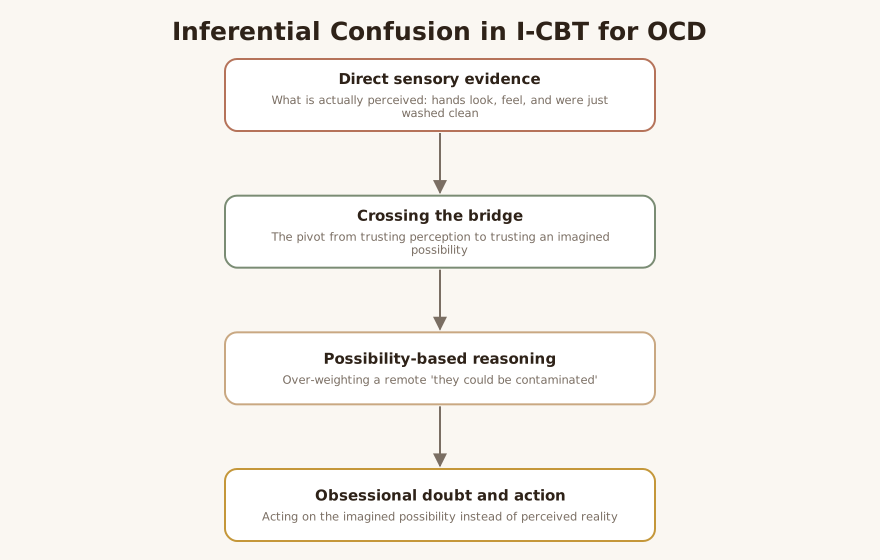
The central construct is inferential confusion: the person conflates what is happening in imagination with what is happening in reality, shifting from sensory evidence to possibility-based reasoning 2. In ordinary reasoning, conclusions about the world rest on perception and direct sensory evidence; in obsessional reasoning, the person distrusts the senses and over-weights a remote, imagined possibility 2. The hands look clean, feel clean, and were just washed — but the person reasons their way to “they could be contaminated” and acts on the imagined possibility instead of the perceived reality 2. LLM
I-CBT locates a precise pivot point it calls “crossing the bridge” — the moment the person stops trusting what they directly perceive and begins trusting what they imagine might be possible 2. Identifying this transition is a core therapeutic task, because everything obsessional flows downstream of it 2. The doubt is not a reasonable response to a real signal; it is constructed by a specific, identifiable chain of reasoning, and that chain can be examined and unwound 2.
A second pillar is the vulnerable self-theme — a specific life domain in which the person does not trust themselves 2. People with OCD characteristically fear becoming someone they do not want to be, yet they typically embody the opposite of their feared identity, which is why obsessions so often target areas of greatest conscientiousness 2. LLM The person who fears being violent is usually the gentlest in the room; the person who fears being a careless parent is usually the most attentive. I-CBT treats this distrust of self as the soil in which inferential confusion takes root 2.
Interventions & Techniques
Treatment is structured and psychoeducational before it is corrective 2. A typical course runs roughly 10–20 sessions across about twelve modules, beginning with formulation and moving into reasoning work 2. The Montreal RCT delivered a longer 26-session protocol — four formulation sessions followed by twenty-two treatment sessions — illustrating that session count scales with severity and setting 1. LLM
The core sequence teaches the client to (1) distinguish normal from obsessional reasoning, (2) identify their personal “crossing the bridge” moment, (3) recognize the vulnerable self-theme driving it, and (4) practice reality-based reasoning inside OCD-triggering situations 2. Rather than provoking and tolerating anxiety, the client learns to recognize and challenge the faulty reasoning before anxiety escalates 2. Crucially, I-CBT does not require deliberately provoking distress, which is the feature most often cited as making it more tolerable than exposure-based work 2.
A defining therapeutic move is helping the client step out of the obsessional chase entirely 2. Reassurance-seeking pursues certainty from others and rumination tries to solve the obsession internally; I-CBT does neither, instead examining how the doubt was constructed and returning attention to direct sensory reality 2. LLM In session this often looks like slow, Socratic reconstruction of the “story” that made the doubt feel believable, followed by deliberate practice of trusting the senses in the exact contexts where the client has learned to override them.
LLM-generated illustrative example (not a guideline): A client with checking compulsions reports she “knows” the stove might be on after leaving home, despite having seen the dials off. In I-CBT the clinician does not ask her to sit with the anxiety of not checking; instead they map the moment she crossed from “I saw the dials off” to “but it could have turned itself on,” surface the self-theme (“I’m the kind of person who causes disasters through carelessness”), and rehearse trusting the perceptual evidence she actually has 2. LLM
Evidence Base
The maturity of I-CBT is best described as established but not yet field-standard, and a clinician audience deserves the candid version 1. The strongest evidence is a two-site multicenter randomized controlled trial (n = 111) comparing I-CBT, appraisal-based CBT (which included exposure and cognitive restructuring), and mindfulness-based stress reduction as a non-OCD-specific control 1. All three arms produced large, statistically significant reductions in Y-BOCS scores by post-test, with no significant overall between-group differences and response rates in the range of roughly 48–64% 1. I-CBT’s distinct advantages were narrower but clinically meaningful: it reached remission faster (showing significantly higher remission than the control at mid-treatment) and outperformed the control on overvalued ideation at mid-treatment 1. Dropout and refusal were comparable across arms (around 27%), supporting acceptability rather than proving superiority 1.
Two caveats matter most 1. First, the trial included no ERP-only comparator, so it cannot make a clean head-to-head claim against the field’s frontline treatment; the authors instead noted that observed effects aligned with meta-analytic benchmarks for standard CBT 1. Second, the bulk of the I-CBT literature — including the foundational open trials and a comprehensive review of the etiological model, efficacy, and model of change — originates from the developing group, so independent replication remains thin 56. LLM That is the single most important honesty caveat for a clinician weighing this approach: the model is internally coherent and now RCT-supported, but it has not accumulated the broad, independent replication base that ERP enjoys.
Supporting work includes an open trial of the inference-based approach across symptom subtypes and treatment-resistant cases, suggesting applicability beyond the cleanest presentations 5. The originating group has also validated a measure of the core construct, the Inferential Confusion Questionnaire, and published on self-help delivery and on inferential confusion in adolescents 4.
Populations & Indications
I-CBT is indicated for OCD broadly and appears especially suited to several subgroups 2. It is particularly considered for clients who have struggled with or not responded to ERP, for whom an exposure-free route may re-open treatment 2. It is well matched to presentations dominated by mental compulsions — covert checking, rumination, mental review — where there is little overt behavior to expose 2. It is also positioned for clients with overvalued ideation, where strong conviction in the obsession blunts standard cognitive challenge, a domain where the RCT showed an I-CBT edge 1.
The model has been studied across symptom subtypes and in treatment-resistant cases, supporting use beyond textbook contamination/checking presentations 5. Application has extended to adolescents, where the group has examined the role of inferential confusion in obsessive-compulsive symptoms 4. LLM Within the obsessive-compulsive spectrum, the reasoning model is conceptually portable to presentations driven by pathological doubt and possibility-over-perception thinking — health anxiety, body dysmorphic concerns, hoarding, and magical thinking — though the strongest direct evidence remains in OCD itself 2.
Problems-for-Work
The natural problems-for-work are those organized around constructed doubt rather than around a real, perceivable threat 2. LLM
- Obsessions and intrusive thoughts: work targets the reasoning that grants the intrusion credibility, rather than the intrusion’s content or frequency 2.
- Compulsions: addressed by removing their justification — once the doubt is seen as imagined, the compulsion loses its rationale, rather than being resisted under provoked anxiety 2.
- Pathological doubt: the prototypical target; therapy reconstructs how the doubt was built and restores trust in the senses 2.
- Overvalued ideation: a specific indication, given the RCT signal favoring I-CBT here 1.
- Hoarding disorder, body dysmorphic disorder, health anxiety, magical thinking: candidates insofar as each can be driven by trusting an imagined possibility over perceptual reality, with OCD remaining the best-evidenced anchor 2.
LLM-generated illustrative example (not a guideline): A client with health anxiety feels a benign muscle twitch and reasons to “this could be ALS.” I-CBT would not debate the medical probability but would expose the inferential leap — the twitch is felt and observable; the disease is imagined — and rebuild confidence in attending to actual bodily evidence 2. LLM
Contraindications, Cautions & Cultural Humility
I-CBT is a psychotherapy, not a substitute for psychiatric assessment, and clinicians should retain standard care for comorbid conditions and risk 2. LLM Because the evidence base is dominated by the developing group and lacks an ERP head-to-head, ERP and appraisal-based CBT remain reasonable first-line offerings, and I-CBT is most defensibly framed to clients as an evidence-supported alternative rather than a proven equal of ERP 1. The clinician should be transparent that I-CBT was equivalent — not superior — to appraisal-based CBT overall in the available RCT 1. LLM
A specific caution: the absence of deliberate exposure should not become collusion with avoidance 2. LLM Reality-based reasoning is delivered in triggering situations, so the work still requires the client to engage real-world contexts; a drift toward purely intellectual discussion that never touches the feared domain would hollow out the method 2. Cultural humility matters because what counts as “reasonable” inference, acceptable doubt, or a feared self-identity is culturally and spiritually shaped; the vulnerable self-theme in particular intersects with religious, moral, and familial values that the clinician must hold with curiosity rather than correction 2. LLM
Treatment-Plan Suggestions & SMART Objectives
| Goal | SMART objective (example) | Mechanism |
|---|---|---|
| Build a shared reasoning formulation | Within 4 sessions, client articulates one personal example distinguishing normal from obsessional reasoning, in their own words | Psychoeducation on inferential confusion 2 |
| Identify the “crossing the bridge” moment | Within 6 sessions, client names the specific point where they shift from perceived reality to imagined possibility in 2 of their top obsessions | Targeting the pivot that generates doubt 2 |
| Surface the vulnerable self-theme | By session 8, client states the feared self-identity driving a primary obsession and one piece of disconfirming evidence | Addressing the self-distrust beneath obsessions 2 |
| Reduce reliance on senses-override | Over 8 weeks, client logs 3 weekly instances of trusting sensory evidence instead of acting on imagined possibility | Reality-based reasoning practice 2 |
| Decrease compulsions by removing justification | Reduce Y-BOCS compulsion subscale by a clinically meaningful margin by post-test | Compulsion loses rationale once doubt is seen as imagined 1 |
| Disengage from the obsessional chase | Within 10 sessions, client interrupts reassurance/rumination on 50% of logged occasions by re-examining how the doubt was built | Stepping out of certainty-seeking 2 |
| Generalize across triggers | By follow-up, client applies reasoning skills to a second symptom domain without new instruction | Process-level (not content-specific) change 1 |
| Sustain gains | Maintain response (≥35% Y-BOCS reduction) at 6-month follow-up | Durable correction of reasoning style 1 |
Common Misconceptions
A frequent misconception is that I-CBT is “ERP without the hard part” — a softer therapy that avoids the discomfort of recovery 2. LLM In fact it does not avoid the feared domain; it changes the mechanism, targeting faulty reasoning rather than building tolerance through habituation, and clients still engage triggering situations 2. A second misconception is that, lacking exposure, it must rely on reassurance; in reality I-CBT explicitly opposes reassurance-seeking and rumination, helping clients stop the certainty-chase rather than feed it 2. A third is that equivalence in the RCT means inferiority; equivalence to appraisal-based CBT, with faster remission and better overvalued-ideation outcomes, is a meaningful result, not a disappointing one 1. LLM Finally, some assume the model is fringe; it is associated with an established university research program and a published RCT, even if independent replication is still maturing 31.
Training & Certification
The originating group maintains a dedicated knowledge base for I-CBT, including its history, founders, and a curated publications list, which is the primary reference point for clinicians entering the approach 34. The first treatment manual, developed by Aardema and O’Connor in the early 2000s and later published as Beyond Reasonable Doubt, established the framework clinicians work from 3. LLM Clinicians seeking to adopt I-CBT should ground themselves in the manualized protocol and the validated assessment of the core construct (the Inferential Confusion Questionnaire) before applying the model, and should track the developing group’s publications for protocol updates and new population data 4.
Key Terms
- Inferential confusion: confusing what is imagined with what is real, shifting reasoning from sensory evidence to remote possibility 2.
- Inverse inference: mistaking imaginary probability for real possibility; the precursor concept to inferential confusion 3.
- Crossing the bridge: the identifiable moment the person abandons trust in perception and begins trusting an imagined possibility 2.
- Vulnerable self-theme: the specific domain of self-distrust around which obsessions cluster, typically the opposite of the person’s actual character 2.
- Obsessional reasoning: a reasoning style that distrusts the senses and over-weights remote possibilities 2.
- Overvalued ideation: strong conviction in the truth of an obsession, a presentation in which I-CBT showed a comparative advantage 1.
Resources & Further Reading
▶ Watch — a video introduction to this concept:
- Evaluation of Inference-Based CBT for OCD: A Multicenter RCT with Three Treatment Modalities (Aardema et al., 2022)
- The inference-based approach to OCD: a comprehensive review of its etiological model, treatment efficacy, and model of change
- The Inference-Based Approach (IBA) to OCD: An Open Trial Across Symptom Subtypes and Treatment-Resistant Cases (Aardema et al., 2017)
- The Founders — Inference-Based Cognitive Behavioral Therapy (icbt.online)
- Publications — Inference-Based Cognitive Behavioral Therapy (icbt.online)
- What is Inference-Based CBT (I-CBT)? A Gentler OCD Treatment — ScienceWorks
Reflective / Supervision Questions
- For a client stuck in ERP, can you identify their “crossing the bridge” moment, and would naming it open a path the exposure work has not? LLM
- How will you keep reality-based reasoning anchored in real triggering contexts so the work does not drift into intellectualization that avoids the feared domain? 2 LLM
- When you present I-CBT to a client, are you honest that it was equivalent — not superior — to appraisal-based CBT, and that independent replication is still limited? 1 LLM
- How does this client’s vulnerable self-theme intersect with their cultural, religious, or familial values, and are you holding it with humility rather than correcting it? LLM
- Which of your current OCD-spectrum clients are organized around constructed doubt versus real perceivable threat, and does that distinction change your modality choice? 2 LLM