
Type & Discipline
The Health Action Process Approach (HAPA) is a theoretical model in health psychology rather than a standalone psychotherapy modality 1. It belongs to the family of social-cognitive health behavior change models, sitting alongside the Theory of Planned Behavior, the Transtheoretical Model, and Social Cognitive Theory 7. HAPA is best understood as an explanatory and design framework: it specifies the cognitive and self-regulatory variables that predict whether a person adopts and maintains a health behavior, and it organizes those variables into a sequence that clinicians and researchers can target with interventions 15. LLM
What distinguishes HAPA from purely continuum (single-equation) models is that it is a hybrid model — it treats motivation as a continuous prediction problem but also recognizes qualitatively distinct phases of change, attempting to bridge the gap between intention and action that plagues most earlier models 14. For practicing therapists, this matters because HAPA gives you a vocabulary for diagnosing where in the change process a client is stalled, rather than treating “low motivation” as a single undifferentiated problem 3. LLM
Creators & Lineage
HAPA was developed by Ralf Schwarzer, a German health psychologist, and elaborated with collaborators including Aleksandra Luszczynska 47. The model was articulated in its mature form in Schwarzer’s widely cited 2008 paper in Applied Psychology and in the European Psychologist exposition with Luszczynska 14.
Its intellectual lineage is explicitly social-cognitive. The central construct of self-efficacy is drawn from Bandura’s self-efficacy theory and Social Cognitive Theory 7. HAPA’s emphasis on outcome expectancies and risk perception as motivational antecedents echoes expectancy-value traditions, and its phase structure responds to and refines the stage thinking of the Transtheoretical Model (Stages of Change) while addressing limitations Schwarzer identified in the Theory of Planned Behavior — chiefly, that intention alone is a weak predictor of behavior 17. In essence, HAPA was built to repair the “intention-behavior gap” that the Theory of Planned Behavior and similar continuum models left unexplained 14. LLM
Core Principles
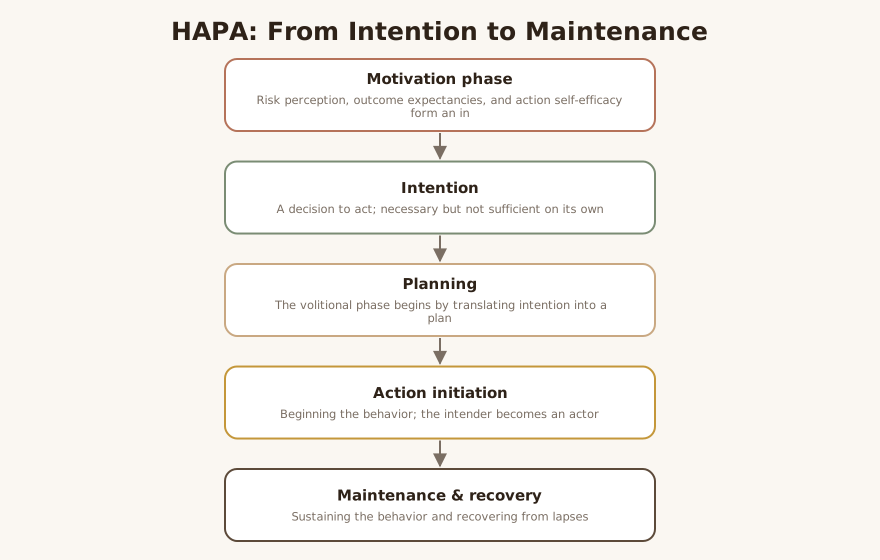
HAPA’s organizing claim is that adopting and maintaining a health behavior unfolds across two superordinate phases 14.
1. The motivation (pre-intentional) phase. Here the person develops an intention to act. Three classes of belief drive intention formation: risk perception (a distal “set the stage” appraisal of one’s vulnerability), outcome expectancies (beliefs about the consequences of the behavior), and action self-efficacy — the confidence that one could initiate the behavior 15. Risk perception is treated as a relatively weak, distal predictor; outcome expectancies and self-efficacy carry more weight 4. LLM
2. The volition (post-intentional) phase. Forming an intention is necessary but insufficient. The volitional phase covers planning, initiation, maintenance, and recovery from lapses 14. The volitional phase is often subdivided into people who are intenders (have decided but not yet acted) and actors (have begun the behavior) 47. LLM
A signature feature of HAPA is its treatment of self-efficacy as phase-specific rather than a single global trait 4. The model distinguishes: - Action (task / pre-action) self-efficacy — confidence to start 4. - Maintenance self-efficacy — confidence to sustain the behavior against barriers and competing demands 4. - Recovery self-efficacy — confidence to get back on track after a lapse or relapse 4.
This decomposition is clinically powerful: a client may be highly confident they can start exercising but have low recovery self-efficacy, so a single setback derails them 4. LLM
The other signature construct is planning, itself split into action planning (the when, where, and how of acting) and coping planning (anticipating obstacles and pre-committing responses) 14. Planning is the proximal mediator that converts an intention into behavior, and is HAPA’s central answer to the intention-behavior gap 14. Action control — self-monitoring, awareness of one’s standards, and self-regulatory effort — further supports maintenance 47. LLM
Interventions & Techniques
Because HAPA is a model, its “interventions” are behavior-change techniques mapped to the construct a given client is stuck on 23. The general principle is matching: deliver motivational techniques to non-intenders and volitional (planning) techniques to intenders and actors 4. LLM
- Motivational-phase techniques. Personalized risk communication and feedback to calibrate risk perception; exploration of pros and cons to strengthen positive outcome expectancies; and confidence-building (e.g., mastery experiences, vicarious learning) to raise action self-efficacy 14. LLM
- Action planning. Guiding the client to specify exactly when, where, and how they will perform the behavior — converting “I will eat better” into “I will pack a vegetable lunch the night before each workday” 14. LLM
- Coping planning. Anticipating high-risk situations and rehearsing if-then responses, e.g., “If the cafeteria has no healthy option, then I’ll eat the snack I brought” 4. LLM
- Self-efficacy targeting by phase. Distinguish whether confidence to start, maintain, or recover is the weak link, and tailor encouragement and skills accordingly 4. LLM
- Action control supports. Self-monitoring tools (logs, apps), reminders, and feedback loops to keep the behavior salient against the standard 47. LLM
LLM-generated illustrative example (not a guideline): A therapist working with a post-MI cardiac patient who has already intended to walk daily but isn’t doing it would skip further risk education (the client is already an intender) and instead co-write an action plan (“after breakfast, 20 minutes, the loop around the block”) plus a coping plan (“if it rains, I use the mall corridor”), then check recovery self-efficacy by asking how they’d restart after missing two days LLM.
Evidence Base
HAPA is an established model with a substantial empirical literature. Its constructs have been examined across many health behaviors — physical activity, dietary change, smoking, dental hygiene, screening, and medication and treatment adherence — and the model has been applied specifically to persons with chronic illness or disability 27. The maturity here is in predictive and mechanistic evidence: studies consistently support planning (action and coping) as a mediator between intention and behavior, and support the phase-specific role of self-efficacy 124. LLM
Be honest with clients and supervisees about what “established” does and does not mean. HAPA has strong status as a framework and good support for its core mediational pathways, including in chronic-illness populations where mechanisms of change have been directly tested 2. However, it is not a manualized therapy with a coherent RCT efficacy literature the way CBT or a specific adherence program is; effect sizes for HAPA-based interventions vary by behavior and population, and the model is continually being refined 13. Its primary clinical value is as a theory-driven scaffold for designing and explaining behavior-change interventions, not as a packaged treatment 35. LLM
Populations & Indications
HAPA was explicitly extended to people with chronic illness or disability, where the mechanisms of behavior change were tested directly 2. It is indicated wherever the clinical task is to help a person adopt or sustain a health behavior 15. Relevant populations from the literature and applied use include:
- People with chronic illness, including those managing long-term self-care regimens 2. LLM
- People with diabetes, for whom dietary, activity, and monitoring behaviors are central 2. LLM
- Cardiac patients in secondary prevention and rehabilitation 2. LLM
- People in physical rehabilitation, where adherence to home exercise is decisive 2. LLM
- Adults pursuing lifestyle change — weight, activity, diet 1. LLM
- Patients with health-risk behaviors such as smoking, where both motivational and volitional supports are needed 17. LLM
Problems-for-Work
HAPA maps cleanly onto adherence and self-management problems that therapists encounter, especially in integrated and behavioral-medicine settings 2. LLM
- Medication and treatment nonadherence. Diagnose whether the breakdown is motivational (the client doesn’t intend to adhere) or volitional (intends but lacks planning/action control), then intervene accordingly 24. LLM
- Physical inactivity and unhealthy diet. Use outcome-expectancy and self-efficacy work to form intention, then action/coping planning to enact it 14. LLM
- Smoking cessation. Combine risk and outcome appraisal with recovery self-efficacy and coping plans for high-risk situations 17. LLM
- Relapse prevention. Recovery self-efficacy and coping planning are HAPA’s explicit tools for getting back on track after a lapse 4. LLM
- Self-management of chronic conditions. Maintenance self-efficacy and action control sustain behaviors over the long arc of illness 24. LLM
- Low self-efficacy. Rather than treating this globally, locate which phase-specific efficacy is deficient (action, maintenance, or recovery) 4. LLM
LLM-generated illustrative example (not a guideline): A client with type 2 diabetes who “knows” they should check glucose but rarely does may show adequate risk perception and intention but absent action control. Co-designing a fixed routine (test strips placed next to the morning coffee) and a coping plan for travel days targets the actual volitional gap rather than re-educating them on risk LLM.
Contraindications, Cautions & Cultural Humility
HAPA is a descriptive/design model, so it carries no medical contraindications, but several cautions apply 3. LLM
First, HAPA is not a substitute for clinical care. It addresses behavior adoption and maintenance; it does not treat the underlying mood, trauma, cognitive, or substance disorders that often cause nonadherence. A depressed or cognitively impaired client may “fail” planning steps for reasons HAPA does not model 3. LLM
Second, the model is individual and cognition-centric. It foregrounds beliefs and self-regulation and underweights structural determinants — poverty, food and housing insecurity, discrimination, access to care, and competing caregiving demands. Treating nonadherence as a planning deficit when the real barrier is cost or access is both clinically wrong and potentially harmful 7. LLM
Third, cultural humility is essential. Constructs like self-efficacy, autonomous goal-setting, and individual outcome expectancies are shaped by culture; family- or community-oriented framings of health decisions may fit some clients better than an individualistic planning model 7. Risk communication that works in one community may misfire or stigmatize in another 1. The clinician should adapt HAPA’s scaffolding to the client’s values and material reality rather than imposing it LLM.
Treatment-Plan Suggestions & SMART Objectives
| Goal | SMART objective (example) | Mechanism |
|---|---|---|
| Form a concrete intention to change | Client states a specific behavior-change intention (e.g., daily 20-min walk) with rated importance ≥7/10 by session 3 | Outcome expectancies + action self-efficacy in the motivation phase 14 |
| Build an action plan | Client produces a written when/where/how plan for the target behavior covering ≥5 days/week within 2 weeks | Action planning as proximal mediator of intention→behavior 14 |
| Build a coping plan | Client identifies ≥3 high-risk situations and a pre-committed if-then response for each by session 4 | Coping planning; barrier anticipation 4 |
| Raise maintenance self-efficacy | Client rates confidence to sustain the behavior under common barriers at ≥7/10 after 4 weeks of practice | Maintenance self-efficacy 4 |
| Strengthen recovery from lapses | Client demonstrates a rehearsed “restart” routine and resumes the behavior within 48 hrs of a lapse, twice over 6 weeks | Recovery self-efficacy; relapse prevention 4 |
| Install action control | Client self-monitors the behavior ≥6 of 7 days/week using a log or app for 4 consecutive weeks | Action control / self-regulation 47 |
| Calibrate risk perception (non-intenders) | Client articulates personal vulnerability and 2 personally relevant consequences by session 2 | Risk perception as distal motivational antecedent 14 |
Common Misconceptions
- “HAPA is a kind of therapy you can certify in.” It is a health-psychology model and design framework, not a trademarked, manualized treatment 13. LLM
- “It’s just the Stages of Change with new labels.” HAPA is a hybrid model: it keeps continuous prediction and phase distinctions, and its central contribution — phase-specific self-efficacy plus action/coping planning as mediators — is absent from the Transtheoretical Model 14. LLM
- “Once a client intends to change, the work is mostly done.” The entire point of HAPA is that intention is a weak predictor; the volitional phase (planning, action control, recovery) is where most clinical leverage lives 14. LLM
- “Self-efficacy is one thing.” HAPA insists it is at least three things — action, maintenance, and recovery — that rise and fall independently 4. LLM
- “Scaring people into change works.” Risk perception is a relatively weak, distal driver in HAPA; it sets the stage but does not sustain behavior 4. LLM
Training & Certification
There is no formal certification in HAPA because it is an academic model rather than a proprietary therapy 17. Clinicians “learn” HAPA by studying the primary literature and integrating its constructs into their existing practice 5. LLM
Foundational reading is Schwarzer’s 2008 model paper and the Schwarzer & Luszczynska European Psychologist exposition, supplemented by the chronic-illness mechanisms paper and the FU Berlin overview maintained by the originating group 1245. Practitioners already trained in CBT, behavioral medicine, or Motivational Interviewing can adopt HAPA’s planning and self-efficacy components with minimal additional training, since the techniques (specific implementation planning, if-then coping plans, confidence ratings, self-monitoring) are familiar 4. LLM
Key Terms
- Motivation phase — the pre-intentional phase in which risk perception, outcome expectancies, and action self-efficacy combine to form an intention 14.
- Volition phase — the post-intentional phase covering planning, initiation, maintenance, and recovery 14.
- Action (task) self-efficacy — confidence to initiate a new behavior 4.
- Maintenance self-efficacy — confidence to sustain a behavior against barriers 4.
- Recovery self-efficacy — confidence to resume after a lapse 4.
- Action planning — specifying when, where, and how to act 14.
- Coping planning — anticipating obstacles and pre-committing if-then responses 4.
- Action control — self-monitoring and self-regulatory effort that keep behavior aligned with one’s standard 47.
- Intenders vs. actors — the volitional-phase distinction between those who have decided but not started and those already performing the behavior 47.
- Intention-behavior gap — the well-documented shortfall between intending and acting that HAPA’s volitional constructs are designed to close 14.
Resources & Further Reading
▶ Watch — a video introduction to this concept:
- Schwarzer (2008), Modeling Health Behavior Change — Applied Psychology
- Schwarzer, Lippke & Luszczynska (2011), Mechanisms of health behavior change in chronic illness/disability — PubMed
- HAPA as a Theoretical Framework to Understand Behavior Change — SciELO
- Schwarzer & Luszczynska (2008), The Health Action Process Approach — European Psychologist (FU Berlin PDF)
- The Health Action Process Approach (HAPA) — FU Berlin overview
- Health Action Process Approach — The Behavioral Scientist (glossary)
- Health action process approach — Wikipedia
Reflective / Supervision Questions
- For a given nonadherent client, can you locate the breakdown in a specific HAPA construct — motivation, planning, or action control — rather than labeling it “low motivation”? LLM
- When a client relapses, do you distinguish a maintenance-self-efficacy problem from a recovery-self-efficacy problem, and does your intervention follow? LLM
- How might HAPA’s individual, cognition-centric framing lead you to overlook structural barriers (cost, access, caregiving, discrimination) for a particular client? 7 LLM
- Are you delivering HAPA’s planning and self-efficacy work inside a clearly named, documented billable modality, or are you treating the model as the treatment itself? 35
- For clients from collectivist or family-centered backgrounds, how would you adapt HAPA’s autonomous goal-setting and individual outcome-expectancy language? 7 LLM
- Where in your own caseload are you spending effort on risk communication (a weak, distal lever) when planning and coping work (proximal levers) would yield more? 4 LLM