
Type & Discipline
Group Analysis is a modality within group psychotherapy, situated in the family of psychoanalytic group therapy 1. It combines psychoanalytic insight with an understanding of social and interpersonal functioning, treating the group itself — not merely a collection of individuals who happen to share a room — as the therapeutic instrument 1. The discipline rests on a distinctive premise: that psychological disturbance arises within networks of interpersonal relations rather than inside an isolated mind, and that it is therefore most coherently addressed within a relational field 2. This places Group Analysis closer to a relational and systemic reading of psychoanalysis than to a one-to-one transference model imported wholesale into a group setting 12.
Practically, this means the clinician’s unit of attention is the whole group and the communicational web running through it, even as individual members do their own work 3. The approach is applied not only to therapeutic groups but to couples, families, organisations, and training settings, reflecting its claim that human experience is inherently social 6. For a practising therapist, the orienting shift is from “treating patients in a group” to “treating through the group” LLM.
Creators & Lineage
Group Analysis was originated by S. H. (Siegmund Heinrich) Foulkes, who founded the movement in London during the 1940s alongside colleagues including John Rickman and Henry Ezriel 2. Foulkes’s thinking was shaped both by psychoanalysis and by Gestalt theory, from which he drew the idea that the individual and the group form a figure–ground whole — neither fully intelligible without the other 2. Much of the formative clinical work occurred in the context of the Northfield experiments at Hollymoor Hospital, where wartime conditions pressed psychoanalytically trained clinicians toward group methods 1. Foulkes set out his framework in foundational texts including Therapeutic Group Analysis 4.
The lineage is genuinely hybrid. From psychoanalysis and psychodynamic theory Group Analysis takes the unconscious, transference, and developmental conflict; from social and developmental psychology and systems thinking it takes the conviction that problems can sit “at the level of group, organisation or institutional system” and not solely in the individual 1. Commentators trace antecedents from Trigant Burrow’s early “group analysis” usage through Foulkes’s mature formulation, with Wilfred Bion’s parallel work on group dynamics developing alongside as a distinct strand 2. Group Analysis is also a natural conceptual neighbour of object relations theory and of interpersonal group psychotherapy in the Yalom tradition, which share its emphasis on the here-and-now relational field LLM.
To carry the work forward, Foulkes and colleagues established the institutional scaffolding the field still uses: the Group Analytic Society (now Group Analytic Society International) and, in 1971, the Institute of Group Analysis 16.
Core Principles
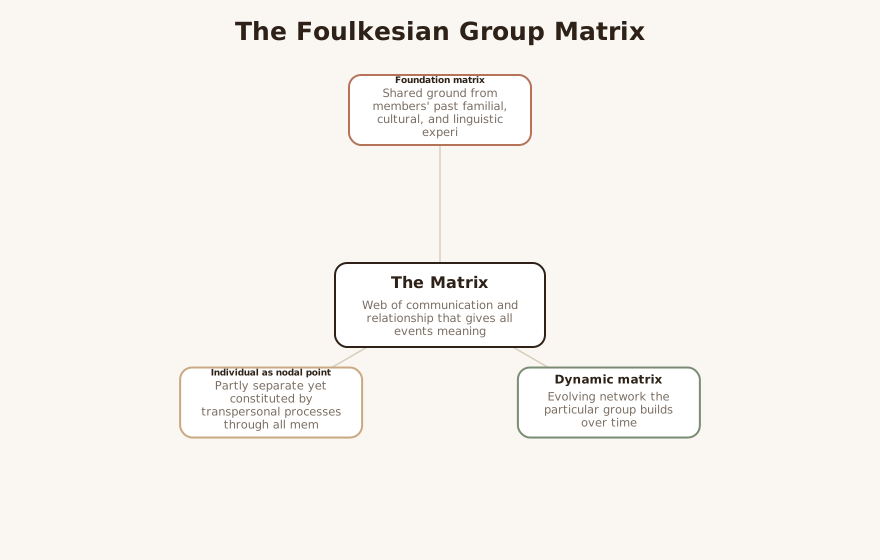
The central organising idea is the matrix. Foulkes defined it as the hypothetical web of communications and relationships of a given group — “the common shared ground which ultimately determines meaning and significance of all events” and which operates substantially at unconscious levels 3. The matrix is what makes a collection of strangers into a group whose communications are mutually intelligible 3.
Foulkes distinguished two aspects of this web. The foundation matrix is the shared ground created by members’ past familial, cultural, social, and linguistic experiences — the common biological and cultural inheritance that lets people who have never met begin to relate at all 3. The dynamic matrix is the evolving network of relationships that develops moment-to-moment as the particular group meets and works over time 3.
Within this field, the individual is reconceived as a nodal point — not dissolved into the group, but constituted by transpersonal processes that pass through all members 3. Foulkes used diffusion metaphors: each mind remains “partly separate and different from others” while being shaped by group-wide processes, so individuality is preserved within collective dynamics rather than erased by them 3. This is the conceptual move that distinguishes Group Analysis from approaches that treat the group only as a convenient container for individual therapy LLM.
Two further principles follow. First, the group as a whole is a legitimate object of understanding: the clinician aims to listen to, understand, and interpret the group as a totality in the here-and-now 2. Second, illness is relational — symptoms are read as expressions of disturbance in the network of relations, which the group is uniquely positioned to surface and rework 2.
Interventions & Techniques
The defining structural technique is free-floating discussion, the group-analytic analogue of free association: members talk without a fixed agenda, and the clinician attends to what emerges in and between them rather than steering toward predetermined content 1LLM. What surfaces is understood as communication within the matrix, carrying shared unconscious meaning that can be taken up at the level of the whole 3.
The clinician’s role is captured in Foulkes’s signature image: the therapist is the group’s conductor — as in music — rather than its director 1. The conductor’s task is less to interpret authoritatively from outside than to help the group become a working instrument, and over time to wean members from excessive and inappropriate dependency toward becoming their own therapists 1. This is a deliberately de-centred stance; the conductor trusts the therapeutic factors resident in the group itself 1LLM.
Interpretation in Group Analysis is therefore often addressed to the group, or to a theme moving through it, more than to a single member in isolation 2. The clinician works with the here-and-now — the live communicational field of the session — using the matrix as the frame of reference that gives individual contributions their shared significance 23. Phenomena such as unconscious resonance between members — where one person’s material vibrates with another’s — are read as evidence that the group is functioning as an integrated whole rather than as parallel monologues 2.
LLM-generated illustrative example (not a guideline): A member describes feeling silenced at work; minutes later, without an obvious link, another member falls quiet and then speaks about never being heard at home. The conductor names the theme of silencing moving through the group rather than addressing either member alone, inviting the group to notice what it is doing together. LLM
Evidence Base
Honesty about maturity matters here. Group Analysis is best described as an established clinical tradition rather than a heavily trialled, manualised treatment 1LLM. It has roughly eight decades of continuous practice, a dedicated international society and training institute, and a sustained professional literature including a peer-reviewed journal 156. In that institutional and clinical sense it is mature and well-embedded 56.
What it does not have, in the provided source base, is the kind of large randomised-controlled-trial evidence that defines empirically supported treatments such as cognitive behavioural therapy LLM. The matrix concept itself is acknowledged to show its greatest explanatory value in small therapeutic groups rather than in larger organisational settings, which sets a natural boundary on where its core construct has been most usefully applied 3. Clinicians should therefore present Group Analysis to clients and referrers as a long-standing, theoretically coherent psychodynamic group method with strong clinical and training infrastructure, while being candid that its outcome evidence is less quantified than that of the structured behavioural therapies 13LLM.
This is not a reason to dismiss it. Group psychotherapy broadly has substantial outcome support, and Group Analysis sits within that tradition; but the specific Foulkesian model is carried more by clinical theory, supervision culture, and institutional continuity than by a dense trial literature in these sources 16LLM.
Populations & Indications
Group Analysis is principally an adult group psychotherapy and is offered across a range of presentations 16. It is particularly suited to people whose difficulties are fundamentally interpersonal — those who struggle in relationships, who feel chronically misunderstood, or whose symptoms are tied to patterns that repeat across many relationships 2LLM. Because the matrix surfaces relational patterns in real time, it offers such clients something individual therapy cannot easily provide: a live arena in which their patterns reappear and can be worked 23LLM.
Indicated populations include people with personality disorders, people with interpersonal difficulties, people with depression and anxiety, trauma survivors, and individuals with attachment problems, where the relational and developmental focus of the method is especially apt LLM. The approach is also applied beyond formal therapy groups — to couples, families, organisations, and training environments — wherever group-level dynamics are the relevant unit of intervention 6.
The shared thread is that these are conditions where the disturbance lives in relationships, so a treatment that works through relationships has a natural mechanism of action 2LLM.
Problems-for-Work
The method lends itself to a recognisable set of problems-for-work, each of which has a clear route into the matrix LLM.
- Interpersonal difficulties. Maladaptive relational patterns reappear in the group, where they can be observed and renegotiated rather than only described 23. Application: a member who experiences others as rejecting begins to elicit the very withdrawal they fear, and the group helps make this visible LLM.
- Social isolation / loneliness. The group is itself a corrective experience of belonging and being understood within a shared matrix 3LLM.
- Relationship conflict. Conflict that erupts in the room is treated as workable here-and-now data rather than a disruption to be smoothed over 2LLM.
- Low self-esteem. Being heard and held meaningfully by the group provides experiences that can revise a member’s sense of worth 2LLM.
- Unresolved developmental conflicts. The psychodynamic frame allows early conflicts to be reactivated and reworked within the group’s relational field 12LLM.
- Complex trauma. The group can offer a containing relational context, approached carefully given the activating potential of group exposure 2LLM.
Contraindications, Cautions & Cultural Humility
Group Analysis is a relational, often emotionally activating, and open-ended method, and it is not universally indicated LLM. The here-and-now intensity that makes it powerful can overwhelm clients in acute crisis, those at significant risk who need stabilisation first, or some trauma survivors for whom unstructured group exposure may be retraumatising before sufficient containment is established 2LLM. Careful assessment, preparation, and timing are therefore part of responsible practice, and the conductor’s clinical judgement about group composition is consequential LLM.
A conceptual caution also follows from the model itself: the matrix has its strongest explanatory and clinical value in small therapeutic groups, so claims about its reach into very large or organisational systems should be made modestly 3.
On cultural humility, the model is unusually well-disposed but not automatically safe. The foundation matrix is explicitly built from members’ familial, cultural, social, and linguistic histories, so culture is theorised as constitutive of the group rather than peripheral to it 3. Foulkes held that a carefully formed group whose membership reflects the wider norms of society is where lasting change occurs — and that problems may sit at the level of group, organisation, or institutional system, not only in the individual 1. That same lens obliges the clinician to attend to how power, marginalisation, and difference enter the room, and to avoid pathologising as individual deficit what may be a response to a wider social field 1LLM. A conductor who ignores cultural difference risks letting the dominant group’s norms become invisible defaults LLM.
Treatment-Plan Suggestions & SMART Objectives
| Goal | SMART objective (example) | Mechanism |
|---|---|---|
| Reduce interpersonal reactivity | Within 12 weekly sessions, client will identify and verbalize one recurring relational pattern as it occurs in the group on at least 3 occasions | Here-and-now observation of patterns within the matrix 23 |
| Decrease social isolation | Over 16 sessions, client will initiate contact or response to another member in ≥70% of sessions attended | Corrective experience of belonging in the group 3 |
| Tolerate and work with conflict | Within 10 sessions, client will remain present and reflective during one group conflict rather than withdrawing, twice | Conflict treated as workable here-and-now data 2 |
| Increase self-understanding | Over 20 sessions, client will articulate one link between a current relational pattern and an earlier developmental experience | Psychodynamic reworking of developmental conflict 12 |
| Improve self-esteem | Within 12 sessions, client will accept group feedback without immediate self-dismissal in ≥50% of instances | Being meaningfully heard and held by the group 2 |
| Build relational autonomy | By session 24, client will offer a reflective observation to another member, functioning as a “co-therapist” twice per month | Weaning from dependency toward becoming one’s own therapist 1 |
| Strengthen affect regulation in relationship | Over 16 sessions, client will name an in-session feeling toward another member before acting on it, on 4 occasions | Resonance and reflection within the matrix 23 |
Common Misconceptions
“It’s just individual therapy done in a group.” This inverts the model. The unit of treatment is the group and its matrix; the clinician works through the group rather than taking individuals in turn 13. “The conductor leads and interprets like an authority.” The conductor’s image is musical, not directive — the aim is to help the group function as its own instrument and to wean members toward becoming their own therapists 1. “The individual disappears into the group.” Foulkes’s nodal-point concept preserves individuality; each mind remains partly separate even as it is shaped by group-wide processes 3. “It’s the same as Bion’s group methods.” Bion’s work developed in parallel and is a distinct strand, not synonymous with Foulkesian group analysis 2. “It is an unstructured chat group.” Free-floating discussion is a disciplined technical method analogous to free association, not absence of method 1LLM.
Training & Certification
Formal training is delivered chiefly through the Institute of Group Analysis (IGA), founded in 1971 by S. H. Foulkes and colleagues to provide clinical education in group-analytic psychotherapy 6. The IGA has expanded to multiple UK training locations plus international courses, and is governed by a board of trustees with national training staff and course directors overseeing its programmes 6. Training is structured progressively, from foundation-level study through qualifying diploma-level clinical training, consistent with the institute’s stated commitment to excellence in training and ongoing professional development 6.
The wider professional home is the Group Analytic Society International (GASi), an international body spanning over 40 countries that exists for the international exchange of group-analytic theory and practice 5. GASi sustains the field’s intellectual life through the annual Foulkes Lecture, winter and summer workshops, symposia, the International Journal of Group-Analytic Psychotherapy, and a shared IGA/GASi library 5. Clinicians seeking to practise group analysis should expect a training that combines theory, supervised clinical work, and substantial personal experience of being in a group 6LLM.
Key Terms
- Matrix — the hypothetical web of communications and relationships in a group; the shared ground that gives all events their meaning, operating largely unconsciously 3.
- Foundation matrix — the shared ground from members’ prior familial, cultural, social, and linguistic experience that lets strangers relate 3.
- Dynamic matrix — the evolving relational network that develops as the particular group meets over time 3.
- Nodal point — the reconception of the individual as constituted by transpersonal processes passing through all members, while remaining partly separate 3.
- Conductor — the therapist’s role, modelled on a musical conductor rather than a director, fostering the group’s own therapeutic capacity 1.
- Free-floating discussion — the group-level analogue of free association, the method’s core technical stance 1LLM.
- Resonance — unconscious vibration of one member’s material with another’s, evidence of the group working as a whole 2.
- Group as a whole — the totality the conductor aims to understand and interpret in the here-and-now 2.
Resources & Further Reading
▶ Watch — a video introduction to this concept:
- Group analysis (Wikipedia) 1
- Group Analysis (Encyclopedia.com) 2
- The Group-Analytic Group Matrix Concept (Group Analytic Society International) 3
- Therapeutic Group Analysis by S. H. Foulkes (Routledge) 4
- Group Analytic Society International (GASi) 5
- Institute of Group Analysis (IGA) — About 6
Reflective / Supervision Questions
- When I attend to “the group as a whole,” whose material am I privileging and whose am I missing, and how does that map onto the foundation matrix members bring? 23LLM
- Am I conducting or directing — where do I reflexively step in to interpret rather than trusting the group’s own therapeutic capacity? 1LLM
- What themes are resonating through the group right now, and how am I distinguishing genuine shared communication from my own projection onto it? 2LLM
- For which of my clients is the activating intensity of unstructured group work contraindicated, and how do I assess for that before placement? 2LLM
- How do power and cultural difference enter this group, and am I letting one subgroup’s norms become an invisible default? 1LLM
- Where am I tempted to locate a problem in an individual member that more honestly belongs to the group or its wider system? 1LLM