
Type & Discipline
Bion’s theory of group dynamics is a psychoanalytic theory of the unconscious life of groups, sitting at the intersection of psychoanalysis and organizational psychology 1. It belongs to the family of group psychoanalysis and is most often taught within the Tavistock tradition of group relations 6. The theory’s central claim is structural rather than diagnostic: any group, at any moment, is operating as two groups at once — a rational “work group” oriented to its task, and an unconscious “basic assumption group” organized around shared, defensive fantasies 1. LLM For a practicing clinician, this is less a treatment manual than a perceptual lens: it trains the eye to read what a therapy group, a treatment team, or an organization is doing beneath what it says it is doing.
The discipline is dual by design. Bion developed the ideas observing soldiers in a military psychiatric setting and later refined them at the Tavistock Clinic, and the same framework was carried directly into the study of organizations, leadership, and institutional consultancy 1. LLM That portability is why a therapist running a process group and a consultant studying a dysfunctional team reach for the same vocabulary.
Creators & Lineage
Wilfred Ruprecht Bion (1897–1979) was an English psychoanalyst, born in Mathura, India, who served as president of the British Psychoanalytical Society from 1962 to 1965 1. Before his analytic career he commanded tanks in the First World War, earning the Distinguished Service Order at Cambrai — a biographical detail often noted because his lifelong preoccupation with how groups behave under threat has roots in lived experience of collective fear 1. He conducted his foundational group experiments while running the training wing of a military hospital during the Second World War 1.
His theory of groups is set out in Experiences in Groups, published in 1961 but assembled from papers written in the 1940s 1. Bion extended Melanie Klein’s object relations theory and is considered a major contributor to that tradition; his clinical work with psychotic patients, alongside Hanna Segal and Herbert Rosenfeld, deepened psychoanalytic understanding of projective identification and countertransference 1. LLM This lineage matters for interpretation: the basic assumptions are best understood as group-level expressions of primitive object-relational defenses — splitting, idealization, projection — scaled up from the individual to the collective.
The institutional home of the theory is the Tavistock Clinic and the associated group relations tradition, which Bion and colleagues developed and which now organizes “group relations conferences” worldwide as experiential laboratories for studying authority, anxiety, and the unconscious life of groups 6. Later theorists extended the original three assumptions: Pierre Turquet proposed “oneness” (baO) in 1974, describing the wish to merge identity into the group or a higher power, and Lawrence, Bain, and Gould later proposed “me-ness” (baM), the group’s resistance to functioning as a collective at all 6.
Core Principles
The organizing distinction is between the work group and the basic assumption group 1. The work group keeps the group “anchored to a sophisticated and rational level of behaviour,” in touch with reality, able to tolerate frustration and get its task done 1. The work group is task-focused, efficient, and reality-oriented 6. The basic assumption group, by contrast, reacts to unconscious collective anxieties instead of to the task 6. LLM The crucial point is that these are not two kinds of group but two states that the same group oscillates between, often within a single session.
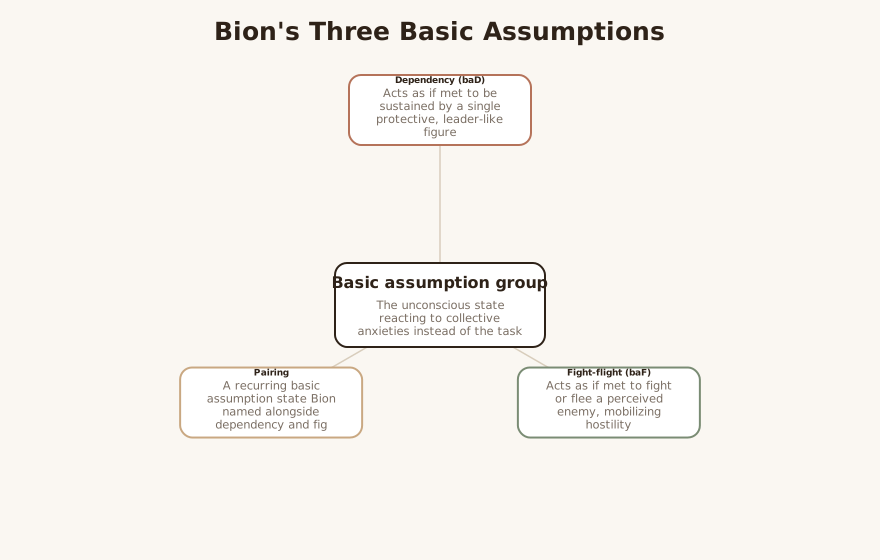
Bion named three recurring basic assumption states 1:
- Dependency (baD): the group behaves as if it has met to be sustained by a single protective, leader-like figure; members become passive, helpless, and unwilling to take responsibility for their own thoughts and actions 14. In its more extreme form the leader is idealized as omniscient or godlike, and the group cannot function independently of that hierarchy 6.
- Fight–flight (baF): the group behaves as if it has met to fight or flee from a perceived enemy, mobilizing hostility, competition, defensiveness, and a readiness either to confront or to escape 14. The threat may be entirely constructed — a post-merger team can split into hostile factions with no objective conflict between them 6.
- Pairing (baP): the group invests its hope in a pair (typically two members) whose imagined union will produce a savior or solution that rescues the group from its difficulties 16. Members form exclusive alliances and rely on the pairing for emotional support, which can generate cliques and exclusion 4.
LLM Two further principles make the theory clinically usable. First, basic assumptions are defenses against anxiety: they emerge precisely when a group is most threatened, uncertain, or asked to do difficult work, and they function to manage feeling rather than to accomplish anything 4. Second, the assumptions are mutually exclusive in operation — a group is in one basic assumption at a time — but it can switch rapidly between them and back to work-group functioning as the underlying anxiety shifts 6.
A related concept worth naming is valency — the individual’s characteristic readiness to enter, and pull others into, a particular basic assumption. LLM Clinically, valency explains why the same member reliably becomes the dependent supplicant, the fighter, or half of a hopeful pair across different groups; it is the personal propensity that the group recruits.
Interventions & Techniques
Bion’s framework is primarily interpretive, and its core “intervention” is the consultant’s or therapist’s interpretation of the group’s unconscious state to the group itself 6. LLM In the Tavistock tradition, the leader is reframed as a consultant to the group-as-a-whole rather than a teacher or facilitator of individuals: the consultant attends to what the entire group is doing in the here-and-now, names the operative basic assumption, and resists being recruited into the role the group is unconsciously assigning 6.
In practice the clinician works through several moves. LLM The first is reading the state: noticing whether the group is on-task or has slid into dependency, fight–flight, or pairing — for example, recognizing that a sudden chorus of “tell us what to do” signals baD, that scapegoating one member signals baF, or that two members monopolizing the room with mutual admiration signals baP 4. The second is using countertransference as data: the pull the clinician feels — to rescue, to fight, to sit back and watch a hopeful couple — is itself information about the group’s current assumption, an application of Bion’s own emphasis on projective identification and countertransference 1. The third is interpreting the assumption at the level of the whole group rather than the individual, so that the unconscious organization can become conscious and the group can return to work 6.
LLM-generated illustrative example (not a guideline): In week four of a process group, a member discloses a painful relapse. The group falls silent, then three members in quick succession ask the therapist to “set some ground rules” and “tell us how this is supposed to go.” The therapist notices an urge to comply and instead comments, “When something painful arrived just now, the group seemed to want me to take charge so no one had to sit with it together.” Naming the dependency assumption lets the group recover its capacity to respond to the member directly. LLM
LLM A non-interpretive but essential technique is boundary management — holding time, role, and task boundaries firmly — because basic assumption activity intensifies wherever boundaries are loose or authority is ambiguous 6.
Evidence Base
The maturity of this body of work is best described as established but interpretive rather than experimentally validated in the manner of a manualized treatment. LLM Bion’s theory has been foundational to group psychotherapy and organizational consultancy for over half a century and is a standard component of group relations training internationally 6. Empirical study exists — Karterud’s 1989 work specifically set out to study Bion’s basic assumption groups and represents one of the more systematic attempts to examine the model’s constructs against observed group behavior 2.
LLM Clinicians should hold the evidence honestly. The basic assumptions are clinically resonant and widely corroborated by practitioner observation, but they are constructs about unconscious processes, which are intrinsically difficult to operationalize and falsify. Much of the supporting literature is theoretical, observational, or case-based rather than controlled. Its durability rests on descriptive usefulness — it reliably helps experienced clinicians make sense of otherwise baffling group behavior — rather than on randomized evidence 4. Used as a lens that organizes perception and guides interpretation, it is well established; treated as a tested causal theory, it remains under-evidenced LLM.
Populations & Indications
The framework applies wherever people convene around a shared task. Its principal populations are therapy groups and group therapy clients, organizational teams, leaders and managers, and training and supervision groups 16. LLM In clinical settings it is indicated for understanding process-oriented and analytic therapy groups, but it is equally useful for psychoeducational, support, and skills groups whenever the process threatens to overwhelm the task.
Beyond formal therapy groups, the theory is routinely applied to treatment teams, multidisciplinary meetings, and whole institutions — staff splitting on an inpatient unit, a team that idealizes then devalues its leader, or a clinic that mobilizes against an external “threat” are all readily read through the basic assumptions 6. LLM For supervisors and program leaders, the lens is indicated any time a team’s behavior seems disproportionate to its stated problem, which is often the tell that a basic assumption rather than the task is driving the room.
Problems-for-Work
LLM Bion’s framework is a strong fit for a recognizable cluster of presenting problems, each of which maps onto a basic assumption.
- Group conflict and scapegoating. When a group turns on one member or splits into camps, fight–flight is usually operating: the group exports its anxiety into an enemy, internal or external 46. Application: naming the function of the scapegoating — “the group seems to need someone to fight so the harder feelings stay outside” — can interrupt the dynamic.
- Resistance in group therapy. Stalled, passive, or “stuck” groups often signal dependency: the group waits to be rescued rather than working 4. Application: interpreting the wish for the therapist to supply the answer returns responsibility to the group.
- Dysfunctional team dynamics and organizational dysfunction. Recurrent cycles of hope-and-collapse, idealization of saviors, or factional hostility in teams are basic assumption activity, not simply “bad communication” 6. Application: a consultant reframes the dysfunction as anxiety-driven regression rather than individual fault.
- Leadership difficulties. Leaders are unconsciously pressed into baD (be our protector), baF (lead the charge), or baP (be one of the hopeful pair); difficulty arises when a leader is captured by the assigned role 46. Application: recognizing the role being projected lets a leader decline it and re-anchor the group on its task.
- Anxiety in groups and interpersonal difficulties. Because every assumption is fundamentally a defense against collective anxiety, the framework directly addresses the affective storms that derail groups 4. Application: surfacing the warded-off anxiety, rather than the surface conflict, is the lever for change.
Contraindications, Cautions & Cultural Humility
LLM The framework’s chief risk is interpretive overreach. Because basic assumptions concern unconscious process, a clinician can read defensive fantasy into behavior that is in fact a reasonable response to real conditions — labeling a team’s protest about genuine understaffing as “fight–flight,” for instance, pathologizes legitimate grievance and protects the very authority the theory should help examine. The honest caution is that calling something a basic assumption is a hypothesis to be tested against the group, not a verdict.
A second caution concerns power and culture. LLM What looks like “dependency” may be appropriate deference in cultures or contexts where hierarchy carries different meaning, and what looks like “fight–flight” may be a marginalized member’s accurate naming of harm. The construct of valency should not become a way to fix a single member as the chronic problem; basic assumptions are properties of the whole group, and locating them in one person risks recapitulating the scapegoating the theory describes 6. Cultural humility here means holding the interpretation lightly, attending to who has the authority to name the group’s state, and remaining open that the “irrational” behavior may be rational from a vantage the clinician does not occupy.
Finally, the deeply interpretive, here-and-now Tavistock method is not for every group or every member. LLM For acutely fragile, paranoid, or trauma-survivor populations, unmodulated group-as-a-whole interpretations can be experienced as exposing or persecutory; the technique should be titrated, and structure, safety, and individual support prioritized where regression would be harmful.
Treatment-Plan Suggestions & SMART Objectives
LLM The following objectives translate the framework into measurable work for a process-oriented or team-based group. They are illustrative, not prescriptive, and should be individualized.
| Goal | SMART objective (example) | Mechanism |
|---|---|---|
| Increase tolerance of group anxiety without retreating to dependency | Within 8 sessions, member will offer at least one response to another member before looking to the leader, in 3 consecutive sessions | Interrupts baD by returning responsibility to the group |
| Reduce scapegoating | Over 6 weeks, group will go 4 consecutive sessions without one member being made the sole focus of criticism, per facilitator log | Surfaces and metabolizes the fight–flight defense |
| Build capacity to stay on task under stress | Within 10 sessions, group will return to its stated agenda within 10 minutes after an emotionally charged disclosure, in 3 of 4 sessions | Strengthens work-group functioning against basic assumption pull |
| Develop a member’s awareness of personal valency | Within 12 sessions, member will name their habitual group role (e.g., “the rescuer”) in at least 2 sessions | Makes individual valency conscious and modifiable |
| Improve a team’s tolerance of leader-absence | Over one quarter, team will complete 3 meetings productively when the usual chair is away, per minutes | Reduces idealizing dependency on a single authority |
| Strengthen here-and-now reflective capacity | Within 8 sessions, group will articulate “what is happening between us right now” at least once per session for 4 weeks | Builds the group’s own observing function |
| Reduce hope-collapse cycling | Over 6 weeks, group will identify one realistic next step rather than awaiting a savior solution, in 3 sessions | Names and interrupts the pairing fantasy |
Common Misconceptions
LLM Several misreadings recur. The first is that a group is either a work group or a basic assumption group; in fact every group is always both at once, and the clinical question is which is dominant at a given moment 1.
A second is that basic assumptions are pathology to be eliminated. LLM They are universal, unconscious, and not in themselves a disorder — they are how groups manage anxiety, and the aim is not their abolition but the group’s capacity to notice and recover from them 4.
A third is that the assumptions are deliberate strategies. LLM They are unconscious states the group falls into, not chosen tactics; members are usually unaware they have left the task 6. A fourth conflates the model with simple “group roles” or personality typing — but basic assumptions are properties of the group-as-a-whole, with individuals expressing them through valency, not fixed labels for persons 6. Finally, some treat the framework as a leadership how-to; it is primarily a theory for understanding group process, and its prescriptive value lies in restraint — declining the role the group projects — rather than technique LLM.
Training & Certification
LLM There is no single licensing credential in “Bion’s group dynamics.” Competence is developed experientially, chiefly through the group relations conferences that grew out of the Tavistock tradition Bion helped establish — intensive residential events in which participants study authority, anxiety, and the basic assumptions by living them in real time under the eye of consultants 6. Tavistock-method and “group relations” conferences run internationally and are the standard route into the work.
For clinical application, training typically comes through group psychotherapy programs, supervised experience leading process groups, and personal participation as a group member 1. LLM Because the theory turns on using one’s own countertransference as data, supervision and ideally personal therapy or analysis are considered essential adjuncts to formal study rather than optional extras.
Key Terms
- Work group: the aspect of a group that is task-focused, rational, and in touch with reality 16.
- Basic assumption group: the aspect of a group that reacts to unconscious collective anxiety rather than to the task 6.
- Dependency (baD): the assumption that the group exists to be sustained by a protective, often idealized leader 14.
- Fight–flight (baF): the assumption that the group exists to combat or escape a perceived enemy 14.
- Pairing (baP): the assumption that hope lies in a pair whose union will deliver a savior or solution 16.
- Oneness (baO): later assumption (Turquet, 1974) — the wish to merge into the group or a higher power 6.
- Me-ness (baM): later assumption — the group’s resistance to functioning as a collective 6.
- Valency: an individual’s characteristic readiness to enter and pull others into a particular basic assumption LLM.
- Projective identification: the object-relational mechanism, central to Bion’s lineage, by which feelings are unconsciously located in others — a key route by which groups distribute their states 1.
Resources & Further Reading
▶ Watch — a video introduction to this concept:
- Wilfred Bion — Wikipedia
- A Study of Bion’s Basic Assumption Groups (Karterud, 1989)
- Basic assumptions — Oxford Reference
- Bion’s Basic-Assumption Groups: Dependency, Pairing, and Fight-Flight — Psychology Fanatic
- The Tavistock Model (PDF)
- Basics of group relations: Bion’s basic assumption groups
Reflective / Supervision Questions
LLM The following questions are offered for supervision and personal reflection.
- When my group stalls, what do I feel pulled to do — rescue, fight, or wait for a hopeful pair — and what does that pull tell me about the group’s current assumption?
- Which basic assumption am I personally most prone to enter? What is my own valency, and how does it shape the groups I lead?
- When I label a group’s behavior “dependency” or “fight–flight,” have I tested that hypothesis against the possibility that the behavior is a reasonable response to real conditions?
- Whose authority is being contested or idealized in this group right now, and how am I participating in that?
- Am I interpreting at the level of the whole group, or am I inadvertently scapegoating one member by locating the group’s state in them?
- For this particular population, is unmodulated here-and-now interpretation likely to be containing or persecuting — and how should I titrate it?