
Type & Discipline
Genderlect — and its paired terms report-talk and rapport-talk — is a sociolinguistic construct, not a treatment, diagnosis, or stand-alone therapy LLM. It belongs to the academic study of language and gender, where it is the signature contribution of Deborah Tannen’s 1990 book You Just Don’t Understand: Women and Men in Conversation 1. The construct describes patterned differences in conversational style — the goals, conventions, and unspoken rules people bring to talk — rather than prescribing anything a clinician should do in session 2. Tannen coined “genderlect” by analogy to dialect and register, framing women’s and men’s habitual ways of talking as distinct but equally valid varieties of language rather than as one being correct and the other deficient 1.
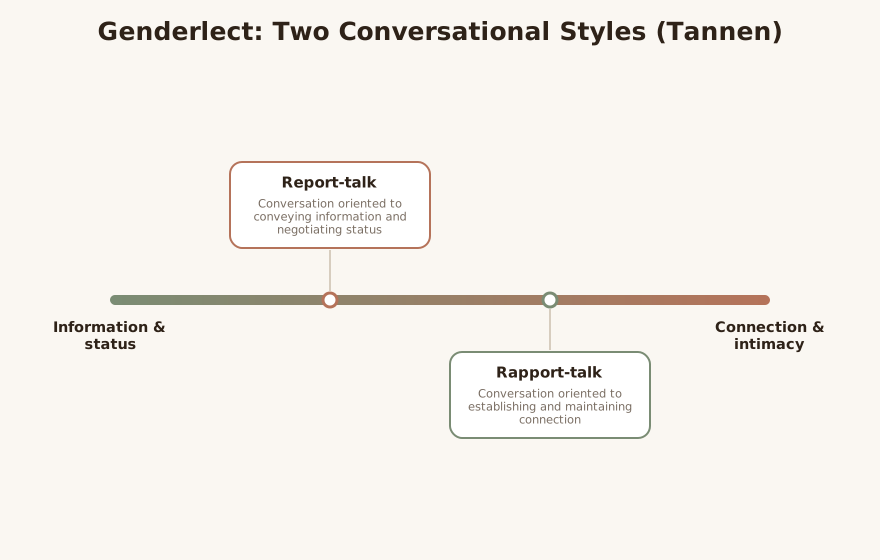
The core distinction is between report-talk and rapport-talk 4. Report-talk is oriented to transmitting information, demonstrating knowledge, negotiating status, and holding the floor — language as a way to establish and maintain standing in a hierarchical social order 4. Rapport-talk is oriented to establishing connection, intimacy, and affiliation — language as a way to build and sustain relationships and signal that one is included 4. Tannen associated report-talk more with men’s socialized style and rapport-talk more with women’s, and argued that when the two styles meet, each partner can be doing exactly what their style intends while the other hears something entirely different 1. For the clinician, the value of the construct is not that it is something one delivers, but that it supplies a precise, de-pathologizing vocabulary for a recognizable class of couple and team miscommunication LLM.
Creators & Lineage
The construct was developed by the American linguist Deborah Tannen, a professor of sociolinguistics, in You Just Don’t Understand: Women and Men in Conversation, published in 1990 2. The book became a long-running bestseller and brought the academic study of conversational style into popular awareness, introducing “genderlect,” “report-talk,” and “rapport-talk” to a general readership 1. Tannen’s central argument is that boys and girls grow up in what amount to different sociolinguistic subcultures, learning conversational rules in same-sex peer groups, so that cross-gender adult conversation has the character of cross-cultural communication 1.
This places genderlect within what sociolinguists call the difference model — sometimes the “two-cultures” model — of language and gender 3. The difference model holds that men and women belong to distinct speech communities with their own norms, so miscommunication arises from divergent but equally legitimate conventions rather than from one party’s deficiency 3. It is conventionally contrasted with the earlier deficit model (which framed women’s speech as inadequate against a male norm) and the dominance model (which read gendered speech differences as products and instruments of male power) 3. The difference model, and Tannen’s work specifically, drew sustained criticism precisely for downplaying power and context in favor of symmetrical “difference” 3.
Conceptually, genderlect sits in the same family as communication accommodation theory — which examines how speakers converge toward or diverge from one another’s styles — and standpoint theory, which holds that social position shapes how one experiences and talks about the world LLM. Tannen’s framework is descriptive sociolinguistics applied to everyday interaction, and it is best understood as one influential voice within a contested literature rather than a settled finding 5.
Core Principles
The first principle is that conversational style is learned and culturally patterned, not simply individual personality 1. Tannen argues that conversational conventions are acquired in childhood peer groups and become so automatic that speakers experience their own style as “just talking” and the other’s as willful or defective 1. The genderlect frame asks the clinician and client to treat a frustrating conversational habit as a learned dialect rather than as a moral failing or a deliberate slight LLM.
The second principle is the report-talk / rapport-talk distinction itself 4. In report-talk, the implicit job of conversation is to convey information and negotiate position; in rapport-talk, the implicit job is to establish and maintain connection 4. A clinically useful corollary is that the same utterance can be produced for opposite reasons: a story about one’s day may be an information report to one speaker and a bid for closeness to another, and a piece of advice may be a gift of competence to one and a dismissal of feelings to the other LLM.
The third principle is that miscommunication arises from style mismatch, not bad intent 1. Tannen’s recurring claim is that partners frequently mean well and are each following their own coherent rules, yet end up at cross purposes because they decode the same exchange through different conventions 1. The often-cited example is the “troubles talk” mismatch, in which one partner shares a problem seeking empathic connection (rapport) while the other responds with solutions and information (report), leaving the first feeling unheard and the second feeling unappreciated 4. The fourth principle, emphasized by Tannen herself and central to using the construct responsibly, is non-hierarchical equality of styles: neither report-talk nor rapport-talk is the mature or correct mode, and the therapeutic aim is mutual translation rather than converting one partner to the other’s style 1.
Interventions & Techniques
Because genderlect is a descriptive construct rather than a therapy, there are no “genderlect techniques”; the concept works by shaping formulation and psychoeducation and is then operationalized inside recognized modalities LLM. The most direct application is psychoeducation about conversational style, in which the clinician offers report-talk and rapport-talk as a shared map that lets partners externalize a recurring fight as a clash of styles rather than a clash of characters 4. Naming the pattern can lower defensiveness because it reframes “you don’t care” or “you’re too sensitive” as “we’re running different conversational programs” LLM.
A second move is teaching meta-communication and stylistic translation — helping partners ask what a given exchange is for before responding to its surface content, and to make their own aims explicit (“I just want you to listen” versus “I’m actually asking for ideas”) LLM. This is consistent with how communication-skills and behavioral couple approaches already work, and the genderlect frame simply gives the skill a memorable rationale LLM. A third move is identifying the troubles-talk mismatch in vivo, slowing a couple down at the moment one partner shares a problem so that the listener can check whether empathy or problem-solving is wanted rather than defaulting to their own style 4.
LLM-generated illustrative example (not a guideline): A partner comes home and describes a hard day; the other immediately proposes fixes and is met with irritation. Using the report/rapport map, the clinician helps the couple name that one was speaking rapport-talk (a bid for connection) and the other answering in report-talk (a bid to help via information), then coaches the listener to ask, “Do you want me to just hear you, or do you want ideas?” before responding — and coaches the speaker to state which they want up front LLM.
A fourth move, important for fidelity to the construct’s own critics, is holding the gender mapping loosely — using report and rapport as styles any client of any gender may use, and attending to power, culture, and context rather than reducing a couple’s dynamic to “men do X, women do Y” 3.
Evidence Base
Honest appraisal: genderlect is an influential but empirically contested descriptive theory, and its clinical use is therefore analogical — a reasoned extension of a popular sociolinguistic frame, not an evidence-based intervention with outcome trials 5. Tannen’s work rests on close observation of conversational style and is widely cited and taught, which is a genuine form of scholarly standing, but it is qualitative and interpretive rather than experimental 1. Empirical tests of the model are mixed: studies examining whether report-talk and rapport-talk map cleanly onto gender have produced inconsistent support, and at least one direct empirical test of Tannen’s model frames the binary as needing qualification by gender role rather than biological sex 5.
The deeper critique is structural, not merely statistical 3. Dominance-model and social-constructionist critics argue that the difference model overstates a stable male/female binary, underplays the role of power and social context, and risks treating culturally contingent patterns as if they were near-natural gender traits 3. Some contemporary work continues to find report/rapport and hedging patterns useful as descriptive lenses on discourse, including in online communication, which suggests the styles have descriptive traction even where the gender binary does not hold tightly 6. Two implications follow for the clinician LLM. First, report-talk and rapport-talk are most defensible when used as named styles that decouple from gender, applied to whichever partner actually shows them LLM. Second, any clinical claim built on genderlect should be held as a working hypothesis to be checked against the specific couple in the room, not as a law about how men and women must communicate 5.
Populations & Indications
The construct’s natural reach is broad, since style mismatch can occur in any sustained relationship, but it is most clinically indicated where distress is organized around recurring conversational miscommunication and the feeling of being misunderstood by an intimate or a colleague 1. It is best known and most applicable in work with couples and heterosexual partners, where Tannen’s original observations were centered and where the troubles-talk mismatch is a frequent presenting complaint 1. It also offers a usable frame for families, where parents and children or siblings may run divergent styles, and for mixed-gender work teams, where report-oriented and rapport-oriented contributions can be misread as, respectively, domineering or unserious LLM.
It is well suited to adults in communication training and to people with cross-gender communication difficulties, for whom a shared, non-blaming vocabulary can reduce the secondary conflict that grows up around the original misunderstanding 4. Across these populations the indication is the same: the presenting problem is less a discrete symptom than a repeating pattern in which each party follows their own conversational logic and both end up feeling unheard LLM. The construct is most appropriate as a psychoeducational and formulation aid layered onto an established couple or communication intervention, not as a treatment on its own LLM.
Problems-for-Work
Genderlect maps onto a recognizable cluster of problems centered on style-mismatch miscommunication and its relational fallout 4. Communication problems and conversational mismatch are the most direct: a couple’s chronic friction can be reformulated as two coherent styles colliding, which gives clinician and clients a shared, de-escalating language 1. Conflict over emotional support versus problem-solving is the paradigmatic case — the troubles-talk mismatch — where one partner’s bid for rapport meets the other’s offer of report, and both leave the exchange dissatisfied 4.
Misattribution of intent is a central target: the genderlect frame directly contests the leap from “you responded in your style” to “you don’t care about me,” replacing a hostile attribution with a stylistic one 1. Feeling unheard or dismissed and emotional invalidation are the felt signatures of receiving report when one wanted rapport, and naming the mechanism can reduce the sting of the experience 4. Relationship conflict, marital distress, and general miscommunication all involve the same currency — divergent conventions for what talk is for — and the construct supplies a common map for them LLM.
LLM-generated illustrative example (not a guideline): A couple reports that “every conversation turns into a fight.” Tracking a recent example, the clinician finds that one partner experiences the other’s detailed problem-solving as a refusal to simply listen, while the other experiences the partner’s venting as an unsolvable demand. Reframed as a report/rapport mismatch rather than as not caring, the couple can practice stating their conversational aim before launching in, and the “fights” lose their accusatory charge LLM.
Contraindications, Cautions & Cultural Humility
The foremost caution is that genderlect can essentialize gender if used carelessly 3. Presenting report-talk and rapport-talk as “how men talk” and “how women talk” risks installing a stereotype that pathologizes any partner who does not fit it and can reinforce, rather than loosen, a couple’s gendered grievances 3. The safer clinical practice is to introduce report and rapport as styles and let the couple discover who uses which, rather than assigning styles by gender in advance LLM. This is doubly important with LGBTQ+ couples and any pairing where the male/female mapping simply does not apply, and the construct’s styles remain usable there only once decoupled from the gender binary LLM.
A second caution is that the difference model can obscure power and abuse 3. Critics note that framing conflict as a symmetrical “difference” can mask asymmetries of power, control, or coercion, and a clinician who reduces a controlling or contemptuous dynamic to “just different conversational styles” risks minimizing harm 3. The genderlect lens must never displace assessment for intimate-partner violence, coercive control, contempt, or other indicated clinical concerns LLM.
A third caution concerns cultural humility about conversational norms themselves LLM. What counts as report or rapport, how directly one states needs, and how status is negotiated in talk vary across cultures, so a clinician should hold the framework as a starting hypothesis and ask each couple how talk works in their world rather than importing a single norm LLM. Finally, because the evidence is contested, the construct should be offered to clients transparently as a useful map, not a proven law, so that it serves reflection rather than becoming another stick partners use to diagnose each other 5.
Treatment-Plan Suggestions & SMART Objectives
| Goal | SMART objective (example) | Mechanism |
|---|---|---|
| Build shared language for the recurring conflict | Within 3 sessions, partners will each name 2 recent exchanges and label whether each was report- or rapport-oriented | Externalizes conflict as style mismatch rather than character flaw 4 |
| Reduce hostile attributions of intent | Over 6 weeks, each partner will reframe 3 incidents from “you don’t care” to a stated style difference, in session | Replaces misattribution of intent with a stylistic explanation 1 |
| Resolve the troubles-talk mismatch | Over 8 weeks, the listener will ask “listen or ideas?” before responding to a problem in 4 tracked conversations | Interrupts the empathy-vs-solutions mismatch at the point of impact 4 |
| Increase explicit conversational aims | Within 5 sessions, the speaker will state their goal (“just listen” vs “help me solve”) before raising a concern, 4 times | Makes implicit conversational purpose explicit, reducing cross-purpose talk LLM |
| Validate the partner’s style as legitimate | Over 6 sessions, each partner will voice one genuine appreciation of the other’s conversational strengths | Enacts the non-hierarchical, equal-styles stance central to the construct 1 |
| Generalize beyond the gender binary | Within 4 sessions, partners will identify one situation where each uses the “other” style | Decouples report/rapport from gender, guarding against stereotyping 3 |
| Repair a felt sense of being unheard | Over 8 weeks, partners will complete a structured listening exercise twice weekly and log felt understanding | Targets emotional invalidation by privileging connection before content 4 |
Common Misconceptions
A frequent error is treating report-talk and rapport-talk as a hierarchy — assuming rapport is the warm, healthy mode and report the cold, immature one — when Tannen’s explicit point is that the two styles are equally valid and the goal is mutual translation, not converting one partner to the other 1. A second misconception is reading the styles as fixed sex traits: the construct is about socialized, learnable conventions, and tying them rigidly to biological sex is precisely the move its critics warn against 3. A third is assuming the gender mapping is empirically settled, when direct tests of Tannen’s model are mixed and at least one frames gender role, not sex, as the better predictor 5.
A fourth misconception is that genderlect is a therapy one delivers, when it is a descriptive construct that informs psychoeducation and formulation inside other modalities LLM. A fifth is that style differences explain all relational conflict, which overextends a communication frame onto problems — contempt, coercion, betrayal — that it cannot and should not absorb 3. Finally, the framework is sometimes treated as a precise predictor of how a given man or woman will talk, overstating what a descriptive, contested model can forecast about any individual 5.
Training & Certification
There is no certification in “genderlect”; it is a sociolinguistic construct studied within linguistics, communication studies, and gender studies, not a credentialed clinical technique LLM. Clinicians typically encounter it through coursework in language and gender or interpersonal communication, where Tannen’s You Just Don’t Understand is the standard primary text and the difference model is taught alongside its deficit- and dominance-model alternatives 2. Reading the primary source, supplemented by a university explainer of the report/rapport dynamic, is the most direct route to understanding the construct in its own terms 4.
For applied clinical competence, the relevant training lives in the modalities that operationalize the frame — couple therapies and communication-skills approaches in which psychoeducation, meta-communication, and structured listening are taught under supervision LLM. Because the construct is contested, responsible use also requires familiarity with its critiques, so that a clinician can offer report and rapport as flexible styles while staying alert to power, culture, and the limits of a gender binary 3. A generalist therapist may legitimately use genderlect for psychoeducation provided they represent its evidentiary status honestly and deliver care through modalities in which they are trained LLM.
Key Terms
Genderlect — Tannen’s term, by analogy to dialect, for the patterned conversational style associated with a gender, treated as a distinct but equally valid variety of language 1. Report-talk — a conversational style oriented to conveying information, demonstrating knowledge, and negotiating status and position 4. Rapport-talk — a conversational style oriented to establishing connection, intimacy, and affiliation 4. Difference model (two-cultures model) — the framework, including Tannen’s, holding that men and women belong to distinct speech communities with equally legitimate norms, so miscommunication stems from divergent conventions rather than deficiency 3. Deficit model — the earlier view that women’s speech is inadequate measured against a male norm, which the difference model rejects 3. Dominance model — the rival view that gendered speech differences reflect and reproduce male power, central to critiques of the difference model 3. Troubles-talk mismatch — the recurring pattern in which one partner shares a problem seeking rapport while the other responds with report-style solutions, leaving both dissatisfied 4. Hedges — softening linguistic devices examined in discourse studies of report/rapport patterns, including in online communication 6.
Resources & Further Reading
▶ Watch — a video introduction to this concept:
- You Just Don’t Understand: Women and Men in Conversation — Deborah Tannen (1990), Wikipedia entry
- You Just Don’t Understand — official page, Deborah Tannen
- Difference model — Wikipedia
- Breaking the Code: Report Talk and Rapport Talk — Languaged Life (UCLA Sociolinguistics)
- You Need to Understand My Gender Role: An Empirical Test of Tannen’s Model (ResearchGate)
- Genders’ Talk On Online Discourse: The Case Of Report/Rapport Talk And Hedges (DOI)
Reflective / Supervision Questions
- When a couple presents a recurring fight, am I curious about whether each partner is following a coherent conversational style, or have I already decided one of them is “the problem” 1?
- Am I offering report and rapport as flexible styles available to anyone, or am I quietly assigning them by gender and risking a stereotype 3?
- Have I checked whether what looks like a “style difference” is in fact masking an asymmetry of power, contempt, or coercion that needs a different response 3?
- How do I represent the evidence for this model to clients — as a useful map to test against their own experience, or as a settled fact about how men and women talk 5?
- In the troubles-talk mismatch, am I helping both partners name what a given exchange is for before they respond to its surface content 4?