
Type & Discipline
Communication Accommodation Theory (CAT) is a descriptive theory of interpersonal and intergroup communication, rooted in sociolinguistics and social psychology rather than in clinical psychology 3. It seeks to explain and predict when, how, and why individuals make interactional adjustments to their speech and nonverbal behavior during conversation 3. CAT is not a psychotherapy, a treatment protocol, or a billable modality; it is a conceptual lens that clarifies a mechanism — how people calibrate their communication to one another — that runs underneath every clinical encounter LLM. For therapists, its value is in naming and working with relational process: how alliance is built or ruptured, how rapport is signaled, and how identity and group membership shape what is said and heard in the room LLM.
Creators & Lineage
CAT was developed by social psychologist Howard Giles and colleagues during the 1970s, originally as Speech Accommodation Theory (SAT) 23. SAT was created to address a gap in sociolinguistics by offering a psychological account of why linguistic variation tracks social context 3. Over the following decades — notably through qualitative work with Justine and Nikolas Coupland — Giles broadened the framework from speech alone to the full range of communicative behavior, and SAT became CAT 2. The theory draws heavily on social identity theory, which holds that self-concept includes both personal and social (group-based) identity, and that people manage communication to signal group distinctiveness and protect a positive social identity 3. Its broader lineage sits within interpersonal communication theory and sociolinguistics, and its emphasis on meeting a person’s communicative style resonates with the rapport-building and “rolling with resistance” stance of motivational interviewing LLM.
Core Principles
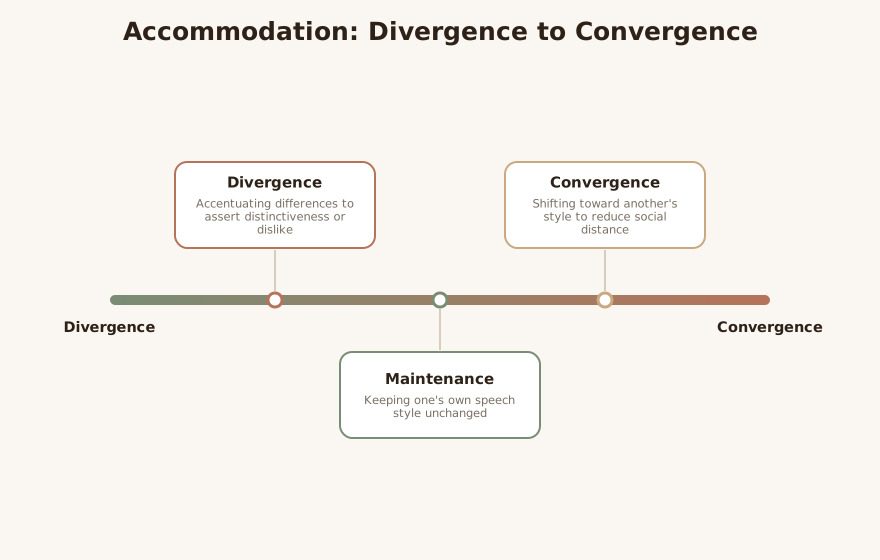
The central claim is that speakers adjust their communication — vocal qualities, pronunciation, rate, body language, and the intimacy of self-disclosure — in response to the person they are talking with 3. Two processes anchor the theory. Convergence is shifting toward another’s style to reduce social distance and signal a desire for approval, affiliation, and connection 26. Divergence is accentuating differences to assert distinctiveness, dominance, or group identity, or to express dislike 36. A third option, maintenance, is keeping one’s own style unchanged 6.
CAT integrates several socio-psychological principles: similarity-attraction (perceived similarity increases liking, so convergence tends to draw people closer), social exchange (people weigh the rewards and costs of accommodating), and causal attribution (listeners judge why a speaker adjusted, evaluating convergence positively only when they attribute it to genuine connection rather than manipulation or situational pressure) 3. Crucially, what matters clinically is the perception of accommodation, not the speaker’s intent alone — the same adjustment can read as warmth or as mockery depending on attribution 3.
Interventions & Techniques
CAT is not itself an intervention, but it generates concrete communicative moves a clinician can use within standard practice LLM. The healthcare literature describes provider convergence as speaking clearly and deliberately, repeating statements when needed, maintaining eye contact, staying patient and empathetic, avoiding judgment, and giving comfort — while divergence shows up as speaking too rapidly, overloading the partner with information, and failing to listen 4.
A more granular vocabulary comes from CAT studies of pharmacist-patient interaction, which identified five accommodative strategies clinicians can deploy intentionally 3:
- Approximation — adjusting one’s speech (rate, vocabulary, register) toward the partner’s 3.
- Interpretability — actively ensuring the partner comprehends, e.g., checking understanding and simplifying without condescension 3.
- Discourse management — facilitating the flow of conversation, including turn-taking and topic selection 3.
- Emotional expression — conveying empathy and attending to affect 3.
- Interpersonal control — managing power and role, ideally toward equality rather than dominance 3.
These map cleanly onto attuned therapeutic communication: matching a client’s register, checking comprehension, sharing control of the agenda, and reading nonverbal affect LLM.
Evidence Base
The honest framing matters here. CAT’s maturity is established as a communication-science theory with broad descriptive and empirical support — not as an evidence-based treatment with controlled clinical-outcome trials LLM. The theory has accumulated decades of cross-domain application in psychology, sociology, medicine, criminal justice, and digital communication 2. Quantitative evidence is substantial: an analysis of roughly 200 million Twitter messages from about 189,000 users found that people significantly adapted their language depending on the group membership of their interlocutors, supporting the convergence/divergence framework at scale 3. Healthcare studies have used CAT to structure provider-patient communication, including a proposed framework for training clinicians who work with persons living with dementia 4.
What does not exist is a body of randomized trials showing that “doing CAT” produces superior symptom outcomes, because CAT is a process model rather than a manualized therapy LLM. Critics have argued that real conversations may be too complex to reduce to convergence and divergence, and that the theory assumes a “reasonable standard” of communication that does not account for irrational or hostile interlocutors 3. For clinicians, the takeaway is to treat CAT as a well-validated explanatory lens — strong for understanding alliance and miscommunication — while delivering care through recognized modalities LLM.
Populations & Indications
CAT is most useful where social distance, identity, or group membership shape the clinical relationship LLM. The theory has been applied extensively to intergenerational communication, including how younger people address older adults, and research suggests older adults may accommodate less than younger counterparts in status-laden settings 3. It is central to intercultural and intergroup contexts — bicultural individuals and immigrants navigating new environments — where convergence and divergence carry identity stakes 2. It informs clinician-patient dyads, including the dementia-care and pharmacist-patient work noted above 34. And it has been applied to gender communication and to adolescent and digital contexts, where accommodation is constantly negotiated 3. In couples work, the framework illuminates how partners converge or diverge in conflict LLM.
Problems-for-Work
CAT gives clinicians language for several presenting concerns LLM:
- Therapeutic alliance difficulties. When a client experiences the clinician as distant or “not getting it,” CAT reframes this as a divergence or under-accommodation problem the clinician can repair through deliberate convergence and interpretability 34.
LLM-generated illustrative example (not a guideline): A clinician notices a teen client going quiet and monosyllabic. Recognizing that their own formal, jargon-heavy register may be reading as intergroup divergence, the clinician shifts to plainer language and lets the client set the topic — an approximation-and-discourse-management move that reopens the conversation LLM.
- Cross-cultural miscommunication. Misattributed intent (hearing accommodation as condescension, or non-accommodation as rejection) is exactly what CAT’s attribution principle predicts, and naming it can de-escalate 3.
- Couple/marital distress and relationship conflict. Partners often diverge in escalation; CAT helps externalize the pattern as a style mismatch rather than a character flaw LLM.
- Social anxiety. Over-monitoring how one is being received, and over-converging to win approval, can be examined through the lens of accommodation and attribution LLM.
Contraindications, Cautions & Cultural Humility
The chief risk is overaccommodation — adjusting beyond what is appropriate 3. Classic forms include “elderspeak” or baby talk with older adults, which alienates despite good intentions 3. The LibreTexts treatment distinguishes sensory overaccommodation (over-adapting to someone perceived as limited), dependency overaccommodation (speaking down as if to a lower-status person), and intergroup overaccommodation (responding to a cultural stereotype rather than the individual) 6. Under-accommodation — failing to adjust at all — is also experienced negatively 6.
For clinicians, the cultural-humility implication is direct: convergence done from a stereotype is overaccommodation, not attunement, and it harms alliance LLM. The corrective is to converge toward the individual in front of you, check your attributions, and treat any speech adjustment as a hypothesis to be confirmed by the client’s response rather than imposed LLM. CAT is a lens, not a license to mimic or “code-switch into” a client’s identity LLM.
Treatment-Plan Suggestions & SMART Objectives
| Goal | SMART objective (example) | Mechanism |
|---|---|---|
| Strengthen therapeutic alliance | Within 4 sessions, clinician will use one interpretability check (comprehension check / plain-language restatement) per segment, with client-reported feeling-understood rated ≥7/10 | Convergence + interpretability reduce social distance 34 |
| Reduce couple conflict escalation | Over 6 weeks, partners will each identify 3 in-session instances of divergence and practice one convergence repair, logged in a shared worksheet | Naming divergence; deliberate convergence 36 |
| Improve cross-cultural rapport | By session 3, client will report reduced sense of being stereotyped (≤2/10) after clinician adopts individualized convergence | Avoiding intergroup overaccommodation 6 |
| Build social-confidence skills | Within 8 weeks, client will complete 4 graded conversations applying approximation without over-converting to seek approval | Approximation; corrected attribution 3 |
| Enhance affect attunement | Each session for 4 weeks, clinician will reflect one nonverbal affect cue aloud and confirm accuracy with client | Emotional expression strategy 3 |
| Share session agenda (reduce power imbalance) | By session 2, client co-sets the agenda in ≥80% of sessions, tracked on the note | Interpersonal control toward equality 3 |
| Improve communication with a cognitively impaired patient/family | Caregiver will demonstrate 3 convergence behaviors (clear pace, repetition, eye contact) by week 4 | Provider convergence; nonverbal attunement 4 |
Common Misconceptions
- “Convergence is always good and divergence is always bad.” Both are strategic; divergence can appropriately assert expertise, boundaries, or identity (as when a parent or teacher signals authority), and excessive convergence can read as inauthentic 63.
- “If my intent is kind, the client will receive it that way.” CAT centers on the listener’s perception and attribution — well-meant accommodation can land as condescension 3.
- “More accommodation is better.” Overaccommodation, including elderspeak, alienates 3.
- “CAT is a therapy I can deliver and bill.” It is a communication theory and explanatory lens, not a treatment with outcome trials LLM.
Training & Certification
There is no certification in Communication Accommodation Theory; it is an academic framework taught within communication studies, sociolinguistics, and social psychology rather than a credentialed clinical method LLM. Clinicians encounter it most usefully as conceptual background that sharpens skills already trained elsewhere — alliance-building, cultural humility, MI rapport work, and couples-communication coaching LLM. Foundational reading is the Giles and colleagues body of work; the resources below offer accessible entry points LLM.
Key Terms
- Convergence — shifting one’s communication style toward a partner’s to reduce social distance 26.
- Divergence — accentuating differences to mark distinctiveness, dominance, or identity 36.
- Maintenance — keeping one’s own communicative style unchanged 6.
- Overaccommodation — adjusting beyond what is appropriate (e.g., elderspeak), often alienating 36.
- Underaccommodation — failing to adjust, also experienced negatively 6.
- Attribution — the listener’s interpretation of why a speaker accommodated, which determines whether it is evaluated positively 3.
- Approximation / interpretability / discourse management / emotional expression / interpersonal control — five accommodative strategies identified in healthcare communication research 3.
Resources & Further Reading
▶ Watch — a video introduction to this concept:
- Giles & Ogay — Communication Accommodation Theory (book chapter PDF)
- Communication accommodation theory (CAT) — EBSCO Research Starters
- Communication accommodation theory — Wikipedia
- Using CAT to Improve Communication Between Healthcare Providers and Persons With Dementia (PMC9681716)
- Giles et al. — CAT: Past accomplishments, current trends, and future prospects (ScienceDirect)
- 4.3 Communication Accommodation Theory — Social Sci LibreTexts
Reflective / Supervision Questions
- In a recent session that felt “stuck,” was I converging toward this client, or unconsciously diverging through my register, pace, or jargon? LLM
- When I adjust my speech with a client from a different background, am I attuning to the individual or responding to a stereotype (intergroup overaccommodation)? LLM
- How do I know whether my accommodation is being perceived as warmth versus condescension — do I check the client’s attribution? LLM
- Where might appropriate divergence (asserting a boundary, clarifying my role) actually serve the work, rather than always converging for approval? LLM
- In couples or family sessions, can I name the convergence/divergence pattern in the room without blaming either partner? LLM