
Type & Discipline
Ashby’s Law of Requisite Variety is a foundational theorem of cybernetics, the study of control and communication in animals, machines, and social systems 5. It is a theory about regulation, not a clinical modality, and it carries no treatment protocol of its own LLM. Its central claim is compact: “only variety can destroy variety,” meaning that the disturbances entering a system can be neutralized only by a regulator that itself possesses sufficient variety 1. In cybernetic usage, “variety” is a precise term – the number of distinguishable states or elements in a set, or equivalently the base-2 logarithm of that count expressed in bits 5.
For practicing therapists, the law functions as a systems-theory lens rather than a billable intervention LLM. It supplies the formal backbone for a clinical intuition that runs through family, couples, and strategic-systemic work: a person, dyad, or family that meets a wide range of situations with a narrow, repeated response will lose regulatory control of its own outcomes LLM. Understanding the law lets a clinician name why rigidity fails and what would constitute genuine adaptation LLM.
Creators & Lineage
The law was articulated by the British psychiatrist and cybernetician W. Ross Ashby, principally in his 1956 book An Introduction to Cybernetics 2. Ashby was trained in medicine and psychiatry, which shaped his interest in how organisms maintain stable internal conditions against a fluctuating environment 2. The book is regarded as one of the first rigorous, mathematically grounded textbooks of the field and introduced both the concept of variety and the law that bears his name 2. It remains in print and continues to be cited as the canonical source for these ideas 3.
Ashby extended the same logic in his 1962 paper “Principles of the Self-Organizing System,” where he examined how systems can reorganize and amplify their own regulatory capacity rather than treating their structure as fixed 4. Conceptually, the law sits within cybernetics and general systems theory, and it was carried into the helping professions through family systems therapy and the strategic and systemic traditions, which model symptoms as properties of feedback-governed relational systems rather than of isolated individuals LLM. A more recent line of work, “complexity matching,” reframes the law for interactions between two complex systems, arguing that effective coupling occurs when their complexities are matched 7.
Core Principles
The first principle is the definition of variety. Any system, response repertoire, or set of disturbances can be characterized by how many distinct states it can take; this count (or its log-base-2 in bits) is its variety 5. Variety is inseparable from information and uncertainty: the more distinguishable states a system can occupy, the more uncertainty an observer has about which state it is in at any moment 5.
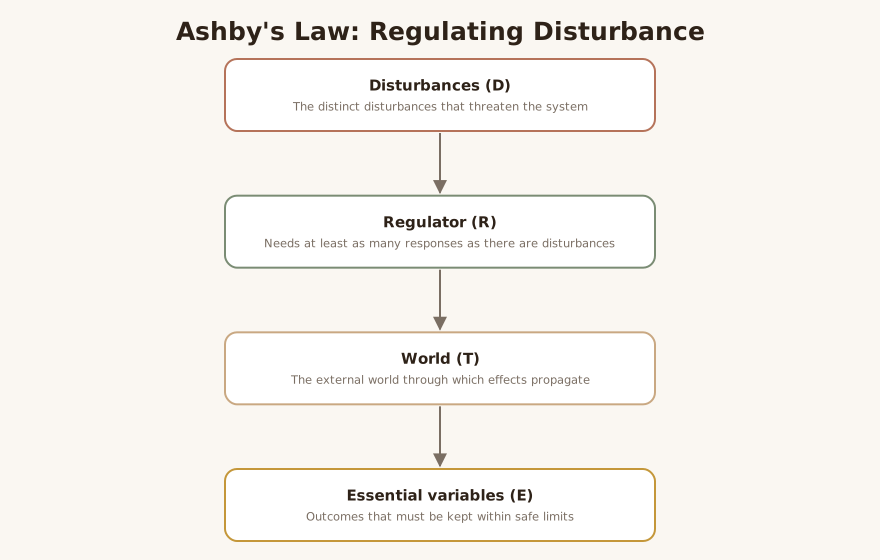
The second principle is the regulator-disturbance-outcome relationship. Ashby models regulation with four elements: disturbances (D) that threaten the system, a regulator (R) that responds, the external world (T) through which effects propagate, and essential variables (E) that must be kept within safe limits 1. The law states that the variety remaining in the outcomes can be reduced only to the ratio of the disturbance’s variety divided by the regulator’s variety; put plainly, a perfect regulator must have at least as many distinct responses as there are distinct disturbances 5.
The third principle is that regulation is bounded by communication capacity. Ashby was explicit that “R’s capacity as a regulator cannot exceed R’s capacity as a channel of communication” – a regulator can only suppress what it can detect and process information about 1. The amount of disturbance that can be diminished is limited by the amount of information the regulator can transmit and act on 1.
The applied restatement, common in organizational writing, is that “variety absorbs variety”: to handle a diverse set of problems you need a repertoire of responses at least as nuanced as the problems you face 6. A practical corollary follows – in any interaction, the element with the greatest flexibility of behavior tends to control the system, because it can match more of what the other element does 6.
Interventions & Techniques
Because the law is a theory rather than a therapy, it generates orienting moves and design heuristics rather than scripted techniques LLM. Two complementary strategies follow directly from Ashby’s own treatment of “variety engineering”: attenuation and amplification 6.
Attenuation reduces the incoming variety a regulator must handle – for example by filtering, simplifying, or stabilizing the environment so fewer distinct disturbances reach the essential variables 6. Ashby noted that human physiology and social conditioning already attenuate information automatically, but that poorly chosen attenuators can discard information crucial to functioning 6. Clinically, structure, routine, and reduced demand can be legitimate attenuators for an overwhelmed client, provided they do not strip away the information the person actually needs to adapt LLM.
Amplification increases the regulator’s own variety 6. Ashby pointed to the brain as the prototypical variety amplifier, generating adaptive capacity for unexpected challenges through its neural complexity 6. In therapy, the parallel is expanding a client’s, couple’s, or family’s behavioral and emotional repertoire so that more situations can be met with a fitting response rather than the same overused one LLM. Ashby’s later work on self-organizing systems gives this a theoretical footing: a system can, under the right conditions, reorganize so as to generate more regulatory variety than it began with 4.
LLM-generated illustrative example (not a guideline): A couple meets every disagreement – money, in-laws, parenting, sex – with the same escalate-then-withdraw cycle. Their response variety is one, while their disturbance variety is high. A clinician working from this lens does not try to eliminate conflict (the disturbances); instead the work amplifies the couple’s repertoire, building several distinct, rehearsable responses so that the variety on the regulator side begins to match the variety of situations they actually face LLM.
Evidence Base
The maturity of Ashby’s Law is best described as established – but established as a theorem within cybernetics and systems science, not as an empirically validated clinical treatment LLM. As a mathematical proposition about regulation it is settled and widely taught; An Introduction to Cybernetics is treated as a canonical text 23. There is no body of randomized clinical trials testing “requisite variety therapy,” because no such standalone therapy exists LLM.
What evidence does exist is theoretical and cross-disciplinary. The law connects variety to information theory and entropy, giving it a rigorous formal status 5. More recent work on complexity matching proposes that two complex systems exchange information most effectively when their complexities are matched, extending the requisite-variety idea from a single regulator-against-environment frame to coupled, mutually adapting systems 7. This is directly suggestive for dyadic clinical work but should be presented to clients and supervisees as a framework and analogy, not as proof that a particular technique works LLM. Honesty about this distinction matters: the law explains and predicts; it does not by itself license efficacy claims about any intervention LLM.
Populations & Indications
The law is most useful wherever a clinician is thinking in terms of systems and feedback LLM. In family systems work it clarifies why a family that responds to every novel stress with the same rigid rule loses the capacity to stay regulated LLM. With couples it frames repetitive conflict as a mismatch between high situational variety and a one- or two-move response repertoire LLM. For organizations and teams – a setting where the law is most frequently applied – it explains why standardization works only when the variety an organization faces is known and limited, and why it fails in uncertain, innovation-heavy environments 6.
It is equally a lens for leaders and regulators of any system, and for therapists and systems consultants themselves, who function as regulators of the therapeutic field and need adequate variety in their own clinical repertoire LLM. At the broadest level it applies to any complex adaptive system that must maintain essential variables against a fluctuating environment 4.
Problems-for-Work
- Rigid coping / inflexibility. The core clinical translation: a fixed response set against a varied world guarantees loss of control over outcomes 1. Application: inventory the client’s actual response repertoire, name its narrowness, and treat repertoire expansion as the explicit target LLM.
- Relationship conflict. Reframe gridlock as a variety mismatch rather than a moral failing, then build differentiated responses 6. Application: help partners generate distinct responses for distinct triggers instead of one global reaction LLM.
- Family system dysfunction. A family rule that worked for one developmental stage may be under-varied for the next LLM. Application: identify which rules have lower variety than the situations they now govern LLM.
- Communication breakdown. Because regulation cannot exceed channel capacity, breakdowns often reflect lost information, not lost goodwill 1. Application: restore the information channel before adding new behaviors LLM.
- Maladaptive feedback loops. Loops persist when the regulator cannot detect or vary enough to interrupt them 1. Application: locate where variety is being attenuated away and re-introduce it 6.
- Organizational adaptation problems / difficulty adapting to change. Rising environmental variability outpaces rigid standardization 6. Application: design for amplification of response variety where uncertainty is high 6.
Contraindications, Cautions & Cultural Humility
The chief caution is misapplication through over-literalism: variety has a precise meaning in cybernetics, and treating “more options is always better” as the clinical goal misreads the law LLM. The point is requisite variety – enough to match the disturbances that matter, not maximal variety for its own sake 1. Indiscriminately increasing options can overwhelm a destabilized client, who may need attenuation – structure and reduced demand – before any amplification 6.
A second caution concerns attenuation that discards needed information: Ashby warned that attenuators can eliminate information crucial to operation, so simplifying a client’s environment must not strip away the signals they require to adapt 6. Clinicians should not use the law to justify suppressing a client’s distress signals merely to make the system quieter LLM.
On cultural humility, what counts as a “disturbance,” an “adaptive response,” or an “essential variable” is culturally and contextually defined, and the clinician does not get to decide unilaterally which of a client’s behaviors are surplus variety to be reduced LLM. A response that looks rigid from outside may be a high-variety, finely tuned adaptation to a hostile or unpredictable environment the clinician has not seen LLM. The law is also a model, not the territory; human systems are not finite-state machines, and presenting cybernetic formalism as literal truth about a person or family is reductive and should be avoided LLM.
Treatment-Plan Suggestions & SMART Objectives
| Goal | SMART objective (example) | Mechanism |
|---|---|---|
| Expand response repertoire (amplify variety) | Within 8 sessions, client identifies and rehearses at least 3 distinct responses to a recurring trigger, demonstrating use of 2 in session | Increasing regulator variety to match disturbance variety 1 |
| Reduce overwhelm via attenuation | Over 4 weeks, client and clinician define a daily structure that lowers the number of competing demands, reported in weekly logs | Attenuating incoming variety to within manageable channel capacity 6 |
| Restore a communication channel (couple) | By session 6, partners complete a structured exchange in which each accurately reflects the other’s message before responding, in 3 consecutive sessions | Regulation cannot exceed channel capacity; restoring information flow 1 |
| Interrupt a maladaptive feedback loop | Within 6 sessions, client names the loop and inserts one alternative response at an identified choice point, tracked between sessions | Adding variety at the point where the loop is currently under-varied 1 |
| Differentiate responses to distinct stressors | Over 8 weeks, client maps 4 recurring stressors to 4 tailored coping responses rather than one global reaction | Matching response variety to the variety of disturbances 5 |
| Build family-rule flexibility | Within 10 sessions, family revises 1 outgrown rule and pilots a more situation-sensitive alternative for 2 weeks | Reorganizing toward greater requisite variety (self-organization) 4 |
| Strengthen clinician/system-consultant variety | Across supervision, clinician adds 2 new intervention options for a presenting pattern and applies 1 with a client | Amplifying the regulator’s own repertoire 6 |
Common Misconceptions
A frequent misconception is that the law means “more is always better” – that maximizing options or stimulation is the goal LLM. The law specifies requisite variety: enough to match the relevant disturbances, no more 1. A related error is reading variety loosely; in cybernetics it has a defined, countable meaning (states, or bits) rather than a vague synonym for “diversity” 5.
Another misconception is that the law is an empirically tested therapy with outcome data LLM. It is a theorem about regulation, established within cybernetics and systems science, that informs clinical thinking but does not by itself validate any technique 2. People also sometimes treat the regulator as omnipotent; Ashby’s own framing makes clear that regulation is hard-bounded by information and communication capacity, so a regulator cannot control what it cannot perceive 1. Finally, the slogan “the most flexible element controls the system” is sometimes taken as a power tactic rather than a statement about matching, when its real meaning is that control comes from having responses that fit the situation 6.
Training & Certification
There is no certification in Ashby’s Law of Requisite Variety, because it is a scientific principle rather than a credentialed practice LLM. Clinicians typically encounter it through training in cybernetics, general systems theory, and the systemic-strategic and family-therapy literatures LLM. The primary route to genuine fluency is reading Ashby’s source text, An Introduction to Cybernetics, which lays out variety and the law in full 23. His 1962 paper on self-organizing systems is a useful companion for the amplification and reorganization side of the idea 4. Applied management treatments such as Businessballs offer accessible secondary explanations and worked examples for organizational settings 6. Certification, where relevant, belongs to the parent clinical modality (e.g., family or couples therapy), not to the law itself LLM.
Key Terms
- Variety: The number of distinguishable states or elements in a set, or its base-2 logarithm in bits 5.
- Requisite variety: The minimum variety a regulator needs – at least as many distinct responses as there are distinct disturbances – to keep outcomes controlled 5.
- Regulator (R): The element that responds to disturbances to protect the system’s essential variables; its capacity cannot exceed its capacity as a communication channel 1.
- Disturbance (D): A source of variation that threatens the system’s essential variables 1.
- Essential variables (E): The outcomes that must be kept within safe limits for the system to survive or function 1.
- Attenuation / amplification: Variety engineering – reducing incoming variety, or increasing the regulator’s own variety 6.
- Self-organization: A system’s capacity to reorganize and increase its own regulatory variety 4.
- Complexity matching: An extension proposing that two complex systems couple most effectively when their complexities are matched 7.
Resources & Further Reading
▶ Watch — a video introduction to this concept:
- Ashby, “Requisite Variety” (1956 excerpt, Panarchy)
- An Introduction to Cybernetics (Ashby, 1956) – Wikipedia
- An Introduction to Cybernetics – W. Ross Ashby (book)
- Ashby, “Principles of the Self-Organizing System” (1962) PDF (Pace University)
- Variety (cybernetics) – Wikipedia
- Ashby’s Law of Requisite Variety (Businessballs)
- Complexity Matching and Requisite Variety (arXiv, 2018)
Reflective / Supervision Questions
- For a client or family I am treating, what is the actual variety of their habitual responses, and how does it compare to the variety of situations they face LLM?
- Where in this system is needed information being attenuated away – and am I, as clinician, contributing to that attenuation 6?
- Am I aiming for requisite variety, or have I slipped into assuming more options are always better 1?
- What is my own response repertoire as the regulator of this therapeutic field, and where is it under-varied LLM?
- What looks like rigidity in this client that might actually be a finely tuned adaptation to an environment I have not yet seen LLM?
- When I frame requisite variety to a client, am I presenting it as a useful model or implying it is a literal, proven truth about who they are LLM?