
Type & Discipline
The Dreyfus Model of Skill Acquisition is a descriptive framework, not a therapy or a measurement instrument, that maps how a person’s performance changes as they acquire a complex skill 1. It originates in philosophy and expertise studies rather than psychology or medicine, and it makes claims about the phenomenology of skilled action — how doing a skill is experienced from the inside as it matures 2. For practicing therapists, its relevance is twofold: as a lens on your own and your supervisees’ professional development, and as a psychoeducational scaffold you can offer clients whose presenting concerns center on competence, learning, and self-judgment LLM.
The model is best understood as a continuum. Performers move from rigid, rule-bound, emotionally detached analysis toward fluid, context-embedded, intuitive engagement, with each stage describing a qualitatively different relationship to rules, context, decision-making, and emotional involvement 12. It is “established” in the sense that it is pervasively taught and cited in clinical and nursing education, but it remains contested as an empirical theory of cognition — a distinction this article keeps in view throughout 2.
Creators & Lineage
The model was developed in 1980 by brothers Stuart Dreyfus, a mathematician and systems analyst, and Hubert Dreyfus, a philosopher, through research funded by the US Air Force Office of Scientific Research at the University of California, Berkeley 1. It originally described five stages; the Dreyfus brothers later added a sixth stage of mastery 1. Their work grew out of observing how people such as pilots and chess players actually perform, and it was explicitly framed against the idea that expertise is just faster rule-following 2.
For clinicians, the most consequential branch of the lineage is Patricia Benner’s adaptation of the model to nursing. Benner, a nursing theorist and professor emerita at the University of California, San Francisco, applied the Dreyfus stages to nursing practice in her influential 1984 book From Novice to Expert 3. She argued that expert nurses develop their knowledge and skill set through experiences accumulated over time, and she drew a key distinction between “know-how” (experiential knowledge) and “know-that” (theoretical knowledge) 3. Benner’s translation is why the model shows up in clinical training programs at all, and it reshaped nursing education by emphasizing experiential learning alongside formal instruction 3. Related intellectual neighbors include deliberate practice theory, competency-based supervision frameworks, and Bloom’s taxonomy of learning, though those are distinct bodies of work rather than parts of the Dreyfus model itself LLM.
Core Principles
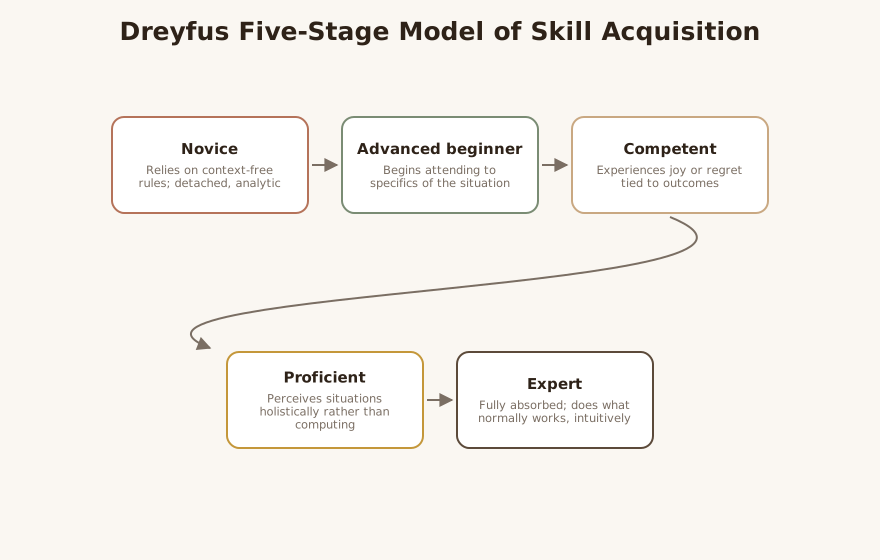
The model rests on a single organizing claim: as skill matures, performers shift “from rigid adherence to taught rules to a largely intuitive mode of operation” that relies on implicit knowledge rather than conscious reasoning 2. Three dimensions change together along that path 1.
First, the relationship to rules and context inverts. Beginners need context-free rules because they cannot yet read the situation; advanced performers attend to the specifics of the situation and find generic rules increasingly inadequate or even obstructive 14. Second, decision-making moves from detached, analytic deliberation toward holistic perception in which the right response is “seen” rather than computed 1. The model’s striking formulation is that “when things are proceeding normally, experts don’t solve problems and don’t make decisions; they do what normally works” 1. Third, emotional involvement increases. The detached calculation of the novice gives way to genuine engagement, where the competent performer experiences joy or regret tied to outcomes, and the expert is fully absorbed and involved in the action 1.
A central nuance, often lost in casual retellings, is that the Dreyfus brothers did not claim experts never reason. When critics argued that experts still use analytical thinking, the Dreyfuses responded that the criticism misreads their account of “deliberative rationality” — the reflective reasoning experts deploy when something goes wrong or when they step back to evaluate 1. The intuitive mode describes normal, fluent performance, not the absence of all deliberation 1.
Interventions & Techniques
The Dreyfus model is not itself an intervention; it is a map. Its clinical utility comes from how you apply that map in supervision, training, and psychoeducation LLM. The model’s developmental logic supports several concrete uses 4.
Staging assessment. Each stage has characteristic behaviors, so the model can be used to locate where a learner currently is and to identify the next developmental need 4. A supervisor noticing that a supervisee rigidly applies a protocol regardless of fit can recognize this as advanced-beginner behavior and respond accordingly 4LLM.
Customizing input to stage. Because what helps differs by stage, instruction can be tuned: clear rules and structure early, then graduated exposure to ambiguity and judgment later 4. MindTools specifically notes the value of extra encouragement at the competent stage, when learners are most prone to feeling overwhelmed by the volume of information they must now organize and own 4.
Calibrating expectations. The model helps allocate effort by clarifying what level of proficiency a given task actually requires, so neither over-training nor premature autonomy is imposed 4.
LLM-generated illustrative example (not a guideline): A second-year trainee delivers technically correct CBT but reports paralysis when a client “goes off script.” Reframing this through the model — you are an advanced beginner whose rules are sound but not yet contextual — normalizes the experience and reorients supervision toward pattern recognition (reviewing recordings to notice what experienced clinicians attend to) rather than adding more rules LLM.
Evidence Base
Honesty about maturity matters here. The Dreyfus model is established in the sense that it is widely adopted, taught, and influential — particularly in nursing and medical education through Benner’s translation 3. It is not established as an empirically validated theory of how cognition develops, and a clinician using it should hold those two facts simultaneously 2.
The principal critique comes from Peña’s 2010 critical perspective in Medical Education Online. Peña argues the model derives from phenomenology rather than scientific realism and that Dreyfus provides “no citing of scientific evidence to ground their proposals” 2. Three specific objections are worth carrying into practice. First, clinical reasoning cannot operate purely through implicit knowledge; research indicates “there is not a pure skill that allows only implicit or explicit knowledge to contribute to performance,” so the clean novice-to-intuition trajectory oversimplifies 2. Second, the model was built from observing direct, well-defined tasks (jet pilots, dancers), whereas clinical diagnosis is an inverse problem — reasoning backward from symptoms to causes — which may require fundamentally different cognitive processes 2. Third, the claim that experts work “automatically” is contradicted by studies showing experts actually spent more time than novices determining an appropriate representation of the problem, implying deliberate analysis rather than pure intuition 2. Separately, Gobet and Chassy challenged the existence of discrete developmental stages and argued experts retain analytical thinking 1. The takeaway for therapists: treat the model as a useful heuristic for framing development, not as a validated account of what is happening in a clinician’s head 2LLM.
Populations & Indications
The model’s natural population is anyone acquiring a complex skill, but in a clinical setting it is most directly useful for clinicians and trainees, supervisees, students and learners, healthcare professionals, educators, and professionals in coaching 14. Benner’s work makes the indication for healthcare professionals explicit, framing clinical competency development as a staged, experience-driven process 3.
A second indication is client-facing. Clients whose distress is organized around learning, performance, and self-evaluation — graduate students, early-career professionals, medical and nursing trainees, performers, and career-changers — can often use the model as a normalizing scaffold LLM. The shift it describes (rules feel safe early; ambiguity feels intolerable in the middle; fluency comes only with accumulated experience) maps closely onto the felt experience of someone moving through a steep learning curve 4LLM.
Problems-for-Work
Because the model normalizes a non-linear developmental arc, it speaks directly to several common presentations LLM.
- Imposter syndrome and competence concerns. Naming a clinician or client as a competent-stage performer — organized, responsible, but acutely aware of how much they do not yet know — reframes the discomfort as a predictable stage feature rather than evidence of fraudulence 4LLM.
- Performance anxiety. The model predicts that conscious rule-following peaks before fluency, so anxiety about “doing it right” is expected mid-curve and recedes as perception becomes intuitive 1LLM.
- Perfectionism. The expectation of expert-level fluency at an advanced-beginner stage is a setup for self-criticism; staging the timeline can loosen the demand for premature mastery LLM.
- Self-efficacy concerns and skill-development deficits. Locating a concrete next step appropriate to the current stage gives the client a tractable goal instead of a global judgment about ability 4LLM.
- Professional burnout. The competent stage’s signature overwhelm — feeling flooded by information and responsibility — can be a contributor; recognizing it as a stage feature can reduce shame and guide pacing 4LLM.
LLM-generated illustrative example (not a guideline): A new nurse practitioner presents with insomnia and rumination about “not being good enough.” Mapping her onto the competent stage — where the model predicts exactly this sense of being overwhelmed and newly responsible for outcomes — reframes the symptom as a developmental signal, and the work shifts toward sustainable pacing and selective rule-prioritization rather than self-diagnosis of incompetence 4LLM.
Contraindications, Cautions & Cultural Humility
The model has no contraindications in the clinical-risk sense because it is not a treatment, but it carries several cautions LLM. Do not present it as scientifically validated; its empirical foundations are genuinely contested, and overselling it as established fact misrepresents the literature 2. Avoid using it to rank people’s worth — the stages describe a skill in a domain, not a person’s overall competence, and someone can be expert in one area and novice in another 1LLM. Be cautious about treating “intuition” as infallible; the same critique that experts may rely on intuition also warns that intuition can entrench error, which is why supervision and reflective reasoning remain essential at every stage 2.
Cultural humility is important when applying any expertise-development frame. The model was derived from a narrow set of Western, often male, expert exemplars (pilots, chess players), and its emphasis on individual skill acquisition may underweight collectivist, relational, or community-situated definitions of competence 1LLM. What counts as “expert” performance is partly culturally constructed, so a clinician should hold the stages loosely and avoid imposing a single trajectory on a client whose context defines mastery differently LLM.
Treatment-Plan Suggestions & SMART Objectives
The frame below is clinician/professional development: the model is used as psychoeducation and a structuring tool for goals about competence, learning, and the self-judgments attached to them LLM.
| Goal | SMART objective (example) | Mechanism |
|---|---|---|
| Reduce imposter-related self-criticism | Within 6 sessions, client identifies their current Dreyfus stage in 2 work domains and reframes 1 self-critical thought per week using stage-normalization | Cognitive restructuring of competence appraisals 4LLM |
| Lower performance anxiety in skill execution | Over 8 weeks, client completes 3 graded skill exposures (low to high ambiguity) and rates anticipatory anxiety pre/post, targeting a 30% reduction | Graded exposure plus reattribution of mid-curve anxiety as expected 1LLM |
| Loosen perfectionistic standards | Within 4 sessions, client defines a “good-enough advanced-beginner standard” for one task and tests it twice without remediation | Behavioral experiment challenging premature-mastery demands LLM |
| Build self-efficacy via tractable next steps | Each week, client sets one stage-appropriate micro-goal and logs completion, sustained 4 consecutive weeks | Mastery experiences scaled to current stage 4LLM |
| Address competent-stage overwhelm / burnout | Within 6 sessions, client implements a rule-prioritization routine and reduces self-reported overwhelm on a 0-10 scale by 2 points | Cognitive load reduction and values-based prioritization 4LLM |
| Reframe a recent “failure” as developmental | By session 3, client reauthors one failure narrative as stage-appropriate learning, stated aloud and in writing | Narrative reframing of know-how acquired through experience 3LLM |
| Increase reflective practice (supervisee) | Over a 12-week supervision block, supervisee reviews 1 recorded session/fortnight, naming 2 contextual cues missed | Deliberative reflection to build pattern recognition 2LLM |
Common Misconceptions
“Experts don’t think — they just react.” The model says experts do not deliberate during normal, fluent performance, but it explicitly preserves “deliberative rationality” for atypical situations and reflection 1. Reading the expert as a mindless automaton is the misreading the Dreyfus brothers rebutted 1.
“It’s a proven model of how the brain develops skill.” It is a phenomenological description with limited empirical grounding, and serious critiques exist about its applicability to clinical reasoning specifically 2. Treating it as validated science overstates the case 2.
“Higher stage = better clinician overall.” The stages are skill- and domain-specific, not a global ranking of a person 1LLM. A proficient psychotherapist may be a novice at a new modality, and the model expects that 1.
“Once you reach expert, you’re done.” The reliance on intuition can ossify into bias, which is precisely why reflective practice and supervision remain necessary at the top of the curve 2LLM.
Training & Certification
There is no certification in the Dreyfus model; it is a conceptual framework, not a credentialed intervention LLM. Familiarity is typically acquired through expertise-studies and education literature and, for clinicians, through Benner’s From Novice to Expert, which is a standard reference in nursing curricula and competency-development training 3. Supervisors and educators most often encounter it embedded within competency-based education and clinical-supervision frameworks rather than as a freestanding course LLM. Practical fluency comes from using the staging language in real supervision and reflective practice, not from a course completion 4LLM.
Key Terms
- Novice: Relies on context-free rules and step-by-step instruction; analytic and detached from outcomes; struggles when situations deviate from the rules 1.
- Advanced beginner: Begins recognizing recurring, situation-specific patterns and applies experience-based maxims alongside general rules; still lacks full sense of responsibility 14.
- Competent: Selects goals and adopts an overall perspective; more organized and responsible; experiences joy or regret tied to outcomes but may be overwhelmed and rigidly hold a chosen plan 14.
- Proficient: Intuitively grasps what a situation requires while still consciously deciding the specific response; adapts well to change 1.
- Expert: Integrates perception and action without deliberation in normal conditions; fully involved; “does what normally works” and reorients fluidly when surprised 1.
- Know-how vs. know-that: Benner’s distinction between experiential, embodied skill and propositional, theoretical knowledge 3.
- Deliberative rationality: The reflective reasoning experts still use when situations are atypical or under review 1.
- Inverse problem: A problem (like diagnosis) requiring reasoning backward from effects to causes, raised by Peña as a limit on the model’s clinical fit 2.
Resources & Further Reading
- Dreyfus model of skill acquisition — Wikipedia
- The Dreyfus model of clinical problem-solving skills acquisition: a critical perspective (Peña, 2010)
- Novice to Expert: the Dreyfus model of skill acquisition (Lyon, devmts.org.uk)
- Patricia Benner — Wikipedia
- From Novice to Expert — Nursing Theory
- The Dreyfus Model of Skill Acquisition — MindTools
- Dreyfus Novice to Expert Learning Model — YouTube
Reflective / Supervision Questions
- For a current supervisee, which Dreyfus stage best describes their performance in a specific modality, and what is the single next developmental need at that stage? LLM
- Where in my own practice am I leaning on intuition in a way that could be entrenching error rather than reflecting genuine expertise? 2LLM
- Am I matching my supervision input to the supervisee’s stage — structure and rules for the early learner, exposure to ambiguity and judgment for the advancing one? 4LLM
- When a client describes “imposter” feelings, can I locate them on a competence curve in a way that normalizes without minimizing? 4LLM
- Do I treat the stage labels as descriptions of a skill in a domain, or am I slipping into ranking the person? 1LLM
- How does my own cultural definition of “expert” shape what I implicitly hold up as the goal for clients and supervisees? LLM