
Type & Discipline
Double-loop learning is a theory of learning and change, not a psychotherapy. It originates in organizational behavior and the study of how individuals, teams, and institutions detect and correct error.1 It belongs to the broader family of theories of action developed by Chris Argyris and Donald Schon, which model the relationship between what people believe, what they actually do, and the consequences that follow.1 Although it was built to explain organizational learning, its core distinction has migrated into coaching, leadership development, education, healthcare quality improvement, and clinical supervision.16
For practicing therapists, the value is conceptual rather than procedural. Double-loop learning supplies a precise, transferable vocabulary for a process clinicians already pursue under other names: helping a person move from fixing surface behavior to revising the governing beliefs that keep generating the problem.LLM It also offers a mirror for our own development as practitioners, because the theory was originally aimed at exactly the kind of highly trained professional who struggles to learn from feedback.3
Creators & Lineage
The framework was developed by Chris Argyris, an organizational psychologist, in collaboration with the philosopher and urban planner Donald Schon, across the 1970s.1 Argyris introduced the term “double-loop learning” into the management literature in a 1977 Harvard Business Review article, and elaborated it in widely read pieces such as the 1991 “Teaching Smart People How to Learn.”23 The concept had earlier antecedents: Cyert and March’s A Behavioral Theory of the Firm (1963) already described organizations that change their rules in response to longer-run feedback according to more general rules, foreshadowing the double-loop idea.6
The theory sits inside Argyris and Schon’s larger architecture of theories of action, theory-in-use versus espoused theory, and the contrast between Model I and Model II behavioral worlds.1 Within clinical thought, double-loop learning maps cleanly onto several established lineages: cognitive restructuring in CBT (modifying the beliefs that drive automatic thoughts), schema therapy (revising early maladaptive schemas rather than only managing their downstream behaviors), and reflective practice in clinical supervision (a tradition Schon himself helped found).LLM6 Related conceptual cousins include mental models, metacognition, and second-order cybernetics.6
Core Principles
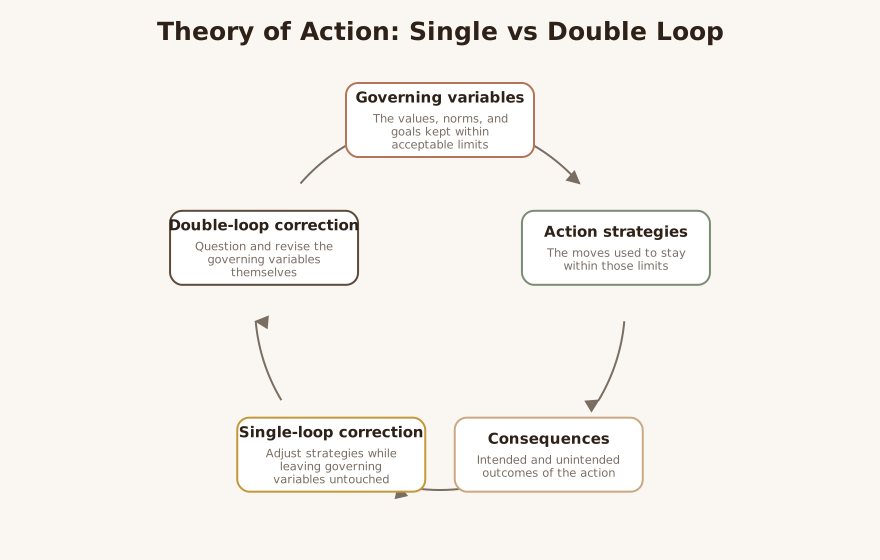
The theory rests on the idea that all deliberate action is governed by a theory of action with three elements: governing variables (the values, norms, and goals a person tries to keep within acceptable limits), action strategies (the moves used to stay within those limits), and consequences (intended and unintended outcomes).1 Argyris distinguishes the espoused theory people report when asked from the theory-in-use that actually drives behavior; the two often diverge, and people are typically unaware of the gap.1
Single-loop learning detects and corrects error while leaving the governing variables untouched. Argyris’s canonical analogy is a thermostat: it senses that the room is too hot or too cold and switches the heat on or off, but never asks whether the target temperature is correct.12 Double-loop learning turns attention back on the governing variables themselves and asks the second-order question: “Why am I set to 68 degrees? Is that the optimum?”3 It modifies the underlying assumptions, values, and goals rather than only the strategies that serve them.16
Argyris further described two behavioral worlds. Model I is governed by the values of unilateral control, winning and not losing, suppressing negative feelings, and appearing rational; it produces defensive routines, low-validity information, and little public testing of assumptions.1 Model II prioritizes valid information, free and informed choice, and internal commitment, and it pairs advocacy of one’s own view with genuine inquiry into others’ views.1 Double-loop learning is the kind of learning Model II makes possible.1
Interventions & Techniques
Double-loop learning is a target, not a manualized protocol, but Argyris and the Action Design tradition describe concrete moves toward it.5 The first is surfacing the theory-in-use: making explicit the inconsistencies between what a person espouses and what they actually do, since change begins with seeing that gap.3 The second is identifying governing variables: naming the values, norms, and goals a person is holding constant, then asking which alternatives exist.5
Action Design frames implementation in three stages: discovering how current values limit effectiveness and identifying alternatives; developing the skills to produce new behaviors (noting that early attempts often feel like “gimmicks”); and integrating the new behavior into group norms as the new standard.5 A complementary distinction is between behavioral and technical/policy change: shifting how people interact (for example, learning to surface conflict rather than suppress it) raises learning capacity more durably than adjusting a procedure.5
For clinicians, the translation is direct.LLM
LLM-generated illustrative example (not a guideline): A client repeatedly redesigns their calendar to “finally get on top of things.” That is single-loop: better strategies serving the unexamined governing belief “my worth depends on output.” The double-loop move is the therapist’s question, “What would it mean about you to leave a task undone on purpose?” which targets the governing variable rather than the scheduling system. LLM
Useful clinical techniques that operationalize the loop include Socratic questioning aimed at assumptions rather than behaviors, downward-arrow to reach core beliefs, behavioral experiments that test a governing rule, and supervision exercises that compare a clinician’s espoused stance with their in-session theory-in-use.LLM
Evidence Base
Honesty about maturity matters here. As an organizational and management theory, double-loop learning is established and durable: it has been a foundational construct in organizational learning for nearly five decades, is widely taught, and continues to generate scholarship, including recent systematic review work proposing a research agenda for the construct.14 Its conceptual influence is not in dispute.1
However, “established” describes its standing as a theory, not a body of randomized clinical-outcome trials.LLM The construct grew out of case observation, action research, and intervention work in organizations rather than controlled experimentation, and ongoing review work points to continued conceptual and measurement challenges in the organizational literature itself.4 There is no double-loop learning RCT in psychotherapy, because it is not a standalone treatment.LLM When clinicians use it, the empirical warrant comes from the modalities that carry it: cognitive restructuring and schema change have substantial outcome evidence in their own literatures, and double-loop learning is best understood as a clarifying lens over those mechanisms, not an independent evidence-based intervention.LLM Claims should be scaled accordingly.LLM
Populations & Indications
In its native setting the theory targets organizations and teams, leaders and executives, and adults in coaching, where the goal is shifting governing values rather than tuning procedures.15 Argyris’s most cited clinical-adjacent insight concerns students, learners, and highly trained professionals: paradoxically, the smartest and most successful people are often the worst at double-loop learning because they rarely fail and so have little practice learning from error.3
That observation makes the theory directly relevant to healthcare professionals and clinicians in supervision, populations that combine high expertise with strong incentives to avoid looking incompetent.3 Translated to the consulting room, double-loop learning is indicated wherever the presenting problem persists despite competent surface-level problem solving, signaling that an unexamined governing belief is doing the work.LLM
Problems-for-Work
The theory speaks to a recognizable cluster of clinical presentations, each readable as a governing variable that single-loop effort cannot touch.LLM
- Cognitive rigidity and resistance to change: the person optimizes strategies inside a fixed frame; the work is to make the frame itself visible and revisable.1
- Perfectionism: better and better performance serves the unexamined value “I must not be seen to fail,” the very Model I value Argyris flags.3
- Maladaptive core beliefs: the governing variables in Argyris’s terms; cognitive restructuring and schema work are the double-loop change.LLM
- Avoidance and self-defeating patterns: defensive routines that protect a governing belief while blocking the information that would update it.1
- Burnout: especially in clinicians, where heroic single-loop effort substitutes for questioning the goals and norms generating the overload.3
- Problem-solving deficits: a tendency to iterate strategies without examining whether the goal is the right one.1
LLM-generated illustrative example (not a guideline): A perfectionistic resident physician responds to a near-miss by studying harder and double-checking more (single-loop). Supervision invites a double-loop question, “What rule says a competent doctor never feels uncertain?” reframing the governing value that drives the overwork. LLM
Contraindications, Cautions & Cultural Humility
Double-loop learning is not contraindicated as a concept, but several cautions apply when importing it into clinical work.LLM First, questioning governing beliefs is destabilizing by design; in acute crisis, trauma flooding, or thin affect tolerance, single-loop stabilization (skills, structure, safety) is the appropriate and sometimes the only safe target until capacity is restored.LLM Pushing assumption-level inquiry prematurely can be experienced as invalidation.LLM
Second, the theory was forged in Western corporate settings and carries embedded values, explicit verbal challenge, individual self-examination, advocacy paired with inquiry, that are not culturally neutral.1 What looks like a “defensive routine” may be a culturally adaptive way of preserving relationship, face, or hierarchy, and labeling it a deficit risks pathologizing difference.LLM Cultural humility means holding the framework as one lens, checking whose values define the “optimum” the thermostat is being asked to question, and respecting that some governing variables are protective, identity-anchoring commitments rather than errors to be corrected.LLM Finally, because clinicians are themselves the high-expertise professionals Argyris describes, the same defensiveness can show up as imposing reframes the client did not ask for; the curiosity should be genuine, not a sophisticated form of being right.3
Treatment-Plan Suggestions & SMART Objectives
| Goal | SMART objective (example) | Mechanism |
|---|---|---|
| Surface the theory-in-use | Within 4 sessions, client will identify, in writing, two situations where stated intentions diverged from actual behavior. | Espoused vs theory-in-use gap 13 |
| Name a governing belief | Within 6 sessions, client will articulate one core rule (governing variable) driving a recurring problem, rated >=70% confidence. | Identifying governing variables 5 |
| Move from single- to double-loop framing | Over 8 weeks, client will reframe one repeated “try harder” pattern into a question about the underlying goal, in 3 of 4 logged instances. | Single- vs double-loop distinction 12 |
| Test a governing assumption | Within 8 sessions, client will complete two behavioral experiments that deliberately violate a perfectionistic rule and log the outcome. | Behavioral experiment / disconfirmation LLM |
| Reduce defensive routines | Over 6 sessions, client will practice pairing one advocacy statement with one genuine inquiry question in 4 conflict situations. | Model II advocacy + inquiry 1 |
| Integrate new norm | By week 12, client will report applying the revised belief without prompting in >=2 novel situations. | Integration into standing norms 5 |
| Clinician/supervisee development | Supervisee will bring one session transcript per month and identify their own theory-in-use vs espoused stance. | Reflective practice on professional defensiveness 3 |
Common Misconceptions
“Double-loop is good, single-loop is bad.” Both are necessary; single-loop learning is the correct response to many problems, and stable governing values are not a defect.1 The error is using single-loop effort where the problem actually lives in the governing variables.2
“It’s just thinking harder or being more reflective.” Argyris is explicit that the obstacle is not effort but defensive reasoning that deflects threatening information; smart, motivated people fail at double-loop learning precisely because their skill protects them from disconfirmation.3 More analysis inside the same frame is still single-loop.1
“It’s a technique you apply to others.” The theory targets the practitioner first; Argyris insists change starts with examining one’s own theory-in-use, and recommends that top management (or, by analogy, the clinician) model the behavior before asking others to adopt it.3
“It’s an evidence-based therapy.” It is an established organizational theory and a useful clinical lens, not a treatment with its own outcome trials.4LLM
Training & Certification
There is no certification in double-loop learning and none is needed; it is a conceptual framework, not a licensed modality.LLM Foundational fluency comes from the primary sources, principally Argyris’s 1977 HBR article and “Teaching Smart People How to Learn,” plus the infed.org overview of theories of action.123 Practitioner-oriented training in the associated methods (the ladder of inference, advocacy-and-inquiry, action science) is offered through consultancies in the Action Design lineage.5 For clinicians, the relevant credentialed training is in the carrier modalities, recognized CBT training for cognitive restructuring, formal schema therapy certification, and supervision-of-supervision or reflective-practice training, where double-loop concepts are absorbed as part of the method rather than studied separately.LLM
Key Terms
- Theory of action: the implicit model linking governing variables, action strategies, and consequences that guides behavior.1
- Espoused theory: what a person says they believe and do when asked.1
- Theory-in-use: the model that actually governs behavior, often inconsistent with the espoused theory and outside awareness.1
- Governing variables: the values, norms, and goals a person keeps within acceptable limits; the clinical equivalent of core beliefs.1
- Single-loop learning: detecting and correcting error without changing governing variables (the thermostat maintaining its setting).12
- Double-loop learning: questioning and revising the governing variables themselves.16
- Defensive reasoning / defensive routines: self-protective patterns that block threatening information and inhibit learning.13
- Model I / Model II: the defensive, control-oriented behavioral world versus the inquiry-oriented one that enables double-loop learning.1
Resources & Further Reading
▶ Watch — a video introduction to this concept:
- Chris Argyris: theories of action, double-loop learning and organizational learning (infed.org)
- Argyris (1977), Double Loop Learning in Organizations, Harvard Business Review (PDF)
- Argyris, Teaching Smart People How to Learn (full text)
- Revitalizing double-loop learning in organizational contexts: A systematic review and research agenda (European Management Review)
- Double-Loop Learning (Action Design)
- Double-loop learning (Wikipedia)
Reflective / Supervision Questions
- When a client’s problem persists despite competent effort, am I helping them solve it better (single-loop) or examining the governing belief that keeps generating it (double-loop)?LLM
- Where in my own caseload am I reasoning defensively, protecting a formulation rather than testing it against disconfirming session data?3
- Can I name the gap between my espoused therapeutic stance and my actual theory-in-use as seen on a recorded session?1
- Whose values define the “optimum” when I invite a client to question a governing belief, and is that belief an error or a culturally protective commitment?LLM
- With this particular client right now, is assumption-level inquiry indicated, or is single-loop stabilization the safer and more respectful target?LLM
- As a supervisor, am I modeling double-loop learning about my own work, or asking supervisees to do what I avoid?3