
Type & Discipline
This article concerns three psychological constructs rather than a freestanding therapy: decisional balance, self-efficacy, and situational temptation, the intervening or mediating variables of the Transtheoretical Model (TTM) of health behavior change 1. They belong to clinical and health psychology and sit within the broader family of TTM mediators, alongside the stages of change and the ten processes of change 4. The model itself is “transtheoretical” because it was assembled from analysis of many systems of psychotherapy rather than derived from one school 7. For the practicing clinician these three constructs are best understood not as a treatment to deliver but as measurable dimensions of readiness that tell you where a client is and which clinical moves are likely to help LLM.
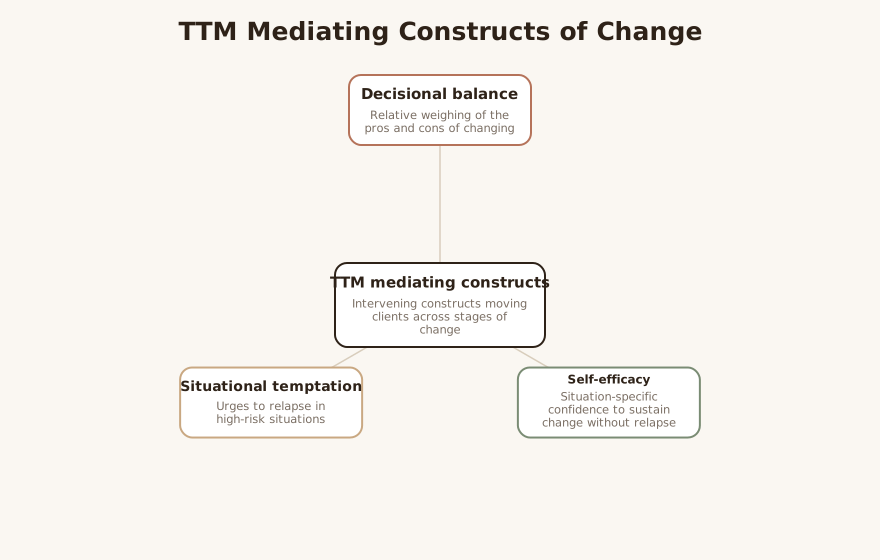
Within TTM, the stages of change describe when change happens, the processes describe how people move, and decisional balance, self-efficacy, and temptation describe the internal mechanics that mediate that movement 4. Conceptually they answer three distinct questions: Does the client think change is worth it (decisional balance)? Does the client believe they can do it and sustain it (self-efficacy)? And how strong is the pull back toward the old behavior (temptation) LLM?
Creators & Lineage
The constructs emerged from the program of research that James O. Prochaska and Carlo C. DiClemente began at the University of Rhode Island in the late 1970s, working with Wayne F. Velicer and colleagues 7. The decisional balance construct was operationalized by Velicer, DiClemente, Prochaska, and Brandenburg in their 1985 measure for smoking, which adapted Janis and Mann’s “decisional balance sheet” of perceived gains and losses into a brief paper-and-pencil instrument 2. The self-efficacy and temptation constructs were grounded in Albert Bandura’s social-cognitive theory, in which greater perceived self-efficacy predicts larger behavior change, and were tied explicitly to the stages of smoking change by DiClemente, Prochaska, and Gibertini in their 1985 paper 3. The synthesis of all constructs into the integrated model the field now cites is most often referenced through Prochaska and Velicer’s 1997 statement 1.
The lineage therefore braids together health behavior theory, Janis and Mann’s conflict-theory model of decision-making, and Bandura’s self-efficacy theory, with motivational interviewing developing in parallel as a clinical method highly compatible with the stage and ambivalence concepts 7. Pro-Change Behavior Solutions, the company founded out of this research group, has carried the constructs into commercial stage-tailored interventions 6.
Core Principles
Decisional balance reflects the individual’s relative weighing of the pros and cons of changing 7. Although Janis and Mann’s original framework proposed multiple categories of gains and losses, the empirical data collapsed cleanly into just two factors: Pros and Cons 4. The clinically important regularity is the crossover: for an unhealthy behavior such as smoking, the pros of the behavior outweigh the cons in Precontemplation, the two scales come into balance during Contemplation, and the cons come to outweigh the pros in the later stages 4. Velicer and colleagues showed that these two scales successfully differentiated the five stage groups and predicted smoking status at six-month follow-up, leading the authors to call decisional balance “a powerful construct of potentially wide application in behavior change” 2.
Self-efficacy in TTM is the situation-specific confidence that people have that they can cope with high-risk situations without relapsing to the unhealthy habit 4. It is not global self-esteem but a domain- and situation-bounded estimate, consistent with Bandura’s formulation 7. Empirically, self-efficacy increases monotonically across the stages, so confidence is lowest in Precontemplation and highest in Maintenance 4. DiClemente and colleagues established this stage-graded relationship for smoking, linking rising confidence to advancement through self-change 3.
Situational temptation is the intensity of urges to engage in the specific behavior when in the midst of difficult situations 4. It is essentially the mirror image of self-efficacy and tends to decrease monotonically across the stages 4. Both self-efficacy and temptation are typically structured around three situational factors: negative emotional or affective distress, positive social situations, and craving 4. These two measures are described as particularly sensitive to the changes involved in the later stages of progress, which makes them especially relevant to relapse prevention work 4. At the theoretical endpoint, the Termination stage, temptation reaches zero and self-efficacy is complete, though many clinicians treat lifelong Maintenance as the realistic target 7.
A unifying principle is that healthy and unhealthy behaviors behave differently on these dimensions LLM. For acquiring a healthy behavior such as exercise, the pros tend to stay high across stages because the behavior requires ongoing decision-making rather than a single act of quitting 4.
Interventions & Techniques
Because these are constructs rather than a protocol, the “interventions” are the clinical moves that shift each construct in the desired direction LLM. The model further holds that processes should be matched to the client’s stage, and the constructs tell you which process is timely 7.
- Decisional-balance work. Eliciting and recording the pros and cons of changing, then deliberately tipping the balance by raising the salience of the cons of the status quo and the pros of change, is the core move for clients in Precontemplation and Contemplation 4. Experiential processes such as consciousness raising, dramatic relief, and self-reevaluation are the levers that shift this balance, and they peak early in the stage sequence 4.
- Self-efficacy building. Confidence is raised through staged mastery experiences, planning for specific high-risk situations, and the behavioral processes of counterconditioning and stimulus control that give clients concrete coping responses 4. StatPearls frames the clinician as an “experienced coach” in Preparation, developing executable plans, which is precisely efficacy-building activity 5.
- Temptation management. Stimulus control removes cues for the old habit and adds prompts for the new one, while counterconditioning substitutes healthier responses for the tempted behavior 4. Mapping a client’s temptation profile across the three situational factors (negative affect, social situations, craving) tells you which coping skills to prioritize 4.
LLM-generated illustrative example (not a guideline): A clinician working with a client in Contemplation about alcohol might literally draw a four-quadrant grid (pros/cons of drinking, pros/cons of cutting back) to surface the crossover, then, once the client tips toward change, shift to rehearsing a specific Friday-night high-risk scenario to build situational confidence. LLM
The clinician’s posture is also expected to change by stage: a nurturing, empathic stance in Precontemplation, a Socratic questioning stance in Contemplation, a coaching stance in Preparation, and a consultative stance in Action and Maintenance 5.
Evidence Base
The maturity of these constructs as measures is established. The decisional balance, self-efficacy, and temptation scales have been validated across many behaviors, and the cross-stage patterns (pro/con crossover, monotonic rise in efficacy, monotonic fall in temptation) replicate across dozens of behaviors 4. Prochaska and Velicer’s integration reports decisional-balance findings spanning roughly four dozen behaviors 7. Velicer’s original validation demonstrated both concurrent (stage differentiation) and predictive (six-month smoking status) validity 2.
Honesty requires distinguishing measurement validity from intervention efficacy. The strongest applied support is in smoking cessation, where TTM-based programs have produced long-term abstinence rates in the range of roughly 22 to 26 percent and outperformed comparison interventions 7. Stage advancement itself is prognostic: advancing one stage in the first month roughly doubles the chance of taking action by six months 5. Pro-Change reports that dynamically tailoring on each TTM construct yields greater effects in meta-analyses of tailored interventions, and that tailored smoking programs can be effective even when more than 80 percent of participants begin not ready to quit 6.
Against this, the evidence for stage-matching as a mechanism is genuinely mixed LLM. A 2003 systematic review concluded that stage-based interventions were no more effective than non-stage-based or no intervention for smoking, and Cochrane reviews of weight loss and physical activity found limited or inconclusive evidence with variable methodological quality 7. Stage-matched treatment of multiple simultaneous behaviors has been disappointing, with only 1 of 39 studies achieving significant change across three or more behaviors 5. Critics also note that stage boundaries are partly arbitrary, that many studies are cross-sectional, and that there is scant evidence of strictly sequential movement through discrete stages 7. The fair summary is that the constructs are well-measured and clinically informative, but the model’s claim that matching interventions to stage outperforms good generic treatment is not consistently supported LLM.
Populations & Indications
The constructs were developed in smoking cessation but have been applied across health behavior change broadly: alcohol and substance use, weight control, exercise, diet, medication adherence, and preventive screenings such as mammography 5. They are most clinically valuable with people who present as ambivalent or precontemplative, because the framework gives the clinician something useful to do when a client is not yet ready to act 4. They fit clients with substance use disorders and other addictive behaviors, where temptation and self-efficacy profiles map directly onto relapse risk 4.
A practical indication arises from the population distribution: across large samples roughly 40 percent of people are in Precontemplation, 40 percent in Contemplation, and 20 percent in Preparation, which means action-oriented programs aimed only at the ready minority will see low uptake and high dropout 5. People managing chronic illness who must sustain a healthy behavior fall into the “acquisition” pattern, where the pros stay high and the clinical work centers on efficacy and temptation rather than on tipping a balance 4.
Problems-for-Work
- Ambivalence about change. Decisional-balance mapping externalizes the client’s competing motivations and identifies which cons of change to address; for a client stuck in chronic contemplation, surfacing the crossover can be the move that unlocks Preparation 4.
- Low self-efficacy. When a client believes change is worthwhile but doubts they can sustain it, the target is situation-specific confidence, built through graded mastery and concrete coping plans 4.
- Relapse and relapse prevention. Because temptation is most sensitive in the later stages, profiling a client’s temptation across negative-affect, social, and craving situations guides targeted relapse-prevention skills 4.
- Treatment non-adherence. A client who is not adhering may simply be in Precontemplation or Contemplation rather than “resistant,” reframing the work toward consciousness raising rather than action planning 5.
- Smoking cessation and other addictive behaviors. This is the construct set’s home turf, where the pro/con crossover and rising confidence have the most replicated support 2.
Contraindications, Cautions & Cultural Humility
There are no medical contraindications to assessing these constructs, but there are clinical cautions LLM. Treating relapse as failure is a misuse of the model: smokers take an average of three to four action attempts before reaching long-term maintenance, so recycling through stages is expected and is best framed as data for refining triggers and plans 5. Forcing an action-stage intervention on a precontemplative client is the predictable error the stage distribution warns against and tends to produce dropout 5.
Clinicians should hold the model’s limitations explicitly: stage boundaries defined by fixed time windows are partly arbitrary, and the assumption that people make coherent, stable plans does not fit everyone 7. The constructs should inform clinical judgment, not replace it LLM.
Cultural humility matters in at least two ways. First, the empirical stage distributions differ markedly across populations; European smoking samples have shown roughly 70 percent in Precontemplation versus about 40 percent in American samples, so norms developed in one population may not transfer 4. Second, what counts as a “pro” or a “con,” what constitutes a high-risk situation, and how confidence is expressed are all culturally shaped, so the clinician should elicit the client’s own pros, cons, and tempting situations rather than impose a standard list LLM.
Treatment-Plan Suggestions & SMART Objectives
| Goal | SMART objective (example) | Mechanism |
|---|---|---|
| Resolve ambivalence about changing a target behavior | Within 4 sessions, client will complete a written pros/cons grid and verbally identify two cons of the status quo previously outside awareness | Decisional balance; consciousness raising shifts the pro/con balance 4 |
| Tip the decisional balance toward change | Over 6 weeks, client will report that the cons of the old behavior outweigh its pros on a brief self-rating, indicating crossover | Decisional balance crossover characteristic of later stages 4 |
| Build situation-specific confidence | Within 30 days, client will rate confidence to cope with their top high-risk situation at 7/10 or higher after rehearsing a coping plan | Self-efficacy via graded mastery and planning 3 |
| Reduce temptation in negative-affect situations | Over 8 weeks, client will use a counterconditioning skill in place of the behavior in at least 3 negative-affect episodes | Temptation reduction via counterconditioning 4 |
| Reduce craving-driven temptation through cue management | Within 2 weeks, client will remove or alter 3 environmental cues linked to the behavior | Stimulus control lowers situational temptation 4 |
| Prevent relapse during Maintenance | For 90 days, client will log high-risk situations weekly and report no full return to the old behavior | Self-efficacy and temptation are most sensitive in later stages 4 |
| Advance one stage of change | Within 1 month, client will move from Precontemplation to Contemplation as indicated by stated intent to change within 6 months | Stage advancement doubles likelihood of later action 5 |
Common Misconceptions
- “It’s a therapy you deliver.” Decisional balance, self-efficacy, and temptation are constructs and measures, not a standalone modality; they describe readiness and guide which techniques to use 4.
- “Self-efficacy means self-esteem.” TTM self-efficacy is situation-specific confidence about coping without relapse, not global self-worth 4.
- “Stage-matching is proven to beat ordinary treatment.” Several reviews find stage-based interventions no more effective than non-stage-based ones, so this claim is not consistently supported 7.
- “Relapse means the client failed.” Relapse is an expected recycling event, and most people make several attempts before lasting change 5.
- “Everyone is ready to change.” Most people in any given sample are in Precontemplation or Contemplation, which is why action-only programs fail to engage the majority 5.
Training & Certification
There is no licensure or certification required to assess or use these constructs; they are part of general health-psychology and behavior-change literacy LLM. Foundational competence comes from the primary literature, the Prochaska and Velicer synthesis, and the validated measures themselves 1. The University of Rhode Island Cancer Prevention Research Center maintains the canonical construct descriptions and many of the original measurement instruments 4. Pro-Change Behavior Solutions offers commercial tailored programs and materials built on the model for organizations seeking to deploy it at scale 6. Clinicians typically pair these constructs with formal training in motivational interviewing, which supplies the conversational method for shifting decisional balance and confidence 7.
Key Terms
- Decisional balance — the relative weighing of the pros and cons of changing a behavior 7.
- Pros / Cons — the two empirically derived factors of decisional balance 4.
- Crossover — the point at which cons of an unhealthy behavior come to outweigh its pros as the client advances through stages 4.
- Self-efficacy — situation-specific confidence in coping with high-risk situations without relapsing 4.
- Situational temptation — the intensity of urges to engage in the behavior in difficult situations 4.
- Stages of change — Precontemplation, Contemplation, Preparation, Action, Maintenance (and theoretical Termination) 5.
- Stage-matching — tailoring interventions and processes to the client’s current stage 7.
Resources & Further Reading
▶ Watch — a video introduction to this concept:
- Prochaska JO, Velicer WF. The Transtheoretical Model of health behavior change (1997)
- Velicer et al. Decisional balance measure for assessing and predicting smoking status (1985)
- DiClemente et al. Self-efficacy and the stages of self-change of smoking
- Detailed Overview of the Transtheoretical Model — URI Cancer Prevention Research Center
- Stages of Change Theory — StatPearls (NCBI Bookshelf)
- Transtheoretical Model of Behavior Change — Pro-Change Behavior Solutions
- Transtheoretical model — Wikipedia
Reflective / Supervision Questions
- When a client is not adhering or seems “resistant,” am I assessing their stage and decisional balance, or defaulting to action-stage techniques they are not ready for? 5
- For my current caseload, can I name each client’s top high-risk situation and rate their self-efficacy and temptation for it? 4
- Where in my work do I implicitly treat relapse as failure, and how would reframing it as expected recycling change my response? 5
- Am I imposing a standard list of pros, cons, and tempting situations, or eliciting the client’s own culturally and personally specific ones? LLM
- Given the honest evidence that stage-matching does not reliably outperform good generic treatment, how am I using these constructs to inform rather than replace sound clinical judgment? 7