
Type & Discipline
Coordinated Management of Meaning (CMM) is a theory of interpersonal communication rooted in social construction, not a packaged psychotherapy 5. Its discipline of origin is communication studies, where it was developed to explain how people manage the meanings that arise in conversation rather than passively receiving fixed messages 5. The CMM Institute frames it as “an approach to understanding our social worlds through a communication perspective,” with the core claim that “taking a communication perspective shows us how we make our world in communicating” 3. For clinicians, the practical upshot is that CMM is a lens and a set of mapping tools that can be folded into recognized therapies, rather than a standalone billable modality with its own manual or protocol LLM.
The theory belongs to the social-constructionist and systemic family of ideas, sitting alongside systemic family therapy, narrative therapy, and dialogic communication theory LLM. Where many therapy models locate the problem inside an individual, CMM locates meaning and pattern in the space between people, in the back-and-forth of talk over time 4. That relocation is why it travels naturally into couple, family, group, organizational, and community work 3.
Creators & Lineage
CMM was developed in the mid-1970s by W. Barnett Pearce (1943–2011) and Vernon E. Cronen at the University of Massachusetts Amherst 5. Pearce in particular pushed the “communication perspective” — the stance that communication is the primary social process through which human realities are made, not merely a channel for transmitting pre-formed thoughts 3. Over subsequent decades the theory was elaborated through a family of practical models and extended from dyads to communities, including a community dialogue process described by Pearce and Pearce 6.
Its intellectual lineage runs through social constructionism, systemic family therapy, narrative therapy, and dialogic communication theory LLM. These cousins share the premise that selves, relationships, and problems are constituted in language and interaction; CMM’s distinctive contribution is a granular grammar for the levels of context that organize any given utterance LLM. The CMM Institute continues the work today as an international community of scholar-practitioners and a community of practice rather than a credentialing body 3.
Core Principles
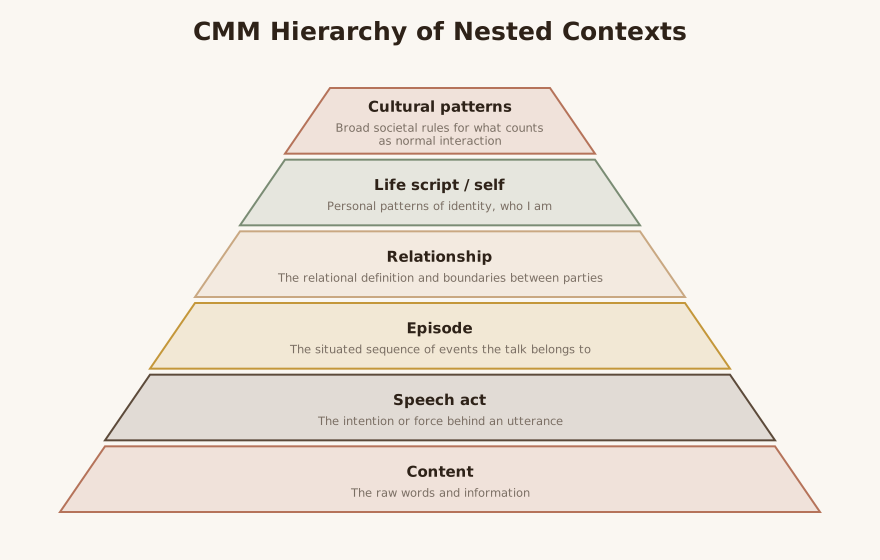
The foundational principle is that people co-create their social realities in communication, and that meaning is organized in nested, hierarchical contexts 5. CMM names six levels, from lowest to highest: content (the raw words and information), speech act (the intention or force behind an utterance — a compliment, promise, or threat), episode (the situated sequence of events the talk belongs to), relationship (the relational definition and boundaries between parties), life script or self (personal patterns of identity, “who I am”), and cultural patterns (the broad societal rules for what counts as normal interaction) 5. Higher levels contextualize and give meaning to lower ones — the same sentence means different things inside different episodes, relationships, and cultures 5.
CMM is built on rules. Constitutive (constructive) rules tell a person how to interpret what an event or message means, while regulative rules guide how to respond and behave 4. Three further processes describe what communication accomplishes: coherence, the way humans build meanings through stories that interpret their world; coordination, the way actions and words mesh into patterns that produce shared events; and mystery, the acknowledgment that not everything can be explained or tidied into a coherent story, and that interactions can yield surprising outcomes 4. Coordination specifically is “the degree to which persons perceive that their actions have fitted together into some mutually intelligible sequence” — note that people can coordinate, and keep a conversation going, without ever sharing the same meaning 5.
A central clinical insight is that meaning-making can loop. In a charmed loop the levels of context reinforce one another consistently; in a strange loop they contradict, producing self-perpetuating binds — the classic example being a person who cycles between identities, such as the drinking/not-drinking oscillation, where each frame implies its own opposite 5. CMM also distinguishes logical forces acting on a speaker: contextual force, where the surrounding context seems to demand a particular action, and practical force, oriented toward a desired future outcome 5.
Interventions & Techniques
CMM’s “techniques” are primarily mapping tools that make tacit meaning-making visible so it can be discussed and shifted 5. The hierarchy model maps how a moment’s contexts nest — what episode, relationship, self-story, and cultural rule are framing a given speech act — letting a clinician ask which level a stuck conversation is really being driven by 5. The serpentine model lays out communication as a back-and-forth wave across time rather than a linear sender-receiver transmission, so a couple or family can see how each turn invites the next 54.
The daisy model places the present utterance at the center and uses surrounding “petals” to surface the multiple conversations, relationships, and influences feeding into it at once 54. The LUUUTT model directs attention to the fuller storytelling landscape — lived stories, unknown stories, untold stories, unheard stories, and the stories actually told — which is especially useful for noticing what is being left out 45. Practically, a clinician using CMM works through questions: What context are you putting this in? What story makes this response make sense to you? What would have to be true for the other person’s behavior to be reasonable? LLM
LLM-generated illustrative example (not a guideline): A couple replays the same fight about a late text. Using the hierarchy model, the clinician helps them see that for one partner the speech act “I’ll be home soon” is read inside an episode of reassurance, while for the other it is read inside a life-script context of “people leave without warning.” Naming the level at which they diverge moves the conversation from “you’re lying” to “we’re framing this in different contexts” LLM.
Evidence Base
It is important to be honest about what “established” means here. CMM is an established and widely taught communication theory — it appears in standard textbooks and has a decades-long literature — but it is established as an interpretive/heuristic framework, not as an empirically validated treatment with outcome trials 51. The theory has drawn substantial critique within its own discipline: that it is vague and abstract, hard to use to identify what matters in a specific interaction, difficult to operationalize into measurable or falsifiable hypotheses, burdened by excessive terminology, and inattentive to power dynamics 5. Defenders respond that as an interpretive theory it should not be held to positivist standards of falsifiability and instead offers a useful framework for understanding real communication 5.
In clinical settings the evidence is descriptive and conceptual rather than controlled. A published account from a UK gender identity development service argued that CMM offers practical frameworks for systemic family therapy, helping clinicians engage families presenting diverse understandings of a referral and work constructively with multiple, often competing meanings 2. That is a reasoned case-and-concept article, not an efficacy study 2. The honest summary for a referring clinician: use CMM as a way of thinking and a conversational toolkit, and lean on the established evidence base of the host modality (e.g., systemic or couple therapy) for the outcomes you document LLM.
Populations & Indications
CMM is indicated wherever the presenting difficulty is fundamentally relational and meaning-laden rather than housed in one person LLM. The most natural fits are couples and families, where nested contexts and recurring interaction loops are easy to map 32. It also extends upward in scale to organizations and teams, mediation and conflict parties, multicultural and cross-cultural groups, and whole communities — the latter demonstrated through CMM-informed community dialogue work 63.
It is especially apt when multiple parties hold genuinely different framings of the same event and the clinical task is to surface and bridge those framings rather than adjudicate a single truth 2. The gender identity service example illustrates this: adolescents and their families often arrive with conflicting understandings of why they are there, and CMM gives the clinician a structured way to hold all of those meanings in the room at once 2.
Problems-for-Work
- Relationship and marital conflict — map the strange loops and divergent context levels driving a recurring fight, then build a shared episode definition 5LLM.
- Communication problems and misunderstanding — distinguish coordination (the conversation runs) from shared coherence (the meanings actually match), and locate where the two split 5.
- Family conflict — use the daisy and hierarchy models to surface each member’s life-script and relationship contexts so a referral or symptom is seen from multiple legitimate angles 25.
- Recurrent destructive interaction patterns — name the charmed or strange loop sustaining the pattern so partners can step outside the self-reinforcing cycle 5LLM.
- Cross-cultural and identity/meaning conflicts — bring cultural-pattern and self levels explicitly into view rather than leaving them as unexamined assumptions 52.
- Group and organizational conflict — apply the communication perspective and serpentine mapping to a team’s repeating dynamics, and the dialogue-process extension to larger units 36.
LLM-generated illustrative example (not a guideline): In a blended-family session, a stepparent’s instruction is heard by the teen as a threat at the relationship level (“you’re not my parent”) even though the content is neutral. The clinician uses the LUUUTT model to elicit the teen’s untold story and the parent’s lived story, shifting the work from enforcing the rule to renegotiating the relationship context the rule lives in LLM.
Contraindications, Cautions & Cultural Humility
The principal caution is scope: CMM is not a treatment for acute risk, and it should not displace evidence-based interventions where those are indicated — for instance active suicidality, psychosis, trauma stabilization, or substance withdrawal need their own established protocols, with CMM at most layered onto the relational work LLM. Because the framework is abstract and terminology-heavy, there is a real risk of the clinician over-intellectualizing and the client feeling diagrammed rather than understood; the models are scaffolding for conversation, not the conversation itself 5LLM.
A documented limitation is CMM’s relative inattention to power 5. Treating all framings as equally valid “meanings” can obscure genuine asymmetries of power, safety, or harm — coercive control in a couple, or abuse in a family, is not merely a difference in coherence to be coordinated 5LLM. Cultural humility is intrinsic to the theory’s logic, since the cultural-patterns level explicitly shapes meaning, but the clinician must apply it actively: surface their own cultural and life-script assumptions, and avoid imposing a dominant frame on parties whose contexts differ 52. The gender identity work is a useful model precisely because it foregrounds holding multiple, contested meanings respectfully rather than resolving them prematurely 2.
Treatment-Plan Suggestions & SMART Objectives
| Goal | SMART objective (example) | Mechanism |
|---|---|---|
| Reduce recurring conflict cycle | Within 6 sessions, partners will jointly name the repeating loop driving one identified argument and describe each person’s context level, in 2 consecutive sessions | Hierarchy model surfaces divergent contexts; charmed/strange-loop awareness interrupts the cycle 5 |
| Improve mutual understanding | Within 8 weeks, each family member will accurately restate one other member’s framing of the referral to that member’s satisfaction in session | Coordination vs. coherence distinction; perspective-taking questions 52 |
| Interrupt a self-perpetuating bind | Within 4 sessions, client will identify one strange loop in a key relationship and one alternative response that breaks it, and try it once | Strange-loop mapping; introducing a new regulative rule 5 |
| Surface unspoken stories | By session 5, family will identify at least one untold or unheard story relevant to the conflict and discuss it in session | LUUUTT model elicits the wider storytelling field 45 |
| Increase contextual flexibility | Over 6 sessions, client will reframe one recurring trigger by placing it in a different episode context and report reduced reactivity (self-rated) | Constitutive-rule shift; reframing the level of context 54 |
| Build cross-cultural common ground | Within 8 sessions, parties will co-author one shared “rule for how we talk about X” that respects each cultural framing | Cultural-pattern level made explicit; co-construction 52 |
| Strengthen team/organizational dialogue | Over a 4-meeting cycle, the team will use a serpentine map of one recurring dynamic and agree one changed conversational turn | Serpentine model + communication perspective 36 |
Common Misconceptions
A frequent misconception is that CMM is a therapy model with a protocol; it is a communication theory and a set of heuristics, and its clinical use is as a lens layered onto established modalities 5LLM. A second is that coordination equals agreement — in CMM people can coordinate their actions into an intelligible sequence while still holding entirely different meanings, so a “smooth” conversation is not proof of shared understanding 5. A third is that “mystery” is a gap to be eliminated; CMM treats mystery as an irreducible feature of communication, the recognition that outcomes can exceed any coherent story 4. Finally, the hierarchy of contexts is sometimes read as fixed, but a defining feature of CMM is that loops let lower levels reframe higher ones, so the ordering is dynamic, not rigid 5.
Training & Certification
There is no formal CMM license or certification in the way some manualized therapies are credentialed 3. The CMM Institute operates as an international community of scholar-practitioners and a community of practice, offering books, videos, publications, archived resources, podcasts, and graduate-level fellowships rather than a certifying credential 3. Clinicians typically encounter CMM through communication-theory coursework and textbook treatments, then learn the models applied to practice through the systemic and family therapy literature and through institute resources 13. The responsible path for a therapist is to develop CMM fluency as an adjunct skill while maintaining and documenting practice within a modality for which they are properly trained and licensed LLM.
Key Terms
- Coordination — the degree to which people’s actions fit into a mutually intelligible sequence, with or without shared meaning 5.
- Coherence — building meaning through stories that interpret experience 4.
- Mystery — the acknowledgment that communication produces outcomes beyond full explanation 4.
- Hierarchy of meaning — nested context levels: content, speech act, episode, relationship, life script/self, cultural patterns 5.
- Constitutive and regulative rules — rules for interpreting meaning and for guiding response, respectively 4.
- Charmed loop / strange loop — context levels that reinforce vs. contradict one another, the latter producing self-perpetuating binds 5.
- Serpentine, daisy, LUUUTT, and hierarchy models — CMM’s practical mapping tools for turn-by-turn interaction, concurrent influences, the storytelling field, and nested contexts 54.
- Communication perspective — the stance that we make our social worlds in the act of communicating 3.
Resources & Further Reading
▶ Watch — a video introduction to this concept:
- CMM Institute for Personal and Social Evolution — the international community of practice; books, videos, podcasts, and fellowships 3.
- Pearce & Cronen — CMM chapter (A First Look at Communication Theory) — accessible textbook treatment of the theory 1.
- Coordinated Management of Meaning — Communication Theory — concise overview of principles and models 4.
- Coordinated Management of Meaning — Wikipedia — origins, models, logical forces, and documented criticisms 5.
- Co-ordinating meaning within a gender identity development service (PubMed) — applied clinical account in systemic family work 2.
- Extending CMM Through a Community Dialogue Process (Communication Theory) — scaling CMM from dyads to communities 6.
Reflective / Supervision Questions
- In a stuck case, at which level of context (episode, relationship, self, culture) is the conversation actually being driven, and how do you know? 5LLM
- Where am I mistaking coordination for shared understanding — a conversation that runs smoothly but in which meanings have not actually met? 5
- What untold, unheard, or unknown stories might be shaping this family’s dynamic, and what would let me invite them in? 45
- Whose framing am I privileging, and am I using “all meanings are valid” in a way that obscures a real power or safety asymmetry? 5LLM
- What are my own life-script and cultural assumptions in this room, and how are they constituting the meanings I am drawing? 52
- Am I using CMM’s models to deepen the conversation, or to diagram the client in a way that distances them? 5LLM