
Type & Discipline
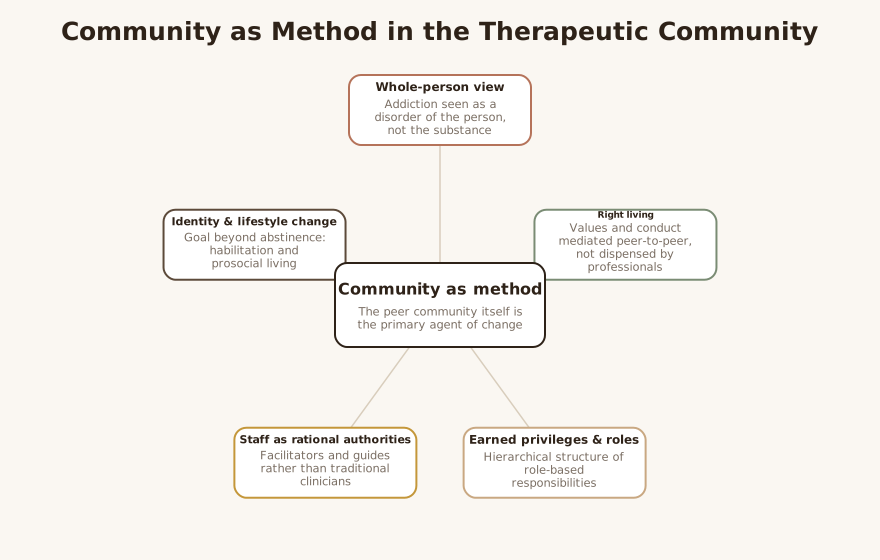
The concept-based therapeutic community (TC) is a residential treatment modality within addiction medicine, not an outpatient talk therapy 4. It is best understood as a level of care and a social environment rather than a single technique: the entire residential milieu—its rules, roles, hierarchy, and peer relationships—is the intervention 1. The defining slogan of the model is “community as method,” which De Leon describes as “the purposive use of the community to teach individuals to use the community to change themselves” 1.
It is one of two historically distinct strands that both carry the name “therapeutic community.” This article concerns the concept-based (also called hierarchical or American) strand, which grew out of Synanon and Daytop and was later codified by George De Leon 652. It should not be conflated with the democratic therapeutic community associated with Maxwell Jones, which has a separate post-war psychiatric lineage and a flatter, less authority-driven structure LLM.
For practicing therapists—most of whom work in outpatient settings and will rarely run a residential hierarchy—the practical value of this article is twofold: understanding what a referral to a TC actually entails, and learning which TC principles can be imported into group, IOP, and milieu work LLM.
Creators & Lineage
The concept-based TC begins with Synanon, founded by Charles Dederich in Santa Monica in 1958 as an alternative to Alcoholics Anonymous for people whose drug addiction was not welcomed in AA 6. Synanon’s signature practice was “The Game,” an intensive group session of harsh peer criticism described as “a form of attack therapy,” originally framed as a leveling device that allowed even leadership to be confronted 6.
In 1963, Daytop Village was founded on Staten Island by Daniel Casriel, Monsignor William O’Brien, and Ron Brancato, drawing its methods directly from Synanon—including confrontation and behavior-modification techniques—but reorienting them toward a time-limited, recovery-oriented residential program rather than lifelong membership 5. Daytop became the prototype for the modern drug-free TC and seeded programs across the United States and internationally 57.
George De Leon is the theorist who transformed this practice tradition into a coherent framework, organizing the essential elements of the TC into four areas—its perspective, treatment approach, program model, and treatment process 2—and later articulating the full “theory, model, and method” in book form 3.
The model draws on social learning theory (change through modeling, reinforcement, and graduated role responsibility), shares abstinence ideals with the Twelve-Step / Minnesota Model, and operates as a form of milieu therapy in which the environment itself is therapeutic 17. The historical record also includes the democratic (Maxwell Jones) TC as a contrasting ancestor: the broader “therapeutic community” idea was coined in post-WWII Britain to reintegrate traumatized soldiers, but that democratic, flat-structured lineage is distinct from the hierarchical Synanon-Daytop line treated here 7.
It is essential to be honest that this lineage is morally mixed. Synanon, after declaring around 1968 that addicts could never truly recover and therefore needed “lifetime rehabilitation,” degenerated into an authoritarian and ultimately violent cult—forced vasectomies, head-shaving, an internal enforcement unit, and a 1978 rattlesnake attack on an attorney 6. Daytop, too, later faced serious sexual-abuse allegations, including posthumous accusations against a founder 5. The field’s deliberate move away from coercive confrontation is a direct response to this history LLM.
Core Principles
The TC views addiction as a disorder of the whole person, not of the substance: “the problem is with the individual and not the substance abused,” and addiction is treated “as a symptom rather than the essence of their disorder” 1. Residents are understood to commonly present with problems with authority, difficulty managing feelings, and habitual lying, manipulation, and deception as coping behaviors 1.
Because the disorder is of the person, the goal is not merely abstinence but “identity and lifestyle changes” 1. De Leon distinguishes habilitation—developing a conventional, prosocial lifestyle for the first time—from rehabilitation, returning to a previously held one 1. The currency of change is “right living,” a set of values and conduct mediated peer-to-peer rather than dispensed by professionals 1.
The peer community is the primary therapeutic agent. It functions psychologically as both “a safe haven in which one can enter” and “a secure base from which one can start again,” operating through “mutual self-help” 1. Staff—both recovering paraprofessionals and licensed clinicians—act as “rational authorities, facilitators, and guides” rather than as traditional treaters 4. Authority in the TC is explicitly relational and developmental: it is meant to be modeled and internalized, not merely obeyed 4.
Interventions & Techniques
Hierarchy and earned status. The community is organized as a hierarchy of resident job functions; members advance through roles and earn privileges based on demonstrated commitment and behavioral change 4. Status is not given but worked for, which operationalizes social-learning reinforcement within daily life 4LLM.
Work as therapy. Residents run the facility—cleaning, food service, maintenance—and these work roles are framed as vehicles for “skill development” and for fostering “self-examination and personal growth through performance challenge and program responsibility” 4.
Encounter / peer groups. The peer encounter group is described as the principal therapeutic mechanism, used to heighten awareness of attitudes and behaviors needing change 4. Historically this involved intense confrontation; contemporary adaptations include lower-intensity “conflict resolution groups,” especially for people with co-occurring mental illness 4.
Phased treatment. Programs move through developmental phases—roughly orientation and breaking denial, then intensive self-examination and socialization in primary treatment, then re-entry with increased autonomy and continued accountability 4. Movement between phases is tied to demonstrated change rather than time alone 4LLM.
LLM-generated illustrative example (not a guideline): A resident who arrives minimizing his cocaine use is initially assigned to kitchen cleanup under a senior peer. Over weeks, consistent reliability and honest participation in encounter groups earn him a coordinator role and later off-site passes—each privilege framed by peers as evidence of “right living” rather than as a reward dispensed by staff LLM.
Evidence Base
The honest characterization of this modality’s maturity is established in the sense of being longstanding, codified, and globally entrenched—over 3,000 TCs or modified TCs operate worldwide—rather than established in the sense of strong causal evidence 74.
The most frequently cited empirical claim is that “there is a consistent correlation between treatment retention in TCs and positive post-treatment outcomes,” supported by longitudinal follow-ups spanning one to twelve years 1. The crucial caveat is that this is a correlation: people who remain in treatment differ systematically from those who leave (motivation, severity, social stability), so retention-outcome associations are confounded by selection and cannot by themselves establish that the TC caused the improvement LLM. Reported follow-up figures such as large reductions in cocaine and heroin use and in predatory illegal behavior at one year come from observational follow-up rather than randomized comparison, and self-reported program “success rates” should be read with corresponding skepticism 45LLM.
The strongest comparative signal is in criminal justice settings, where in-prison TC treatment combined with community aftercare is associated with greater reductions in recidivism 4. Even there, the design literature is uneven, and the field’s own description of TC effectiveness is appropriately hedged as cost-effective and therapeutically effective “for certain substance abuser subgroups” rather than universally 1. In short: this is a mature, widely deployed model whose rigorous randomized-trial base is more modest than its institutional prominence implies LLM.
Populations & Indications
TCs were developed for, and are best indicated for, people with substance use disorders—including alcohol and opioid use disorders—whose difficulties extend beyond the drug into identity, conduct, and lifestyle 1. The model classifies people less by drug of choice than by degree of psychological dysfunction and social deficit 1.
Specific populations served include adults in residential treatment, people with chronic or severe addiction who have not responded to lower-intensity care, and justice-involved individuals, for whom the prison-plus-aftercare TC has its clearest comparative evidence 4. Modified therapeutic communities (MTCs) adapt the core model for people with co-occurring serious mental illness and for other complex populations such as pregnant women, homeless individuals with dual diagnoses, and adolescents 47.
The model is a candidate when a structured, high-containment, peer-driven environment matches clinical need—typically high severity, weak prosocial supports, or entrenched antisocial behavior patterns—and when the person can tolerate communal living and graduated confrontation LLM.
Problems-for-Work
- Substance use disorders, alcohol and opioid use disorder. The TC targets the broader lifestyle and identity around use, not only consumption 1. Application: a referral for someone whose drinking is embedded in an unstructured, high-risk social world that outpatient care has not been able to interrupt LLM.
- Antisocial behavior patterns and criminogenic behavior. The hierarchy, role responsibility, and peer accountability directly engage problems with authority and rule-breaking 14. Application: in-custody TC tracks designed to reduce recidivism via prosocial role rehearsal 4.
- Impulsivity and inability to manage feelings. Encounter and conflict-resolution groups are used to raise awareness of behaviors needing modification before they are acted on 14.
- Co-occurring mental health disorders. MTCs lower confrontation intensity and individualize structure while preserving community-as-method 4.
- Relapse prevention and social/occupational dysfunction. Habilitation toward conventional roles, work functioning, and a prosocial peer network is the explicit aim 1.
Contraindications, Cautions & Cultural Humility
The single most important caution is historical and ethical: the harsh confrontation and “attack therapy” that defined early concept-based TCs are now widely regarded as potentially harmful, and the field has deliberately “smoothed over the rough edges” while keeping the structure 46. The arc from Synanon’s coercion and violence to Daytop’s later abuse allegations is part of why contemporary, ethical TCs reduce confrontation and increase individualization 65LLM.
High-intensity confrontation is contraindicated for people with trauma histories and PTSD and for those with serious co-occurring mental illness, for whom unmodified encounter groups can be retraumatizing or destabilizing—hence the existence of modified TCs with reduced confrontational intensity and greater flexibility 4LLM. Coercive or cult-like dynamics (escalating in-group loyalty, demonization of leaving, public humiliation) are a known failure mode of this lineage and should be actively screened for in any program a clinician refers to 6LLM.
Cultural humility matters because the model’s “right living” can encode a specific, conventional, often mid-century-American notion of a prosocial life; clinicians should ensure the program respects clients’ cultural, religious, and identity contexts rather than demanding assimilation, and should note that MTCs were in part developed to adapt the model to varied cultures and populations 7LLM. Finally, abstinence-only TC roots historically treated any drug use as a threat; clinicians should confirm that a given program now integrates medications for opioid and alcohol use disorder rather than excluding patients who need them 7LLM.
Treatment-Plan Suggestions & SMART Objectives
| Goal | SMART objective (example) | Mechanism |
|---|---|---|
| Increase prosocial engagement | Client attends 3 of 3 weekly process groups for 4 consecutive weeks and contributes at least one verbal reflection per session | Community-as-method; peer mutual self-help 1 |
| Build accountability | Client completes an agreed weekly role/responsibility (e.g., group timekeeper) for 4 weeks with peer acknowledgment | Role-based responsibility and earned status 4 |
| Strengthen emotion management | Client identifies and names a difficult feeling before acting on it in 4 of 5 logged high-urge situations over 30 days | Self-examination via group feedback 14 |
| Reduce antisocial/rule-conflict patterns | Client gives and receives peer feedback in conflict-resolution group without escalation in 3 consecutive sessions | Lower-intensity encounter, modeling 4 |
| Support habilitation | Client establishes one structured prosocial activity (work, study, volunteer role) within 60 days and sustains it 4 weeks | Conventional-role development 1 |
| Sustain abstinence/recovery | Client maintains abstinence with documented attendance at mutual-help meetings ≥2x/week for 8 weeks | Right-living values mediated by peers 1 |
| Improve treatment retention | Client remains engaged in the program through the next planned phase transition with no unplanned absences for 30 days | Retention as a recovery indicator 1 |
Common Misconceptions
- “It’s just group therapy in a residence.” No—the entire community (roles, hierarchy, work, privileges, peers) is the treatment, not a single group format 14.
- “It targets the drug.” The model explicitly treats addiction as a symptom of a whole-person disorder, aiming at identity and lifestyle change 1.
- “Harsh confrontation is the active ingredient and still standard practice.” Confrontation defined the Synanon era, but contemporary TCs have deliberately reduced its intensity and use modified, conflict-resolution formats for vulnerable populations 46.
- “It’s the same thing Maxwell Jones described.” The democratic TC is a distinct, flatter, post-war psychiatric lineage; the concept-based TC is the hierarchical Synanon-Daytop line 7LLM.
- “The outcome data prove it works because people who stay do well.” Retention-outcome links are correlational and confounded by who stays versus who leaves 1LLM.
Training & Certification
There is no single universal credential for the concept-based TC in this source set; the role differentiation in TCs spans recovering paraprofessional staff and licensed clinicians, all functioning as rational authorities, facilitators, and guides 4. De Leon’s theoretical framework and his book-length “theory, model, and method” are the canonical texts a clinician should read to understand the model’s logic and fidelity expectations 23. Clinicians seeking to apply TC principles within group or milieu settings should ground that work in the published theory and in modified-TC adaptations rather than in the harsher historical practice traditions 34LLM.
Key Terms
- Community as method — Using the community purposively to teach members to use the community to change themselves 1.
- Right living — The prosocial values and conduct mediated peer-to-peer that the TC promotes 1.
- Habilitation vs. rehabilitation — Building a conventional lifestyle for the first time vs. restoring a prior one 1.
- Mutual self-help — Recovery messages delivered primarily by peers rather than professionals 1.
- Rational authority — Staff stance as facilitator/guide rather than traditional treater 4.
- Encounter / conflict-resolution group — Peer group used to raise awareness of behaviors needing change; lower-intensity variants serve co-occurring populations 4.
- Modified Therapeutic Community (MTC) — TC adapted with reduced confrontation and greater individualization for people with serious mental illness and other complex needs 47.
Resources & Further Reading
▶ Watch — a video introduction to this concept:
- The Therapeutic Community: A Unique Social Psychological Approach to the Treatment of Addictions and Related Disorders (Frontiers in Psychiatry, 2020)
- Therapeutic communities for addictions: a theoretical framework (De Leon, 1995)
- The Therapeutic Community: Theory, Model, and Method (De Leon, 2000)
- Therapeutic Communities — The ASAM Principles of Addiction Medicine (5th ed., Ch. 61)
- Daytop (Daytop Village) — Wikipedia
- Synanon — Wikipedia
- Historical Note on Therapeutic Communities — Weill Cornell Program for Substance Use and Stigma of Addiction
Reflective / Supervision Questions
- When I refer a client to a residential TC, do I know whether that specific program still uses high-intensity confrontation, and have I screened it for coercive or cult-like dynamics? 6LLM
- For a client with significant trauma or serious co-occurring illness, is an unmodified TC contraindicated, and is a modified TC or a different level of care more appropriate? 4LLM
- Which TC principles—community-as-method, peer feedback, role responsibility—can I ethically import into my group or IOP work, and which require the full residential structure I cannot provide? 14LLM
- Am I interpreting “retention predicts outcome” as causal evidence when it is correlational, and how does that shape what I tell clients and families about expected benefit? 1LLM
- Does the “right living” being promoted respect this client’s cultural, religious, and identity context, or am I implicitly asking for assimilation? 7LLM
- For clients who need medications for opioid or alcohol use disorder, does the program I am considering integrate them rather than excluding patients on the basis of abstinence-only history? 7LLM