
Type & Discipline
Cognitive Behavioral Therapy for Hoarding Disorder is a disorder-specific cognitive-behavioral protocol within clinical psychology, designed for the distinct problems of saving, acquiring, and living with clutter rather than adapted secondhand from obsessive-compulsive disorder treatment 3. It belongs to the family of manualized, disorder-specific CBT protocols and is the most studied psychological treatment for hoarding disorder to date 4. The approach is structured, present-focused, and skills-oriented, but it is unusually long by CBT standards and leans heavily on motivational and in-home work because clutter accumulates in the client’s environment rather than only in the consulting room 6. LLM
Hoarding disorder was recognized as a standalone diagnosis in DSM-5, separating it from obsessive-compulsive disorder, and this protocol was developed in parallel with that conceptual shift 6. Clinically, it sits at the intersection of cognitive therapy (beliefs about possessions), behavioral therapy (exposure to discarding and not acquiring), and skills training (categorizing, organizing, and decision-making) 2. LLM
Creators & Lineage
The protocol was developed primarily by Gail Steketee and Randy Frost, who authored the Treatment for Hoarding Disorder: Therapist Guide in the Oxford “Treatments That Work” series, along with a companion client workbook 2. David Tolin collaborated closely on the early trials and on the meta-analytic work that established the evidence base 57. Their first open trial of cognitive-behavioral therapy for compulsive hoarding appeared in Behaviour Research and Therapy in 2007, and a waitlist-controlled trial followed in Depression and Anxiety in 2010 51. LLM
The model’s intellectual lineage runs through obsessive-compulsive spectrum treatment — exposure and response prevention, cognitive therapy for overvalued beliefs — but Frost and Steketee argued that hoarding required its own framework rather than a borrowed one, because standard OCD treatment performed poorly for hoarding symptoms 3. They built an information-processing and attachment model: people who hoard show difficulties in attention, categorization, and decision-making, hold strong emotional and identity-based attachments to objects, and maintain beliefs about responsibility, memory, and waste that make discarding feel intolerable 2. The treatment targets each of these strands. LLM
Core Principles
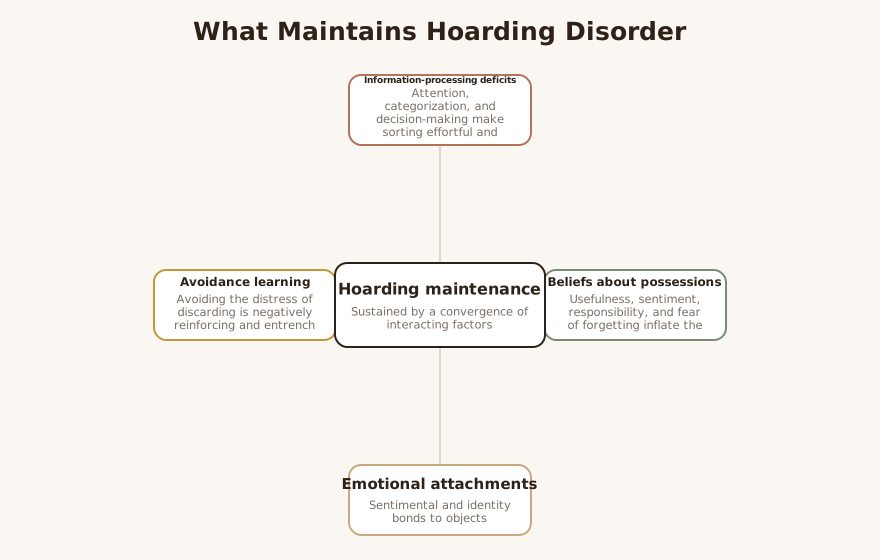
The central model holds that hoarding is maintained by a convergence of information-processing deficits, problematic beliefs about possessions, emotional attachments, and avoidance learning 2. Information-processing difficulties — in sustained attention, categorization, and decision-making — make sorting genuinely effortful and aversive, so the person avoids it, and clutter grows 3. Beliefs about possessions (their usefulness, their sentimental or identity value, the responsibility not to be wasteful, the fear of forgetting) inflate the perceived cost of discarding 2. LLM
Avoidance is the behavioral engine: discarding and resisting acquisition provoke anxiety, grief, or guilt, and avoiding those feelings is negatively reinforcing, which entrenches saving and acquiring over time 3. The treatment therefore combines cognitive work on beliefs, behavioral exposure to discarding and non-acquiring, and direct skills training, all scaffolded by motivational strategies because ambivalence and limited insight are common 6. A guiding principle is that the client makes every keep-or-discard decision; the clinician coaches and structures but does not remove items, which distinguishes treatment from a forced cleanout 6. LLM
Interventions & Techniques
Assessment and case formulation come first, often including a home visit or photographs to gauge clutter severity and safety, since office-only reports underestimate the problem 6. The clinician and client build an individualized model of how acquiring, saving, and clutter are maintained for that person, and set up systems for organizing and decision-making 2. LLM
Skills training addresses the information-processing piece: teaching the client to categorize, to make timely keep/discard decisions using agreed-upon questions, and to organize remaining items so spaces become usable 2. Sorting practice is the core behavioral exercise — working through piles in session and at home, making decisions one item at a time, and tolerating the distress that surfaces 3. Non-acquisition exposure targets compulsive buying and acquiring: graded exposure to stores, sales, and free-item opportunities while resisting the urge to acquire, functioning much like response prevention 2. LLM
Cognitive restructuring examines and tests beliefs about possessions — running behavioral experiments (for example, discarding an item and tracking whether the feared consequence actually occurs) and using downward-arrow techniques to surface the meaning an object carries 2. Motivational interviewing is woven throughout to address ambivalence, and homework between sessions extends practice into the home environment, which is essential because the clutter lives there 6. Treatment is typically delivered over roughly 26 sessions across many months, considerably longer than most CBT protocols 1. LLM
LLM-generated illustrative example (not a guideline): A client cannot discard a stack of decade-old newspapers, citing “I might need this article someday.” The clinician helps her run a behavioral experiment — recycle ten papers, then track over two weeks whether she ever needed any of them — while restructuring the underlying belief that discarding equals irresponsibility. LLM
Evidence Base
The evidence base is established but the effects are honestly moderate, and clinicians should set expectations accordingly 7. The 2007 open trial reported that participants who completed cognitive-behavioral therapy showed significant reductions in hoarding symptoms, providing the first prospective support for the protocol 5. The 2010 waitlist-controlled trial demonstrated that treated clients improved significantly more than those on a waitlist, strengthening causal inference 1. LLM
A meta-analysis by Tolin and colleagues pooled the available studies and found that cognitive-behavioral therapy produced significant improvements in hoarding symptoms, with the largest gains in difficulty discarding and somewhat smaller gains in clutter and acquisition 7. Importantly, even after treatment, many clients remained symptomatic — improved relative to baseline but still meeting or approaching diagnostic thresholds — so partial response is the typical outcome rather than remission 7. Moderators of better outcome in the meta-analytic literature included younger age, female sex, and more treatment sessions and home visits, suggesting that dose and in-home work matter 7. Subsequent meta-analytic work has continued to support moderate efficacy while underscoring that response is incomplete for most clients 4. LLM
In short: this is the best-supported treatment available for hoarding disorder, it reliably helps, and it rarely produces full resolution — a realistic frame to share with clients 4. LLM
Populations & Indications
The protocol was developed and tested primarily with adults who meet criteria for hoarding disorder, including those with co-occurring depression and anxiety, which are common 1. Hoarding symptoms tend to begin in adolescence and worsen across the lifespan, so a substantial share of presenting clients are middle-aged and older adults 6. Older adults are an important target population given accumulating clutter, increasing health and fall risks, and often greater social isolation 6. LLM
Indications include difficulty discarding possessions, excessive acquisition through buying or collecting free items, and clutter that prevents normal use of living spaces — the core diagnostic features the protocol directly targets 2. Because attention and categorization difficulties are part of the model, clients with co-occurring attention problems are explicitly considered in formulation and skills training 2. Clients with limited insight or marked ambivalence are still candidates, but the protocol front-loads motivational work for them rather than excluding them 6. LLM
Problems-for-Work
Difficulty discarding. The clinician structures repeated sorting practice with agreed decision rules and behavioral experiments that test catastrophic predictions about parting with items 2. LLM
Excessive acquisition. Graded non-acquisition exposure — visiting triggering stores or free-item sources without acquiring — reduces the acquiring loop while building tolerance for the urge 2. LLM
Avoidance of sorting and decision-making. Skills training plus in-session and homework sorting break the avoidance cycle by making decisions repeatedly under coaching, lowering their aversiveness over time 3. LLM
Low insight and ambivalence. Motivational interviewing and collaborative goal-setting are used before and during active work to build and sustain engagement 6. LLM
Functional impairment and safety hazards. Home visits help the clinician target the spaces whose clutter most threatens safety and daily functioning, prioritizing pathways, exits, and kitchens 6. LLM
LLM-generated illustrative example (not a guideline): For a client whose kitchen is unusable, early sessions prioritize clearing the stove and a single counter — concrete, safety-relevant wins that also generate evidence that sorting is survivable. LLM
Contraindications, Cautions & Cultural Humility
The most important caution is that this is not a cleanout: the clinician never removes or discards the client’s possessions, and every decision belongs to the client, because forced removal damages trust and does not change the underlying patterns 6. Limited insight is common and is a clinical feature to work with motivationally, not a reason to coerce 6. LLM
Treatment is long and effortful, and dropout is a real concern; the meta-analytic finding that more sessions and home visits predict better outcomes also implies that under-dosing the protocol likely undertreats the client 7. Because most clients improve only partially, framing realistic, incremental goals protects against discouragement and premature termination 4. LLM
Safety, capacity, and risk warrant attention: severe clutter can create fire, fall, and sanitation hazards, and cases sometimes involve other agencies, which raises questions about coordination, autonomy, and the client’s right to make decisions about their own home 6. Cultural humility matters around the meaning of possessions, thrift, and saving — what looks like pathology to an outsider may intersect with values around frugality, history of scarcity, or sentimental and identity attachments, and the formulation should be built collaboratively rather than imposed 2. LLM
Treatment-Plan Suggestions & SMART Objectives
| Goal | SMART objective (example) | Mechanism |
|---|---|---|
| Reduce difficulty discarding | Over 8 weeks, sort one defined zone weekly, discarding at least 5 items per session, logged in homework | Repeated decision-making plus exposure to discarding-related distress 2 |
| Reduce acquisition | Complete 3 graded non-acquisition outings within 6 weeks without acquiring, with urge ratings recorded | Response prevention reduces the acquiring loop 2 |
| Restore use of a key space | Make the kitchen counter and stove usable within 4 weeks | Prioritized sorting targets safety and function 6 |
| Build sorting/decision skills | Apply agreed keep/discard questions to 20 items per week for 6 weeks | Skills training offsets categorization and decision deficits 3 |
| Test beliefs about possessions | Run one behavioral experiment per week for 5 weeks and record actual outcomes | Cognitive restructuring weakens overvalued saving beliefs 2 |
| Strengthen motivation/engagement | Co-author a written values-and-goals statement by session 4 and review monthly | Motivational work reduces ambivalence and dropout 6 |
| Sustain gains | Maintain cleared zones and complete a relapse-prevention plan in the final 3 sessions | Consolidation guards against re-accumulation given partial response 7 |
Common Misconceptions
“It’s a cleanout.” The clinician does not remove the client’s belongings; treatment is collaborative skills, exposure, and cognitive work in which the client makes every decision 6. LLM
“It’s just OCD treatment relabeled.” Hoarding disorder is a separate diagnosis, and standard obsessive-compulsive disorder treatment performed poorly for it, which is precisely why this dedicated protocol was developed 3. LLM
“If they would just try harder, the clutter would go.” The model identifies genuine information-processing difficulties in attention, categorization, and decision-making, so sorting is harder for these clients than willpower framing suggests 2. LLM
“CBT cures hoarding.” Most clients improve but remain symptomatic after treatment; partial response is the norm and should be named openly 7. LLM
“A few sessions will do it.” This is an unusually long protocol of roughly two dozen sessions over many months, and more sessions and home visits predict better outcomes 17. LLM
Training & Certification
There is no single licensing body specific to this protocol; competence is built by clinicians already trained in cognitive-behavioral therapy who study the manualized materials and apply them under supervision 2. The primary training text is Steketee and Frost’s Treatment for Hoarding Disorder: Therapist Guide with its companion client workbook, which lays out the session-by-session structure 2. LLM
The International OCD Foundation’s Hoarding Center provides professional resources and guidance on the cognitive-behavioral approach for clinicians seeking orientation and referral pathways 3. The American Psychological Association has published continuing-education material on treating hoarding disorder that summarizes the model and clinical considerations for practitioners building competence 6. Given the role of home visits and motivational work, supervised practice and consultation are valuable beyond reading the manual alone 6. LLM
Key Terms
Hoarding disorder — a distinct diagnosis defined by persistent difficulty discarding possessions and resulting clutter that impairs use of living spaces 6. LLM
Information-processing model — the framework attributing hoarding partly to difficulties in attention, categorization, and decision-making 2. LLM
Non-acquisition exposure — graded exposure to acquiring opportunities while resisting acquisition, analogous to response prevention 2. LLM
Sorting practice — structured, one-item-at-a-time keep/discard work done in session and as homework 3. LLM
Cognitive restructuring — identifying and testing beliefs about possessions (responsibility, waste, memory, identity) through behavioral experiments 2. LLM
Partial response — the typical outcome in which symptoms improve meaningfully but do not fully remit 7. LLM
Resources & Further Reading
▶ Watch — a video introduction to this concept:
- Waitlist-controlled trial of CBT for hoarding disorder (Steketee, Frost et al., 2010) 1
- Treatment for Hoarding Disorder: Therapist Guide (Steketee & Frost, Oxford / Treatments That Work) 2
- Treatment of HD — Cognitive Behavioral Therapy (CBT) — IOCDF Hoarding Center 3
- Cognitive Behavioral Therapy for Hoarding Disorder: A Meta-Analysis (Focus / Psychiatry Online) 4
- An open trial of cognitive-behavioral therapy for compulsive hoarding (Tolin, Frost, Steketee, 2007) 5
- CE Corner: Treating people with hoarding disorder — APA Monitor on Psychology 6
- Cognitive behavioral therapy for hoarding disorder: a meta-analysis (Tolin et al., 2015) 7
Reflective / Supervision Questions
- How do I distinguish between coaching a client toward their own discard decisions and subtly pressuring them toward mine, and where is that line tested in my recent sessions? LLM
- Given that partial response is the norm, how am I framing realistic goals with this client, and am I tracking incremental functional wins rather than total clutter elimination? 7 LLM
- Am I delivering an adequate dose — enough sessions and home contact — or am I under-treating because the protocol is long and demanding? 7 LLM
- How is my own discomfort with the client’s living conditions or possessions shaping the formulation, and where might cultural humility around thrift, scarcity, and sentiment change my interpretation? 2 LLM
- When ambivalence rises, am I returning to motivational work, or am I pushing forward with sorting and exposure prematurely? 6 LLM
- What is my plan if safety hazards escalate, and how do I coordinate with others while protecting the client’s autonomy and decision-making? 6 LLM