
Type & Discipline
Cognitive-Behavioral Conjoint Therapy for PTSD (commonly abbreviated CBCT for PTSD) is a manualized, time-limited couple therapy situated within clinical psychology and the broader family of cognitive-behavioral trauma treatments 2. Unlike individual trauma protocols, it treats the dyad rather than a single patient, working with the couple in the room together across all sessions 4. Its defining feature is a dual target: it is designed to reduce PTSD symptoms in the diagnosed partner and to improve intimate-relationship functioning for both members of the couple at the same time 1. This places it at the intersection of trauma-focused care and couple/family therapy, and it is the reason the approach is often described as “conjoint” rather than simply adjunctive partner support LLM.
The treatment is delivered over roughly 15 sessions in its standard protocol form 1. It is recognized within Veterans Affairs settings as a couple-based option for PTSD, and is disseminated through a formal training and provider community rather than as an open-access technique 34.
Creators & Lineage
CBCT for PTSD was developed by Candice M. Monson and Steffany J. Fredman, who authored the treatment manual that codifies the model 2. The pivotal randomized trial establishing its efficacy was led by Monson and Fredman together with Alexandra Macdonald, Nicole D. Pukay-Martin, Patricia A. Resick, and Paula P. Schnurr 1. The presence of Patricia Resick — the originator of Cognitive Processing Therapy — among the authors signals the lineage clearly: CBCT for PTSD inherits the cognitive-restructuring logic of CPT and adapts it for two people working in concert LLM. The involvement of Paula Schnurr, a long-standing figure in VA PTSD research, similarly locates the work within the veteran-focused trauma treatment tradition 1.
Conceptually, the model braids three strands LLM. From cognitive-behavioral PTSD treatment it takes the premise that avoidance maintains symptoms and that distorted trauma-related cognitions must be examined and modified LLM. From behavioral couple therapy it takes structured communication training and the deliberate scheduling of shared, approach-oriented activity LLM. From an interpersonal-systems view it takes the insight that PTSD is not contained within one body — it reshapes the relationship, and the relationship in turn either maintains or heals the disorder 2. The manual’s subtitle, Harnessing the Healing Power of Relationships, captures this organizing idea: the couple bond is treated as a therapeutic asset rather than a casualty to be managed around 2.
Core Principles
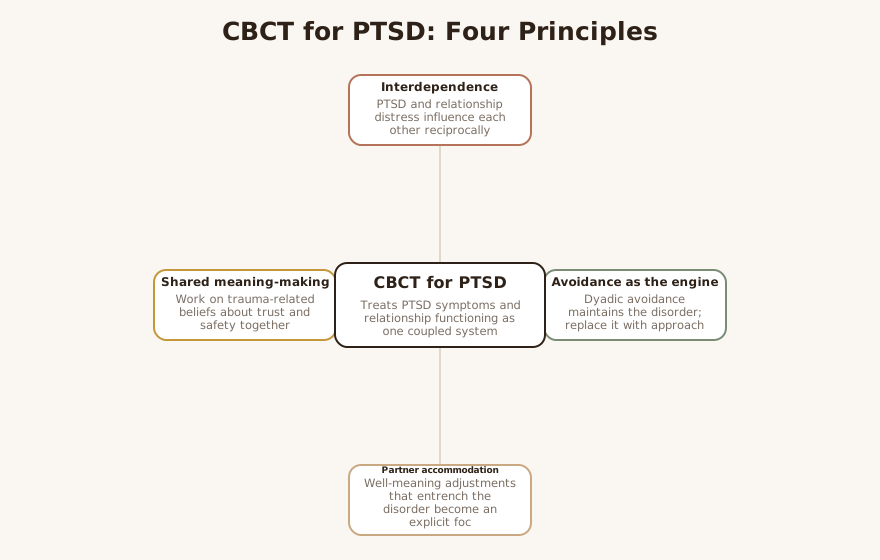
The first principle is interdependence: PTSD and relationship distress are understood to influence each other reciprocally, so that symptom severity and relationship dysfunction co-vary and can be treated as a single coupled system 2. Improvement in one is expected to support improvement in the other, which is why the protocol pursues both targets simultaneously rather than sequentially 1.
The second principle is avoidance as the engine of maintenance. Trauma survivors and, often, their partners collaborate — usually without intending to — in avoiding trauma reminders, difficult conversations, and intimacy itself LLM. CBCT for PTSD treats this dyadic avoidance as a central maintaining mechanism and works to replace it with approach behavior LLM.
The third principle is partner accommodation. Partners frequently adjust their own behavior to reduce the survivor’s distress — taking over responsibilities, avoiding certain topics or places, walking on eggshells LLM. While well-meaning, accommodation can entrench the disorder, and the model makes it an explicit focus LLM.
The fourth principle is shared meaning-making. Trauma-related beliefs (about trust, safety, control, blame, intimacy) are examined dyadically, so the couple builds a common, more accurate understanding of the trauma’s effects rather than two private and often conflicting narratives 2. The therapeutic stance is collaborative and psychoeducational throughout, positioning both partners as agents of recovery 4.
Interventions & Techniques
The protocol is organized into three phases, each with a distinct task 4. The phases below reflect the model’s standard architecture; specific in-session activities are described here as clinical synthesis rather than verbatim manual content LLM.
Phase 1 — Psychoeducation and safety/satisfaction building. Early sessions orient the couple to PTSD and to how it operates within relationships, building a shared framework and rationale 4. The clinician establishes safety, addresses any behaviors that threaten it, and begins increasing positive, low-conflict shared activity to rebuild relationship satisfaction and create a stable platform for the harder work ahead LLM.
Phase 2 — Communication skills and behavioral approach. The middle phase trains the couple in concrete communication skills and, crucially, in approaching rather than avoiding LLM. Partners practice moving toward situations, conversations, and forms of intimacy they have been avoiding, with the relationship serving as the vehicle for graded behavioral approach 2. This is where dyadic exposure to avoided experiences is woven into everyday relating LLM.
Phase 3 — Dyadic cognitive interventions. The final phase targets trauma-related “stuck points” — appraisals about safety, trust, power/control, esteem, and intimacy — through cognitive work done together, so that both partners examine and modify the beliefs that maintain symptoms and distance 2. This phase is the most direct descendant of Cognitive Processing Therapy’s cognitive restructuring, adapted for two people LLM.
Across all phases, the techniques are explicitly behavioral and cognitive rather than insight-oriented, and they are supported by between-session practice, tracking forms, and workbooks supplied through the model’s resources 4.
LLM-generated illustrative example (not a guideline): A veteran and his partner have stopped going to restaurants because crowds spike his hypervigilance; she has quietly arranged their life around home-only routines. In Phase 2, the couple plans a graded return to a quiet café at an off-peak hour, with an agreed communication script for signaling distress, converting a shared avoidance pattern into a shared approach task LLM.
Evidence Base
The maturity of CBCT for PTSD is best described as established but with a modest trial base — it is manualized, recognized in VA settings, and supported by randomized data, yet the pivotal trials are small LLM. The foundational study was a randomized controlled trial of 40 couples (80 individuals), in which the couple-based treatment was compared against a waitlist control 1. It produced a clinically meaningful reduction in clinician-rated PTSD severity favoring treatment (a mean difference of about 23 points on the Clinician-Administered PTSD Scale; P = .004) and a smaller but significant gain in relationship satisfaction on the Dyadic Adjustment Scale (P = .049), with effects maintained at three-month follow-up 1. The waitlist comparator and small sample are important caveats: the trial demonstrates efficacy against no treatment, not superiority over an active control LLM.
A subsequent randomized trial in military service members and veterans compared CBCT for PTSD against prolonged exposure, a front-line individual treatment, across 32 couples 5. Both treatments produced large improvements in PTSD symptoms (clinician-rated effect sizes roughly 0.97 to 1.71), while CBCT for PTSD showed the expected advantage on relationship outcomes — and prolonged exposure was associated with increased intimacy anxiety for some service members 5. The headline finding, however, was differential dropout: 65% discontinued prolonged exposure versus 27% for CBCT for PTSD, with the gap most extreme among couples whose relationships were already distressed 5. That dropout differential both supports CBCT for PTSD’s tolerability and limits firm between-group efficacy claims 5.
Real-world effectiveness data come from a large VA PTSD specialty clinic: 113 veteran couples treated between 2014 and 2020 6. Veterans showed significant PTSD symptom reductions (medium effect for the full sample, d = −0.69; large for completers, d = −0.88), and both veterans and partners reported improved relationship satisfaction 6. But nearly half the couples (48.7%) dropped out, completers averaging about 14 sessions versus roughly 6 for non-completers — a sobering signal about retention in routine practice 6. Finally, a study of partner outcomes found no main-effect benefit for partners’ depression, anxiety, or anger, but among partners who began treatment clinically distressed, a substantial proportion improved below clinical cutoffs and none worsened — suggesting collateral benefit concentrated in the most distressed partners 7.
Populations & Indications
The clearest indication is a couple in which one partner meets criteria for PTSD and the relationship is part of the clinical picture — whether as a source of distress, a casualty of the symptoms, or a potential engine of recovery 1. The original trial included both heterosexual and same-sex couples, and the model is described for couples generally rather than restricted to opposite-sex dyads 1. The strongest evidence base sits with military service members and veterans and their partners, given the VA-anchored research program, but the foundational trial also drew from a civilian university research site 15.
The approach is particularly apt when relationship distress and trauma symptoms are intertwined, when partner accommodation is prominent, or when a survivor has declined, dropped out of, or not responded to individual trauma treatment and a partner is willing and able to participate LLM. The comparison trial’s retention advantage among already-distressed couples suggests the conjoint format may be especially worth considering when relationship fragility would otherwise threaten engagement in individual exposure work 5.
Problems-for-Work
- PTSD symptom severity. The core target; the survivor’s intrusions, hyperarousal, and numbing are addressed through dyadic exposure and cognitive work 1. Application: a survivor’s startle and hypervigilance are reduced as the couple systematically re-enters avoided situations together LLM.
- Relationship distress and dissatisfaction. Treated directly via early satisfaction-building and communication training 1. Application: a couple rebuilds positive shared time before tackling trauma content LLM.
- Trauma-related avoidance and intimacy avoidance. Reframed as a shared maintaining pattern to be reversed through approach 2. Application: partners plan graded re-engagement with physical and emotional intimacy they have been avoiding LLM.
- Partner accommodation. Made explicit so the couple can dismantle eggshell-walking routines LLM. Application: a partner stops automatically taking over feared tasks, allowing the survivor to approach them LLM.
- Communication breakdown. Addressed with structured skills practice 4. Application: the couple learns to raise trauma-charged topics without escalation LLM.
- Partner psychological distress. Not the primary target, but clinically distressed partners often improve as a collateral effect 7. Application: a partner’s elevated anxiety eases as accommodation and avoidance recede 7.
Contraindications, Cautions & Cultural Humility
CBCT for PTSD is a couple treatment, so it presupposes a relationship that is safe to work within; the early-session emphasis on establishing safety and addressing safety-threatening behaviors implies that ongoing intimate-partner violence is a serious caution requiring assessment and, where present, may contraindicate conjoint work in its standard form 4. Clinicians should screen for coercion and violence before convening dyadic trauma work LLM.
Retention is a real-world concern. With roughly half of couples discontinuing in routine VA practice, clinicians should set expectations about the course length, attend actively to dropout risk, and not assume engagement is secure simply because two people are willing to start 6. The evidence base, while randomized, is small and weighted toward veteran samples and waitlist comparisons, so confidence should be calibrated accordingly and generalization to very different populations made cautiously 15.
Cultural humility is warranted on several fronts: the foundational sample was predominantly Caucasian, the model’s strongest evidence is military-connected, and its assumptions about disclosure, dyadic communication, and intimacy reflect particular cultural framings of partnership 7. Clinicians should adapt pacing and language to the couple’s norms around emotional expression, gender roles, and what counts as “approach,” and remain alert that the model has not been extensively validated across the full range of cultural and relational configurations LLM.
Treatment-Plan Suggestions & SMART Objectives
| Goal | SMART objective (example) | Mechanism |
|---|---|---|
| Reduce PTSD symptom severity | Lower CAPS/PCL score by a clinically meaningful margin over the 15-session course | Dyadic exposure and cognitive restructuring of trauma appraisals |
| Improve relationship satisfaction | Raise both partners’ Dyadic Adjustment Scale scores by posttreatment | Early positive-activity scheduling and communication skills |
| Reverse shared avoidance | Complete one graded couple-approach task per week for 8 consecutive weeks | Behavioral approach replacing dyadic avoidance |
| Reduce partner accommodation | Partner discontinues two identified accommodating behaviors within 6 weeks | Explicit identification and behavioral substitution |
| Build communication skills | Couple uses a structured skill in two charged conversations weekly | In-session training plus between-session practice |
| Modify trauma-related stuck points | Identify and restructure three shared trauma appraisals by Phase 3 | Dyadic cognitive intervention |
| Support distressed partner functioning | Clinically elevated partner moves below cutoff on a distress measure by session 15 | Collateral benefit of reduced avoidance and accommodation |
Common Misconceptions
A frequent misconception is that CBCT for PTSD is “couples counseling that happens to include trauma” — in fact PTSD reduction is a primary, measured target, not a byproduct of improved communication 1. A second is that it is partner-support or psychoeducation for the spouse of a patient; the partner is a full participant in trauma-focused work, not an auxiliary 4. A third is that conjoint treatment reliably resolves the partner’s own mental-health symptoms — the evidence shows benefit concentrated in clinically distressed partners and no significant main effect across partners generally 7. A fourth is that it is a softer or less potent alternative to individual exposure; the head-to-head data show comparable large PTSD improvements alongside far better retention, not weaker symptom effects 5. Finally, some assume a large evidence base; the efficacy trials are randomized but small, and humility about the strength of the evidence is appropriate 1.
Training & Certification
CBCT for PTSD is disseminated through a structured training pathway rather than learned solely from the book 4. The official community-of-practice site indicates that therapists attend workshops conducted by Monson’s training team, after which the site maintains a provider roster of certified, quality-rated practitioners 4. Supporting materials — workbooks, tracking forms, video demonstrations, refresher training, and fidelity-rating tools — are provided to help clinicians deliver the protocol with adherence 4. The treatment manual by Monson and Fredman is the foundational text and is the appropriate starting point for clinicians seeking to understand the model before formal training 2.
Key Terms
- Conjoint therapy — treatment delivered to both partners together, as a dyad, throughout the course 4.
- Dual target — the simultaneous pursuit of PTSD symptom reduction and improved relationship functioning 1.
- Partner accommodation — partner behaviors that reduce the survivor’s short-term distress but can maintain PTSD over time LLM.
- Dyadic avoidance — a shared pattern in which both partners avoid trauma reminders, difficult topics, or intimacy LLM.
- Behavioral approach — deliberate movement toward avoided situations and experiences, done as a couple 2.
- Stuck points — rigid trauma-related beliefs (about safety, trust, control, esteem, intimacy) targeted by cognitive work 2.
- Dyadic cognitive intervention — cognitive restructuring performed jointly so both partners revise trauma-related appraisals 2.
Resources & Further Reading
▶ Watch — a video introduction to this concept:
- Monson, Fredman et al., JAMA 2012 — randomized controlled trial of cognitive-behavioral couple therapy for PTSD
- Monson & Fredman — Cognitive-Behavioral Conjoint Therapy for PTSD: Harnessing the Healing Power of Relationships (Guilford, treatment manual excerpt)
- U.S. Department of Veterans Affairs, National Center for PTSD — clinician summary of CBCT for PTSD
- Couple Therapy for PTSD — official community-of-practice and training site
- Randomized trial: CBCT vs prolonged exposure for PTSD in military service members and veterans
- Pukay-Martin et al., 2022 — effectiveness of CBCT for PTSD in a VA specialty clinic
- Effects of CBCT for PTSD on partners’ psychological functioning
Reflective / Supervision Questions
- When a couple presents with intertwined trauma symptoms and relationship distress, what tells you the conjoint format is indicated rather than individual trauma treatment with separate couple work?
- How will you screen for and respond to intimate-partner violence before convening dyadic trauma work, and what would move this from a caution to a contraindication?
- Given the high real-world dropout rates, what concrete steps will you take in the first three sessions to strengthen retention?
- How do you distinguish supportive partner involvement from accommodation that maintains the disorder, and how will you discuss that distinction with the couple?
- How might your own cultural assumptions about intimacy, disclosure, and “approach” shape how you pace this protocol with a couple whose relational norms differ from the trial samples?
- How will you hold honest expectations with a couple about what the evidence does and does not yet establish for partner mental-health outcomes?