
Type & Discipline
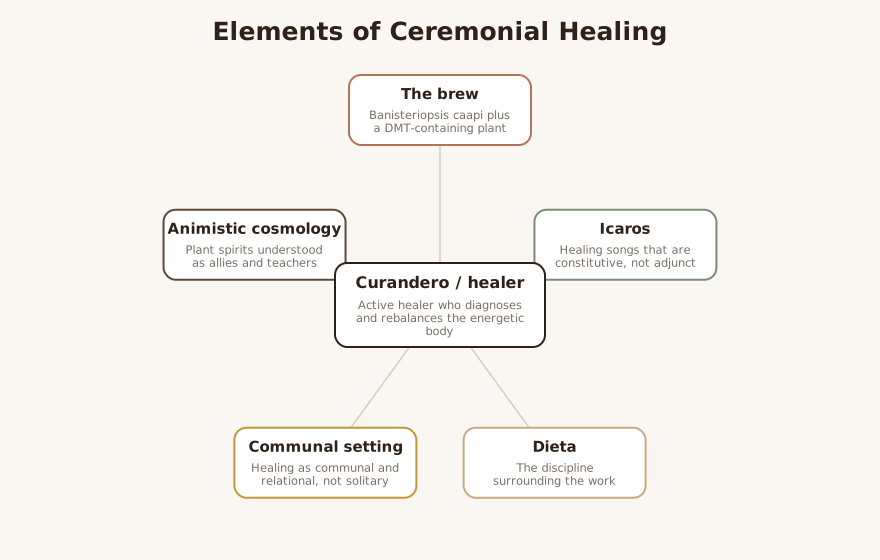
Ayahuasca ceremonial healing is a traditional Amazonian ethnomedical practice, studied primarily through the lenses of medical anthropology and the anthropology of psychedelics rather than as a Western psychotherapy LLM. The brew combines the Banisteriopsis caapi vine, which supplies monoamine oxidase inhibitors (MAOIs), with a DMT-containing plant such as Psychotria viridis or Diplopterys cabrerana; the MAOIs render the orally inactive DMT psychoactive 5. Within this tradition the brew is regarded not as a drug in the pharmacological sense but as a healing “technology” — the keystone of an entire system of diagnosis and treatment 6.
For practicing clinicians, the most useful framing is that this is a body of knowledge about a practice your patients may have undertaken or be considering, not a modality you would deliver LLM. Ayahuasca is a Schedule I substance in the United States, legal only under narrow religious exemptions, so the clinical relevance is in integration, harm reduction, and cultural understanding LLM. Approaching it this way keeps the clinician honest about both the depth of the tradition and the limits of the evidence LLM.
Creators & Lineage
There is no founder; the practice is a living indigenous tradition with many regional expressions LLM. Distinct Amazonian peoples — Shipibo-Conibo, Shuar, Siona, and Tukano among them — maintain their own ceremonial protocols, with the Shipibo-Conibo of Peru especially known for the use of icaros (sacred songs) to guide participants and direct medicinal energy through the ceremonial space 5. Alongside indigenous lineages sit mestizo vegetalismo, a syncretic stream blending indigenous practice with Western esoteric influences 5.
In twentieth-century Brazil the tradition gave rise to syncretic ayahuasca religions — Santo Daime, Barquinha, and the União do Vegetal (UDV) — which fused Amazonian plant use with Christian and spiritualist frameworks and have since expanded globally 3. Scholarly mapping of these movements, notably the bibliographic and critical work of Labate, dos Santos, and Santana de Rose, deliberately centers non-North-American/European perspectives and examines both the anthropological literature and the biomedical research conducted within these contexts 3. The intellectual lineage relevant to a Western clinician therefore runs through shamanism and animism, ethnopharmacology, and medical anthropology rather than through any clinical psychology tradition LLM.
Core Principles
The cosmology is animistic: plant spirits are understood as allies and teachers, and the healer works within a worldview of “many kingdoms” that facilitate healing for those ready to receive it 6. Illness, in the Shipibo frame, is frequently understood as a disturbance of the energetic body — physical or mental ailments arising from a “chaotic energy body” — which the healer perceives and rebalances 6. This is a fundamentally different etiological model from the biomedical one, and the authors of the principal observational study acknowledge that traditional intervention may exceed Western materialist frameworks 1.
Healing is communal and relational, not solitary LLM. The curandero, maestro/maestra, or vegetalista functions less as a passive guide and more as an active healer who diagnoses and treats — in the participants’ own attribution of benefit, the healers’ work was credited alongside the medicine itself 1. Set, setting, the discipline of dieta, and the song-work of icaros are not adjuncts but constitutive elements of the treatment 16.
Interventions & Techniques
Icaros (healing songs). Sung or whistled by the healer, sometimes accompanied by a chakapa (a rattle of bundled leaves), icaros are used to create a protective space, to diagnose energetic blockages, and to cleanse “dense energies” linked to trauma and unconscious patterns 14. The word derives from the Quechua ikaray, “to blow smoke in order to heal” 4. The Shipibo term for their songs is rao bewá, and analogous traditions exist across Amazonian cultures under names such as eshuva, meye, and mariri 4. Mastery may involve knowing hundreds of songs and takes years to acquire 4.
Dieta. A regimen of dietary and energetic restriction, sometimes with supplementary steam or flower baths, used both to prepare and cleanse participants and, for healers, to establish connection with plant spirits 16. Becoming an Onanya (healer) requires completing many dietas over multiple years, through which the practitioner is believed to receive lifelong protection, guidance, and healing 6. Icaros themselves are believed to be learned in part through dieta, as plant spirits “teach” them directly 4.
Mapacho (ceremonial tobacco). Applied within ceremony to transmit icaros and maintain energetic protections 1.
The purge. Vomiting, sweating, crying, and shaking are not side effects but understood as core healing work, both physical and emotional 5.
Ceremonial progression. In the retreat context studied, a sequence of ceremonies followed a coherent arc — a diagnostic session, cleansing and clearing phases, and a culminating “sealing” ceremony — with integration sessions allowing collective meaning-making afterward 1.
Evidence Base
The tradition is well established by centuries of continuous indigenous use; the clinical efficacy is not LLM. These must be kept distinct. The principal empirical study available — Gonzalez et al.’s observational study of 200 Western participants at a Shipibo-led Peruvian retreat — reported statistically significant improvements across psychological well-being, subjective happiness, spiritual well-being, quality of life, and decentering, with large effect sizes (e.g., psychological well-being d = 0.82–1.12) that remained stable at 12 months; 93.5% reported persistent benefits at one year and only 2.5% reported adverse effects at the first follow-up 1.
Those numbers should be read with restraint. The study was uncontrolled and observational, with no placebo group, so the effects of ayahuasca cannot be separated from the healers’ intervention, ceremony, expectancy, or the passage of time 1. The sample was self-selected, affluent, overwhelmingly Caucasian and college-educated, and motivated by spiritual growth — not a clinical population presenting with diagnosed disorders 1. Attrition was high (roughly 50% lost at follow-ups), and all outcomes were self-reported 1. The authors themselves frame the work as descriptive 1. Read honestly, this is hypothesis-generating evidence about well-being in retreat-goers, not efficacy-grade evidence for treating any specific disorder LLM. The broader biomedical literature on ayahuasca religions has likewise been catalogued with explicit attention to its limitations 3.
Populations & Indications
Within the tradition itself the practice serves indigenous Amazonian communities as everyday medicine and spiritual infrastructure 56. The populations a Western clinician will actually encounter are different: adults with treatment-resistant depression, people with substance use disorders, trauma survivors, individuals seeking spiritual healing, and participants in psychedelic retreats who arrive in your office before or after a ceremony LLM. The documented retreat population skews toward those seeking spiritual growth and personal development rather than symptom relief 1.
The honest clinical “indication” here is not for the brew but for the clinical relationship: these are patients who deserve non-judgmental assessment, preparation if they are determined to go, and skilled integration afterward LLM. Suggested benefit signals — improvements in decentering and well-being — are intriguing but unproven as treatments 1.
Problems-for-Work
The problems most often brought to ceremony, and most relevant to integration work, include major depressive disorder, substance use disorders, PTSD, anxiety, grief, existential distress, demoralization, and trauma-related symptoms LLM. The observational data speak to general well-being and decentering rather than to any of these diagnoses specifically 1.
LLM-generated illustrative example (not a guideline): A 38-year-old with chronic demoralization after years of partial response to antidepressants returns from a retreat describing a vivid sense of “seeing her grief from the outside.” Rather than validating or pathologizing the experience, the clinician treats the reported decentering as material for narrative and meaning work, while screening for destabilization and reviewing what she took — including her SSRI — before, during, and after the ceremony LLM.
LLM-generated illustrative example (not a guideline): A client in early recovery from alcohol use disorder is considering a ceremony for its reputed “reset.” The clinician neither endorses nor forbids, but maps the harm-reduction terrain: legality, the MAOI interaction with his current medication, the unregulated nature of retreat settings, and a relapse-prevention plan for the disorienting weeks afterward LLM.
Contraindications, Cautions & Cultural Humility
The most concrete clinician-facing safety issue is pharmacological. Because B. caapi supplies MAOIs 5, combining ayahuasca with serotonergic antidepressants (SSRIs, SNRIs) or other serotonergic agents carries a real risk of serotonin syndrome and other interactions — directly relevant to the antidepressant-treated patients therapists routinely see LLM. Patients on these medications who are determined to attend should be counseled toward a properly supervised medical taper rather than improvised discontinuation, which carries its own risks LLM.
Beyond pharmacology: the intense, destabilizing nature of the experience and the purge make psychotic-spectrum illness, bipolar disorder, and acute suicidality areas of serious concern, and the unregulated commercial retreat market means quality of supervision varies enormously LLM. Adverse psychological reactions, while reported as infrequent in the retreat sample studied, are real and may surface in integration 1.
Cultural humility is not optional here. This is a sacred indigenous practice, and the literature explicitly warns against colonial-era exploitation patterns and urges respect for the wisdom of the originating peoples 5. Clinicians should resist extracting techniques (icaros, dieta) from their cosmological context, avoid positioning themselves as practitioners of a tradition they have not been initiated into, and center the indigenous communities from whom this knowledge comes 5LLM.
Treatment-Plan Suggestions & SMART Objectives
The following are framed for integration and harm-reduction work conducted within standard psychotherapy — not for administering ayahuasca, which is neither legal nor a billable therapy in the US LLM.
| Goal | SMART objective (example) | Mechanism |
|---|---|---|
| Reduce decision-related distress (pre-ceremony) | Within 3 sessions, client will articulate their motivations, fears, and at least 2 harm-reduction steps for a planned ceremony | Informed deliberation; values clarification LLM |
| Mitigate medication interaction risk | Before any planned use, client will consult prescriber re: MAOI interaction and document a supervised plan | Reduces serotonin-syndrome risk from B. caapi MAOIs 5LLM |
| Strengthen psychological stability | Over 4 weeks, client will practice 1 grounding skill daily and rate distress weekly | Affect regulation buffers a destabilizing experience LLM |
| Integrate ceremonial material | Within 6 sessions post-ceremony, client will translate 2 key insights into concrete behavioral commitments | Decentering and meaning-making consolidated into action 1LLM |
| Process trauma content surfaced | Client will use a trauma-informed protocol to process 1 surfaced memory without dissociating, in 8 sessions | Structured exposure/processing in a safe frame LLM |
| Prevent relapse (SUD context) | Client will maintain a written relapse-prevention plan and report adherence weekly for 8 weeks | Continuity of care across the vulnerable post-ceremony window LLM |
| Address existential/grief distress | Over 6 sessions, client will construct a coherent narrative linking the experience to their loss/meaning | Narrative reconstruction reduces demoralization LLM |
Common Misconceptions
“Ayahuasca is a proven treatment for depression/PTSD.” The available data are observational, uncontrolled, and drawn from spiritually-motivated retreat-goers, not diagnosed clinical samples 1. “It’s just the DMT.” The tradition treats the brew, icaros, dieta, the healer’s diagnosis, and the communal frame as one inseparable system, and the strongest study cannot separate pharmacology from these contextual factors 16. “Purging is a side effect to be minimized.” In the tradition, the purge is understood as core healing work 5. “Icaros are background music.” They are functional therapeutic acts — protective, diagnostic, and cleansing — sung by a trained healer 14. “Anyone can run a ceremony after a workshop.” Becoming an Onanya requires years of dieta and apprenticeship 6.
Training & Certification
There is no Western certification that confers the authority of a traditional healer; that role is earned through years of dieta and lineage transmission, not coursework 46. For clinicians, the appropriate training pathway is in psychedelic integration and harm reduction within one’s existing scope of practice, not in administering the medicine LLM. Clinicians seeking to understand the tradition responsibly should ground themselves in the anthropological literature — the Labate, dos Santos, and Santana de Rose bibliography is a starting point that deliberately centers non-Western scholarship 3.
Key Terms
- Ayahuasca — Amazonian brew of B. caapi (MAOIs) plus a DMT-containing plant 5.
- Icaro — Healing song sung/whistled by the healer; “to blow smoke in order to heal” 4.
- Dieta — Dietary and energetic restriction for preparation and plant-spirit connection 6.
- Curandero / Maestro / Onanya — Trained traditional healer 46.
- Chakapa — Leaf-bundle rattle used during icaros 4.
- Mapacho — Ceremonial tobacco used to transmit icaros and maintain protections 1.
- Vegetalismo — Mestizo syncretic stream of plant healing 5.
Resources & Further Reading
▶ Watch — a video introduction to this concept:
- The Shipibo Ceremonial Use of Ayahuasca to Promote Well-Being (Gonzalez et al., 2021)
- Experiences of Listening to Icaros during Ayahuasca Ceremonies at Centro Takiwasi (Graham, 2023)
- Ayahuasca Religions: A Comprehensive Bibliography & Critical Essays (Labate, dos Santos & Santana de Rose, MAPS)
- Icaro (Wikipedia)
- Ayahuasca Ceremonies: Traditions, Origins, and Variations (Psychedelic Support)
- Shipibo Tradition and Technology (La Medicina)
Reflective / Supervision Questions
- Am I clear in my own mind about the difference between an established tradition and established clinical efficacy, and does my language with the patient reflect that distinction? LLM
- Have I screened for the concrete safety issues — MAOI-serotonergic interactions, psychotic/bipolar vulnerability, suicidality — before the patient’s decision rather than after? LLM
- Am I extracting techniques or imagery from a sacred indigenous context in a way that erases the originating communities? 5LLM
- Where are my own beliefs (skeptical or enthusiastic) about psychedelics shaping how I receive this patient’s account? LLM
- Am I billing and documenting honestly for the integration psychotherapy I actually provide, rather than for the ceremony itself? LLM