
Type & Discipline
Ayahuasca-assisted therapy is a psychedelic-assisted treatment modality sitting at the intersection of ethnopharmacology and psychiatry LLM. The active intervention is a plant decoction traditionally brewed in the Amazon basin that combines Banisteriopsis caapi (a source of beta-carboline MAO inhibitors such as harmine, harmaline, and tetrahydroharmine) with a DMT-containing plant such as Psychotria viridis 3. Pharmacologically, the orally inactive psychedelic N,N-dimethyltryptamine (DMT) becomes bioavailable only because the reversible monoamine oxidase inhibitors in the brew prevent its breakdown in the gut 5. As a clinical modality it is best understood as one member of the broader psychedelic-assisted psychotherapy family, alongside psilocybin- and MDMA-assisted protocols, in which a pharmacological catalyst is paired with structured psychological support LLM.
The brew is chemically heterogeneous, and in the leading clinical trial the dose was standardized to deliver 0.36 mg/kg of N,N-DMT in a single 1 mL/kg serving, with measured concentrations of harmine, harmaline, and tetrahydroharmine in the preparation 3. This dual DMT-plus-MAOI architecture distinguishes ayahuasca from other classic serotonergic psychedelics and underlies both its longer development as an oral medicine and its characteristic gastrointestinal effects 5.
Creators & Lineage
Ayahuasca has no single creator; it originates in centuries-old Amazonian and syncretic religious traditions of plant-medicine ceremonial healing, and contemporary clinical research is an attempt to study that practice under controlled conditions rather than to invent a new technique LLM. The most influential modern clinical work comes from the Brazilian research group at the Federal University of Rio Grande do Norte and Onofre Lopes University Hospital in Natal, where Fernanda Palhano-Fontes, Draulio Barros de Araujo, and colleagues conducted the first randomized, placebo-controlled trial of ayahuasca for depression 16. That study is the anchor of the modality’s clinical lineage LLM.
The lineage continues toward standardization. Recognizing that traditional brews carry variable alkaloid ratios, unpredictable bioavailability, prominent nausea and vomiting, and cultural-appropriation concerns, investigators have begun testing ayahuasca-inspired formulations that combine pharmaceutical-grade harmine with controlled DMT dosing to improve precision and tolerability 5. This positions ayahuasca-assisted therapy within the same translational arc as psilocybin and MDMA therapy: from ceremonial use, to naturalistic observation, to controlled trials, toward standardized clinical products LLM.
Core Principles
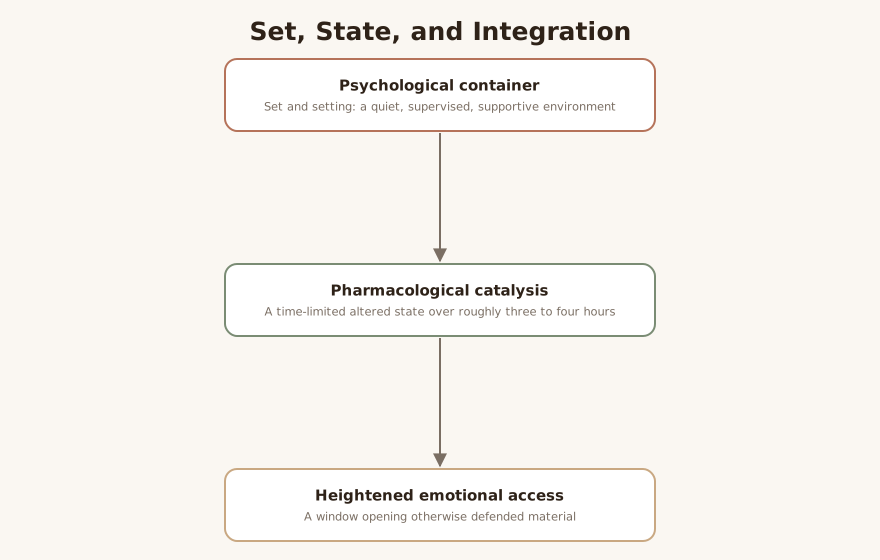
The first principle is that the molecule alone is not the treatment; the pharmacology is delivered inside a deliberately constructed psychological and physical container often summarized as “set and setting” LLM. In the controlled trial, ayahuasca was administered in a quiet, supervised hospital setting with supportive staff present throughout the session 3. Investigators explicitly attributed part of the unusually high placebo response to this supportive environment, which underscores how much the surrounding context shapes outcome 3.
A second principle is acute pharmacological catalysis of a time-limited altered state. With the DMT-plus-MAOI combination, subjective effects build, peak, and resolve over roughly three to four hours, shorter than many classic psychedelics, producing a window of heightened emotional access 5. Reported experiential features in formulation work include psychological insight and “emotional breakthrough” experiences, with one participant describing the ability to “dive into worlds” with eyes closed yet return to the present on opening them 5. The clinical wager is that this state opens material that ordinary defended consciousness keeps out of reach LLM.
A third principle is rapidity. Unlike conventional antidepressants that take weeks, the antidepressant signal in the trial was already present at day one and, notably, grew rather than faded by day seven 3. This delayed-peak trajectory differs from ketamine, where effects tend to be largest early and then wane, and it implies a mechanism extending beyond the acute drug experience itself 3.
Interventions & Techniques
In a clinical-trial framework the intervention is a single supervised dosing session preceded by screening and preparation and followed by integration contact LLM. In the Natal trial, ayahuasca-naive, treatment-resistant patients received one dose in an inpatient or closely supervised setting, with different psychiatrists handling dosing versus follow-up assessment to protect blinding 1. Outcome was tracked with the Montgomery-Asberg Depression Rating Scale (MADRS) and the Hamilton Depression Rating Scale at baseline and days one, two, and seven 3.
Supportive presence during the acute experience is itself a technique: trained staff remained available throughout the session to provide reassurance and safety 3. In standardized-formulation research, the technique extends to titration, with incremental dosing (for example, ten 10 mg intranasal DMT increments over 150 minutes following buccal harmine) used to shape the intensity and duration of the experience and to keep anxiety low 5.
LLM-generated illustrative example (not a guideline): A trial participant with long-standing treatment-resistant depression meets with the team for preparation, sets an intention around chronic self-criticism, receives a single supervised dose with a staff member present, and over the following week works with a therapist to make sense of an emotionally vivid sense of self-forgiveness that surfaced during the session LLM.
Evidence Base
The honest summary is that the evidence base is emerging and immature 4. The strongest single piece of evidence is one double-blind, randomized, placebo-controlled trial in which 29 patients with treatment-resistant depression completed the protocol, 14 receiving ayahuasca and 15 receiving a taste- and color-matched placebo of water, yeast, citric acid, zinc sulfate, and caramel colorant 13. MADRS response rates at day seven were 64% for ayahuasca versus 27% for placebo, a significant difference, with between-group effect sizes (Cohen’s d) of roughly 0.84 at days one and two and 1.49 at day seven 3. HAM-D remission at day seven reached 43% with ayahuasca versus 13% with placebo, a difference at the level of a trend 3.
These numbers are encouraging but must be read against the trial’s own stated limitations: a modest sample, a single dose, a population narrowed to long-duration treatment-resistant illness, and an unusually high placebo response attributed in part to the supportive setting and participant characteristics 3. Blinding is intrinsically difficult in psychedelic trials because the acute effects are obvious to participants, a problem the authors acknowledge 3. Much of the wider literature on ayahuasca and mental health remains observational or uncontrolled, and current reviews frame the field as promising but in need of larger rigorous trials 4. Controlled formulation work to date has been conducted in healthy volunteers rather than patients, so it speaks to pharmacology and tolerability rather than clinical efficacy 5.
Populations & Indications
The population with the best controlled data is adults with treatment-resistant depression, defined in the anchor trial as inadequate response to at least two antidepressants from different classes 3. Beyond that, current reviews discuss ayahuasca and DMT in the context of broader mental-health applications, reflecting research and naturalistic interest in mood disorders, substance use disorders, anxiety, and trauma-related presentations 4. Participants in formal clinical psychedelic trials constitute another defined population, typically screened, prepared, and supervised under research conditions 15.
Other groups frequently discussed for psychedelic-assisted approaches generally, including trauma survivors and people facing end-of-life distress, grief, or demoralization, remain largely aspirational for ayahuasca specifically given the lack of controlled trials in those populations LLM. Indications should therefore be stated cautiously: outside of research, ayahuasca-assisted therapy is not an established standard-of-care treatment for any of these conditions 4.
Problems-for-Work
Treatment-resistant and major depression. This is the problem with the most direct controlled support, where a single supervised dose produced a rapid, growing antidepressant signal over one week 3.
LLM-generated illustrative example (not a guideline): A clinician supporting a research participant frames between-session work around translating an intense session insight (“I am not the failure I narrate”) into concrete behavioral experiments over the following week LLM.
Substance use disorders. Anti-addictive potential is part of the rationale reviewed in the current literature, drawing on naturalistic and ceremonial reports rather than controlled trials 4.
PTSD and trauma-related symptoms. Trauma processing is a hoped-for application across the psychedelic field, but for ayahuasca specifically it remains an area of interest rather than established efficacy 4LLM.
End-of-life distress, grief, and demoralization. These existential targets are commonly raised for psychedelic therapy broadly; for ayahuasca they are extrapolations awaiting direct study LLM.
Contraindications, Cautions & Cultural Humility
The most clinically urgent caution is pharmacological: ayahuasca contains MAO inhibitors, and combining MAOIs with serotonergic agents such as SSRIs, SNRIs, or other serotonergic drugs raises the risk of serotonin toxicity 4LLM. Because the modality is studied in serotonergic depression, this drug-interaction risk is not theoretical and demands careful medication review and washout in any responsible protocol LLM. Cardiovascular and psychiatric screening (for example, personal or family history of psychosis or bipolar disorder) are standard exclusions in psychedelic research and apply here as well 4LLM.
Acute adverse effects are common even when not dangerous: in the trial, nausea (71%), vomiting (57%), restlessness, transient anxiety, and headache occurred, though no serious adverse events were reported 3. The standardized-formulation effort is partly motivated by reducing this gastrointestinal burden and by controlling unpredictable potency 5.
Cultural humility is essential and concrete. Ayahuasca is a sacred Indigenous medicine, and its Western commercialization raises real harms: a documentary-linked account describes fraudulent practitioners (“maniacs disguised as shamans”), warns that “it’s not all love and light,” and notes that surging demand threatens both plant sustainability and Indigenous communities’ traditional access 7. Clinicians should treat the tradition with respect, avoid appropriative framing, and recognize that unregulated retreat settings carry genuine safety hazards for vulnerable people 7.
Treatment-Plan Suggestions & SMART Objectives
| Goal | SMART objective (example) | Mechanism |
|---|---|---|
| Reduce depressive symptom severity | Within a structured research protocol, patient’s MADRS score decreases by a clinically meaningful margin by day 7 post-session, tracked by standardized rating | Acute serotonergic/sigma-1 catalysis plus supportive set and setting 3 |
| Stabilize medication safety | Before any session, complete a documented medication review and clinician-supervised serotonergic washout to mitigate MAOI interaction risk within 2 weeks | Avoidance of serotonin toxicity from MAOI-plus-SSRI combination 4 |
| Strengthen preparation and intention | Patient articulates and records a personal session intention across 2 preparation sessions before dosing | Set/setting optimization shown to shape outcome 3 |
| Improve emotional processing | In 3 integration sessions over 2 weeks, patient names and reframes at least one core self-narrative surfaced in session | Heightened emotional access and “breakthrough” experiences 5 |
| Manage acute tolerability | During the supervised session, anticipate and manage nausea/anxiety so the patient completes the session with staff support | Known transient adverse-effect profile; supportive presence 3 |
| Reduce relapse vulnerability | Over 4 weeks, patient maintains a behavioral-activation plan with weekly check-ins to extend acute gains | Translation of acute state into sustained behavior change LLM |
| Build informed consent and risk literacy | Before enrollment, patient demonstrates understanding of risks, the experimental status, and the difference from unregulated retreats | Cultural humility and harm reduction 7 |
Common Misconceptions
A frequent misconception is that the strong day-seven trial result proves ayahuasca is an effective depression treatment; in fact it is a single small trial with a high placebo response and acknowledged blinding limitations, and the field overall remains emerging 34. Another is that ceremonial and clinical use are interchangeable; the controlled trial relied on hospital supervision, screening, and standardized dosing, conditions absent from many retreat settings 17.
People also assume the brew is uniformly safe because it is “natural,” yet it commonly produces vomiting and nausea and carries serious interaction risk with serotonergic medications 34. Finally, some expect the experience to be reliably blissful; firsthand accounts emphasize that “it’s not all love and light” and that risks include exploitation by unqualified facilitators 7.
Training & Certification
There is no widely recognized, standardized credential for ayahuasca-assisted therapy in mainstream clinical settings, reflecting its experimental and largely non-sanctioned status LLM. Formal exposure currently comes through participation in regulated clinical research, such as the registered trials investigating antidepressant effects in treatment-resistant depression 6. Clinicians interested in the broader psychedelic-therapy skill set typically pursue training developed for psilocybin- and MDMA-assisted protocols, which share core competencies in preparation, in-session support, and integration LLM.
Given the cultural origins of the medicine, responsible training also entails engagement with Indigenous knowledge and ethics rather than purely biomedical instruction, and an awareness of the harms of commercialization documented in popular accounts 7LLM.
Key Terms
- DMT (N,N-dimethyltryptamine): the orally inactive serotonergic psychedelic that becomes bioavailable when protected by MAO inhibition 5.
- MAOI / beta-carbolines (harmine, harmaline, tetrahydroharmine): reversible monoamine oxidase inhibitors from B. caapi that enable oral DMT activity 35.
- Set and setting: the mindset and physical/social environment surrounding a session, shown to influence outcome and placebo response 3.
- MADRS / HAM-D: standardized clinician-rated depression scales used as primary outcomes in the anchor trial 3.
- Integration: the post-session psychological work of translating experiential insight into durable change LLM.
- Emotional breakthrough: an acute experiential quality of accessing and resolving emotional material reported under DMT-plus-harmine 5.
Resources & Further Reading
▶ Watch — a video introduction to this concept:
- Palhano-Fontes et al. 2019, Psychological Medicine — Rapid antidepressant effects of ayahuasca in treatment-resistant depression
- PubMed record (PMID 29903051)
- Full text on PubMed Central (PMC6378413)
- Ayahuasca, DMT, and Mental Health: A Current Review of Scientific Studies (Current Addiction Reports)
- Ayahuasca-inspired N,N-DMT and harmine formulation: a controlled trial in healthy subjects (Frontiers in Psychiatry)
- ClinicalTrials.gov NCT02914769
- The Quest to Cure One Man’s Depression with Ayahuasca (VICE)
Reflective / Supervision Questions
- How do I distinguish, for a given patient, between evidence-supported indications and aspirational ones I may be tempted to over-promise LLM?
- What is my concrete protocol for screening serotonergic medications and other interaction risks before any referral or discussion 4?
- How do I hold cultural humility toward an Indigenous sacred medicine while practicing within a biomedical frame 7?
- When a patient reports a transformative retreat experience, how do I support integration without endorsing unregulated or unsafe practice 7LLM?
- How do I communicate the genuinely emerging, single-small-trial status of the depression evidence without either dismissing or hyping it 34?
- Where are the boundaries of my competence, and at what point should I refer to or coordinate with a research or medical team LLM?