
Type & Discipline
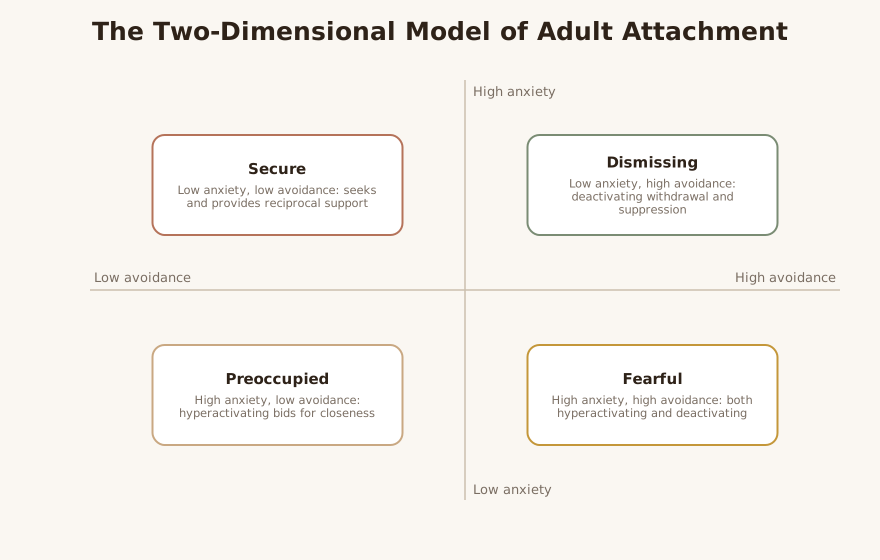
Attachment anxiety and avoidance are not a treatment; they are a measurement and case-formulation construct drawn from social and personality psychology’s account of adult attachment 1. The model holds that individual differences in how adults experience close relationships are best described by two continuous dimensions rather than by a small set of discrete categories 1. Attachment-related anxiety captures the degree to which a person worries whether a partner is available, responsive, and attentive, and fears abandonment or rejection 1. Attachment-related avoidance captures discomfort with closeness and dependence, and a preference for emotional distance and self-reliance 1.
For clinicians, the practical value is dimensional formulation: instead of labeling a client “anxious” or “avoidant,” you locate them on two axes, recognizing that “attachment styles are things that vary in degree rather than kind” 1. A person can be high on both, high on one, or low on both; a secure adult scores low on both dimensions 1. This construct organizes how a client regulates closeness and distress, and it then informs work delivered inside established modalities — it is a lens, not a billable therapy in itself LLM.
Creators & Lineage
The construct sits within Bowlby and Ainsworth’s attachment theory, extended into adulthood by social and personality psychologists who studied romantic bonds 1. The decisive empirical move came from Kelly Brennan, Catherine Clark, and Phillip Shaver, whose 1998 integrative overview factor-analyzed the pool of existing adult-attachment self-report items and showed that two underlying dimensions — anxiety and avoidance — accounted for them 2. That analysis produced the Experiences in Close Relationships (ECR) questionnaire, which became the field’s most widely used adult-attachment self-report instrument 1.
R. Chris Fraley, Niels Waller, and Kelly Brennan subsequently refined the instrument using Item Response Theory, selecting 18 anxiety and 18 avoidance items (36 total) from the existing pool to create the ECR-R 3. Phillip Shaver’s continued program of work — including the UC Davis Adult Attachment Lab he directs — has applied Bowlby’s framework to the conscious and unconscious dynamics of the attachment system and its links to self-esteem, personality, compassion, and related outcomes 7. The lineage connects upstream to object relations theory’s emphasis on internalized relational templates and downstream to clinical applications such as Emotionally Focused Therapy, which treats attachment needs and fears as the organizing target of couple work LLM.
Core Principles
First, attachment is dimensional, not typological. The categorical “styles” clinicians often use (secure, preoccupied, dismissing, fearful) are convenient summaries of regions in a two-dimensional space, but the underlying reality is continuous variation in degree 1. Treating the dimensions as primary avoids the false precision of sorting clients into boxes LLM.
Second, the two dimensions map onto distinct regulatory strategies. High anxiety is associated with hyperactivating strategies — escalating bids for closeness, reassurance-seeking, and vigilance to threat — while high avoidance is associated with deactivating strategies such as withdrawal, suppression, and minimizing the importance of the relationship 5. These are described as different solutions to the same underlying problem of regulating distress within a relationship 5.
Third, security is a low-low profile. Secure adults tend to seek support when distressed, provide reciprocal support, and report greater satisfaction, trust, and commitment 1. Security operates through the classic attachment functions: a partner serving as a safe haven in distress and a secure base for exploration LLM.
Fourth, the dimensions are domain-specific and only modestly stable. The ECR and ECR-R were built to assess attachment in romantic relationships specifically, not a single global trait 13. Correlations between parent-directed and partner-directed security are modest (roughly .20–.50), and one longitudinal study linked childhood attachment to adult romantic security at only .17 — so long-term stability remains genuinely uncertain 1. Clinically, this is good news: a client’s position is changeable, which is consistent with clinical observation that attachment patterns can shift with new relational experience and therapy 6.
Interventions & Techniques
This construct does not prescribe a fixed protocol; it shapes how you assess and where you aim interventions you already deliver LLM. Core uses include:
- Dimensional assessment. Administer the ECR or ECR-R, scoring two continuous averages (1–7) for anxiety and avoidance after reverse-coding the designated items 3. Lower scores indicate greater security 3. Use the scores to anchor a shared formulation rather than to issue a label LLM.
- Formulation of the regulatory cycle. Identify whether the client tends toward hyperactivation (protest, pursuit, reassurance-seeking) or deactivation (withdrawal, suppression), and how these interlock with a partner’s strategy in the classic pursue–withdraw cycle 5LLM.
- Targeting the underlying strategy. For high anxiety, work shifts toward tolerating uncertainty and self-soothing so that bids for reassurance become less escalating; for high avoidance, toward approaching rather than suppressing emotion and tolerating dependence 5LLM.
- Emotion-regulation skill work. Because avoidance is linked to difficulty downregulating emotion through cognitive reappraisal, skill-building can be tailored to the client’s profile rather than applied generically 4LLM.
These techniques are delivered inside recognized modalities — individual attachment-informed psychotherapy or couple therapy such as EFT — not as a separate intervention LLM.
Evidence Base
The construct’s maturity is best described as established for its psychometrics and predictive validity, and more provisional for downstream mechanisms LLM. The two-dimensional structure is robust and reproducible: it emerged from a large integrative factor analysis of the existing item pool 2, and the resulting scales show strong internal consistency, typically exceeding .90 for both anxiety and avoidance 3. The dimensions predict meaningful relationship outcomes; secure (low-low) adults reliably show better support-seeking, support-giving, satisfaction, longevity, trust, and commitment 1.
Three honest qualifiers belong in any clinical use. First, the ECR and ECR-R are, in Fraley’s own words, “for all practical purposes, identical measures of attachment,” so the IRT revision buys precision rather than a different construct 3. Second, measurement precision is uneven across the spectrum — reliability may be lower at the secure end, meaning the instruments discriminate among insecure individuals better than among secure ones 3. Third, temporal stability is modest, with cross-relationship and longitudinal correlations ranging from about .17 to .50 1.
Evidence on attachment-specific emotion-regulation mechanisms is suggestive rather than settled. A 2023 pilot study of 44 Chilean adults found that higher attachment avoidance was associated with greater emotional intensity (poorer downregulation) when participants used cognitive reappraisal, and no significant link between avoidance and the subjective effectiveness of expressive suppression 4. This is a small, single-sample finding and should be held as a hypothesis to test with a given client, not a law 4LLM.
Populations & Indications
The construct was developed for and validated primarily in adults, couples, and romantic partners, and is widely applied with young adults 13. It is indicated whenever the presenting difficulty is relational in nature or maintained by relational strategies — for example, recurring relationship conflict, fear of abandonment, intimacy avoidance, jealousy, loneliness, or patterns clients describe as codependency 56LLM. In clinical populations, attachment formulation often clarifies how distress is regulated within relationships even when the primary diagnosis is mood- or anxiety-related LLM.
Insecurity on either dimension is common rather than pathological; in the general population, attachment anxiety scores tend to run higher than avoidance scores 4. The dimensions are therefore best used to understand maintenance and to tailor treatment, not as a diagnosis in their own right LLM.
Problems-for-Work
The dimensional model gives you specific, formulation-driven targets:
- Fear of abandonment / reassurance-seeking. High-anxiety clients worry about partner availability and seek closeness and validation intensely 15. Work targets the hyperactivating loop, building distress tolerance so reassurance-seeking de-escalates 5LLM.
- Intimacy avoidance / withdrawal. High-avoidance clients fear dependence itself and preemptively distance, preferring lighthearted over emotionally deep contact 5. Work targets approach to emotion and graded tolerance of closeness 5LLM.
- Relationship conflict (pursue–withdraw). When one partner hyperactivates and the other deactivates, conflict cycles self-perpetuate; naming each partner’s strategy interrupts the cycle 5LLM.
- Emotional dysregulation. Tailor regulation work to profile — avoidant clients may need explicit practice with reappraisal and emotion identification, given evidence they struggle to downregulate through reappraisal alone 4LLM.
- Jealousy and loneliness. High anxiety amplifies threat-monitoring and interpretation of distance as rejection, which can be addressed through cognitive and exposure-style work on uncertainty 5LLM.
LLM-generated illustrative example (not a guideline): A client with high anxiety and low avoidance texts a new partner repeatedly when replies are delayed, then feels ashamed. Naming this as a hyperactivating bid for a “safe haven” reframes it from a character flaw to a regulatable strategy, and the work becomes tolerating the gap before the reassurance arrives. LLM
Contraindications, Cautions & Cultural Humility
There are no contraindications to thinking dimensionally, but there are clear cautions in how scores are used LLM. Do not treat an ECR/ECR-R profile as a fixed identity or a diagnosis; given modest stability and uneven precision, a single administration is a snapshot, not a verdict 13LLM. Avoid the popular tendency to collapse the dimensions back into rigid “attachment style” labels, which can pathologize clients and obscure within-person variation across relationships 1LLM.
Cultural humility is essential. The ECR/ECR-R were developed and validated largely in Western, English-speaking, predominantly student and romantic-relationship samples, so norms and even the meaning of items may not transfer cleanly across cultures, languages, or relationship structures LLM. The one cross-cultural emotion-regulation study cited here was a small Chilean pilot, underscoring how thin the non-WEIRD evidence base remains 4LLM. Self-reliance and emotional restraint that score as “avoidant” may reflect adaptive cultural norms rather than insecurity, and intense interdependence may reflect collectivist values rather than “anxiety” — interpret scores against the client’s relational context, not against a Western template LLM.
Treatment-Plan Suggestions & SMART Objectives
| Goal | SMART objective (example) | Mechanism |
|---|---|---|
| Build shared attachment formulation | Within 3 sessions, client completes the ECR-R and collaboratively maps their anxiety/avoidance profile to one recurring relational cycle | Dimensional self-report scored on two continuous axes 3 |
| Reduce hyperactivating reassurance-seeking | Over 8 weeks, client reduces escalating reassurance bids from daily to ≤2/week, logged in a tracker | Targets the hyperactivating strategy linked to high anxiety 5 |
| Increase approach to emotion (high avoidance) | Within 6 sessions, client names and stays with one difficult emotion for 60 seconds in session, 3 of 4 weeks | Counters deactivation and emotion-suppression tendencies 5 |
| Improve emotion downregulation | Over 8 weeks, client applies a reappraisal skill to 3 logged situations/week with self-rated distress reduction | Addresses avoidance-linked difficulty regulating via reappraisal 4 |
| Interrupt pursue–withdraw conflict cycle | Within 10 sessions, couple identifies and pauses the cycle in real time during 2 of 3 recorded disagreements | Naming interlocking hyper/deactivating strategies 5 |
| Strengthen distress tolerance / fear of abandonment | Over 6 weeks, client tolerates a 2-hour partner-unavailability window without contact, self-rated weekly | Builds capacity to wait for the safe-haven response 1 |
| Increase secure-base behaviors | Within 8 sessions, client initiates one support-seeking and one support-giving behavior weekly | Models low-low (secure) reciprocal support patterns 1 |
Common Misconceptions
- “There are four (or three) attachment styles.” The categories are summaries of regions in a two-dimensional space; the underlying construct is continuous, so degree matters more than kind 1LLM.
- “The ECR-R is a fundamentally better test than the ECR.” Fraley’s own assessment is that the two are, for all practical purposes, identical measures; the revision improved item selection via IRT, not the construct measured 3.
- “A high-avoidance score means the client doesn’t want connection.” Avoidance reflects discomfort with dependence and a deactivating strategy, often alongside a fear that others will reject them — not an absence of attachment needs 5LLM.
- “Attachment is fixed for life.” Stability is only modest, and clinical sources affirm that attachment patterns can change with awareness, new relational experience, and therapy 16.
- “One score captures the whole person.” The measures are domain-specific to romantic relationships and discriminate less well at the secure end, so scores describe a relational tendency, not a global trait 13.
Training & Certification
There is no certification for the construct itself, because it is a measurement and formulation tool rather than a proprietary therapy LLM. The ECR and ECR-R are freely available self-report instruments with published scoring instructions — average the relevant items on a 1–7 scale, reverse-coding designated items — so any trained clinician can administer and score them 3. Competence comes from two directions: psychometric literacy (understanding dimensional scoring, the uneven reliability across the spectrum, and the romantic-domain specificity) 13, and training in the host modalities where the formulation is applied, such as attachment-based individual therapy or Emotionally Focused couple therapy, which have their own training and certification pathways LLM. Research programs such as the UC Davis Adult Attachment Lab are useful for clinicians wanting to follow the evolving science of attachment dynamics 7.
Key Terms
- Attachment anxiety — A continuous dimension reflecting worry about a partner’s availability and responsiveness and fear of abandonment 1.
- Attachment avoidance — A continuous dimension reflecting discomfort with closeness and dependence and preference for emotional distance and self-reliance 1.
- Hyperactivating strategy — Escalated bids for closeness, reassurance-seeking, and threat vigilance, associated with high anxiety 5.
- Deactivating strategy — Withdrawal, suppression, and minimizing relational importance, associated with high avoidance 5.
- ECR / ECR-R — The Experiences in Close Relationships self-report measures of the two dimensions; the ECR-R is an IRT-refined 36-item version 23.
- Secure base / safe haven — The functions a trusted figure provides — a base for exploration and a refuge in distress; characteristic of low-low (secure) adults 1LLM.
Resources & Further Reading
▶ Watch — a video introduction to this concept:
- A Brief Overview of Adult Attachment Theory and Research — R. Chris Fraley
- Brennan, Clark & Shaver (1998), Self-report measurement of adult attachment: An integrative overview
- Fraley, Waller & Brennan (2000) — ECR-R (psychometric revision via IRT)
- Emotion regulation strategies and the two-dimensional model of adult attachment — Frontiers (2023)
- Anxious vs. Avoidant Attachment — Simply Psychology
- Attachment Styles: Causes, What They Mean — Cleveland Clinic
- Adult Attachment Lab — UC Davis (Shaver et al.)
Reflective / Supervision Questions
- When I describe a client as “anxious” or “avoidant,” am I collapsing a two-dimensional, changeable profile into a fixed label — and what do I lose by doing so? LLM
- For this client, which strategy (hyperactivating or deactivating) am I most likely to misread as the “real problem,” and how does my own attachment style shape that reading? LLM
- Given modest temporal stability, how am I tracking change in the client’s relational strategies over time rather than treating one assessment as definitive? 1LLM
- Could behaviors I’m coding as “avoidant” or “anxious” reflect this client’s cultural or relational context rather than insecurity? LLM
- Am I delivering this formulation inside a coherent, documentable modality, or am I treating “attachment style” as if it were the therapy itself? LLM