
Type & Discipline
This article concerns a foundational theory within the discipline of art therapy rather than a single manualized protocol 1. Art therapy is an integrative mental health profession that uses active art-making, the creative process, and applied psychological theory within a therapeutic relationship to support functioning and well-being 1. Practitioners are typically master’s-level credentialed clinicians who blend visual-arts media with established psychotherapeutic frameworks 1.
The “Naumburg vs. Kramer” polarity names the field’s defining theoretical axis: whether the therapeutic action lies primarily in interpreting the produced image as communication (art psychotherapy) or in the act of making itself (art as therapy) 3. Both positions sit inside the broader family of art therapy theory and share a common ancestry in psychoanalysis 2. The distinction is less a rivalry than a continuum that organizes how a clinician understands what is healing in any given session 3 LLM.
Creators & Lineage
The intellectual lineage runs directly from Freudian and post-Freudian psychoanalysis into the first generation of American art therapists 2. Margaret Naumburg, often called the “mother” of American art therapy, drew on psychoanalytic theory and conceived of spontaneous artwork as a form of symbolic communication arising from the unconscious 2. Her approach, sometimes termed “dynamically oriented art therapy,” treats the image as material to be brought into dialogue and interpreted much as a dream or free association would be 2 7.
Edith Kramer represented the complementary pole 2. Working extensively with children, Kramer grounded her thinking in ego psychology and the concept of sublimation — the channeling of conflictual drives and difficult affect into socially valued creative form 2. For Kramer, the curative element was the disciplined act of making art itself, with the therapist functioning partly as an auxiliary ego who supports the creative process, rather than primarily as an interpreter of symbols 2 7.
These two figures established the conceptual scaffolding the discipline still uses 2. The shorthand contrast — Naumburg’s “art psychotherapy” and Kramer’s “art as therapy” — has become the standard way of locating any art therapy practice on the map 3 7.
Core Principles
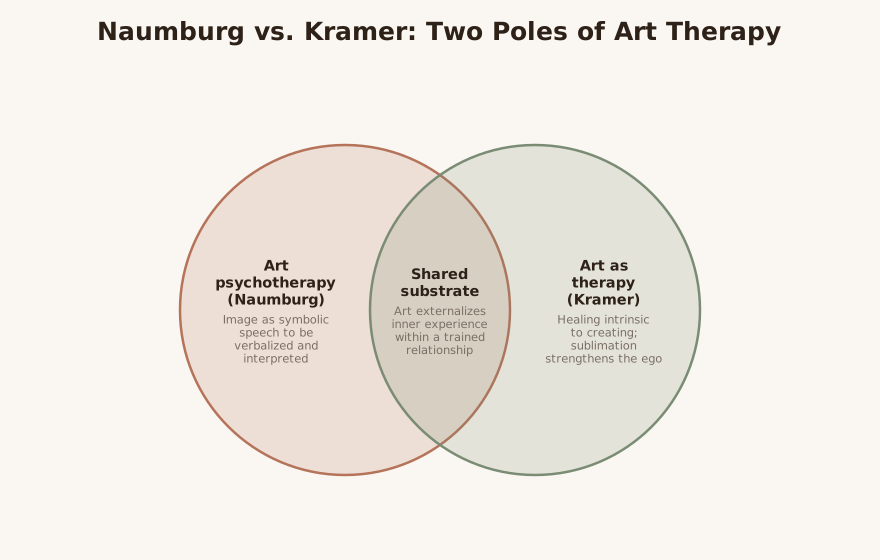
Naumburg’s pole — art psychotherapy (art in therapy). The image is treated as spontaneous symbolic speech: a route to unconscious material that may bypass verbal defenses 2 7. Verbalization and interpretation of the artwork are central, and the art serves the larger psychotherapeutic process 3. The relationship is broadly psychoanalytic, with transference and free symbolic expression as working concepts 2 7.
Kramer’s pole — art as therapy. Healing is intrinsic to the creative act 3. Through sublimation, raw drives and unmanageable feelings are transformed into ordered, aesthetically coherent objects, which itself strengthens ego functioning 2 7. Interpretation is de-emphasized; the quality and integrity of the creative experience carry the therapeutic weight 3.
The shared substrate. Both poles assume that art externalizes inner experience, that the process is meaningful in its own right, and that a trained relationship holds the work 1. In practice, most contemporary clinicians do not occupy one pole exclusively but move fluidly along the process-to-product continuum according to the client and the moment 3 LLM.
Interventions & Techniques
Art therapy interventions span a wide media range — drawing, painting, collage, clay and other sculptural work, and mixed media — selected for their psychological “fit” with the client and goal 1 4. The clinician attends to media properties: fluid materials such as wet paint can loosen affect, while resistive materials such as clay or pencil can support containment and control 4 LLM.
On the Naumburg side, techniques foreground meaning-making after the image is produced: inviting spontaneous imagery, then exploring associations, narrative, and symbolic content together 2 7. On the Kramer side, technique foregrounds the conditions of good-enough making — offering structure, scaffolding skill, and protecting the absorbed, regulating experience of creating, with less pressure to verbally decode the result 2 7.
LLM-generated illustrative example (not a guideline): A clinician working with an adolescent who shuts down verbally might offer clay (a containing, resistive medium) and simply support sustained making across several sessions — a Kramer-leaning, sublimation-oriented stance. As trust grows, the same clinician might shift toward Naumburg’s pole, asking what a recurring figure in the work represents and linking it to the teen’s family narrative. LLM
Because the field is integrative, these techniques are routinely embedded within a recognized psychotherapy frame (for example psychodynamic, cognitive-behavioral, or trauma-focused work) rather than delivered as a freestanding ritual 1 LLM.
Evidence Base
The maturity here is best described as established as theory, with a still-developing empirical base LLM. The Naumburg/Kramer distinction is firmly canonized in the field’s historiography and training literature 2 7, and art therapy is recognized as a defined mental health profession by professional bodies 1. Mechanistic and clinical research, however, lags the conceptual maturity LLM.
In trauma populations, systematic reviews report promising but methodologically limited evidence 5 6. Schouten et al. (2015) reviewed art therapy for traumatized adults and concluded that results were encouraging — with indications of reduced trauma symptoms and depression — but that the studies were few and of limited methodological quality, precluding strong causal claims 5. A more recent systematic review and meta-analysis of visual arts therapy for traumatic experiences similarly found favorable signals while underscoring heterogeneity and the need for higher-quality trials 6. Overviews of the field echo this pattern of plausible benefit alongside thin rigorous evidence 4 7.
The honest clinical takeaway: the theory is foundational and widely taught, and outcome data are suggestive and growing rather than definitive, so claims should be framed accordingly with clients and referrers 5 6 LLM.
Populations & Indications
Art therapy, and the dual framework specifically, is applied across a broad range of populations 1 4. Children and adolescents were central to Kramer’s developmental, sublimation-based work and remain a core population 2. Clients with limited verbal expression — including some people with developmental disabilities or those who are pre-verbal, guarded, or alexithymic about affect — are frequently cited beneficiaries, because the image can carry what words cannot 1 7 LLM.
Trauma survivors are a major focus of current research, given the nonverbal, image-laden nature of traumatic memory and the relevant systematic-review activity 5 6. People with serious mental illness, and clients presenting with depression and anxiety, are also commonly served within general psychotherapy settings using these media 1 4. Across these groups, the choice of pole is matched to capacity and goal: more containment and process-focus (Kramer) for fragile or dysregulated presentations, more interpretation (Naumburg) when a client can tolerate and use symbolic exploration 3 LLM.
Problems-for-Work
- Difficulty verbalizing emotions / symbolic expression of unconscious conflict. The Naumburg pole is most apt here: spontaneous imagery offers a channel for material that resists direct verbalization, which can then be explored collaboratively 2 7.
- Sublimation of conflict and behavioral problems. Kramer’s framework directly addresses the transformation of disruptive drives into constructive creative form, classically with children and adolescents 2.
- Trauma processing. Image-based externalization may give traumatic experience a manageable form; the evidence is promising but should be presented as emerging 5 6.
- Emotional dysregulation. Resistive, structured media and a process focus can support containment and regulation before any interpretive work begins 4 LLM.
- Major depressive disorder and anxiety disorders. Used adjunctively within psychotherapy, art-making can support engagement, affect expression, and behavioral activation, with outcome evidence still developing 4 6.
- Low self-esteem. Producing a coherent, valued object can reinforce competence and agency, consistent with Kramer’s emphasis on the integrity of the made thing 2 LLM.
LLM-generated illustrative example (not a guideline): A trauma survivor who freezes when asked to “tell the story” might first make a textured collage of “how the body feels,” staying entirely on the process pole. Only once regulation is reliable would the clinician invite tentative naming of what the imagery holds — moving toward the interpretive pole at the client’s pace. LLM
Contraindications, Cautions & Cultural Humility
There is no universal contraindication to making art, but the interpretive pole carries specific cautions LLM. Premature or therapist-imposed interpretation of imagery can feel intrusive or destabilizing, especially with trauma or psychosis, where loosening defenses without adequate containment may flood the client 4 LLM. With fragile or actively psychotic presentations, the Kramer-leaning emphasis on structure, containment, and grounded making is often the safer default before any symbolic exploration LLM.
Practitioners should resist fixed, “decoder-ring” readings of symbols 7 LLM. Image meaning is personal and culturally situated; color, motif, and form carry different valences across cultures, so the client must remain the authority on what their work means 1 LLM. Cultural humility also means attending to media access, comfort with “art,” and any shame about perceived skill, since the therapeutic value does not depend on technical quality 1 LLM. Finally, because the empirical base is still maturing, clinicians should avoid overstating efficacy when obtaining informed consent 5 6 LLM.
Treatment-Plan Suggestions & SMART Objectives
| Goal | SMART objective (example) | Mechanism |
|---|---|---|
| Increase nonverbal affect expression | Within 8 sessions, client will complete one image-based externalization of a current feeling state in 80% of sessions and name one associated emotion afterward | Image as symbolic speech (Naumburg pole) bypassing verbal defenses 2 7 |
| Improve emotional regulation | Over 6 weeks, client will use a structured, resistive medium (e.g., clay) to down-regulate distress, reporting a 2-point drop on a 0-10 distress scale in 3 consecutive sessions | Containment via media properties and absorbed making 4 |
| Channel disruptive impulses constructively | Within 10 sessions, adolescent will complete one sustained art project per week without behavioral disruption in 75% of attempts | Sublimation of drive into ordered creative form (Kramer pole) 2 |
| Support trauma processing | Over 12 sessions, client will externalize one trauma-related image and tolerate brief shared reflection on it without dissociating in 3 sessions | Externalization plus titrated meaning-making; evidence emerging 5 6 |
| Strengthen self-esteem and agency | Within 6 sessions, client will identify two qualities they value in a completed artwork and verbalize one statement of competence | Competence and integrity of the made object 2 |
| Increase verbal engagement | Over 8 sessions, guarded client will move from making-only to offering one verbal association about their image in 50% of sessions | Graduated shift from process pole to interpretive pole 3 |
| Reduce depressive withdrawal | Across 8 weeks, client will initiate one creative activity between sessions weekly and report it at the next visit | Behavioral activation and affect expression within psychotherapy 4 |
Common Misconceptions
- “Art therapy is just doing art / a fun craft activity.” It is a clinical practice that applies psychological theory within a therapeutic relationship, not recreational art 1 LLM.
- “Symbols have fixed meanings the therapist decodes.” This caricatures even the Naumburg pole; meaning is co-constructed and idiosyncratic, and the client is the authority 7 LLM.
- “You must be talented for it to work.” Therapeutic value is independent of technical skill; the Kramer pole locates benefit in the process itself 2 LLM.
- “Naumburg and Kramer are opposing camps you must choose between.” They mark a continuum; competent practice moves between interpretation and process as clinically indicated 3 LLM.
- “The evidence is settled.” Outcome research is promising but methodologically limited, especially in trauma, and should be described as emerging 5 6.
Training & Certification
Art therapy is a defined profession requiring specialized graduate-level education in both art and psychological theory, supervised clinical training, and credentialing through the field’s professional structures 1. The Naumburg/Kramer framework is core curriculum: it is the standard lens through which trainees learn to conceptualize cases and locate their own theoretical stance 2 7 LLM. Clinicians who are not credentialed art therapists can still use art-based techniques within their existing scope, but should be candid about that distinction and seek consultation when working at the interpretive end with vulnerable clients 1 LLM.
Key Terms
- Art psychotherapy / art in therapy (Naumburg pole): Approach treating the image as symbolic communication to be verbalized and interpreted within a psychoanalytically informed process 2 3.
- Art as therapy (Kramer pole): Approach locating the healing in the act of making, with the therapist supporting the creative process rather than decoding it 2 3.
- Sublimation: Channeling of conflictual drives and difficult affect into socially valued creative form; the central mechanism in Kramer’s model 2.
- Spontaneous imagery: Unplanned art arising from the unconscious, used by Naumburg as a route to symbolic material 2 7.
- Process-to-product continuum: The practical spectrum between valuing the making (process) and interpreting the result (product) 3 LLM.
Resources & Further Reading
▶ Watch — a video introduction to this concept:
- What Is Art Therapy? — American Art Therapy Association (AATA) 1
- A Brief History of Art Therapy: From Freud to Naumburg and Kramer (ResearchGate) 2
- Art as Therapy vs. Art in Therapy: Understanding the Distinction (Psychology Town) 3
- Art Therapy — StatPearls (NCBI Bookshelf) 4
- The Effectiveness of Art Therapy in the Treatment of Traumatized Adults: A Systematic Review (Schouten et al., 2015) 5
- On the Effectiveness of Visual Arts Therapy for Traumatic Experiences: A Systematic Review and Meta-Analysis (Maddox) 6
- Art Therapy — Wikipedia 7
Reflective / Supervision Questions
- When I introduce art-making with a given client, am I working primarily at the process (Kramer) or interpretive (Naumburg) pole, and is that choice matched to the client’s current capacity? LLM
- How do I guard against imposing my own meanings on a client’s imagery, and how do I keep the client as the authority on their work? 7 LLM
- With fragile or trauma-affected clients, do I have adequate containment in place before inviting symbolic exploration? 4 LLM
- How honestly am I representing the strength of the evidence base when I describe art therapy to clients and referrers? 5 6 LLM
- If I am not a credentialed art therapist, how am I documenting these techniques within a recognized psychotherapy modality and staying within my scope? 1 LLM