
Type & Discipline
The Theory of Work Adjustment (TWA) is a person-environment fit theory of vocational behavior, situated at the intersection of counseling psychology and industrial-organizational psychology 1. It is a conceptual and measurement framework for understanding how workers and work environments adapt to one another over time, rather than a packaged psychotherapy protocol 1. The broader family of person-environment (P-E) theories examines “the person (P) in an environment (E) and the interaction of P and E,” on the premise that a person “always exists and behaves in an E” rather than in isolation 5. For practicing therapists, TWA functions as a lens for conceptualizing the work-related distress, fit problems, and adjustment dynamics that clients frequently bring into the room, even when the presenting complaint is framed as anxiety, low mood, or burnout LLM.
Its native outcomes are vocational ones — satisfaction, satisfactoriness, and tenure — and its native instruments are psychometric inventories, which marks it as a measurement-driven individual-differences theory rather than an interpretive or process model 1. Clinicians should hold it as complementary to, not a substitute for, the mental-health modality they are working within LLM.
Creators & Lineage
TWA was developed by René V. Dawis and Lloyd H. Lofquist at the University of Minnesota and formalized in their 1984 work, A Psychological Theory of Work Adjustment: An Individual-Differences Model and Its Applications 1. The theory grew out of Minnesota’s decades-long, federally funded research program studying how vocational rehabilitation clients adjusted to work during the 1960s and 1970s 5. It belongs squarely to the trait-and-factor tradition and to the individual-differences tradition in psychology, which seek to describe persons and situations on commensurate (parallel, matching) dimensions so that fit can be assessed 5.
Within the career-development literature, TWA is a sibling to John Holland’s RIASEC theory of vocational personalities; both are P-E fit models, but where Holland emphasizes typological congruence between personality type and occupational environment, TWA emphasizes the continuous correspondence of needs with reinforcers and abilities with requirements LLM. Its applied descendant is Person-Environment-Correspondence (PEC) counseling, which extends the original work-focused theory into a more general counseling framework 1. Vocational rehabilitation counseling remains its closest applied home, reflecting the disability-and-work origins of the Minnesota studies 5.
Core Principles
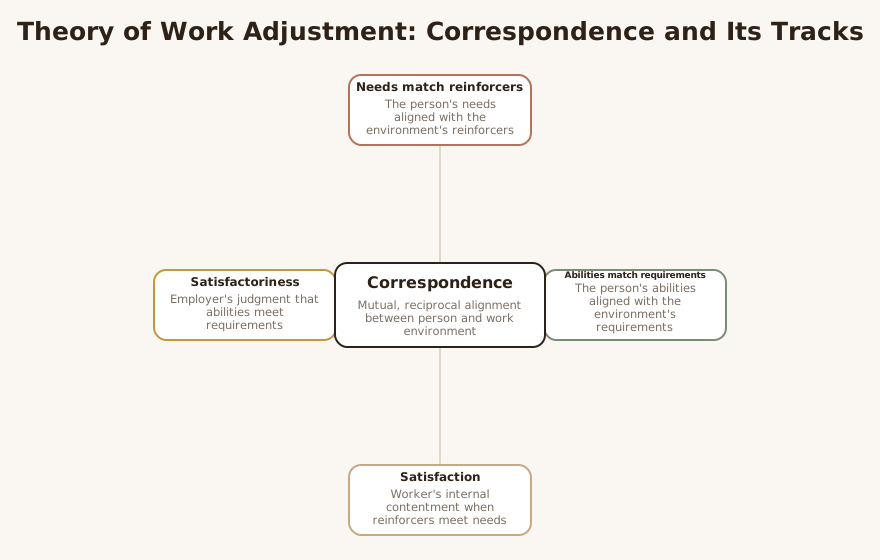
The organizing concept is correspondence: the mutual, reciprocal alignment between a person and a work environment 1. Work is conceptualized as an ongoing interaction in which both parties have requirements — the environment needs task performance, and the individual needs compensation and favorable conditions — and “the degree to which the requirements of both are met may be called correspondence” 1. Correspondence carries two related meanings in the theory: fit, the degree to which P characteristics match E characteristics on commensurate dimensions, and interaction, the mutual give-and-take of P and E responding to one another over time 5.
Two outcome constructs anchor the model. Satisfaction is the worker’s internal contentment, which results when the environment’s reinforcers correspond to the person’s needs 4. Satisfactoriness is the external, employer-side judgment of whether the person’s abilities meet the environment’s requirements — that is, whether the worker performs adequately 5. Crucially, these two run on parallel tracks: needs are matched against reinforcers to predict satisfaction, and abilities are matched against requirements to predict satisfactoriness 4. Together, satisfaction and satisfactoriness predict tenure, the principal behavioral indicator of work adjustment 1.
Beneath needs and abilities sit higher-order values (reference dimensions that organize clusters of needs) and abilities (reference dimensions underlying specific skills), which the theory uses to predict tenure through correlational analysis 5. Needs may be understood as reinforcer requirements, and skills as response capabilities 5. Because work personalities and work environments are described on the same measurement dimensions, the model can directly compare a person’s needs to a job’s reinforcer pattern and a person’s abilities to a job’s requirements 1.
The theory also describes how people adjust when correspondence is imperfect. Workers use two broad modes: an active mode, in which the person acts on the environment to change it, and a reactive mode, in which the person modifies their own behavior or expectations 4. Each person has a characteristic celerity (speed of responding) and a level of tolerance for discorrespondence before adjustment behavior is triggered 4. These style variables explain why two equally ill-fitting workers may behave very differently — one renegotiating the job, the other quietly adapting or leaving LLM.
Interventions & Techniques
TWA is not a manualized treatment, so its “interventions” are better described as a structured assessment-and-matching process that a clinician can fold into counseling LLM. The first move is commensurate measurement: describing the client’s needs, values, and abilities on the same dimensions used to describe candidate environments, so that fit can be examined rather than guessed 1.
The Minnesota program produced a coordinated battery for exactly this purpose. The Minnesota Importance Questionnaire (MIQ) measures the importance of the person’s psychological needs 4. The Minnesota Job Description Questionnaire (MJDQ) characterizes occupational rewards and yields an Occupational Reinforcer Pattern for a given job 4. The Minnesota Job Requirements Questionnaire (MJRQ) captures the skills needed for success in occupations, and the Minnesota Satisfaction Questionnaire assesses the satisfaction outcome itself 4. The theory enumerates a set of psychological needs — including ability utilization, achievement, activity, advancement, authority, compensation, creativity, independence, recognition, responsibility, security, social status, supervision, variety, and working conditions, among others — against which an environment’s reinforcers can be compared 4.
In counseling practice, the clinician’s task is to make discorrespondence visible and workable: clarifying which needs are going unmet, which abilities are underused or overstretched, and which adjustment mode (active versus reactive) the client is defaulting to 4. From there, the work is to expand the client’s repertoire — supporting active strategies (renegotiating role, scope, or conditions) where the environment is changeable, and reactive strategies (reframing, skill-building, or values reprioritization) where it is not LLM.
LLM-generated illustrative example (not a guideline): A nurse reports dread before every shift. A correspondence-informed conversation reveals high needs for autonomy and recognition sitting against a unit that reinforces security and compliance. The clinician helps her see this as a needs-reinforcer mismatch rather than personal failure, then explores active options (requesting a charge role) and reactive options (relocating recognition needs to a mentoring side-project) LLM.
Evidence Base
Honesty about maturity matters here. As a vocational and industrial-organizational theory, TWA is established: it rests on decades of Minnesota measurement research, a coordinated and validated instrument battery, and a substantial correlational literature 1. Research consistently supports the theory’s central propositions — that need-reward correspondence is positively related to job satisfaction, and that satisfaction and satisfactoriness relate to job tenure and performance 4. The theory’s predictive claim, that “tenure can be predicted from the correspondence of an individual’s work personality with the work environment,” is its most tested proposition 1.
What the evidence base is not: it is not a body of randomized controlled trials demonstrating that TWA-based counseling treats depression, anxiety, or other mental-health conditions LLM. The maturity is in the descriptive and predictive psychometrics of fit, not in clinical-outcome trials of a therapy LLM. For a practicing therapist, the appropriate claim is that TWA offers a well-validated way to conceptualize work-related distress and fit, and to organize a career-counseling conversation — not that “doing TWA” is itself an empirically supported treatment for a clinical disorder LLM. Used this way, it complements an evidence-based modality rather than competing with it LLM.
Populations & Indications
TWA was built for working-age adults and is most directly applicable to adult workers and career counseling clients negotiating questions of fit, satisfaction, and tenure 1. Its disability-and-rehabilitation origins make it especially apt for people with disabilities in vocational rehabilitation, where the explicit matching of abilities to requirements and needs to reinforcers supports realistic, individualized placement 5.
It also fits job seekers and people in career transition, who benefit from a structured way to compare candidate environments against their own needs and abilities before committing 4. And it is well suited to employees experiencing job dissatisfaction, for whom the satisfaction-versus-satisfactoriness distinction can separate “I am unhappy here” from “I am performing adequately here,” two facts that often coexist and require different responses 4. Across these groups, the common indication is a presenting concern that centers on the relationship between the person and a work environment LLM.
Problems-for-Work
TWA gives therapists a vocabulary for several recurring work-related problems-for-work LLM.
- Job dissatisfaction maps directly onto a needs-reinforcer mismatch; the work is to identify which specific needs (e.g., autonomy, recognition) are unmet by the environment’s reinforcers 4.
- Poor person-job fit and underemployment distress are framed as discorrespondence between abilities and requirements — often abilities exceeding requirements, leaving needs for achievement or ability utilization unmet 4.
- Occupational stress and burnout can be read as prolonged discorrespondence that has exceeded the person’s tolerance, calling for a deliberate choice between active environment-changing and reactive self-adjusting strategies 4.
- Career indecision and vocational identity concerns are addressed by commensurate assessment of values and abilities, giving the client a structured basis for comparing options 1.
- Workplace conflict and work-related adjustment problems can be examined as friction between the worker’s adjustment style (active versus reactive) and what the environment will tolerate or reinforce 4.
LLM-generated illustrative example (not a guideline): A mid-career engineer presents with burnout. Reframed through TWA, his exhaustion looks less like a stamina deficit and more like chronic discorrespondence — high achievement and autonomy needs against a micromanaged role — that has finally crossed his tolerance threshold, clarifying that the target is the fit, not his “resilience” LLM.
Contraindications, Cautions & Cultural Humility
The first caution is scope. TWA is a fit-and-adjustment framework, not a treatment for acute psychiatric conditions; using it as the primary intervention where a client needs trauma, mood, or risk-focused care would be a misapplication LLM. When work distress is a symptom of an underlying clinical condition, the clinical condition takes precedence, with TWA layered in as conceptualization rather than substituted for treatment LLM.
A second caution is the theory’s individual-differences premise, which can implicitly locate the “problem” inside the person’s measured traits 5. Real environments are shaped by labor markets, discrimination, caregiving demands, immigration status, and economic precarity — constraints that a needs-and-abilities matching exercise can flatten if applied uncritically LLM. Cultural humility requires the clinician to treat the “environment” side of correspondence as genuinely contested and unequal, not as a neutral menu of options the client is free to choose among LLM. The instruments themselves were normed within particular populations and should be interpreted, not mechanically applied, across cultural and linguistic contexts LLM. Finally, the active/reactive adjustment framing must not become a way to pressure clients facing unjust conditions toward purely reactive self-adjustment when the environment, not the person, is the proper target of change LLM.
Treatment-Plan Suggestions & SMART Objectives
| Goal | SMART objective (example) | Mechanism |
|---|---|---|
| Clarify sources of job dissatisfaction | Within 3 sessions, client will identify their top five work needs and rate how well each is reinforced by the current job | Commensurate measurement of needs vs. reinforcers 4 |
| Distinguish satisfaction from performance | By session 4, client will articulate, in writing, where they are satisfactory (performing) versus dissatisfied, separating the two | Satisfaction vs. satisfactoriness distinction 5 |
| Expand adjustment repertoire | Over 6 weeks, client will list two active and two reactive strategies for one identified discorrespondence and trial one | Active/reactive adjustment modes 4 |
| Improve person-job fit assessment | Within 4 sessions, client will compare two candidate roles against their abilities and needs using a structured fit grid | Abilities-requirements and needs-reinforcers matching 1 |
| Reduce burnout tied to discorrespondence | In 8 weeks, client will renegotiate or modify at least one role condition driving chronic mismatch and re-rate distress | Reducing discorrespondence below tolerance threshold 4 |
| Support a vocational-rehabilitation placement | Before placement, client will identify three reinforcers an environment must provide to meet their core needs | Occupational Reinforcer Pattern matching 4 |
| Build vocational identity clarity | Within 5 sessions, client will name their three highest work values and one occupation that reinforces them | Higher-order values as predictive reference dimensions 5 |
Common Misconceptions
A frequent misconception is that TWA is a theory of choosing a career; in fact its center of gravity is adjustment — what happens after entry, and how person and environment continue to respond to one another over time 1. Another is conflating satisfaction with satisfactoriness; the theory deliberately separates the worker’s contentment from the employer’s judgment of adequate performance, and a client can be high on one and low on the other 5. A third is treating correspondence as a one-way demand that the person fit the job, when the model is explicitly reciprocal, with the environment having requirements the person must meet and the person having needs the environment must reinforce 1. Some clinicians also mistake TWA for an evidence-based psychotherapy; it is an established vocational theory, but its empirical base is in fit prediction, not in clinical-outcome trials LLM. Finally, the active/reactive distinction is sometimes read as a fixed personality label rather than a style that can be coached and expanded LLM.
Training & Certification
There is no licensure or certification specific to “doing TWA”; it is a theory taught within graduate counseling psychology, vocational rehabilitation, and industrial-organizational programs rather than a credentialed treatment 1. Competent use depends on grounding in the original Dawis and Lofquist formulation and familiarity with the Minnesota instrument battery — the MIQ, MJDQ, MJRQ, and Minnesota Satisfaction Questionnaire — including their administration, scoring, and interpretive limits 4. Clinicians who intend to administer these inventories should hold the assessment qualifications those instruments require and interpret them within their scope of practice LLM. For most psychotherapists, appropriate “training” means learning to use the correspondence framework as a conceptual overlay, while referring to or collaborating with career-counseling or vocational-rehabilitation specialists for formal vocational assessment LLM.
Key Terms
- Correspondence — the reciprocal fit between a person and a work environment across matching dimensions; the theory’s central construct 1.
- Satisfaction — the worker’s contentment, resulting when environmental reinforcers meet the person’s needs 4.
- Satisfactoriness — the employer-side judgment that the person’s abilities meet the environment’s requirements 5.
- Tenure — duration of the work relationship; the principal indicator of work adjustment, predicted by satisfaction and satisfactoriness 1.
- Needs and reinforcers — the person’s reinforcer requirements matched against what the environment provides, predicting satisfaction 4.
- Abilities and requirements — the person’s response capabilities matched against what the job demands, predicting satisfactoriness 5.
- Values — higher-order reference dimensions that organize clusters of needs and serve as predictive variables 5.
- Active vs. reactive adjustment — acting on the environment to change it versus modifying one’s own behavior in response to discorrespondence 4.
- Celerity and tolerance — the speed of adjustment responding and the amount of discorrespondence tolerated before adjustment is triggered 4.
Resources & Further Reading
▶ Watch — a video introduction to this concept:
- Theory of Work Adjustment — Vocational Psychology Research, University of Minnesota
- Essentials of Person-Environment-Correspondence (Lofquist & Dawis, 1991) — full-text PDF
- From Theory of Work Adjustment to Person-Environment Correspondence Counseling (PDF, CDC stacks)
- Theory of Work Adjustment — Counseling Theories (iResearchNet)
- Major Theories of Career Development (Wiley, chapter excerpt PDF)
Reflective / Supervision Questions
- When a client presents with work distress, do I distinguish whether the problem is satisfaction (their unmet needs) or satisfactoriness (their performance) — and am I treating the right one? LLM
- Where in my conceptualization am I implicitly locating the “problem” inside the client’s traits versus inside an inequitable environment, and what does cultural humility ask of me here? LLM
- Am I defaulting my client toward reactive self-adjustment when the environment is the proper target of change? LLM
- How do I hold TWA as a conceptual overlay without overstating it as an evidence-based treatment for a clinical condition? 1
- When does work-related distress signal an underlying psychiatric condition that should take precedence over a fit-focused approach? LLM
- Do I know the limits of my scope around the Minnesota instruments, and when to collaborate with a vocational-rehabilitation specialist? 4