
Type & Discipline
Teshuvah (Hebrew, literally “return”) is a religious and ethical framework drawn from Jewish thought and pastoral tradition, not a psychotherapy modality in its own right LLM. The Hebrew word names a turning back toward one’s deepest values and toward God, and toward the people one has harmed 3. In English it is conventionally translated “repentance,” but several commentators note the translation is imperfect: “repentance” carries connotations of penance and self-punishment, whereas teshuvah emphasizes return, restoration, and re-alignment 6. For the clinician, teshuvah functions as an organizing structure — a culturally rooted, stepwise map of moral repair — that can be integrated alongside established secular interventions when working on guilt, amends, and behavior change LLM. It is best understood as a framework borrowed for clinical scaffolding, carrying its own theological commitments that the therapist should hold with care rather than treat as neutral technique LLM.
Creators & Lineage
Teshuvah is an ancient, biblically rooted concept; the prophets called the people to “return,” and the practice is woven through the liturgy of the High Holy Days 3. Its most influential systematic formulation is by Maimonides (Moses ben Maimon, the Rambam, 12th century), whose Hilchot Teshuvah (Laws of Repentance) within the Mishneh Torah lays out the stages and conditions of genuine return 1. Maimonides’ treatment is the standard reference point for the staged model used clinically today, including his demanding test of “complete teshuvah” 2. Later thinkers extended the tradition: the 20th-century philosopher and Talmudist Joseph B. Soloveitchik developed an existential, experiential reading of teshuvah as self-creation and transformation, though his specific contributions are not detailed in the sources provided here LLM. The contemporary psychotherapist and rabbinic teacher Estelle Frankel is frequently associated with translating teshuvah into a language of psychological and spiritual healing for a clinical and lay audience, again beyond what the provided sources document LLM. The lineage relevant to a therapist runs from biblical “return,” through Maimonides’ codification, into modern pastoral and integrative-clinical adaptation LLM.
Core Principles
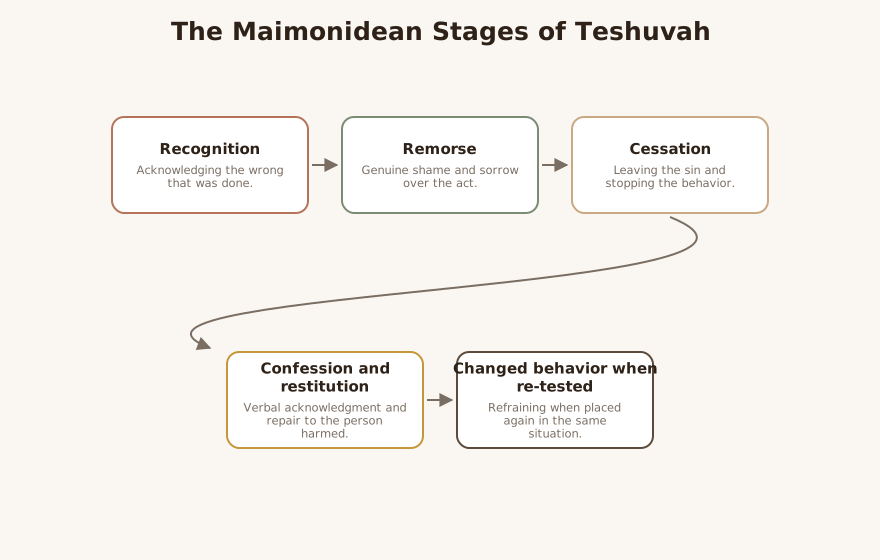
The Maimonidean structure is usually rendered as four to five elements. The Orthodox Union summarizes four: leaving the sin (ceasing the behavior), regret (genuine shame and sorrow over the act), confession before God (verbal acknowledgment, vidui), and acceptance for the future (resolving never to repeat it) 4. A complementary mapping names five touchpoints — recognition, remorse, cessation, restitution, and confession 5. A defining principle is that interpersonal wrongs are not absolved by God until one has first sought forgiveness directly from the person harmed 4. A second principle guards against cheap grace: one cannot premeditate a sin on the assumption that repentance will later wash it away 4. The gold standard, “complete teshuvah,” is behavioral and situational — a person has truly returned when, placed again in the same circumstance with the same temptation and the same capacity to repeat the act, they refrain because they have changed 2. Crucially, the process is not rigidly linear; one “may begin at any point,” and the elements interrelate as a spiral that deepens with each turn rather than a checklist completed once 5.
Interventions & Techniques
Teshuvah does not come packaged as a manualized protocol; the clinician operationalizes its elements as discrete therapeutic moves LLM. Recognition maps onto guided self-examination — helping a client name, concretely and without minimization, what was done and to whom LLM. Remorse and regret invite affect work that distinguishes constructive sorrow from corrosive self-attack 4. Confession (vidui) translates into structured disclosure — articulating the wrong aloud, whether in session, in a letter, or within the client’s own faith practice — which externalizes and concretizes accountability 5. Restitution and direct amends operationalize the principle that interpersonal repair requires approaching the wronged party, mirroring the amends step many clients already know from 12-step recovery 4. Resolution for the future becomes relapse-prevention and values-based planning — identifying the situations that will re-test the client and rehearsing the changed response 2. The spiral framing licenses iteration: the therapist normalizes returning to earlier elements as understanding deepens, rather than treating a single pass as failure or completion 5.
LLM-generated illustrative example (not a guideline): A client who, years ago, betrayed a sibling’s confidence works through recognition by writing exactly what was disclosed and the harm it caused, sits with genuine regret without sliding into “I am worthless,” drafts and reads aloud a confession of the wrong, plans a direct conversation of amends paced to the sibling’s readiness, and identifies the future situations (family gossip, alcohol) most likely to re-tempt the behavior — rehearsing the changed response for each LLM.
Evidence Base
Honesty about maturity matters here. As a religious and ethical tradition, teshuvah is established — millennia old, codified by Maimonides, and central to lived Jewish practice 3. As a measured clinical intervention, however, it is essentially untested: the provided sources are theological and explanatory, not outcome studies, and no controlled trials of “teshuvah therapy” are cited or, to this author’s knowledge, available LLM. Clinicians should therefore not claim that teshuvah-based work produces specific symptom reductions; such claims would outrun the evidence LLM. What can be said responsibly is that its components overlap conceptually with constructs that do have empirical support in adjacent literatures — forgiveness interventions, moral-injury repair, and structured amends — so integration is plausible and defensible as culturally responsive practice rather than as an evidence-based modality in itself LLM. The appropriate clinical stance is integrative and humble: teshuvah supplies a meaningful, client-congruent structure; the mechanisms of change are borrowed from established therapies, and outcomes should be tracked individually rather than assumed LLM.
Populations & Indications
Teshuvah is most naturally indicated for religiously or spiritually committed Jewish clients for whom the framework is already authoritative and emotionally resonant LLM. Because its language of “return” is a return toward one’s own deepest values, the structure can also be adapted, with care and consent, for clients of other faiths or of secular orientation who are wrestling with moral repair 3. It maps cleanly onto the experience of clients in 12-step recovery, whose amends work parallels the teshuvah requirement to seek forgiveness directly from those harmed 4. It is relevant to clients carrying durable guilt over interpersonal harm, and to those experiencing moral injury — the lasting distress that follows acting against, or being party to violations of, one’s moral code — including veterans and healthcare workers LLM. It also fits clients seeking self-forgiveness who feel “stuck” in remorse with no pathway to release LLM.
Problems-for-Work
Guilt and remorse over past harm. The framework gives shapeless guilt a direction: recognition, confession, and a concrete plan convert rumination into action 5. Application: a client looping on “I’m a bad person” is helped to specify the act, the harm, and the available repair, shifting from global self-condemnation to a bounded, addressable wrong LLM.
Amends-making and relational repair. Teshuvah’s insistence that interpersonal wrongs require approaching the person harmed structures the amends process 4. Application: the clinician and client sequence the amends — readiness, safety, timing, and what repair is actually within the client’s control versus the other party’s response LLM.
Moral injury and self-forgiveness. The “complete teshuvah” criterion reframes worth around changed future behavior rather than permanent stain, offering a route out of the belief that one is irredeemable 2. Application: a client convinced they are defined by a past failure is oriented toward the behavioral test — who they are becoming when re-tested — as evidence of genuine change LLM.
Contraindications, Cautions & Cultural Humility
Several cautions are essential. In clients with scrupulosity or obsessive-compulsive presentations, a guilt-and-confession framework can feed the pathology, fueling endless confession, reassurance-seeking, and compulsive “repair”; here the framework may be contraindicated or require explicit OCD-informed boundaries LLM. The clinician must distinguish healthy, proportionate remorse from depressive or pathological guilt; teshuvah presumes a wrong actually occurred, whereas depressive guilt often attaches to imagined or grossly inflated culpability, which calls for mood-focused treatment, not amends LLM. In abuse and intimate-partner-violence contexts the framework carries real danger: it must never be used to pressure a victim toward reconciliation or premature forgiveness, and a perpetrator must not be allowed to weaponize “restitution” or “I’ve repented” to re-access or coerce the person they harmed — the tradition’s own safeguard is that genuine return is proven by changed behavior under re-test, not by words 2. Cultural humility requires that a non-Jewish or non-observant therapist not appropriate or flatten the tradition; the framework belongs to the client’s faith community, and consultation with clergy or a chaplain is often appropriate 6. Finally, teshuvah is theologically loaded — imposing it on a client for whom it is not meaningful is both clinically inert and ethically presumptuous LLM.
Treatment-Plan Suggestions & SMART Objectives
| Goal | SMART objective (example) | Mechanism |
|---|---|---|
| Convert global guilt into a bounded, nameable wrong | Within 3 sessions, client will articulate, in writing, the specific act, the party harmed, and the resulting harm, without global self-labeling | Recognition; cognitive specificity 5 |
| Differentiate healthy remorse from self-attack | Over 4 weeks, client will identify in-session 3 instances of corrosive self-condemnation and reframe each as proportionate regret | Affect differentiation 4 |
| Externalize accountability through confession | Within 2 sessions, client will articulate the wrong aloud (in session or via letter) using vidui-style direct acknowledgment | Confession; disclosure 5 |
| Plan and pace direct amends safely | Within 6 weeks, client will produce a written amends plan specifying timing, safety, and elements within their own control | Restitution; relational repair 4 |
| Build relapse-prevention for the moral domain | By session 8, client will name the top 3 situations likely to re-test the behavior and a rehearsed alternative response for each | Resolution; “complete teshuvah” test 2 |
| Loosen “irredeemable” self-narrative | Over 8 weeks, client will report 2 instances of acting differently when re-tested, cited as evidence of change | Behavioral proof of return 2 |
| Normalize iteration without shame | Ongoing: client will reframe a return to an earlier step as deepening rather than failure on ≥1 documented occasion | Spiral process 5 |
Common Misconceptions
“Teshuvah just means feeling sorry.” Remorse is necessary but insufficient; without cessation, direct amends, and changed future behavior, the process is incomplete 4. “Repentance is a one-time event you finish.” The spiral model holds that one cycles through the elements repeatedly, deepening with each turn rather than completing a checklist 5. “You can sin now and repent later.” Maimonides’ tradition explicitly forbids premeditated wrongdoing on the assumption of later forgiveness, which voids the repentance 4. “God’s forgiveness covers interpersonal harm automatically.” For wrongs against another person, one must first seek that person’s forgiveness directly 4. “Repentance equals self-punishment.” The word means return; several commentators caution that the penance-laden English translation distorts a tradition centered on restoration, not flagellation 6.
Training & Certification
There is no certifying body and no credential for “teshuvah therapy,” because it is a religious framework rather than a regulated clinical modality LLM. The relevant training is in the integration of spirituality into psychotherapy: pastoral counseling, clinical chaplaincy, and supervised competency in spiritually integrated practice, together with the general ethics of working within a client’s faith tradition LLM. For depth in the source material itself, study of Maimonides’ Hilchot Teshuvah and the broader High Holy Day liturgy is the substantive “curriculum,” ideally undertaken with, or in consultation with, knowledgeable clergy 1. Clinicians without grounding in Jewish thought should pursue consultation rather than self-certify competence LLM.
Key Terms
Teshuvah — “return”; the framework of repentance as re-alignment with one’s values and relationships 3. Vidui — confession; the verbal acknowledgment of the specific wrong 4. Charatah / regret — sincere remorse and shame over the act 4. Azivat ha-chet / leaving the sin — cessation of the wrongful behavior 4. Kabbalah le’atid / acceptance for the future — resolve not to repeat the act 4. Complete teshuvah — the standard met when one refrains from the same act under identical temptation and circumstance, proving genuine change 2. Spiral of teshuvah — the non-linear model in which the elements are revisited and deepened over time, enterable at any point 5.
Resources & Further Reading
▶ Watch — a video introduction to this concept:
- Mishneh Torah, Repentance (Hilchot Teshuvah) — Maimonides (Sefaria)
- Maimonides on Teshuvah: The Ways of Repentance (Touro Scholar)
- Teshuvah in Judaism: A Guide to Repentance (Brandeis, The Jewish Experience)
- The Four Steps of Repentance (Orthodox Union)
- Spiraling Towards Repentance (My Jewish Learning)
- Between Teshuva and Repentance (Jewish Theological Seminary)
Reflective / Supervision Questions
- For this specific client, is teshuvah a framework they already hold as authoritative, or am I importing it because it appeals to me? LLM
- Can I distinguish, with this client, healthy proportionate remorse from depressive or scrupulous guilt — and have I screened for OCD before deploying a confession-based structure? LLM
- If amends involve another living person, have I assessed safety, and am I protecting against any pressure on a victim to reconcile or forgive prematurely? LLM
- Where is the actual mechanism of change coming from in my plan, and am I being honest that the evidence lives in adjacent therapies rather than in teshuvah itself? LLM
- Do I have, or should I seek, clergy or chaplaincy consultation to use this tradition with cultural humility rather than appropriation? 6