
Forgiveness Therapy asks a wronged person to do something counterintuitive: to give up the resentment they have a moral right to hold, and to move toward goodwill for the one who hurt them. It is not a fringe self-help posture but a manualized clinical intervention with two decades of randomized trials behind it. LLM The two best-developed models are Robert Enright’s 20-unit, four-phase process model and Everett Worthington’s REACH model, both of which treat forgiveness as a deliberate, staged psychological process rather than a single moment of pardon. 14
Type & Discipline
Forgiveness Therapy is a structured, time-limited psychotherapeutic intervention that sits at the intersection of counseling psychology, developmental psychology, and positive psychology. 1 It is process-oriented and manualized, which has made it tractable for empirical study; Enright and Fitzgibbons frame it explicitly as an empirical guide “for resolving anger and restoring hope.” 1 In practice it is rarely a freestanding modality and is more often delivered as a focused module inside individual psychotherapy, where the forgiveness work is the unit of intervention rather than the whole treatment. LLM
A central conceptual move is the separation of forgiveness from related but distinct constructs. LLM Forgiveness is the wronged party’s internal change of heart toward an offender; it is not condoning, excusing, forgetting, or necessarily reconciling. 4 Worthington’s work makes the same point sharply by distinguishing forgiveness from reconciliation: one can forgive entirely while choosing never to restore the relationship, which matters enormously when the offender remains dangerous. 4
Creators & Lineage
Robert Enright, a developmental psychologist at the University of Wisconsin–Madison and founder of the International Forgiveness Institute, is credited with launching the social-scientific study of forgiveness in the 1980s and with building the process model that bears his name. 5 Richard Fitzgibbons, a psychiatrist, co-authored the clinical guide that operationalized the model for practitioners. 1
Everett Worthington, a counseling psychologist, developed the parallel REACH model and the broader Hope-Focused approach. 4 His scholarship is unusually personal: he trained as a nuclear-physics instructor before psychology, and his work on forgiveness and self-forgiveness was shaped by the 1996 murder of his mother and the later loss of his brother. 4 The lineage of Forgiveness Therapy draws on developmental psychology (Enright’s roots in moral development), cognitive behavioral therapy (its emphasis on reframing and behavioral commitment), and positive psychology (its orientation toward goodwill, compassion, and hope rather than only symptom relief). 14
Core Principles
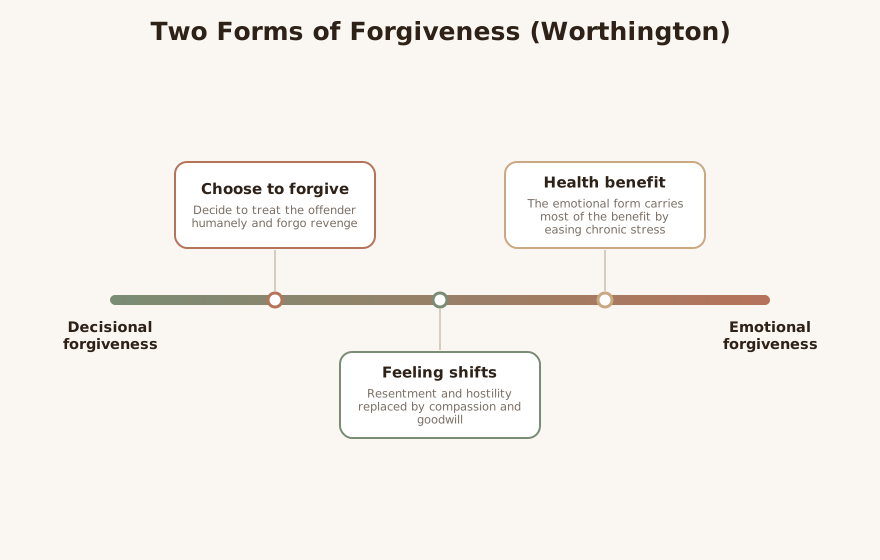
Several principles cut across both models. LLM First, forgiveness is a choice that precedes feeling: the person decides to forgive before the emotional shift arrives, and the emotional shift is the harder, slower work. 4 Worthington formalizes this as the difference between decisional forgiveness (choosing to treat the offender more humanely and forgo revenge) and emotional forgiveness (replacing resentment, bitterness, and hostility with compassion and goodwill), and argues that it is the emotional form that carries most of the health benefit by reducing chronic stress arousal. 4
Second, forgiveness is offered as a “gift” rather than earned by the offender; it does not require the offender’s apology, participation, or even continued existence. 4 Third, empathy and reframing are the engines of change: the client is helped to see the offender as a whole, wounded human being without minimizing the wrong. 1 Fourth, the work is gradual and recursive rather than linear, and clients commonly cycle back through earlier stages. 5
Interventions & Techniques
Enright’s process model moves through four phases comprising twenty units. 56 In the Uncovering Phase, the client confronts the depth of their anger, the psychological defenses they have used, and the toll the injustice and rumination have taken. 5 In the Decision Phase, the client recognizes that prior coping has not worked, learns what forgiveness is and is not, and makes a deliberate commitment to forgive. 5 In the Work Phase—the therapeutic core—the client reframes the offender in context, works toward empathy and compassion, absorbs rather than passes on the pain, and may offer a “moral gift” of goodwill. 15 In the Deepening Phase, the client finds meaning in the suffering, recognizes their own need for forgiveness at times, discovers a new purpose, and experiences emotional release. 5
Concrete techniques include psychoeducation on what forgiveness is and is not, structured anger exploration, perspective-taking and “empathy chair” or imagined-dialogue work, cognitive reframing of the offender, written commitment letters, and review of meaning and growth. 14 Worthington’s REACH acronym sequences the same arc: Recall the hurt without rumination or payback; Empathize with the offender’s perspective; offer the Altruistic gift of forgiveness; Commit to the forgiveness one has experienced, often in writing; and Hold on to that commitment when doubts return. 4
LLM-generated illustrative example (not a guideline): A client carrying decades of anger toward an emotionally absent parent might spend several Uncovering sessions naming the cost of that anger, then in the Decision Phase choose forgiveness as a strategy for their own freedom—explicitly not as approval of the parent’s behavior. Work-phase sessions would reframe the parent’s own deprivation, and the Deepening Phase might surface a commitment to parent differently themselves. LLM
Evidence Base
The evidence base for Forgiveness Therapy is best characterized as established: multiple randomized trials and at least two meta-analyses support efficacy, though the literature remains smaller and more author-clustered than for first-line treatments like CBT. 26 The pivotal adult meta-analysis by Wade, Hoyt, Kidwell, and Worthington pooled 54 research reports (53 posttreatment effect sizes, N = 2,323; 41 follow-ups, N = 1,716). 2 Explicit forgiveness interventions produced significantly greater forgiveness than no-treatment controls (d ≈ 0.56) and than alternative treatments (d ≈ 0.45), along with greater improvement in depression, anxiety, and hope. 2
Crucially, the meta-analysis found that treatment dosage uniquely predicted change—longer interventions outperformed shorter ones—and that individual formats outperformed group formats, an advantage most clearly demonstrated for Enright-model interventions. 2 When other moderators (dosage, offense severity, modality) were controlled, differences between the Enright and Worthington models disappeared, suggesting the models are more alike than different in their active ingredients. 2
In children and adolescents, a meta-analysis of 20 randomized studies (1,472 youth across 10 countries, mean age ~11.7) found a medium effect on forgiveness (g ≈ 0.54) and a small effect on anger reduction (g ≈ 0.29), with gains persisting from four weeks to a year. 6 Notably, the process-based curriculum following Enright’s 20-unit model produced larger effects (g ≈ 0.66) than a story-based curriculum (g ≈ 0.27). 6 A focused review of Enright’s process model documents trials in incest survivors, cardiac patients, substance-dependent and at-risk youth, the elderly, and divorced populations, with improvements in anger, anxiety, depression, hope, and self-esteem. 31
Honest caveats: many trials are small, several were conducted by the model developers, and the field would benefit from more independent replication and active-control comparisons. LLM
Populations & Indications
Forgiveness Therapy is indicated for adults and adolescents whose presenting distress is anchored in an identifiable interpersonal injustice that the person cannot release. 1 It has been studied and applied with survivors of abuse and interpersonal trauma, people processing betrayal and infidelity, couples in conflict, adolescents, and grief and bereavement clients. 13 The shared clinical signature is persistent anger, rumination, and avoidance organized around a specific offender or wrong, often co-occurring with depression and anxiety. 23
Problems-for-Work
The most direct target is resentment and anger tied to an offense, where structured forgiveness work reduces the chronic hostility that fuels distress. 23 Because resentment frequently sustains comorbid conditions, the model has been applied to major depressive disorder, generalized anxiety disorder, and posttraumatic stress disorder, with meta-analytic evidence of secondary improvement in depression and anxiety. 2 It is also used for grief, relationship conflict, interpersonal trauma, rumination, and low self-esteem. 13
LLM-generated illustrative example (not a guideline): For a client with GAD whose worry orbits a business partner’s betrayal, the clinician might frame forgiveness as a way to interrupt the rumination loop rather than as a moral duty—using REACH’s “Recall without payback” and empathy steps to loosen the cognitive fixation, while keeping anxiety management techniques running in parallel. LLM
Contraindications, Cautions & Cultural Humility
The most important caution is that forgiveness must never be conflated with reconciliation or with returning to an unsafe relationship. 4 With ongoing abuse, intimate partner violence, or active offending, safety planning and the establishment of distance take precedence, and premature forgiveness work can be retraumatizing or coercive. LLM Forgiveness is the client’s free choice; it cannot be assigned, pressured, or used to short-circuit legitimate anger or grief. 1
Clinicians should also watch for clients using “forgiveness” as bypass—suppressing affect, excusing the offender, or skipping the Uncovering and Work phases to reach premature peace; the model’s insistence on first confronting anger guards against this. 1 Cultural and religious humility is essential: forgiveness carries heavy spiritual and familial meanings that differ across communities, and the clinician’s job is to follow the client’s values, not impose a normative ideal. LLM
Treatment-Plan Suggestions & SMART Objectives
| Goal | SMART objective (example) | Mechanism |
|---|---|---|
| Reduce offense-linked anger | Client will reduce self-rated anger toward the identified offender from 8/10 to 4/10 over 10 weekly sessions, tracked weekly | Uncovering-phase anger exploration; emotional forgiveness reduces hostility 25 |
| Decrease rumination | Client will report ruminative episodes dropping from daily to ≤2/week within 8 weeks, per a thought log | REACH “Recall without payback”; cognitive reframing of the offender 4 |
| Build empathic reframing | Client will complete two perspective-taking exercises and articulate the offender’s context in session by week 6 | Work-phase empathy and reframing 15 |
| Commit to forgiveness | Client will write and read aloud a forgiveness/commitment letter by week 9 | REACH “Commit” and “Hold on” steps consolidate decisional forgiveness 4 |
| Reduce depressive symptoms | Client will lower PHQ-9 from 16 to ≤9 over 12 sessions | Secondary symptom relief documented in forgiveness trials 23 |
| Restore hope/meaning | Client will identify two areas of personal growth or meaning derived from the experience by week 11 | Deepening-phase meaning-finding 5 |
| Clarify forgiveness vs. reconciliation | Client will verbalize the distinction and state a values-based decision about contact by week 4 | Psychoeducation; protects against unsafe reconciliation 4 |
Common Misconceptions
The most damaging misconception is that forgiving means excusing, condoning, or forgetting the wrong; the models explicitly reject this and require the client to fully acknowledge the injustice first. 14 A second is that forgiveness requires reconciliation—it does not, and the two are deliberately separated. 4 A third is that forgiveness is a single decision; both models treat it as a staged, recursive process where the emotional shift lags well behind the choice. 45 A fourth is that the benefit is purely interpersonal, when in fact the documented gains are largely intrapersonal—lower depression and anxiety, greater hope—regardless of what the offender does. 2 Finally, some assume forgiveness must be fast; the dose-response data argue the opposite, that more sessions yield more change. 2
Training & Certification
There is no single licensure-style credential required to practice Forgiveness Therapy; it is learned primarily through the published manuals and applied within one’s existing scope of practice. LLM The foundational clinical text is Enright and Fitzgibbons’ Forgiveness Therapy (APA Books), which functions as the de facto training manual. 1 The International Forgiveness Institute, founded by Enright, distributes the process-model materials and educational curricula used in many of the trials. 5 Worthington’s REACH workbooks and the Hope-Focused materials provide a parallel, freely adaptable protocol. 4 Clinicians are advised to combine manual study with supervision, particularly when applying the work with trauma survivors. LLM
Key Terms
- Decisional forgiveness — a behavioral choice to forgo revenge and treat the offender more humanely. 4
- Emotional forgiveness — replacing negative emotions (resentment, hostility) with positive ones (compassion, goodwill); the source of most health benefit. 4
- Uncovering / Decision / Work / Deepening — the four phases of Enright’s 20-unit process model. 56
- REACH — Worthington’s five-step sequence: Recall, Empathize, Altruistic gift, Commit, Hold on. 4
- Forgiveness vs. reconciliation — an internal change of heart versus the restoration of a relationship; forgiveness can occur without reconciliation. 4
- Altruistic gift — offering forgiveness freely rather than transactionally, without requiring the offender to earn it. 4
Resources & Further Reading
▶ Watch — a video introduction to this concept:
- Enright & Fitzgibbons (2015), Forgiveness Therapy, APA Books
- Wade, Hoyt, Kidwell & Worthington (2014), meta-analysis of forgiveness interventions (PubMed)
- A Review of the Empirical Research Using Enright’s Process Model (ResearchGate)
- Profile: Everett Worthington on Forgiveness (Psychology Tools)
- Enright Forgiveness Process Model, 20-step / 4-phase PDF (International Forgiveness Institute)
- Meta-analysis of forgiveness education in children and adolescents (PMC)
Reflective / Supervision Questions
- Have I clearly separated forgiveness from reconciliation with this client, and is there any safety reason the two must stay separate? LLM
- Am I following the client’s own pace and values, or am I subtly pressuring them toward forgiveness on a timeline that serves me? LLM
- Has the client genuinely completed the Uncovering work—fully naming the anger and injustice—before moving toward empathy and the moral gift? LLM
- For this presentation, is the medically necessary target (anger, rumination, depression, anxiety) explicit in my framing and documentation? LLM
- Where might cultural, religious, or familial meanings of forgiveness be shaping this client’s readiness, and am I honoring those rather than overriding them? LLM
- Given the dose-response findings, have I allowed enough sessions for the emotional shift to follow the decisional one? 2LLM