
Type & Discipline
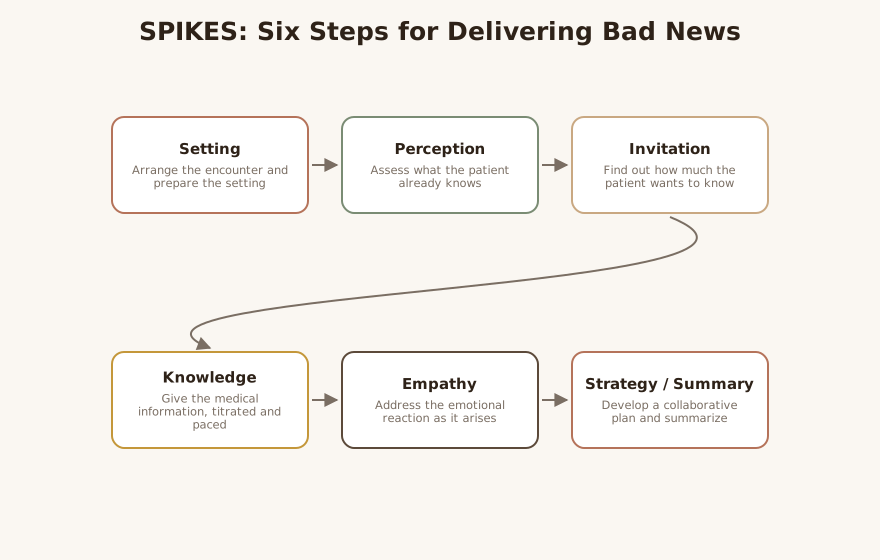
SPIKES is a structured clinical-conversation protocol — a technique rather than a freestanding therapeutic modality — that organizes how a clinician delivers difficult information 1. It originated in psycho-oncology and health communication, where the recurring task of telling patients about cancer diagnoses, recurrences, and poor prognoses exposed how unprepared most clinicians were for these conversations 1. The protocol gives a six-step scaffold for the encounter: Setting, Perception, Invitation, Knowledge, Empathy, and Strategy/Summary 1. Because its logic is communicative rather than disease-specific, it transfers cleanly from oncology to any field where serious news must be disclosed, including mental health LLM.
For practicing therapists, the relevance is direct. Naming a diagnosis a client did not expect, discussing a prognosis of a chronic or recurrent condition, or telling a parent their child meets criteria for a developmental or psychiatric disorder are all “bad news” encounters in the technical sense the protocol describes — moments that “drastically and negatively alter the patient’s view of her or his future” 1. SPIKES is the framework most likely to be shared with the physicians, advanced-practice nurses, and care coordinators a therapist collaborates with, which makes fluency in it a useful interprofessional common language LLM.
Creators & Lineage
SPIKES was formalized by Walter F. Baile and Robert Buckman with colleagues, published in The Oncologist in 2000 1. Buckman, a medical oncologist and communication-skills educator, had written extensively on breaking bad news before the acronym crystallized; Baile, a psychiatrist working in cancer care, brought attention to the emotional and relational dimensions of disclosure 1. The protocol distilled accumulated clinical wisdom and consensus teaching into a memorable, sequential mnemonic intended to be taught and rehearsed 1.
Its conceptual lineage runs through patient-centered communication and the broader movement, from the 1980s onward, toward shared decision-making and informed, collaborative care LLM. SPIKES sits comfortably alongside motivational interviewing, person-centered (Rogerian) therapy, and the NURSE empathy mnemonic — all of which prioritize eliciting the patient’s own perspective before the clinician imposes information or a plan LLM. What SPIKES adds is a specific, ordered choreography for the highest-stakes version of that encounter LLM.
Core Principles
The protocol rests on a small set of principles. First, disclosure is a process, not an announcement — information is titrated, checked, and paced rather than delivered in a single block 1. Second, the clinician should learn before teaching: assessing what the patient already knows and how much they want to know precedes giving knowledge 1. Third, emotion takes precedence over information at the moment it arises; an unaddressed emotional reaction blocks comprehension of anything that follows 1.
Underlying these is a stated set of goals for the encounter. Baile and Buckman frame the bad-news interview as serving four simultaneous objectives: gathering information from the patient, transmitting medical information, providing support, and developing a collaborative plan 1. The sequence of the six steps is engineered so that each objective gets its turn rather than being crowded out by the clinician’s impulse to simply state the facts and move on LLM.
A fourth principle, easy to overlook, is respect for the patient’s pace of wanting to know. Some patients cope by declining detail, and the protocol treats that as a legitimate, defensible stance rather than denial to be overcome 1. This is where SPIKES intersects most directly with therapeutic sensibility: the clinician follows the patient’s lead on depth and timing LLM.
Interventions & Techniques
Each letter names a concrete set of behaviors.
S — Setting up the interview. Arrange privacy, sit down, minimize interruptions, and, with the patient’s permission, include significant others; the physical and emotional staging signals that the conversation matters 1. Maintaining eye contact and managing time pressure are part of the setup, not afterthoughts 1.
P — Assessing the patient’s Perception. Before disclosing anything, use open-ended questions to learn what the patient already understands and believes about their situation — the “before you tell, ask” rule 1. This surfaces misconceptions and calibrates the vocabulary and depth of what follows 1.
I — Obtaining the patient’s Invitation. Ask, explicitly, how much the patient wants to know, and at what level of detail 1. Securing this invitation respects autonomy and protects against both information dumping and paternalistic withholding 1.
K — Giving Knowledge and information. Fire a brief “warning shot” that difficult news is coming, then deliver information in small chunks using plain, non-technical language, pausing to check comprehension 1. Avoiding both euphemism and excessive bluntness is the balance the step asks for 1.
E — Addressing Emotions with empathic responses. Observe the emotion, name it (to oneself or aloud), identify its source, and respond with an empathic statement that connects the feeling to its cause before continuing 1. This is frequently the step clinicians find hardest and skip 1.
S — Strategy and Summary. Once the patient is ready, develop a plan collaboratively, eliciting their goals and fears and framing realistic hope around achievable outcomes 1. Summarizing and confirming next steps closes the encounter 1.
LLM-generated illustrative example (not a guideline): A therapist preparing to share that a client’s presentation meets criteria for borderline personality disorder books a full session with no overlap (S), opens with “What’s your understanding of what we’ve been working on?” (P), asks “Would it be helpful if I shared the formal name for the pattern we keep seeing?” (I), warns “I want to name something that can land hard” before disclosing in plain terms (K), pauses to say “It makes sense this feels overwhelming” when the client tears up (E), and ends by co-building a next-steps plan oriented around skills the client already finds useful (S) LLM.
Evidence Base
The maturity of SPIKES is best described as established in a specific sense: it is a widely adopted, expert-consensus teaching standard, not a treatment validated against hard patient outcomes in randomized trials LLM. Its original publication was a consensus-and-experience synthesis rather than a controlled study 1. In the validation work reported alongside it, oncologists overwhelmingly endorsed the framework — roughly 95% found it practical and felt it made sense — but this measures clinician acceptability and confidence, not downstream patient wellbeing 1.
The same paper documents the problem SPIKES addresses with survey data worth knowing: only about 5% of oncologists reported any formal training in breaking bad news, while a large share had neither training nor even observed it modeled 1. The most commonly cited difficulties were being honest without destroying hope and handling the patient’s emotional reaction 1. This is the gap the protocol fills — a teachable structure for clinicians who otherwise improvise 1.
Educational research supports SPIKES as a teaching tool: structured curricula using the framework improve undergraduate medical students’ communication skills and confidence in simulated bad-news encounters 6. The honest summary for clinicians is that SPIKES reliably improves how prepared and skilled clinicians feel and perform in these conversations, with weaker direct evidence on long-term patient outcomes such as adjustment, satisfaction, or adherence LLM. That is a real but bounded evidence base, and it should be represented as such LLM.
Populations & Indications
In mental health, SPIKES is indicated whenever a disclosure is likely to “drastically and negatively alter” how a client sees their future 1. Concretely, this includes clients receiving a serious diagnosis they did not anticipate — a personality disorder, bipolar disorder, or a first episode of psychosis — and clients being told their condition is chronic or recurrent rather than a one-time episode LLM. It applies to parents and caregivers learning that a child meets criteria for an autism spectrum, learning, or psychiatric diagnosis LLM.
It is also apt for clients with comorbid medical and behavioral health conditions, where a therapist may be present for or coordinating around a medical disclosure, and for families navigating cognitive decline or a dementia diagnosis LLM. The protocol is appropriate across the lifespan, with the Invitation and Knowledge steps adapted to developmental level when the recipient is an adolescent or when caregivers are intermediaries LLM.
Problems-for-Work
Diagnostic-disclosure distress. When the act of naming a condition itself destabilizes the client, the Perception and Invitation steps let the clinician meet the client where their understanding actually is and disclose at a tolerable depth 1.
LLM-generated illustrative example (not a guideline): A client who has read alarming material online about their suspected diagnosis is asked first what they have already concluded (P), allowing the clinician to correct catastrophic misconceptions before adding the formal label LLM.
Prognostic uncertainty and loss of hope. The Strategy/Summary step explicitly reframes hope around achievable goals rather than cure, which directly targets the “honesty without destroying hope” dilemma clinicians most often name 1.
Treatment-adherence ambivalence. Building the plan collaboratively in the final step, after the client’s goals and fears are elicited, supports buy-in rather than imposing a regimen the client may quietly reject 1.
Caregiver shock and grief. The Setting and Empathy steps create the privacy and emotional containment a caregiver needs to absorb news about a child or family member before logistics are discussed 1.
Contraindications, Cautions & Cultural Humility
SPIKES is a communication scaffold, not a clinical license, and it has limits. It should not be applied mechanically; rigidly marching through six steps while ignoring the person in front of you defeats its purpose LLM. The protocol is also not a substitute for scope-of-practice judgment — a therapist should not deliver a medical diagnosis or prognosis outside their competence, and SPIKES does not authorize doing so LLM.
Culturally, the assumption of direct, autonomy-centered disclosure embedded in the framework is not universal LLM. In many cultural contexts, families expect to receive serious news first and to mediate what and how the patient is told; the Invitation step is the natural hinge for negotiating this, but the clinician must actively ask rather than assume a single norm 1. The protocol’s emphasis on eye contact, sitting close, and naming emotion may read as intrusive in some cultural frames and should be adapted rather than imposed LLM.
A further caution: for clients with trauma histories, the pacing and consent built into Perception and Invitation are protective, but the disclosure itself can be activating, and the clinician should be prepared to prioritize grounding and safety over completing the Strategy step in one sitting LLM.
Treatment-Plan Suggestions & SMART Objectives
| Goal | SMART objective (example) | Mechanism |
|---|---|---|
| Reduce diagnostic-disclosure distress | Within 2 sessions, client will articulate an accurate understanding of their diagnosis and rate distress ≤4/10 in 2 consecutive check-ins | Paced, chunked disclosure with comprehension checks (Knowledge step) 1 |
| Restore realistic hope | Within 4 weeks, client will name 3 achievable short-term goals tied to their values | Hope reframed around attainable outcomes (Strategy step) 1 |
| Strengthen treatment buy-in | Within 3 sessions, client will co-author a written care plan they endorse in their own words | Collaborative planning after eliciting goals/fears 1 |
| Improve caregiver coping | Within 2 sessions, caregiver will demonstrate 2 grounding strategies and report feeling heard | Empathic responding and emotional containment (Empathy step) 1 |
| Repair a disclosure-related rupture | Within 4 weeks, client will report restored trust on a 1–10 alliance check ≥7 | Re-disclosure using Perception/Invitation to correct prior mishandling 1 |
| Increase client autonomy in care | By session 6, client will set the depth of information they want and have it honored | Invitation step formalizing informed preference 1 |
| Reduce avoidance of the diagnosis | Within 5 sessions, client will discuss the diagnosis without changing the subject in 3 of 4 sessions | Empathic acknowledgment lowering threat before information 1 |
Common Misconceptions
“SPIKES is only for oncology or end-of-life care.” It originated there, but the protocol is explicitly a general framework for any encounter that negatively reshapes a person’s view of their future 1. Mental-health diagnostic disclosures qualify LLM.
“It’s a script.” SPIKES is an ordered set of objectives, not fixed wording; the steps name what to accomplish, leaving the language to the clinician and the moment 1.
“The point is to deliver the information efficiently.” The protocol deliberately subordinates information delivery to perception-checking and emotional response, on the premise that an unaddressed emotion blocks understanding 1.
“Strong evidence proves it improves patient outcomes.” The robust evidence is for clinician acceptability, confidence, and skill, including in trainees; direct evidence on long-term patient outcomes is comparatively thin 16LLM.
Training & Certification
There is no certifying body or credential for SPIKES; it is a teachable skill embedded in communication-skills curricula rather than a licensed practice LLM. It is most often learned through brief didactic instruction followed by role-play, simulated-patient encounters, and feedback — the format in which it has shown the clearest skill gains 6. Continuing-education summaries and one-page job aids, such as the UBC CPD reference, are widely used for quick orientation and bedside reminders 3.
For therapists, practical mastery comes from rehearsal: practicing the warning shot, the invitation question, and empathic-statement formulation until they are available under the pressure of a real disclosure LLM. Pairing SPIKES practice with supervision on one’s own difficult disclosures is the most direct route to fluency LLM.
Key Terms
- Warning shot — a brief preparatory statement signaling that difficult news is coming, given before the disclosure itself 1.
- Invitation — the patient’s expressed preference for how much information they want, actively solicited rather than assumed 1.
- Empathic response — a statement that names an observed emotion and links it to its cause, offered before further information 1.
- Chunking and checking — delivering information in small units with periodic comprehension checks 1.
- Bad news — any information that drastically and negatively alters a person’s view of their future 1.
Resources & Further Reading
▶ Watch — a video introduction to this concept:
- Baile WF, Buckman R, et al. SPIKES—A Six-Step Protocol for Delivering Bad News (The Oncologist, 2000)
- SPIKES Protocol for Breaking Bad News — UBC CPD summary (PDF)
- Teaching breaking bad news using the SPIKES framework for undergraduate medical students (PMC)
Reflective / Supervision Questions
- Which of the six steps do I most often compress or skip under time pressure, and what does that cost the client? LLM
- When I deliver a diagnosis, do I genuinely ask how much detail the client wants, or do I assume? LLM
- How do I hold the tension between honesty and hope without drifting into false reassurance? 1
- Where do my own cultural assumptions about direct disclosure differ from those of the families I serve, and how do I check them? LLM
- After a difficult disclosure, how do I know whether the client actually understood — and felt understood? LLM