
Type & Discipline
Simulation-based education (SBE) is an experiential training modality within health professions education, paired in nearly all contemporary practice with a structured reflective conversation called debriefing 6. Rather than teaching about clinical work in the abstract, SBE places learners inside a recreated clinical situation — a manikin in cardiac arrest, an actor portraying a patient disclosing suicidal ideation, a role-played family meeting — and then uses a facilitated post-event discussion to convert that experience into durable learning 6. The discipline sits at the intersection of adult learning theory, patient safety, and assessment, and it spans the full continuum from undergraduate students to credentialed clinicians and intact interprofessional teams 5.
For mental and behavioral health clinicians, the modality is most familiar in the form of standardized patients and role-played encounters, but the field’s methodological backbone — particularly its theory of debriefing — was developed and tested largely in acute-care and crisis-resource-management settings 1. The transferable core is not the manikin but the structured, reflective debrief LLM.
Creators & Lineage
The lineage of clinical simulation is usually traced to the development of standardized (or simulated) patients by Howard Barrows in the 1960s, who trained actors to portray patients consistently for both teaching and assessment LLM. The maturation of simulation from an interesting teaching novelty into an evidence-based modality is closely associated with William McGaghie and colleagues, whose work established that simulation produces its strongest effects when embedded in a mastery-learning framework — deliberate practice against an explicit performance standard until every learner reaches it LLM.
The debriefing methodology that defines modern practice was articulated by Jenny (JW) Rudolph and colleagues at the Center for Medical Simulation, whose 2006 paper introduced “debriefing with good judgment” and its signature advocacy-inquiry technique 1. That work was extended by Walter Eppich and Adam Cheng, who in 2015 published PEARLS (Promoting Excellence and Reflective Learning in Simulation), a blended framework that gives facilitators a flexible menu of debriefing strategies rather than a single approach 2. Professional standardization of the field is led by the Society for Simulation in Healthcare (SSH/SSiH) and, for the debriefing process specifically, by INACSL’s Healthcare Simulation Standards of Best Practice 54.
Core Principles
The first principle is that experience alone does not teach — reflection on experience does 6. A scenario without a debrief risks leaving learners with reinforced bad habits or unexamined assumptions, so the debrief is treated as the educational heart of the encounter rather than an afterthought 6. INACSL’s standard frames competent debriefing as a planned, theory-based process facilitated by someone trained to do it 4.
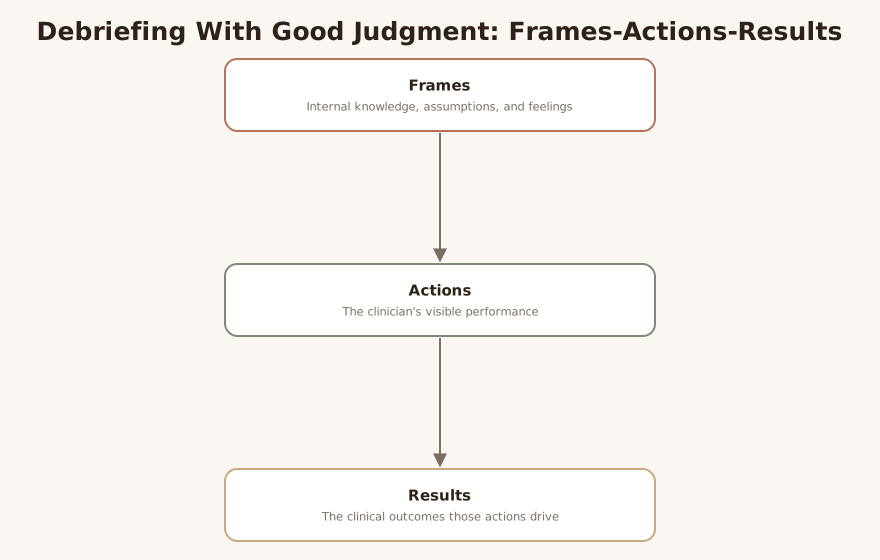
The second, and most distinctive, principle comes from Rudolph and colleagues: there is no such thing as “nonjudgmental” debriefing 1. Facilitators inevitably form judgments about a learner’s performance; pretending otherwise produces either a vague, evasive conversation or a “guess-what-I’m-thinking” interrogation 1. The proposed resolution is the frames-actions-results model — the premise that a clinician’s visible actions flow from internal frames (their knowledge, assumptions, and feelings), and that these frames in turn drive clinical results 1. Effective debriefing therefore works at the level of frames, not just behaviors 1.
The third principle is psychological safety. Productive reflection requires an environment where learners can expose error and uncertainty without humiliation, which is why a stated “basic assumption” of learner competence and good intent, plus an explicit confidentiality contract, are foundational 14.
Interventions & Techniques
Advocacy-inquiry is the core conversational move of debriefing with good judgment 1. The facilitator pairs an advocacy — a clear statement of what they observed and the judgment or concern it raised — with a genuine inquiry into the learner’s reasoning: “I noticed the airway wasn’t secured before transport, and I was concerned about that. I’m curious what you were seeing at that moment” 1. This surfaces the learner’s frame instead of merely correcting the action 1.
The PEARLS framework organizes a debrief into a predictable arc — reactions, description, analysis, and summary — and, critically, equips the facilitator with three interchangeable strategies during the analysis phase: learner self-assessment (plus/delta), focused facilitation (open-ended exploration, including advocacy-inquiry), and directive feedback or teaching when a clear knowledge gap calls for it 2. The contribution of PEARLS is meta-strategic: it teaches facilitators when to deploy each approach rather than defaulting to one 2.
LLM-generated illustrative example (not a guideline): A supervisor runs a simulated intake in which a standardized patient discloses passive suicidal ideation. In the debrief, the supervisor opens with reactions (“How did that land for you?”), uses focused facilitation with advocacy-inquiry to explore why the trainee changed the subject after the disclosure, and closes with brief directive teaching on a structured risk-screen — moving fluidly across PEARLS strategies as the conversation requires. LLM
Other standard techniques include pre-briefing (orienting learners and establishing the safe container before the scenario), use of video review where appropriate, and standardized patients for communication-heavy encounters 46.
Evidence Base
The evidence base for simulation-based education is established — this is one of the better-supported modalities in health professions education LLM. The landmark synthesis is Cook and colleagues’ 2011 JAMA systematic review and meta-analysis of technology-enhanced simulation, which pooled 609 studies enrolling more than 35,000 trainees and found large pooled effects, in comparison with no intervention, for knowledge, skills (process and product/time), and behaviors, with smaller but real effects on patient outcomes 3. The direction and consistency of those findings put the basic question — does simulation work versus nothing — largely to rest 3.
The honest caveats are equally important. Much of the literature compares simulation to no intervention rather than to other active instructional methods, so the more clinically useful question — when is simulation worth its considerable cost relative to alternatives — is less settled 3. Effect sizes are also heterogeneous, and the field’s own consensus is that outcomes depend heavily on instructional design features rather than on technology per se 3. For debriefing specifically, the methods carrying the strongest theoretical and practice consensus — debriefing with good judgment and PEARLS — are well-described and widely adopted, and INACSL codifies debriefing as a standard of best practice, though head-to-head trials isolating one debriefing method’s superiority over another remain limited 124.
Populations & Indications
Simulation-based education applies across the entire arc of a health professional’s career and across professions, from prelicensure students to experienced practitioners and intact clinical teams 5. It is indicated wherever the cost of learning on real patients is high — because the skill is high-stakes, low-frequency, or emotionally demanding — and where deliberate, repeated practice with feedback would otherwise be impossible 6.
For behavioral health specifically, the natural indications are communication-dependent and risk-laden encounters: suicide and violence risk assessment, trauma disclosure, breaking difficult news, motivational interviewing, de-escalation, and family or systems meetings LLM. Standardized patients are the workhorse here, allowing trainees to practice a delicate conversation repeatedly and to receive in-role and out-of-role feedback 6. Supervisors and clinical educators are themselves a key population, since facilitating a good debrief is a learnable skill that itself benefits from training and practice 4.
Problems-for-Work
Skills decay and uneven competency. Simulation paired with mastery-learning standards directly targets the gap between “exposed to” and “competent at,” because learners practice against an explicit benchmark until they reach it LLM. Application: a clinic standardizes a simulated columbia-style suicide screen so every clinician demonstrates the skill to criterion before using it in session LLM.
Difficult conversations and high-stakes communication. Repeated standardized-patient encounters let trainees rehearse the moments they most fear — a disclosure, a refusal, an escalation — in a setting where a misstep is a learning opportunity, not a harm 6. The debrief then unpacks the frames driving an avoidant or clumsy response 1.
Patient-safety errors and crisis management. Crisis-resource-management simulation, the original home of debriefing with good judgment, rehearses team coordination and decision-making under pressure 1.
Reflective practice and feedback skill. Debriefing builds the metacognitive habit of examining one’s own clinical reasoning, and learning to give and receive feedback is itself a trainable competency that simulation surfaces 2.
Contraindications, Cautions & Cultural Humility
Simulation is not risk-free pedagogy. A poorly run debrief — one that abandons psychological safety, shames the learner, or devolves into a guessing game — can do real harm to confidence and to the learning relationship, which is precisely why the “no such thing as nonjudgmental debriefing” argument matters: the alternatives to honest, curious judgment are usually worse 1. Facilitation by an untrained debriefer is a meaningful caution, and INACSL treats facilitator preparation as integral to the standard 4.
Emotional activation is a genuine consideration. Scenarios involving death, trauma, or suicide can evoke strong reactions, particularly in learners with relevant personal history, so a reactions phase and attention to participant well-being are built into competent debriefing 26. Pre-briefing and a clear confidentiality contract help contain this 4.
Cultural humility cuts two ways. The “basic assumption” that learners are intelligent and well-intentioned is itself a stance of humility toward the person in front of you 1. At the same time, standardized-patient scenarios and the judgments facilitators voice can carry cultural and linguistic bias, so scenario design and feedback should be examined for whose norms are being treated as the standard LLM.
Treatment-Plan Suggestions & SMART Objectives
In an educational/supervisory frame, the “client” is the learner or supervisee and the “treatment plan” is a competency-development plan LLM.
| Goal | SMART objective (example) | Mechanism |
|---|---|---|
| Improve high-risk disclosure handling | Within 6 weeks, demonstrate a structured response to a simulated suicidal-ideation disclosure to criterion in 2 consecutive standardized-patient encounters | Deliberate practice + advocacy-inquiry debrief surfacing avoidant frames 1 |
| Reach skill criterion (mastery) | Achieve the predefined passing standard on a simulated risk-assessment checklist before independent use, by end of orientation | Mastery learning: practice to a fixed standard LLM |
| Build reflective-practice habit | In each of 4 debriefs this quarter, self-identify one frame driving a clinical action using plus/delta self-assessment | PEARLS learner self-assessment phase 2 |
| Strengthen de-escalation under pressure | Within 8 weeks, maintain a structured de-escalation sequence through a simulated agitation scenario, rated adequate by 2 facilitators | Crisis-resource-management simulation + debrief 1 |
| Develop facilitation/feedback skill (supervisors) | Within one term, lead 3 debriefs applying at least 2 distinct PEARLS strategies, confirmed by peer observation | Modeling + supervised practice in blended debriefing 2 |
| Improve interprofessional communication | Across 3 team simulations this quarter, demonstrate closed-loop communication rated present by the debrief facilitator | Team-based simulation with structured debrief 6 |
| Increase psychological-safety competence | Establish a confidentiality contract and basic assumption at the start of every simulation session this rotation | Pre-briefing per debriefing best-practice standard 4 |
Common Misconceptions
“The simulation is the lesson.” The most common error is treating the scenario as the educational product; in practice the debrief is where most learning is consolidated, and a scenario run without one is largely wasted 6.
“Good debriefing is nonjudgmental.” A persistent myth, explicitly dismantled by Rudolph and colleagues: facilitators always have judgments, and the skill lies in voicing them honestly and curiously rather than concealing them 1.
“Better technology means better learning.” Cook’s meta-analysis points to instructional design, not fidelity or device sophistication, as the driver of effect — high-fidelity manikins do not guarantee learning 3.
“There is one correct debriefing method.” PEARLS exists precisely because no single approach fits every situation; competent facilitators blend self-assessment, facilitation, and directive teaching as the moment demands 2.
Training & Certification
Becoming a competent simulation educator is itself a course of training, not an inherited skill 4. The Society for Simulation in Healthcare (SSH) is the field’s central professional home and supports its development through publications, an annual conference, accreditation of simulation programs, and certification of individual practitioners 5. Facilitator preparation specifically — the ability to run a theory-based, psychologically safe debrief — is treated by INACSL as a precondition for meeting the debriefing standard of best practice, not an optional add-on 4. In practice, educators build skill through structured faculty-development workshops, supervised facilitation with feedback (often using the same advocacy-inquiry and PEARLS frameworks they will teach), and ongoing peer observation LLM.
Key Terms
- Debriefing — the facilitated, reflective post-scenario conversation that converts a simulated experience into learning 6.
- Advocacy-inquiry — pairing an honest statement of one’s observation and judgment (advocacy) with a genuine question about the learner’s reasoning (inquiry) 1.
- Frames-actions-results — the model that internal frames (assumptions, knowledge, feelings) drive visible actions, which drive clinical results; debriefing targets frames 1.
- PEARLS — a blended debriefing framework giving facilitators a menu of strategies (self-assessment, focused facilitation, directive feedback) across a structured arc 2.
- Psychological safety / basic assumption — the stance that learners are capable and well-intentioned, creating conditions where error can be examined without shame 1.
- Mastery learning — practice to a fixed performance standard rather than for a fixed time LLM.
- Standardized patient — a trained person who portrays a patient consistently for teaching or assessment LLM.
Resources & Further Reading
▶ Watch — a video introduction to this concept:
- There’s No Such Thing as “Nonjudgmental” Debriefing: A Theory and Method for Debriefing with Good Judgment (Rudolph et al., 2006)
- Promoting Excellence and Reflective Learning in Simulation (PEARLS): A Blended Approach to Debriefing (Eppich & Cheng, 2015)
- Technology-Enhanced Simulation for Health Professions Education: A Systematic Review and Meta-Analysis (Cook et al., JAMA 2011)
- Healthcare Simulation Standards of Best Practice: The Debriefing Process (INACSL)
- SSiH: Society for Simulation in Healthcare (overview)
- Healthcare Simulation Debriefing (HealthySimulation.com)
Reflective / Supervision Questions
- When you last gave a trainee feedback, did you voice your actual judgment, or did you soften it into a vague hint? What frame of your own was driving that choice? 1
- Across your recent debriefs, which PEARLS strategy do you default to, and what does your underuse of the others cost your learners? 2
- How do you establish psychological safety at the start of a simulation, and how would you know if a learner did not feel it? 4
- For a skill you teach, do you hold every learner to an explicit performance standard, or to time-served — and what would mastery learning change? LLM
- Whose cultural and communication norms are embedded in your standardized-patient scenarios, and who might they disadvantage? LLM