
Type & Discipline
The Shannon-Weaver and transactional models are theoretical frameworks drawn from communication theory and the mathematics of information, not from clinical psychology 7. They describe how a message moves (or fails to move) between parties and where its fidelity can degrade 7. They are descriptive schemas rather than treatment protocols, and they carry no inherent intervention logic of their own LLM.
For the practicing therapist, this distinction matters from the outset. These models are conceptual scaffolding that can be imported into a recognized therapeutic modality to organize how you teach, diagnose, and repair communication problems LLM. They are not themselves a billable therapy, and no payer reimburses “communication-model work” as a discrete service LLM. Their value is as a shared map you and your clients can point to when the wires get crossed LLM.
Creators & Lineage
The lineage begins with Claude Shannon, a Bell Labs engineer whose 1948 paper A Mathematical Theory of Communication in the Bell System Technical Journal formalized how information could be transmitted reliably across a noisy channel 12. Shannon’s interest was technical: how to reproduce a signal accurately at a second point despite distortion 7. Warren Weaver subsequently collaborated with Shannon, and together they expanded the work into the 1949 book The Mathematical Theory of Communication, which broadened the engineering schema toward human communication 7.
Weaver’s contribution was to articulate three levels at which communication problems occur: the technical level (accurately reproducing the message), the semantic level (whether the symbols convey the intended meaning), and the effectiveness level (whether the received message produces the intended reaction) 7. This three-level framing is what makes an engineering model useful to clinicians, because therapy rarely concerns the technical channel and almost always concerns the semantic and effectiveness levels LLM.
The model was soon criticized for treating communication as a one-way process rather than an interactive exchange 7. Wilbur Schramm developed interactive models that incorporated feedback loops and the idea that communicators draw on overlapping fields of experience 7. Dean Barnlund then advanced a fully transactional model in 1970, reframing communication as “the production of meaning, rather than the production of messages” 4. This arc, from linear transmission to interactive feedback to simultaneous transaction, situates the framework within the broader currents of systems theory, interpersonal communication, and family systems therapy 5LLM.
Core Principles
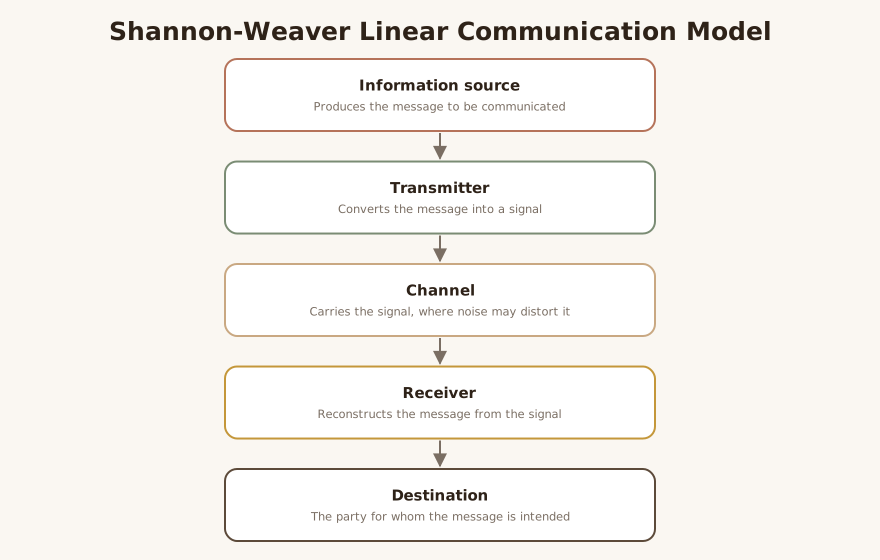
The original linear model specifies a fixed sequence: an information source produces a message, a transmitter converts it into a signal, a channel carries the signal, a noise source distorts it en route, a receiver reconstructs the message, and a destination receives it 7. Communication, in this view, is a one-way process of transmitting a message from one person to another 5. The model’s central insight for clinicians is “noise,” anything that degrades the signal between intention and reception 7.
A key corrective to the linear model is redundancy: building in repetition or structural predictability helps the receiver detect and correct distortions introduced by noise 7. This is the theoretical justification for reflective listening and “checking back” in clinical communication work LLM.
The transactional model overturns the linear sequence. Encoding and decoding are not separate sequential steps but occur simultaneously as interdependent aspects of one process 4. Both participants function continuously as both sender and receiver, eliminating the rigid role distinctions of the earlier framework 4. Communication becomes an ongoing, circular process in which participants continuously influence each other 5.
Barnlund’s model further distinguishes three types of cues that participants read: public cues (environmental elements available to everyone, such as the room or furniture), private cues (internal thoughts and sensations accessible only to the individual), and behavioral cues (the verbal and non-verbal responses under a person’s direct control) 4. Underlying all of this is the principle that the world is meaningless until people assign significance to it through interpretation, and that this assigned meaning remains in constant flux 4. The transactional model embeds each participant’s worldview and situational context directly into the act of communication, so meaning emerges from the relationship between participants rather than from isolated delivery 5.
Interventions & Techniques
These models do not prescribe techniques; clinicians translate their principles into intervention LLM. The most direct translation is naming and locating “noise.” Because the linear model isolates noise as the source of signal degradation, a therapist can use it to help a couple distinguish what was said from what was heard, externalizing the breakdown rather than blaming a person 7LLM.
Redundancy translates into structured reflective techniques. Asking a listener to paraphrase back what they heard before responding builds the predictability that lets distortions be caught and corrected 7LLM. The speaker-listener technique common in couples work operationalizes exactly this redundancy LLM.
Weaver’s three levels give clinicians a triage tool. When a couple reports they “can’t communicate,” the clinician can ask whether the failure is technical (interruptions, talking over each other), semantic (the same words mean different things to each partner), or effectiveness-level (the message lands clearly but does not move the partner to respond as hoped) 7LLM.
The transactional model’s emphasis on simultaneous encoding and decoding directs attention to the non-verbal channel that runs in parallel with words 4. A therapist can highlight that a partner is decoding a sigh or a posture (a behavioral cue) at the same moment they are encoding their own reply, which is why escalation can feel instantaneous 4LLM. Surfacing private cues, the internal sensations a partner has not voiced, becomes an intervention in itself because those cues are otherwise invisible to the other party 4LLM.
LLM-generated illustrative example (not a guideline): A clinician working with a couple draws the linear model on a whiteboard and asks each partner to identify, from last week’s argument, the “noise” between what one intended and what the other received. The wife intended “I need help with the kids” but the husband received “you are failing as a father.” Naming this as semantic-level noise, rather than as evidence of contempt, lowered the temperature enough to attempt a paraphrase exercise LLM.
Evidence Base
The evidence status here requires precision. As communication theory, the Shannon-Weaver and transactional models are established and foundational; they are standard content in communication and public-speaking curricula and are treated as canonical models of how communication works 56. Their maturity as descriptive frameworks is not in question 6.
What is not established is any body of clinical-trial evidence showing that teaching these models, as such, improves treatment outcomes LLM. No outcome literature in the provided sources evaluates these models as interventions LLM. The models are descriptive and explanatory, not empirically validated treatments, and the original Shannon work was an engineering theory rather than a psychological one 7LLM.
Clinicians should therefore frame the evidence honestly: the models are well-established as theory and as a vocabulary for understanding communication breakdown, but the therapeutic benefit comes from the validated modality into which they are embedded (for example, behaviorally based couples work or communication-skills training), not from the models themselves LLM. Critics of even the theoretical model note that the linear version oversimplifies real exchange, which is precisely why the transactional revision exists 7.
Populations & Indications
The framework is broadly applicable wherever two or more parties must coordinate meaning. It is most clinically useful with couples and families, where misattributed meaning drives much of the presenting distress 4LLM. It applies to teams and organizations navigating coordination failures, and to groups in conflict where competing interpretations of shared events fuel escalation 4LLM.
It is also directly relevant to the clinician-client dyad itself, because the therapeutic relationship is a transaction in which both parties continuously encode and decode 4LLM. People with communication difficulties, whether from skills deficits, neurodevelopmental differences, or learned patterns, are natural candidates for the explicit, externalized vocabulary the models provide LLM.
Problems-for-Work
The models map cleanly onto common presenting problems. For relationship conflict and marital distress, the transactional principle that meaning is co-constructed and in constant flux helps partners stop treating their own interpretation as objective fact 4LLM. For communication breakdown and miscommunication, the linear model’s “noise” concept gives a non-blaming location for the failure 7LLM.
For family conflict, Barnlund’s public, private, and behavioral cues help members see how much they are inferring from unspoken internal states 4LLM. For conflict resolution difficulties in groups, the transactional model’s insistence on simultaneous mutual influence reframes “winning” the exchange as impossible, since both parties shape the meaning continuously 45LLM. For therapeutic rupture, the clinician can apply the same lens to the treatment relationship, examining what noise distorted the alliance and which private cues went unspoken 4LLM.
LLM-generated illustrative example (not a guideline): In a family session, an adolescent’s eye-roll (a behavioral cue) was read by the parent as defiance, while the adolescent’s private cue was shame. Mapping this onto Barnlund’s cue types let the clinician make the private cue explicit, shifting the parent’s interpretation LLM.
Contraindications, Cautions & Cultural Humility
There are no physical contraindications to using a conceptual model, but there are real cautions LLM. The chief risk is treating the framework as an explanation that displaces clinical formulation; communication breakdown is sometimes a symptom of abuse, coercive control, untreated psychopathology, or substance use, and a tidy “noise” diagram can obscure a power imbalance that should not be reframed as mutual miscommunication LLM. Where one party’s safety is at issue, the symmetrical transactional framing of “both shape the meaning” can be actively harmful and should be set aside LLM.
Cultural humility is built into the transactional model itself, which holds that each participant brings a distinct worldview, encompassing their values, assumptions, and ways of knowing, into every exchange 5. Because the world is meaningless until people assign significance through interpretation, the clinician must not assume their own cultural reading of a cue is the correct one 4LLM. Public, private, and behavioral cues are culturally patterned; eye contact, silence, and emotional expressiveness carry different meanings across communities, so the clinician should treat their own decoding as a hypothesis to check rather than a fact 4LLM.
Treatment-Plan Suggestions & SMART Objectives
| Goal | SMART objective (example) | Mechanism |
|---|---|---|
| Reduce escalation from misread meaning | Within 6 sessions, each partner will paraphrase the other’s stated message before replying in 4 of 5 observed exchanges | Redundancy reduces semantic noise 7 |
| Distinguish intent from impact | By session 8, client will identify the “noise” in two recent conflicts using the linear model | Externalizes breakdown as signal distortion, not character 7 |
| Surface unspoken internal states | Over 4 weeks, client will name one private cue per session rather than acting on it | Makes private cues visible to the other party 4 |
| Build awareness of simultaneous influence | By session 10, client will describe one instance where their non-verbal cue shaped the partner’s response | Transactional simultaneity of encode/decode 4 |
| Triage communication failures | Client will correctly classify a conflict as technical, semantic, or effectiveness-level in 3 of 4 trials | Weaver’s three problem levels guide intervention 7 |
| Reduce attributional rigidity | Within 8 sessions, client will offer an alternative interpretation of a partner’s behavior in 70% of flagged exchanges | Meaning is assigned and in flux, not fixed 4 |
| Repair an alliance rupture | By next session, client and clinician will jointly identify the noise that distorted a prior exchange | Applies transactional lens to the therapy dyad 4 |
Common Misconceptions
A frequent error is treating the Shannon-Weaver model as a description of how human conversation actually works; it was an engineering theory of signal transmission, and its linear, one-directional form is acknowledged as overly simplistic for real human exchange 57. Relatedly, clinicians sometimes assume “feedback” was always part of the model, but feedback loops were a later addition by interactive theorists such as Schramm, not part of the original linear schema 7.
Another misconception is that “noise” means only literal, audible interference. In the model, noise is anything that distorts the signal between source and destination, which clinically includes semantic and psychological distortion, not just environmental sound 7LLM. Finally, some assume meaning is contained in the message and simply transmitted; the transactional view holds the opposite, that meaning is produced by the communicators and does not pre-exist the exchange 4.
Training & Certification
There is no certification in the Shannon-Weaver or transactional models, and none is needed; they are open theoretical frameworks taught in introductory communication and public-speaking courses rather than gatekept clinical credentials 56. The primary sources are freely available, beginning with Shannon’s 1948 paper 12.
Clinical competence comes not from certifying in the model but from credentialing in the modality that carries it LLM. A clinician who wants to use these ideas with couples should pursue training in an evidence-based couples or family approach, where structured communication work is already a core component, and then layer the model’s vocabulary onto that foundation LLM.
Key Terms
Information source / destination — the originating and final endpoints of a message in the linear model 7. Transmitter / receiver — the components that encode the message into a signal and decode it back 7. Channel — the medium carrying the signal 75. Noise — anything that distorts the signal between source and destination 7. Redundancy — built-in repetition or predictability that lets distortions be detected and corrected 7. Technical, semantic, effectiveness levels — Weaver’s three levels at which communication problems occur 7. Encoding / decoding — in the transactional model, simultaneous and interdependent rather than sequential 4. Public, private, and behavioral cues — Barnlund’s three categories of information communicators read 4. Transactional — communication as simultaneous, mutual, meaning-producing exchange rather than one-way transmission 45.
Resources & Further Reading
▶ Watch — a video introduction to this concept:
- A Mathematical Theory of Communication (Shannon, 1948) — Internet Archive scan of the Bell System Technical Journal
- A Mathematical Theory of Communication — Shannon, 1948, Bell System Technical Journal (Wiley Online Library)
- A Transactional Model of Communication (Barnlund) — De Gruyter Brill
- Barnlund’s model of communication — Wikipedia
- Models of Communication — Principles of Public Speaking (Lumen Learning)
- Models of Communication — EBSCO Research Starters
- Shannon-Weaver model — Wikipedia
Reflective / Supervision Questions
- When a client reports a communication failure, do I reflexively locate the “noise,” and at which of Weaver’s three levels (technical, semantic, effectiveness) does it usually sit for my caseload? 7LLM
- Where in my work do I unconsciously revert to the linear model, assuming my message was simply received as sent, rather than co-constructed? 4LLM
- How do my own private cues, the internal states I do not voice, shape the meaning my clients decode from me in session? 4LLM
- When have I used the symmetrical “both parties shape the meaning” frame in a situation where a power or safety imbalance made that framing inappropriate? LLM
- Am I treating my own cultural reading of a client’s behavioral cues as fact rather than as a hypothesis to be checked? 4LLM
- In what specific billable modality am I embedding this framework, and is my documentation reflecting that modality rather than the model? LLM