
Type & Discipline
The Alexander Technique is best classified as a somatic education method rather than a treatment delivered to a passive recipient 5. Its home discipline sits at the intersection of somatic education and performing arts medicine: it has historically been taught in conservatoires and drama schools, and much of its controlled-trial literature concerns musicians and performers 2. For clinicians, the most important framing is this: the Alexander Technique is taught, not administered. A teacher guides a student (the traditional term) through experiential learning, not a patient through a procedure 4. LLM
This places it in the same broad family as other somatic re-education approaches—Feldenkrais and various forms of postural retraining—that share the premise that habitual patterns of movement and tension are learnable and therefore re-learnable. LLM The practice is described as a way to “move with less stress in your body” by changing inefficient habits and accumulated tension patterns that interfere with natural movement 5.
Creators & Lineage
The technique was developed by Frederick Matthias Alexander (1869–1955), an actor who began his work in the 1890s while trying to resolve his own recurrent voice loss during public performances 6. Through self-observation—reportedly using mirrors to watch himself speak—he concluded that habitual patterns of carriage, particularly involving the head, neck, and spine, were degrading his vocal function, and that improved overall coordination improved functioning more broadly 6. He did not initially conceive of his work as a therapy; it grew out of a practical performer’s problem 6.
Alexander’s method spread first through the performing arts and later into general somatic education and health contexts 25. The lineage is now institutionalized through professional teaching bodies that train and credential teachers, including the Society of Teachers of the Alexander Technique (STAT) 7. The practice has a long roster of well-known performer advocates—actors, musicians, and writers—which has shaped its public identity as much as any clinical literature 5. LLM
Core Principles
The conceptual vocabulary below is the technique’s defining theory. Note that these constructs are part of the established Alexander tradition; the provided sources describe the head-neck-back focus and the active-learning frame but do not formally define each term, so the definitions here are presented as synthesis. LLM
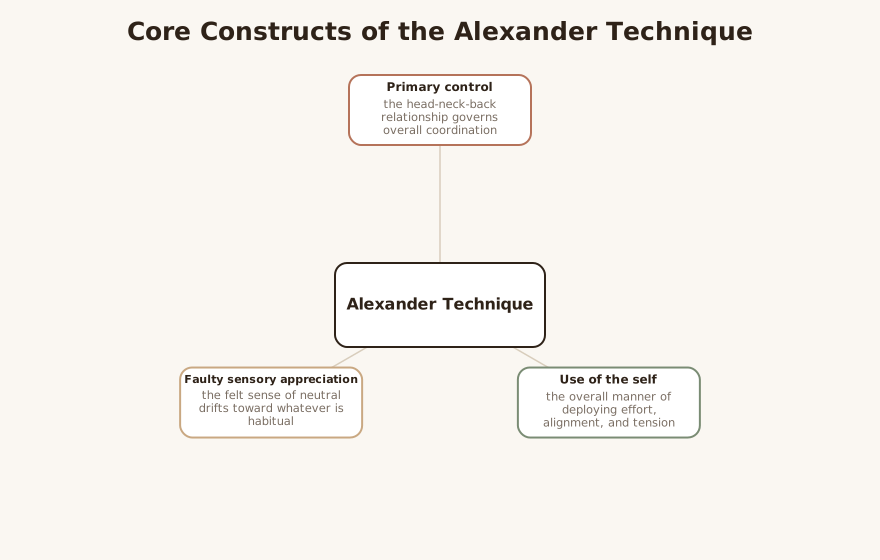
- Primary control. The organizing idea is that the dynamic relationship of the head to the neck and back governs the quality of coordination throughout the rest of the body. Freeing the neck so the head can balance lightly atop the spine is treated as the lever that improves overall use. LLM Sources do describe the core focus as maintaining a comfortable, poised relationship between head, neck, and spine 65.
- Use of the self. “Use” refers to the overall manner in which a person deploys themselves in any activity—the pattern of effort, alignment, and tension recruited to do something. The premise is that habitual misuse (chronic, unnecessary over-tensing) underlies much musculoskeletal strain. LLM
- Faulty sensory appreciation. People’s proprioceptive sense of “neutral” drifts toward whatever is habitual, so a slumped or over-tensed posture can feel “normal” and an efficient one can feel “wrong.” Re-education therefore cannot rely on how a movement feels alone. LLM
- Inhibition. Before reacting to a stimulus (standing up, picking up an instrument), the student learns to pause—to withhold the automatic, habitual response long enough that a new, less effortful response becomes possible. LLM
- Direction. Alongside inhibition, the student gives themselves conscious “directions” (e.g., letting the neck be free, the head go forward and up) that orient coordination without forcing it mechanically. LLM
- End-gaining vs. means-whereby. End-gaining is rushing toward a goal while ignoring how it is achieved; the means-whereby principle is the discipline of attending to the quality of the process. This is the technique’s central attitudinal stance. LLM
What ties these together for a clinician is the emphasis on deliberate rather than habitual movement: bringing mindful awareness to the muscular effort involved in ordinary actions so that automatic patterns become consciously chosen ones 4.
Interventions & Techniques
In practice, a lesson is one-to-one and typically lasts roughly half an hour to an hour 6. The teacher combines verbal instruction with gentle, hands-on guidance, lightly repositioning the student and inviting awareness of the muscles in use—from small distal muscles to the large muscles of the back and core—and of the dynamic balance among them 4. The work is framed as active learning rather than passive treatment: the student is acquiring a skill they can apply to everyday activities such as sitting, standing, walking, and lifting 5.
Common procedural elements in the tradition include guided transitions in and out of a chair (“chair work”), table or lying-down work, and rest in a semi-supine position; the teacher’s hands convey direction and the student rehearses inhibiting habitual effort. LLM Across these, the consistent intervention is the same: noticing and releasing unnecessary tension and re-coordinating around the head-neck-back relationship while performing real activities 64.
LLM-generated illustrative example (not a guideline): A violinist who reports forearm and neck pain when practicing is asked, before lifting the instrument, to pause (inhibit), notice the habitual bracing through the shoulders and jaw, and let the neck soften so the head balances freely. Over several lessons she rehearses raising the violin “by the means” rather than rushing to the sound, and reports playing the same passage with less grip. This is an illustration of the inhibition, direction, and means-whereby principles applied to an activity, not a claim of efficacy. LLM
Evidence Base
Honesty about the evidence is essential here, because the practice is mature but the efficacy data are limited and mixed. A practice can be “established”—long lineage, defined curriculum, professional bodies—without strong proof that it outperforms comparators. LLM
The Ernst & Canter systematic review of controlled clinical trials identified only four eligible trials, of which just two were judged methodologically sound and clinically relevant. Those two suggested benefit for reducing disability in Parkinson’s disease and for pain and functional outcomes in back pain. The authors’ overall verdict was that the technique “deserves to be studied in more detail” but that the existing evidence, while encouraging, was “not convincing” 1.
The musicians-focused systematic review by Klein and colleagues analyzed twelve controlled trials (five randomized controlled trials, five controlled trials, and two mixed-methods studies). It found a consistent signal for performance anxiety—improvement in two of two RCTs and two of two controlled trials—but effects on actual music performance quality, respiratory function, and posture remained inconclusive. The reviewers flagged small samples (averaging around 37 participants in the RCTs), inconsistent randomization reporting, and inadequate blinding, calling for better-designed future trials 2.
Beyond the trial literature, UK guidance from the National Institute for Health and Care Excellence (NICE) states that people with Parkinson’s disease experiencing balance or motor-function problems may consider the Alexander Technique alongside disease-specific physiotherapy, and a 2012 Cochrane systematic review on the topic exists 6. At the same time, some insurer assessments have classified the technique as “experimental and investigational,” and broader reviews have noted that many claimed benefits are constrained by small participant numbers and insufficient evidence 6. LLM
Bottom line for practice: the strongest defensible claims are a plausible benefit for chronic/recurrent back pain (modest, from limited trials) and for musicians’ performance anxiety; most other claims are not yet established 12. LLM
Populations & Indications
The technique is presented as broadly accessible, with no specific fitness or ability prerequisites, and is used across a wide range of ages and lifestyles 45. The populations with the most direct support or rationale are:
- Adults with chronic or recurrent low back pain, the population behind the more promising trial signal 1.
- People with neck and shoulder strain and posture-related musculoskeletal discomfort, consistent with the technique’s focus on releasing unnecessary tension and improving the head-neck-back relationship 65.
- Musicians and performing artists, both for posture/movement economy and—most supported by trials—for performance anxiety 2.
- People with Parkinson’s disease experiencing balance or motor-function problems, where guidance suggests it as an adjunct to physiotherapy 61.
Reported, less-well-evidenced benefits include greater ease and freedom of movement, improved balance and coordination, more energy for daily activities, and a stronger mind-body connection and sense of agency 45.
Problems-for-Work
The following are concrete problems-for-work where the technique is plausibly relevant, with brief application notes. Framing matters: the technique addresses how the person organizes effort during the problem activity, not the underlying pathology per se. LLM
- Chronic low back pain with habitual over-tensing. Application: re-educating sitting-to-standing transitions and daily lifting to reduce unnecessary compressive load 15.
- Music/stage performance anxiety. Application: pausing (inhibition) and re-coordinating before performance to interrupt the bracing-and-rushing pattern that compounds anxiety 2.
- Neck/shoulder tension from screen and instrument use. Application: noticing and releasing chronic shoulder/jaw bracing during the actual task 46.
- Postural strain and “poor poise.” Application: developing awareness that habitual posture feels normal (faulty sensory appreciation) and rehearsing a more economical use 6. LLM
- Balance/motor difficulties in Parkinson’s disease. Application: as an adjunct to physiotherapy targeting functional confidence in everyday transfers 61.
Contraindications, Cautions & Cultural Humility
The technique is low-risk and non-manipulative—light touch and verbal guidance, not high-velocity adjustment—so there are few hard contraindications. LLM The principal cautions are about scope and expectation rather than safety:
- Do not let it displace indicated care. It is positioned as an adjunct (e.g., alongside disease-specific physiotherapy in Parkinson’s), not a replacement for medical or psychological treatment of an underlying condition 6. LLM
- Set evidence-honest expectations. Because the efficacy data are limited and mixed, and some assessors deem it investigational, clinicians should avoid overselling it—especially for indications outside back pain and performance anxiety 126. LLM
- Cost and access vary, and it is unregulated in some jurisdictions. In the UK, for instance, there is no statutory regulation of who may offer the technique, so teacher quality rests on the professional bodies’ training standards 6. LLM
- Cultural humility. Hands-on work and close attention to the body are not neutral for every client; for those with trauma histories, somatic distress, or specific cultural norms around touch, consent should be explicit and ongoing, and a non-contact or client-led adaptation considered. LLM
Treatment-Plan Suggestions & SMART Objectives
| Goal | SMART objective (example) | Mechanism |
|---|---|---|
| Reduce habitual over-tensing in a painful daily activity | Within 6 weekly lessons, client will demonstrate a paused (inhibited) sit-to-stand transition in 4 of 5 trials without observed shoulder bracing | Inhibition + re-coordination of head-neck-back use 64 |
| Lower performance anxiety before performing | Over 8 weeks, client will report a 2-point reduction on a self-rated pre-performance tension scale before 3 consecutive performances | Pause-and-direct before stimulus reduces anticipatory bracing 2 |
| Improve postural self-awareness | Within 4 lessons, client will correctly identify 3 personal habitual tension patterns during a screen-work simulation | Counteracting faulty sensory appreciation through guided noticing 6 |
| Decrease neck/shoulder strain during instrument practice | Over 6 weeks, client will apply a release-and-direct routine at the start of 80% of practice sessions, logged in a practice diary | Reducing unnecessary muscular effort during the task 4 |
| Build functional confidence in daily transfers (Parkinson’s adjunct) | Within 8 weekly sessions, client will complete chair transfers with self-rated steadiness ≥7/10 in 4 of 5 attempts, alongside physiotherapy | Improved movement economy as an adjunct to physiotherapy 61 |
| Generalize ease of movement to daily activities | By week 6, client will independently use a 3-step pause-notice-direct sequence in 2 non-lesson daily activities, reported each session | Transfer of deliberate (vs. habitual) movement to ADLs 45 |
| Reduce recurrence-related back pain disability | Over a 10-week course, client will increase a functional activity tolerance (e.g., standing duration) by a clinician-agreed margin | Re-education of postural load during daily tasks 1 |
Common Misconceptions
- “It’s a relaxation or massage therapy.” It is an active learning process in which the student acquires a skill, not a passive treatment received from a practitioner 5. LLM
- “It’s just good posture / sitting up straight.” The aim is not a fixed “correct” posture but releasing unnecessary tension and improving coordinated use; rigidly holding a posture would itself be over-effort 64. LLM
- “It’s proven to fix back pain (or anything) outright.” The controlled-trial evidence is limited and mixed; the honest claims are modest and specific, mainly chronic back pain and performance anxiety 12. LLM
- “Because it feels right, I’m doing it right.” The principle of faulty sensory appreciation directly warns that habitual patterns feel normal; felt-sense alone is an unreliable guide early on 6. LLM
- “It only matters for performers.” While performers are heavily represented, it is taught for everyday activities and ordinary musculoskeletal strain across the general population 45. LLM
Training & Certification
The technique is taught by trained teachers, and professional organizations exist to set training standards 76. Teacher-training courses are typically multi-year; professional bodies in the UK, for example, characteristically run three-year courses for those becoming instructors 6. The Society of Teachers of the Alexander Technique (STAT) is one such professional body that publishes introductory and educational material about the method 7. LLM
A practical caution for referral: in at least some jurisdictions (e.g., the UK) there is no statutory regulation of who may offer the technique, so the relevant quality assurance is membership in a recognized teaching body rather than a government license 6. Clinicians making referrals should therefore confirm a teacher’s professional-body credentialing. LLM
Key Terms
- Primary control — the head-neck-back relationship treated as the organizing influence on overall coordination. LLM
- Use (of the self) — the overall manner of effort, alignment, and tension a person brings to any activity; misuse is chronic unnecessary tension. LLM
- Inhibition — pausing to withhold the habitual automatic response so a less effortful one becomes possible. LLM
- Direction — conscious orienting “directions” (e.g., free neck, head forward and up) that guide coordination without forcing. LLM
- End-gaining — rushing toward a goal while ignoring the quality of the process. LLM
- Means-whereby — attending to how a goal is achieved rather than just the result. LLM
- Faulty sensory appreciation — the unreliability of felt-sense, since habitual patterns feel “normal.” LLM
- Semi-supine — a common resting position used in lessons to encourage release. LLM
Resources & Further Reading
▶ Watch — a video introduction to this concept:
- The Alexander technique: a systematic review of controlled clinical trials (Ernst & Canter)
- The Alexander Technique and musicians: a systematic review of controlled trials (Klein et al., PMC)
- Alexander Technique — Physiopedia
- How to Use the Alexander Technique — Psychology Today
- What is the Alexander Technique and what are its Benefits? — AlexanderTechnique.com
- Alexander technique — Wikipedia
- Alexander Technique: an introduction (STAT) — YouTube
Reflective / Supervision Questions
- For which of my clients is “how they organize effort during an activity” actually the lever, versus an underlying pathology that needs primary medical or psychological treatment? LLM
- Given the limited and mixed evidence, how do I present the Alexander Technique to a client without over-promising—and where exactly do I draw the line between back pain / performance anxiety (better supported) and everything else? LLM
- How would I confirm a teacher’s credentialing before referring, in a jurisdiction where the practice is unregulated? LLM
- When recommending hands-on somatic work, how am I securing ongoing consent and offering low-contact adaptations for clients with trauma histories or touch-related cultural norms? LLM
- Am I distinguishing in my own documentation between the practice being established and its efficacy being modest, so that my framing stays evidence-honest? LLM