
Type & Discipline
Sabbath-keeping, also rendered as “sacred rest,” is best classified as a technique or structured behavioral practice rather than a free-standing psychotherapy LLM. It sits at the intersection of practical theology and behavioral health: its content is drawn from Jewish and Christian Sabbath theology, while its clinical use borrows the logic of behavioral prescription, stimulus control, and values-based action LLM. The core practice is a recurring, time-bounded cessation from work and, in contemporary adaptations, from technology and acquisition 3. Within a knowledge base of religious-practice research, it belongs alongside other ritual and contemplative interventions that clinicians increasingly fold into secular care for boundary-setting and restoration LLM.
Crucially, Sabbath-keeping is a practice with a deep theological literature but a comparatively thin empirical one LLM. Clinicians should hold it as a promising, emerging adjunct — a way to operationalize rest, not a manualized treatment with established efficacy LLM.
Creators & Lineage
The practice has no single “creator”; it descends from the Sabbath commandment in the Hebrew Bible and millennia of Jewish observance, later carried into Christian traditions 3. The figure most responsible for translating Sabbath into a psychological and existential idiom is Rabbi Abraham Joshua Heschel, whose 1951 book The Sabbath reframed it not as a place of worship but as an “architecture of time” — a “palace in time” rather than space 3. Heschel argued that technical civilization is humanity’s conquest of space, and that the Sabbath offers a counter-discipline: a day devoted not to having and making but to being and meaning 3. His framing of time as the medium of holiness, and of rest as a positive spiritual good rather than mere recovery for more work, is the conceptual taproot for nearly all later wellbeing applications 5. Heschel’s broader meditations on the “mystery of time” extend this theme into his late lectures 7.
A second lineage is theological-political. Walter Brueggemann’s Sabbath as Resistance recasts the practice as a deliberate refusal of the “culture of now” — anxiety, commodification, and ceaseless production — positioning rest as an act of resistance against a system that defines persons by output 4. This framing maps unusually well onto clinical work with burnout and overfunctioning, because it names the cultural driver of restlessness rather than locating the problem solely in the individual LLM.
The contemporary self-help and wellness lineage — popularizers such as Wayne Muller and Matthew Sleeth — translated these theological sources into accessible “rest practices” for general and often secular audiences, which is the form most clinicians and clients now encounter LLM. Hope College’s wellness writing, summarizing this stream, frames Sabbath as a “salubrious celebration” with plausible links to health 6.
Core Principles
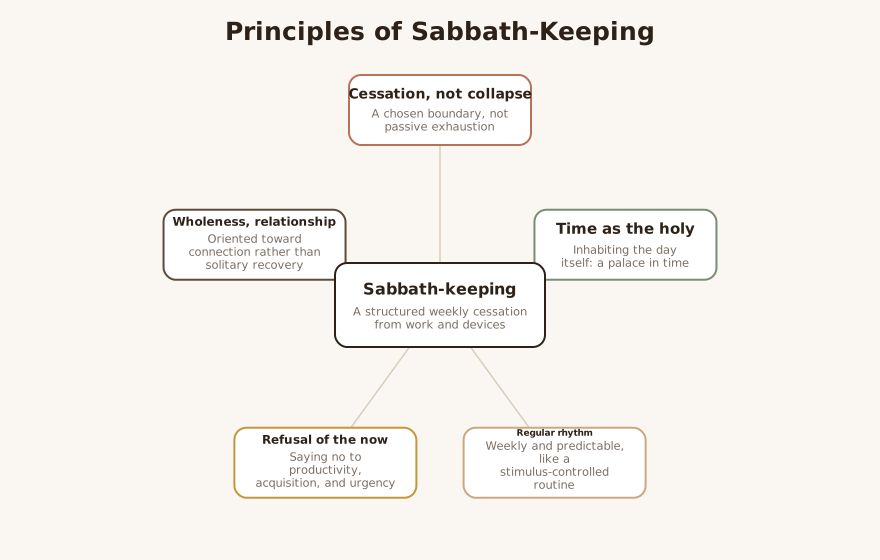
Several principles recur across the theological and applied literature LLM:
- Cessation, not collapse. The Sabbath is an active stopping — a chosen boundary — not passive exhaustion at the end of a depleted week 3. Heschel distinguishes rest-as-meaning from rest-as-recovery-for-labor 3.
- Time as the domain of the holy. The practice elevates a period of time rather than a place or possession; the “palace in time” image asks the person to inhabit the day itself as the good, not as preparation for the next productive interval 5.
- Regular rhythm. Sabbath is weekly and predictable, which gives it the structure of a stimulus-controlled routine rather than an occasional retreat 3.
- Refusal of the culture of now. The practice is framed as saying “no” to productivity pressure, acquisition, and urgency 4.
- Wholeness and relationship. Across traditions the day is oriented toward connection — family, community, the transcendent — rather than solitary recovery 6.
In secular clinical translation, these become: a bounded weekly window, deliberate disengagement from work and devices, and intentional reorientation toward rest, relationship, and meaning LLM.
Interventions & Techniques
In practice, a clinician helps a client design a feasible Sabbath rather than prescribing a religious one wholesale LLM. Common components include:
- Defining the window. Naming a fixed, recurring block (a full day, an evening-to-evening, or a scaled-down half-day) so the practice has predictable edges 3.
- Cessation rules. Agreeing in advance what stops — paid work, email, errands, and increasingly screens and social media — to reduce in-the-moment decision fatigue LLM. This functions like stimulus control: removing the cues that pull the client back into doing LLM.
- Positive substitution. Filling the window with restorative, relational, or contemplative activity rather than leaving a vacuum, which parallels behavioral-activation logic LLM.
- Ritual markers. Using simple opening and closing rituals (a candle, a shared meal, a walk) to bound the time psychologically 6.
- Reframing rest as legitimate. Cognitive work to challenge beliefs that rest must be earned or that stopping is irresponsible — Brueggemann’s “resistance” framing can be a useful externalizing metaphor 4.
LLM-generated illustrative example (not a guideline): A client who checks work email reflexively agrees to a “Friday sundown to Saturday sundown” window during which the work app is deleted from her phone, the laptop stays in a drawer, and the time opens with a shared dinner and closes with a short walk. The clinician frames lapses not as failures but as data about which cues are hardest to interrupt LLM.
Evidence Base
The evidence base is emerging and mixed, and clinicians should represent it that way LLM. The strongest applied data come from the Duke Clergy Health Initiative’s Sabbath Living Study, which tracked changes in Sabbath-keeping and mental health over time among clergy — a population uniquely prone to boundaryless work 1. That evaluation examined whether increased Sabbath observance tracked with mental-health outcomes in a group for whom “always on call” is an occupational norm 1. Findings of this kind are suggestive of benefit but come from a specific, religiously committed sample and an evaluation (not a randomized trial) design 1.
The literature is also honest about costs. Research on Sabbath observance among Orthodox Jews documents both mental-health benefits and burdens — observance can confer structure, community, and respite, but rigid requirements can also generate strain, particularly where the practice intersects with illness, family conflict, or scrupulosity 2. This two-sided finding is clinically important: the same practice that restores one client can become another source of pressure 2.
More popular syntheses, such as Hope College’s wellness writing, gather correlational and theoretical links between Sabbath-keeping and health but do not establish causation 6. Taken together: there is real signal that structured weekly rest is associated with wellbeing, the mechanisms are plausible, and the practice is low-risk for most clients — but there are no large randomized trials of “secular Sabbath” as a clinical intervention, effects are likely entangled with religiosity and community, and the practice can carry costs for some LLM. Present it as a reasonable, theory-rich adjunct, not an evidence-based standalone treatment LLM.
Populations & Indications
Sabbath-keeping is most clearly indicated where the presenting problem is too much doing and too few boundaries LLM. Strong candidates include:
- Clergy and ministry workers, the population in which it has been most directly studied and who face structural pressure against rest 1.
- Observant Jewish and Christian clients, for whom the practice is congruent with existing belief and can be supported rather than introduced 3.
- Burned-out professionals, caregivers, and “always-on” knowledge workers, where a bounded weekly stop directly targets the exhaustion driver LLM.
- Adults with digital or technology overload, where the cessation rules double as a device-boundary intervention LLM.
- High-achieving, overfunctioning clients whose self-worth is fused to output, for whom Brueggemann’s resistance framing can be therapeutically destabilizing in a useful way 4.
Problems-for-Work
- Occupational burnout. A predictable weekly window of cessation interrupts the unbroken work cycle and creates a reliable recovery period 1.
- Workaholism / overfunctioning. The practice externalizes the “always more” demand as a culture to resist, loosening the fusion of identity and productivity 4.
- Digital overload and compulsive device use. Technology cessation rules remove the cues that drive checking, functioning as scheduled, low-friction abstinence LLM.
- Poor work-life boundaries. A fixed, ritual-marked window gives the client a concrete, repeatable boundary to enforce rather than an abstract intention 3.
- Productivity-driven anxiety. Reframing rest as legitimate and meaningful, not as idleness to be justified, can reduce the guilt that fuels restlessness 5.
LLM-generated illustrative example (not a guideline): For a caregiver reporting “I never stop,” the clinician and client co-design a four-hour Saturday-morning Sabbath, hand off caregiving duties to a sibling during that window, and pair it with a closing ritual. Over weeks the client reports the window has become the one time guilt about resting recedes LLM.
Contraindications, Cautions & Cultural Humility
Sabbath-keeping is generally low-risk, but it is not universally indicated LLM. Cautions include:
- Scrupulosity and religious OCD. For clients prone to rigid rule-following, a rules-based practice can amplify obsessive checking, guilt over imperfect observance, and moral distress; the Orthodox-observance research explicitly documents observance-related costs 2. Introduce flexibility deliberately and watch for the practice becoming another performance to fail at LLM.
- Depression with anhedonia or social isolation. An unstructured “rest” window can collapse into rumination or withdrawal; positive substitution and relational components are essential LLM.
- Coercion and authenticity. Clinicians must not impose a religious practice on clients who do not share the tradition; the secular adaptation should be offered as one option among several, framed in the client’s own values LLM.
- Cultural and economic access. A full day of cessation presumes a degree of economic and scheduling privilege many clients lack (shift work, gig labor, caregiving without backup). Scale the practice to the client’s real life rather than an idealized day of leisure LLM.
Cultural humility means treating the deep traditions behind the practice with respect — not stripping Heschel’s or Brueggemann’s theology for parts while ignoring its meaning to communities who live it — and letting religiously committed clients lead on how their own observance is honored in therapy 3.
Treatment-Plan Suggestions & SMART Objectives
| Goal | SMART objective (example) | Mechanism |
|---|---|---|
| Establish a weekly rest boundary | Client will observe one bounded rest window of at least 4 hours each week for 6 consecutive weeks, logged in a simple tracker | Stimulus control + behavioral structure 3 |
| Reduce compulsive device use | Client will keep work email and social apps off devices during the weekly window for 6 of 8 weeks | Cue removal / scheduled abstinence LLM |
| Reframe rest as legitimate | Client will identify and challenge one “rest must be earned” belief per session for 4 sessions | Cognitive restructuring of productivity beliefs 4 |
| Increase restorative activity | Client will plan and complete one relational or contemplative activity within each rest window weekly | Behavioral activation / positive substitution LLM |
| Lower productivity-driven guilt | Client will rate rest-related guilt (0–10) before and after each window for 6 weeks, targeting a downward trend | Habituation + meaning reframe 5 |
| Strengthen work-life separation | Client will define explicit start/stop rituals and use them at least 5 of 6 weeks | Ritual bounding of time 6 |
| Build sustainable rhythm | Client will review and adjust the rest design with the clinician at weeks 3 and 6 to improve feasibility | Iterative fit to real-life constraints LLM |
Common Misconceptions
- “Sabbath just means doing nothing / sleeping in.” The tradition frames it as an active, meaning-oriented cessation, not passive collapse — rest as a positive good, not recovery for more labor 3.
- “It’s only for religious clients.” While its sources are religious, the secular adaptation as a rest-and-boundary practice is offered on the client’s own terms LLM.
- “The evidence proves it works.” The applied evidence is emerging, mostly correlational or evaluation-based, and concentrated in clergy and observant samples; it documents costs as well as benefits 12.
- “More observance is always better.” Research among Orthodox Jews shows rigid observance can carry real psychological costs, so feasibility and flexibility matter 2.
- “It’s a productivity hack.” Brueggemann’s framing is explicitly a refusal of productivity logic, not a technique to recharge for more output 4.
Training & Certification
There is no certification, credentialing body, or manualized training for Sabbath-keeping as a clinical intervention LLM. Clinician preparation is primarily conceptual and self-directed: reading the primary theological sources — Heschel’s The Sabbath for the “palace in time” framework and Brueggemann’s Sabbath as Resistance for the cultural-critique framing — and the applied wellbeing literature such as the Duke Sabbath Living Study 341. Clinicians integrating it should ground their use in established, trainable modalities (behavioral activation, values work, boundary-setting) for which they already hold competence, and consult or refer when a client’s religious tradition is central, to honor the practice’s lived meaning LLM.
Key Terms
- Sabbath / Shabbat: the recurring day of cessation from work in Jewish and Christian tradition; the practical and theological root of the technique 3.
- Palace in time: Heschel’s metaphor framing the Sabbath as sacred time rather than sacred space — the day itself as the good to be inhabited 5.
- Sacred rest: the contemporary, often secularized label for structured restorative cessation derived from Sabbath practice LLM.
- Culture of now: Brueggemann’s term for the productivity-and-acquisition pressure the Sabbath is meant to resist 4.
- Cessation: the active stopping of work (and, in modern forms, technology and acquisition) that defines the practice 3.
- Observance costs: documented psychological burdens that rigid practice can carry, alongside its benefits 2.
Resources & Further Reading
▶ Watch — a video introduction to this concept:
- The Sabbath — Abraham Joshua Heschel (Farrar, Straus and Giroux, 1951)
- Sabbath as Resistance: Saying No to the Culture of Now — Walter Brueggemann
- Changes in Sabbath-Keeping and Mental Health Over Time — Sabbath Living Study (Duke Clergy Health Initiative)
- The Mental Health Benefits and Costs of Sabbath Observance Among Orthodox Jews
- A “Palace in Time”: Rabbi Abraham Joshua Heschel on the Sabbath
- Sabbath as a Salubrious Celebration: Links Between Sabbath-Keeping and Health (Hope College, The Bell Tower)
- Abraham Joshua Heschel on the Mystery of Time (1967 lecture excerpts)
Reflective / Supervision Questions
- When I introduce “rest” as a clinical goal, am I drawing on the client’s own values and tradition, or importing a practice that fits my framework better than theirs? LLM
- For this client, is structured rest likely to relieve pressure or to become one more rule to perfect — and how would I tell the difference early? 2
- How do I represent the evidence honestly, naming that it is emerging and concentrated in specific populations, without either overselling or dismissing a plausible, low-risk practice? 1
- Am I scaling the practice to the client’s real economic and caregiving constraints, or to an idealized day of leisure they cannot access? LLM
- If a client is religiously observant, how am I honoring the lived meaning of their Sabbath rather than treating it as a generic wellness technique? 3