
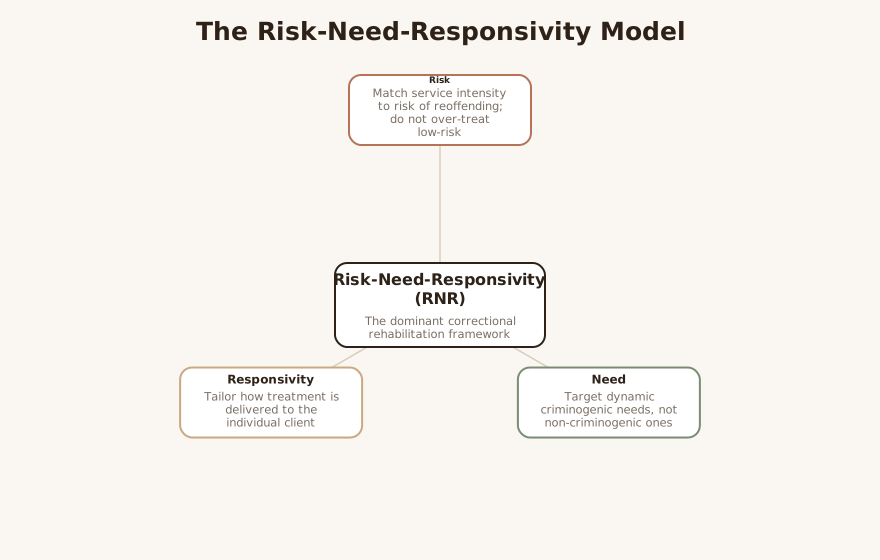
The Risk-Need-Responsivity (RNR) Model is the framework most correctional and forensic systems use to decide who gets treated, what gets treated, and how 1LLM. Its premise is deceptively simple: match the intensity of service to the person’s risk of reoffending, target the dynamic factors actually linked to their criminal behavior, and deliver that intervention in a way the person can absorb 1. For clinicians who work anywhere near the justice system — forensic settings, mandated treatment, probation-referred clients, or substance use programs with court-involved patients — RNR is less an optional model than the operating grammar of the field, and understanding it lets you read assessments, treatment plans, and program designs that would otherwise look like jargon 5LLM.
Type & Discipline
RNR is a framework for offender assessment and rehabilitation rather than a single psychotherapy, and its disciplinary home is forensic psychology and correctional rehabilitation 1LLM. It does not prescribe one named therapy so much as a set of principles that govern how any rehabilitative intervention should be selected, targeted, and delivered to justice-involved people 1. In practice it functions as a meta-framework: a cognitive-behavioral program, a substance use intervention, or a structured supervision plan can all be “RNR-adherent” or not, depending on whether they honor the three principles 3LLM.
Because it is a framework rather than a modality, RNR is defined by its decision rules rather than by a particular set of in-session techniques 1LLM. Its three core principles — risk, need, and responsivity — are widely described as among “the most carefully studied, yet least understood” terms in the criminal justice lexicon, precisely because each is routinely confused with a colloquial meaning that the model does not intend 5. The model’s unit of concern is the population of justice-involved people and the matching of service to their assessed characteristics, not the therapeutic hour in isolation 1LLM.
Creators & Lineage
RNR was developed primarily by the Canadian psychologists Donald Andrews and James Bonta, whose formulation in work for Public Safety Canada became the model’s canonical statement 1. The model is considered by many the best existing framework for determining offender treatment, and its development is closely associated with Andrews, Bonta, and Paul Gendreau, who together built much of the empirical case for what does and does not reduce recidivism 4. Stephen Wormith joined Andrews and Bonta in later articulations that defended and extended the model against competing frameworks 2.
The theoretical engine beneath RNR is the General Personality and Cognitive Social Learning (GPCSL) theory of criminal conduct, which holds that criminal behavior results from a personality predisposition interacting with learned expectations about the rewards and costs of acting 1. In this account, behavior occurs when the anticipated rewards for crime outweigh those for prosocial alternatives, which is why the model treats attitudes, associations, and reinforcement contingencies as the levers of change 1. RNR did not emerge in a vacuum: it grew out of, and partly in reaction to, the “nothing works” pessimism about rehabilitation, marshaling meta-analytic evidence to argue that rehabilitation does work when it follows the principles 3LLM. A significant later thread in the lineage is the dialogue with Tony Ward’s Good Lives Model, a strengths-and-goals-oriented alternative that Andrews, Bonta, and Wormith engaged directly 2.
Core Principles
The first principle is risk: match the level of service to the offender’s risk to reoffend 1. This rests on two claims — that criminal behavior can be reliably predicted, and that treatment intensity should be concentrated on higher-risk individuals rather than spread evenly 1. The counterintuitive clinical implication, which clinicians new to the field often resist, is that low-risk clients should receive little or no intensive intervention, because over-treating them can do harm 5LLM.
The second principle is need: assess criminogenic needs and target them in treatment 1. Criminogenic needs are dynamic risk factors directly linked to criminal behavior — the things that, when they change, change the probability of reoffending 1. This is distinguished sharply from non-criminogenic needs, which may be genuine human needs but are not statistically tied to recidivism; raising self-esteem without addressing procriminal attitudes, the model warns, may simply produce “confident criminals” 1. The empirically supported targets are usually organized as the “Central Eight,” with a “Big Four” subset — antisocial personality pattern, procriminal attitudes, antisocial associates, and a history of antisocial behavior — carrying the most predictive weight, alongside substance abuse, family/marital relationships, school/work performance, and the use of leisure/recreation 14.
The third principle is responsivity: maximize the person’s ability to learn from a rehabilitative intervention 1. It has two layers. General responsivity holds that cognitive social-learning methods are the most effective way to influence human behavior, so interventions should be cognitive-behavioral in style regardless of the individual 1. Specific responsivity is the “fine tuning” — adapting the intervention to the person’s learning style, motivation, abilities, strengths, personality, culture, and circumstances 1. Responsivity is the principle clinicians most often misread, treating it as a vague call to “build rapport” rather than a structured requirement to match method to learner 5LLM.
Interventions & Techniques
RNR’s “interventions” begin with structured, validated assessment: the model instructs practitioners to use validated instruments to assess risk, need, and responsivity rather than relying on unaided clinical impression 1. Tools in the Andrews-Bonta lineage, such as the Level of Service inventories, operationalize the Central Eight into scored domains that classify risk level and identify which dynamic needs to target 4LLM. The assessment is not a gatekeeping formality; it is the document that determines dosage and content of treatment 1LLM.
The treatment that follows is, by general responsivity, cognitive-behavioral and social-learning based — prosocial modeling, reinforcement of prosocial behavior, cognitive restructuring of procriminal thinking, and skills practice 1. The model also specifies how staff should behave: effective programs depend on staff relationship skills (a respectful, collaborative, warm yet firm style) combined with structuring skills (modeling, reinforcement, and problem-solving), delivered with continuity and ongoing monitoring 1. Where possible, the model favors community-based delivery over institutional settings, and it requires agency-level commitment to staff selection, training, and clinical supervision for the approach to hold its effects 1.
LLM-generated illustrative example (not a guideline): A probation-referred client scores high-risk on a validated inventory, with procriminal attitudes and antisocial peers as his top criminogenic needs. An RNR-adherent plan assigns him to an intensive cognitive-behavioral group (matching service to risk), focuses sessions on restructuring procriminal thinking and building prosocial associations (targeting his specific needs), and — because he reads at a low level and is initially hostile — uses concrete, skills-based exercises and a motivational stance rather than abstract worksheets (specific responsivity) LLM.
Evidence Base
The maturity of RNR’s evidence base is best described as established, and it is one of the more quantified frameworks in applied psychology 1LLM. Its distinctive feature is that effect sizes scale with adherence to the principles, drawn from a large body of meta-analytic tests 1. Across roughly 374 tests, adherence to the risk principle was associated with about a 10% average reduction in recidivism; targeting criminogenic needs was associated with around a 19% average difference; and using general-responsivity (cognitive-behavioral) methods with about a 23% average difference 1.
The most striking finding concerns combination and setting. When all three principles are honored together, reported reductions in recidivism reach roughly 17% in residential or custodial settings and about 35% in community settings — and the community advantage is part of why the model favors community delivery 1. These success rates compare favorably with criminal-justice benchmarks such as police crime-clearance rates and with the effect sizes of some routine medical interventions, a comparison the model’s developers use to argue rehabilitation is not a weak lever 1LLM.
Honesty about the downside is part of the evidence. The same literature indicates that programs which violate the principles — for example, delivering intensive treatment to low-risk people or targeting non-criminogenic needs — can be iatrogenic, actually increasing recidivism rather than leaving it unchanged 1. This “do no harm” finding is one of the model’s most clinically important and most counterintuitive contributions 1LLM. Critics note that much of the evidence is correlational at the program level and that the model’s effects depend heavily on implementation fidelity, which is uneven in real systems 6LLM.
Populations & Indications
RNR was built for and validated on justice-involved populations — incarcerated people, those on community supervision such as probation and parole, and the broad range of adults processed through correctional systems 14. It is the framework most correctional agencies use to triage caseloads and design programming, and its assessment-driven logic is meant to apply across the spectrum of offense types rather than to one diagnosis 1LLM.
Beyond adult corrections, the principles have been extended to justice-involved youth and to forensic mental health contexts, where the same logic of matching intensity to risk and targeting dynamic factors applies, though with adaptations for developmental stage and clinical complexity 4LLM. The model is also routinely invoked in substance use treatment for court-involved clients, since substance abuse is one of the Central Eight criminogenic needs and frequently co-occurs with offending 1LLM. A crucial indication point clinicians sometimes miss: RNR explicitly indicates minimal intervention for low-risk individuals, so the model’s “population” is really the higher-risk segment of any justice caseload 51.
Problems-for-Work
RNR gives a team a structured way to attack a specific set of problems, all organized around reducing future offending 1LLM.
- Recidivism risk that is poorly stratified is the foundational problem: the risk principle gives clinicians a defensible basis for concentrating scarce intensive services on higher-risk clients and pulling back from low-risk ones 1.
- Procriminal attitudes and cognitions are a core Big-Four target, addressed through cognitive restructuring within social-learning interventions 1.
- Antisocial peer associations are another high-weight need, worked through interventions that build prosocial supports and reduce criminal social networks 1.
- Substance use linked to offending is a Central Eight need and a frequent focus of RNR-adherent programming for court-involved clients 1.
- Treatment non-engagement in mandated clients is addressed through the responsivity principle — matching method, motivation, and staff style so that involuntary clients can actually learn 15.
- The temptation to “treat everything” is itself a problem RNR disciplines, by directing attention away from non-criminogenic needs that do not move recidivism 1.
LLM-generated illustrative example (not a guideline): A reentry program is overwhelmed and treating every participant with the same intensive curriculum. An RNR review reassesses the caseload, reassigns low-risk participants to minimal monitoring, and reallocates the freed group hours to high-risk participants whose top needs are antisocial peers and procriminal attitudes — concentrating the dose where the evidence says it matters LLM.
Contraindications, Cautions & Cultural Humility
The clearest caution in RNR is structural: applying the model badly is worse than not applying it, because intensive intervention with low-risk people and targeting of non-criminogenic needs can increase recidivism 1. This makes accurate, validated assessment a near-prerequisite; an RNR plan built on a poor risk classification can do harm in the model’s own terms 1LLM. The framework should not be treated as a license to ignore acute clinical needs — suicidality, acute mental illness, trauma, housing — simply because they are “non-criminogenic”; those needs may be irrelevant to recidivism prediction yet entirely relevant to the person’s welfare and to engagement 5LLM.
The model’s main intellectual critique, associated with Tony Ward’s Good Lives Model, is that RNR is deficit-focused and risk-centric, treating people as bundles of risk factors to be reduced rather than agents with goals, and that it underweights motivation, identity, and the building of a meaningful life 2. Andrews, Bonta, and Wormith responded that the responsivity principle already accommodates strengths and motivation, and questioned whether grafting the Good Lives Model onto RNR adds measurable crime-prevention value 2. A practicing clinician can hold both: use RNR’s targeting discipline while attending to agency and good-life goals as engagement and responsivity strategies 26LLM.
On cultural humility, specific responsivity is the formal point of entry — culture, language, and circumstance are explicitly named as factors to fine-tune to — but the assessment instruments and the very concept of “criminogenic need” have been criticized for being developed on, and potentially biased toward, particular populations 16. Clinicians should treat risk scores as decision aids interpreted within context, not as neutral facts, and remain alert to how structural disadvantage can be misread as individual risk 6LLM.
Treatment-Plan Suggestions & SMART Objectives
| Goal | SMART objective (example) | Mechanism |
|---|---|---|
| Match service intensity to risk | Within 2 weeks, client will complete a validated risk/need assessment, and a service dosage matched to the resulting risk level will be documented | Risk principle: concentrate intensive service on higher-risk clients 1 |
| Reduce procriminal attitudes | Over 12 weeks, client will demonstrate, in session and on a structured measure, increased prosocial reasoning in at least 3 previously procriminal scenarios | Targeting a Big-Four criminogenic need via cognitive restructuring 1 |
| Rebuild prosocial associations | Within 8 weeks, client will identify and engage at least 2 prosocial supports while reducing time with antisocial peers, tracked weekly | Need principle applied to antisocial associates 1 |
| Address substance use as a criminogenic need | Over the episode of care, client will complete a cognitive-behavioral substance use module and report use on a structured log at each session | Substance abuse is a Central Eight dynamic risk factor 1 |
| Improve responsivity and engagement | By week 3, the plan will document client’s learning style, motivation, and barriers, and intervention materials will be adapted accordingly | Specific responsivity: fine-tune method to the learner 15 |
| Avoid over-treating low risk | For low-risk clients, the plan will specify minimal monitoring rather than intensive group programming, with rationale recorded | Risk principle: minimal intervention for low-risk people prevents iatrogenic harm 15 |
| Use cognitive-behavioral delivery | All targeted needs will be addressed through social-learning methods (modeling, reinforcement, skills practice) documented in the curriculum | General responsivity: cognitive-social-learning methods are most effective 1 |
| Build prosocial reinforcement | Over 12 weeks, staff will deliver and document prosocial modeling and reinforcement in each contact, with supervision review | Effective staff structuring skills within an RNR-adherent program 1 |
Common Misconceptions
The most common misconception is that higher risk should get more services because they are sicker — clinicians often read the risk principle backward; the principle is about concentrating intensity on high risk and deliberately withholding it from low risk, because intensive treatment of low-risk people can backfire 15. A second misconception is that “need” means any human need; in RNR, “need” is the technical term criminogenic need, a dynamic factor statistically linked to reoffending, not the colloquial sense of a person’s struggles 15. A third is that “responsivity” just means rapport; it is a structured requirement to match the method to the learner, with general and specific layers, not a soft synonym for being nice 51.
A fourth misconception is that RNR ignores strengths and motivation; its defenders argue the responsivity principle already incorporates strengths, learning style, and motivation, even as critics push for a more explicit good-life orientation 12. A fifth is that the model is a specific therapy you can be certified in; it is a framework that any social-learning-based intervention either does or does not adhere to 1LLM. A sixth is that following one principle is enough; the largest recidivism reductions appear only when risk, need, and responsivity are honored together 1.
Training & Certification
There is no single license to “practice RNR”; it is implemented by existing correctional, probation, and clinical staff who learn to assess and deliver services according to its principles 1LLM. Competence centers on two things the model itself specifies: validated assessment of risk, need, and responsivity, and the staff relationship-plus-structuring skills that effective programs require, supported by agency-level training and clinical supervision 1. Many practitioners are trained through certification in specific Andrews-Bonta-lineage assessment instruments and through structured-skills curricula for correctional staff 4LLM.
Introductory training resources frame RNR theory for new practitioners — for example, the Center for Justice Innovation’s training series includes an introductory module on Risk-Need-Responsivity theory aimed at justice-system staff 7. As with any structured framework, fidelity drives outcomes: the model’s reported effects assume the assessment is done with validated tools, the dosage actually matches risk, and the delivery is genuinely cognitive-behavioral, so training that secures implementation fidelity is not optional but load-bearing 16LLM.
Key Terms
- Risk principle: match the level of service to the person’s risk to reoffend, concentrating intensity on higher-risk individuals 1.
- Need principle: assess and target criminogenic needs — the dynamic factors directly linked to criminal behavior 1.
- Responsivity principle: maximize the person’s ability to learn from intervention through cognitive-social-learning methods (general) tailored to the individual (specific) 1.
- Criminogenic need: a dynamic risk factor whose change alters the probability of reoffending 1.
- Non-criminogenic need: a genuine need not statistically tied to recidivism; addressing it alone does not reduce reoffending 1.
- Central Eight / Big Four: the eight empirically supported risk/need domains, of which four (antisocial personality pattern, procriminal attitudes, antisocial associates, history of antisocial behavior) carry the most predictive weight 14.
- General responsivity: the use of cognitive-social-learning methods as the most effective way to influence behavior 1.
- Specific responsivity: fine-tuning the intervention to the individual’s learning style, motivation, strengths, culture, and circumstances 1.
- GPCSL theory: the General Personality and Cognitive Social Learning theory of criminal conduct that underpins the model 1.
- Good Lives Model: a strengths- and goals-oriented alternative/complement, associated with Tony Ward, that RNR’s developers engaged and critiqued 2.
Resources & Further Reading
▶ Watch — a video introduction to this concept:
- Bonta & Andrews (2007), Risk-Need-Responsivity Model for Offender Assessment and Rehabilitation — Public Safety Canada
- Andrews, Bonta & Wormith (2011), The RNR Model: Does Adding the Good Lives Model Contribute to Effective Crime Prevention? — Criminal Justice and Behavior
- The Risk-Need-Responsivity Model of Offender Rehabilitation (ERIC full text)
- Risk-need-responsivity model — Wikipedia
- Risk, Need, and Responsivity: The Most Carefully Studied, Yet Least Understood, Terms — Policy Research Associates
- Critical Review of the Risk-Need-Responsivity (RNR) Model — ResearchGate
- CCAT Training Series — Module One: Introduction to Risk-Need-Responsivity Theory — Center for Justice Innovation
Reflective / Supervision Questions
- For each client on my caseload, is the intensity of service I am providing actually matched to a validated risk assessment, or am I over-treating low-risk people and spreading myself thin? 1
- Can I name the specific criminogenic needs I am targeting with this client, and distinguish them from the non-criminogenic needs I am addressing for the person’s welfare? 1
- When I say I am attending to responsivity, am I genuinely matching my method to how this client learns and what motivates them, or have I collapsed responsivity into “building rapport”? 5
- Where does this client’s risk score risk reflecting structural disadvantage rather than individual culpability, and how does that change how I interpret and use it? 6
- How would a Good Lives orientation — attending to this person’s goals and the life they want — strengthen my engagement and responsivity without abandoning RNR’s targeting discipline? 2
- Is the program I work within actually implementing the principles with fidelity — validated tools, risk-matched dosage, cognitive-behavioral delivery — or RNR in name only? 16