
The Hierarchical Taxonomy of Psychopathology (HiTOP) is a quantitative, empirically derived classification system that organizes mental health problems as dimensions rather than discrete categories.2 It was developed by a consortium of researchers as a working alternative to the categorical structures of the DSM and ICD, building the classification from observed patterns of symptom covariation rather than from expert consensus committees.2 For clinicians, the practical promise is a way to describe a client’s presentation as a profile of severity across well-validated dimensions, instead of forcing a person into one or more all-or-nothing diagnostic boxes.5
Type & Discipline
HiTOP is a classification framework (a nosology), not a treatment modality, manual, or intervention.2 It sits within clinical psychology and psychiatric nosology and belongs to the broader family of dimensional approaches to psychopathology.4 Where the DSM offers categorical diagnoses with thresholds, HiTOP offers continuous dimensions arranged in a hierarchy, from broad spectra at the top down to narrow symptom components at the bottom.2 It is best understood as a measurement-and-organization layer that can sit alongside, or eventually replace, categorical diagnosis in research and increasingly in clinical description.5
Crucially, HiTOP is descriptive rather than etiological: it organizes what symptoms co-occur and how severe they are, and it deliberately does not commit to a specific causal or neurobiological theory of why.2 This distinguishes it from the U.S. National Institute of Mental Health’s Research Domain Criteria (RDoC), which is organized around hypothesized neurobiological systems; the two are often discussed as complementary rather than competing efforts.4
Creators & Lineage
HiTOP was formalized by the HiTOP Consortium, an international working group of psychopathology and assessment researchers, with the foundational synthesis published by Roman Kotov, Robert Krueger, David Watson, and colleagues in 2017.2 A companion statement framing HiTOP as a “paradigm shift in psychiatric classification” appeared in World Psychiatry in 2018.3 The consortium maintains an open infrastructure — workgroups, measures, and updates — through its official website.1
Intellectually, HiTOP did not arrive from nowhere. It consolidates decades of empirical work on the structure of psychopathology, including the well-replicated internalizing–externalizing distinction, quantitative models of personality and personality pathology, and factor-analytic studies of symptom covariation.2 The model is explicitly atheoretical about etiology and bottom-up about structure: dimensions and their groupings are derived from the data, then revised as evidence accumulates, which is why the consortium treats the taxonomy as provisional and iterative rather than fixed.2 This lineage connects HiTOP to traditions in trait psychology (such as Five Factor Model work) and to long-standing observations that diagnostic comorbidity is the rule, not the exception.5
Core Principles
Several organizing ideas define HiTOP.LLM
Dimensionality. Psychopathology is modeled as continuous severity along dimensions, not as present/absent categories.2 A person sits somewhere on a continuum of, say, fear or detachment rather than simply “having” or “not having” a disorder.6
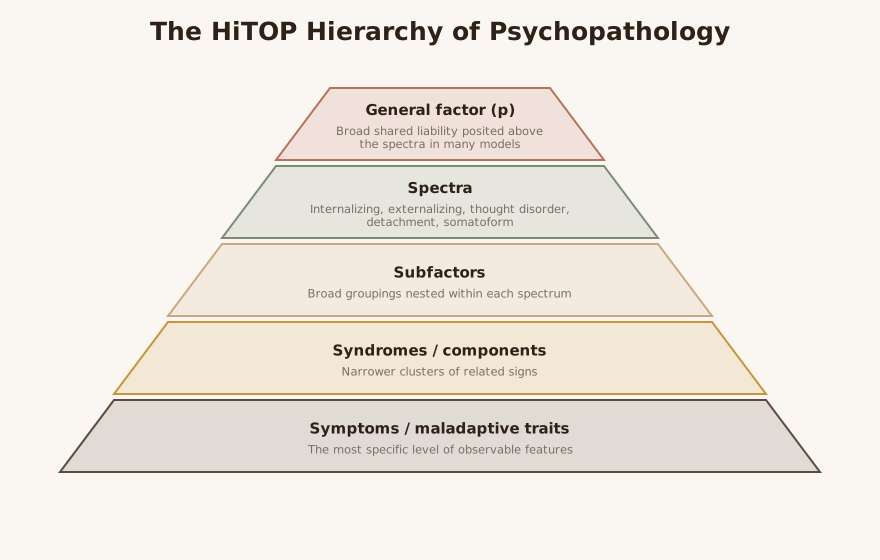
Hierarchy. Dimensions are nested. At the broadest level sit spectra; these decompose into subfactors, then narrower syndromes/components, and finally individual symptoms and maladaptive traits.2 Clinicians can describe a client at whatever level of the hierarchy is most useful for the decision at hand.5
Empirical derivation. Groupings reflect observed covariation of signs and symptoms across large samples, not committee consensus, and the structure is meant to be revised as data accumulate.2
The spectra. The major higher-order spectra typically described include internalizing, externalizing (often split into disinhibited and antagonistic externalizing), thought disorder (psychoticism), detachment, and somatoform.6 Many models also posit a broad general factor of psychopathology — the “p factor” — sitting above the spectra and capturing shared liability across all of them.6
Comorbidity reframed. What categorical systems call “comorbidity” HiTOP reinterprets as shared variance along a common dimension; two “separate” diagnoses that co-occur often load on the same underlying spectrum.5 This reframing is one of HiTOP’s central clinical contributions.4
Interventions & Techniques
HiTOP is not itself a set of interventions, so “technique” here means how the framework is operationalized in practice.LLM In clinical and research use, HiTOP-aligned work typically proceeds by quantitative assessment: administering dimensional measures (self-report and clinician-rated instruments mapped to HiTOP spectra and traits) and producing a profile across dimensions rather than a single label.5 The consortium and applied literature describe several practical moves clinicians can make even today.5
First, measure dimensionally and report a profile. Rather than recording only a categorical diagnosis, the clinician characterizes severity across relevant spectra (for example, elevated internalizing with a specific fear subfactor, plus moderate detachment).5
Second, target the level of the hierarchy that matches the decision. Broad spectrum scores can guide general prognosis and the choice of transdiagnostic strategies, while narrow component scores can guide specific symptom targets and outcome tracking.5
Third, use dimensions to plan transdiagnostically. Because many evidence-based treatments act on broad dimensions (e.g., interventions that reduce internalizing distress broadly), a dimensional formulation can rationalize transdiagnostic treatment selection and progress monitoring.5
Fourth, track change quantitatively. Dimensional scores give a continuous metric of improvement that is more sensitive than category crossing, which is useful for measurement-based care.5
The integration literature is candid that workflows, crosswalks to existing diagnoses, and clinician-friendly tools are still maturing, and that adoption requires translating research measures into something usable in a routine session.5
Evidence Base
The maturity of HiTOP is best described as established as a research framework, with clinical application still emerging.5 The structural evidence is strong: the dimensional and hierarchical organization of psychopathology — including the internalizing–externalizing split and broad spectra — replicates across many large samples, measures, and populations, and this empirical robustness is the model’s principal strength.2 Dimensional scores also tend to show better reliability and validity, and stronger prediction of important outcomes (course, impairment, treatment response), than the categorical diagnoses they parallel.2
Where the evidence is thinner is in clinical implementation: randomized trials demonstrating that organizing care around HiTOP improves patient outcomes relative to standard categorical practice are limited, and the field is still developing the assessment tools, training, and documentation conventions needed for routine use.5 The applied literature frames this honestly as an active translation problem rather than a solved one.5 HiTOP has drawn substantial attention in major journals and from professional bodies, which signals scientific traction but should not be read as proof of clinical superiority in everyday settings.4 In short: the structure is well evidenced; the clinical payoff at scale is promising but not yet established by outcome trials.5LLM
Populations & Indications
HiTOP is intended to apply broadly across the range of psychopathology, since it was built from transdiagnostic symptom data rather than around any single disorder.2 It is especially clarifying for presentations that strain categorical systems.5
- Clients with extensive comorbidity, where several DSM diagnoses co-occur and a single label obscures the picture; HiTOP renders this as a profile across shared spectra.5
- Clients with marked within-diagnosis heterogeneity, where two people with the “same” diagnosis look clinically very different; dimensional profiles capture that variation.2
- Personality pathology, which HiTOP handles natively through maladaptive trait dimensions rather than categorical personality-disorder types.6
- Mood, anxiety, and fear-related presentations (internalizing spectrum), psychotic-spectrum and unusual-thought presentations (thought disorder), substance use and disinhibited presentations (externalizing), and interpersonal withdrawal (detachment).6
- Subthreshold presentations, where meaningful distress and impairment fall short of a categorical cutoff but are still visible as elevated dimensional scores.5
Problems-for-Work
HiTOP is useful for several recurring clinical problems.LLM
Comorbidity that resists a single label. When a client meets criteria for, say, a depressive disorder, a generalized anxiety presentation, and a fear-based condition at once, a HiTOP formulation describes this as elevated internalizing with specific distress and fear subfactors, clarifying what is shared versus distinctive.5
LLM-generated illustrative example (not a guideline): A client carries three prior anxiety/mood diagnoses from different providers and feels “broken in too many ways to fix.” Reframing the picture as one elevated internalizing dimension with a few specific peaks gives both clinician and client a single, coherent target and a less fragmenting story. LLM
Diagnostic instability over time. When a client’s label keeps changing across episodes and providers, dimensional tracking shows continuity of underlying severity even as categorical labels flip.5
Heterogeneity within a diagnosis. Two clients with the same categorical diagnosis can be differentiated by their distinct dimensional profiles, guiding individualized targets.2
Communicating severity and shared liability. Dimensional language (“your detachment is high, your fear is moderate”) can be more concrete and less stigmatizing than a categorical label for some clients, supporting shared understanding.4LLM
Contraindications, Cautions & Cultural Humility
HiTOP is a classification framework, so “contraindications” are really cautions about scope and use.LLM First, HiTOP does not replace risk assessment, crisis response, or any safety-driven categorical decision; dimensional profiling is not a substitute for evaluating acute danger, and clinical judgment still governs care.5LLM Second, much routine infrastructure — insurance, agency reporting, and many established treatment manuals — still runs on categorical diagnoses, so in many settings HiTOP currently augments rather than replaces DSM/ICD coding, and clinicians should not present it to clients as a recognized formal diagnosis.5LLM
Third, the model is explicitly provisional: the consortium revises the structure as evidence accumulates, so clinicians should hold any specific dimensional placement with appropriate tentativeness rather than as settled fact.2 Fourth, dimensional measures inherit the limitations and norms of the instruments used to generate them; cross-cultural validity, measurement invariance across groups, and the representativeness of normative samples all warrant scrutiny before interpreting a client’s scores as objective truth.5LLM Cultural humility means treating a HiTOP profile as one structured lens — useful for organizing observation and tracking change — not as a culture-free verdict on a person.LLM
Treatment-Plan Suggestions & SMART Objectives
The table below is illustrative, intended to show how a dimensional formulation can translate into measurable objectives.LLM It is not a guideline or a validated protocol.5
| Goal | SMART objective (example) | Mechanism |
|---|---|---|
| Reduce overall internalizing severity | Over 12 weeks, lower the internalizing spectrum score by a clinically meaningful margin on a repeated standardized measure | Dimensional tracking of shared distress/fear liability rather than a single symptom count 5 |
| Target a specific fear subfactor | Within 8 weeks, reduce situational avoidance episodes from daily to ≤2 per week, logged in a diary | Narrow-band component targeting within a broad spectrum 2 |
| Address detachment | Within 10 weeks, increase initiated social contacts to ≥2 per week and rate connectedness weekly | Trait/spectrum-level target on the detachment dimension 6 |
| Manage disinhibited externalizing | Over 8 weeks, reduce impulsive-action incidents by 50% using a daily urge-and-action log | Externalizing-spectrum monitoring with behavioral targets 6 |
| Track thought-disorder symptoms | Weekly for 12 weeks, complete a clinician-rated unusual-experiences measure and review trends together | Quantitative tracking on the thought-disorder spectrum 6 |
| Improve formulation coherence | By session 3, co-construct a one-page dimensional profile the client endorses as “fits me” | Profile-based formulation replacing fragmented multi-label picture 5 |
| Monitor cross-cutting progress | Administer a HiTOP-aligned measure at intake, mid-point, and termination and chart change | Measurement-based care using continuous scores 5 |
Common Misconceptions
“HiTOP is a new diagnostic manual that replaces the DSM.” It is a research-derived classification framework, and in routine practice it currently tends to augment rather than formally replace DSM/ICD categories.52
“HiTOP is a treatment or therapy.” It is a way of classifying and measuring psychopathology, not an intervention; it informs formulation and tracking, not a specific technique.2LLM
“Dimensions mean diagnoses are abandoned entirely.” HiTOP retains and reorganizes symptom content; familiar syndromes still appear, now nested within broader spectra and described by severity.2
“The structure is finalized.” The consortium treats the taxonomy as provisional and revisable as new evidence arrives.21
“HiTOP is the same as RDoC.” Both are dimensional alternatives to categorical nosology, but RDoC is organized around hypothesized biological systems, whereas HiTOP is built bottom-up from observed symptom covariation and is agnostic about etiology.42
Training & Certification
There is no licensure or formal certification in HiTOP, because it is a classification framework rather than a credentialed treatment modality.LLM Clinicians typically learn it through the primary and applied literature and through the HiTOP Consortium’s open resources, which include workgroups, measures, and updates published on the official website.1 Accessible orientations include the foundational and integration papers, professional-body summaries, and clinician-oriented discussions such as podcast interviews with consortium-affiliated experts.457 For applied use, the relevant “competency” is less a credential than facility with dimensional assessment instruments and measurement-based care; the integration literature emphasizes that practical, clinician-friendly tools and training pathways are still being developed.5
Key Terms
- Spectrum — A broad, higher-order dimension of psychopathology (e.g., internalizing, externalizing, thought disorder, detachment, somatoform).6
- Subfactor — An intermediate dimension nested within a spectrum (e.g., fear and distress within internalizing).2
- Syndrome/component — Narrower groupings of co-occurring symptoms below the subfactor level.2
- Maladaptive trait — A dimensional personality characteristic incorporated directly into the HiTOP structure.6
- p factor — A proposed general factor of psychopathology capturing liability shared across all spectra.6
- Internalizing / Externalizing — The well-replicated broad division between inwardly directed distress/fear and outwardly directed disinhibited/antagonistic problems.2
- Dimensional vs. categorical — Describing severity on a continuum versus assigning all-or-nothing diagnostic categories.2
- Comorbidity (reframed) — Co-occurrence of “separate” diagnoses, reinterpreted by HiTOP as shared variance on a common dimension.5
Resources & Further Reading
▶ Watch — a video introduction to this concept:
- HiTOP Consortium — official website
- Kotov et al., 2017 — HiTOP: A dimensional alternative to traditional nosologies (PubMed)
- Kotov et al., 2018 — A paradigm shift in psychiatric classification (World Psychiatry)
- APA Spotlight — The Hierarchical Taxonomy of Psychopathology
- Integrating HiTOP into Clinical Practice (PMC)
- Hierarchical Taxonomy of Psychopathology — Wikipedia
- Navigating Neuropsychology Ep. 52 — HiTOP with Dr. Robert Latzman
Reflective / Supervision Questions
- For a client you currently see who carries multiple diagnoses, what would the picture look like if you described it as a profile across internalizing, externalizing, thought disorder, detachment, and somatoform dimensions instead?5LLM
- Where in your own caseload have you noticed “comorbidity” that might be better understood as shared variance on a single underlying dimension?5LLM
- Which of your current outcome measures already map, even loosely, onto HiTOP spectra, and could you begin tracking change dimensionally without adding burden?5LLM
- How would you communicate a dimensional formulation to a client in a way that is clarifying rather than confusing or stigmatizing?4LLM
- Given that the taxonomy is provisional and that instruments carry cultural and normative limits, how will you hold a client’s dimensional profile with appropriate humility?2LLM
- In your setting, where do categorical diagnoses remain necessary (reporting, treatment manuals, safety decisions), and how might a HiTOP profile complement rather than replace them?5LLM