
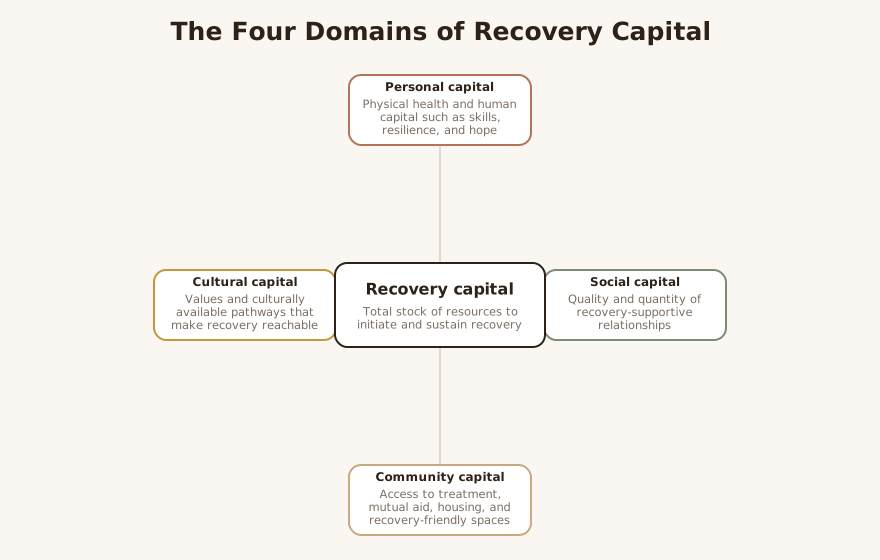
Recovery capital is not a therapy you deliver; it is a lens you assess and plan through. It names the total stock of internal and external resources a person can mobilize to start and sustain recovery from a substance use disorder, and it reframes the clinical question from “what is wrong with this person” to “what does this person have to build on” 2. For practicing therapists, its value is practical: it organizes the messy reality of a client’s life — health, relationships, housing, community ties, hope — into domains you can measure, track, and target 2.
Type & Discipline
Recovery capital is a theoretical construct, not a standalone treatment modality 4. It originated in the sociology of addiction and was developed specifically to explain how people resolve substance problems, including those who do so without formal treatment 4. It now sits at the center of addiction recovery science and recovery-oriented practice, and it functions across disciplines — social work, counseling, peer support, and behavioral health — as an assessment and planning framework rather than a set of session techniques 42. Because it is a construct rather than a manualized intervention, recovery capital is operationalized through measurement instruments and through how clinicians structure assessment, goal-setting, and resource-building over time 12.
Creators & Lineage
The term was coined by sociologists Robert Granfield and William Cloud in the late 1990s while both were faculty at the University of Denver 4. It grew directly out of their research on “natural recovery” — people who overcame addiction without treatment — beginning with an initial study of 46 participants who had recovered without formal services 4. They introduced the term in their 1999 book Coming Clean: Overcoming Addiction without Treatment, coining “recovery capital” while analyzing their interview data 4. Granfield has noted that the work was “initially told… was unscientific and that it lacked validity,” yet the framework has since achieved broad international adoption across Canada, the UK, Australia, and Ireland 4.
Cloud and Granfield expanded the construct in 2008, extending the original framework into a more fully articulated multidimensional model 3. In parallel, William L. White brought recovery capital into mainstream addiction-treatment practice, co-authoring with Cloud a widely used primer that translated the academic construct into clinical language for addictions professionals 2. David Best and colleagues subsequently advanced the measurement and community dimensions of the construct, and recovery capital is now embedded in recovery-oriented systems of care worldwide 1.
Core Principles
Recovery capital is conventionally divided into three broad domains, with a fourth (cultural) added in the construct’s expansion 23. Personal recovery capital subdivides into physical capital (health status, energy, bodily function) and human capital (education, employment skills, cognitive abilities, emotional resilience, psychological resources, hope, and aspirations) 25. Social recovery capital is the quality and quantity of recovery-supportive relationships — family ties, peer networks, mentors, and the social obligations and supports embedded in those relationships 25. Community recovery capital is access to community-level resources: treatment services, mutual-aid groups, recovery community organizations, employment opportunities, housing, transportation, and recovery-friendly social spaces 25. The construct’s expansion added cultural capital — the values, beliefs, and culturally available pathways that make recovery legible and reachable for a given person 34.
Several principles follow from this structure. First, recovery capital is strengths-based: it deliberately shifts attention from deficits to existing assets and protective factors 6. Second, it is dynamic — it accumulates, can be depleted, and operates differently across recovery stages, supporting both entry into recovery and protection against relapse during maintenance 2. Third, there is a threshold concept: individuals appear to need a critical minimum level of recovery capital to successfully initiate and maintain recovery, below which the process becomes substantially harder without intervention 2. Fourth, the construct includes its inverse — negative recovery capital or “capital liabilities” such as chronic illness, unemployment, social isolation, criminal-legal involvement, and community stigma — that actively obstruct recovery 2.
Interventions & Techniques
Recovery capital is operationalized rather than “delivered.” The first technique is structured assessment using a validated instrument to baseline a client’s resources across domains 1. The most widely used measures are the 50-item Assessment of Recovery Capital (ARC) and its 10-item short form, the Brief Assessment of Recovery Capital (BARC-10) 1. More comprehensive tools such as the REC-CAP capture personal, social, and community recovery capital together, and other instruments — the Recovery Capital Questionnaire, the Recovery Strengths Questionnaire, and various recovery capital scales — are also in use 1.
The second set of techniques is strengths-based, gap-targeted planning: leverage existing capital while deliberately building deficient domains 2. In practice this means mapping the client’s current assets and liabilities, then setting collaborative goals that grow human, social, and community capital — for example, intentionally connecting clients to recovery-oriented networks, peer support, and recovery community organizations that reduce isolation and normalize recovery 6. A third technique is serial re-measurement to monitor trajectory: tracking ARC or BARC-10 scores over time gives a quantitative signal of whether capital is growing alongside the recovery process 1.
LLM-generated illustrative example (not a guideline): A clinician administers the BARC-10 at intake and notes high human capital (stable employment, intact cognition) but low social and community capital (no sober relationships, no community ties). Rather than treating “lack of motivation,” the plan targets the actual gap — building social recovery capital through a peer support connection and a recovery community organization — and re-administers the BARC-10 at 90 days to gauge movement LLM.
Evidence Base
Recovery capital is an established construct with broad adoption, but its measurement evidence is still maturing 14. A 2024 systematic review analyzed 69 studies (2016–2023, totaling 60,806 participants) and identified ten distinct recovery capital questionnaires, plus additional studies using social network analysis, linguistic analysis, and secondary data 1. The review concluded that recovery capital questionnaires are “generally considered valid and reliable measures of recovery capital,” yet cautioned that “a strong evidence base on the psychometric properties across diverse populations and settings still needs to be established” 1.
Specific limitations matter for clinicians. The ARC and BARC-10 were reported to represent a single dimension with acceptable-to-high internal validity and good concurrent validity, but reviewers noted issues with the internal consistency of subdomain structure 1. The comprehensive REC-CAP has not yet had its overall psychometrics examined 1. Predictive validity evidence is sparse: the ARC/BARC-10 successfully differentiated people in recovery for over a year from those in recovery less than a year, and the Recovery Strengths Questionnaire moderately discriminated by recovery duration, but the review explicitly noted that predictive validity research “remains sparse and underdeveloped” 1. The literature is also concentrated in the UK and US, predominantly adult, and drawn from samples that were 67% male and 79.5% White-dominant 1. The honest summary: the construct is well-accepted and clinically useful, but treat any single instrument score as a working estimate, not a settled metric 1.
Populations & Indications
Recovery capital was developed for and is most established with adults experiencing substance use disorders 12. Its founding population was people pursuing natural recovery — resolving addiction without formal treatment — which remains a defining indication for the lens 4. It is indicated wherever you need to assess readiness and resources for recovery initiation and to plan for sustained remission and relapse prevention, because capital operates across both stages 2. The community and social dimensions make it especially relevant for clients embedded in recovery community organizations and peer support structures 6.
Because reviewed instruments “appear to be most suited for use among adult populations” and have a documented “lack of testing across gender diverse groups,” indication is strongest for adults and weaker — pending validation — for adolescents and gender-diverse populations 1. Clinically, the framework fits clients facing social isolation, housing instability, unemployment, and criminal-legal involvement, since these map directly onto capital domains and liabilities 2.
Problems-for-Work
Initiating recovery. When a client is ambivalent about change, recovery capital reframes the work as building toward a threshold rather than fixing a deficit; the clinician inventories existing assets and identifies the minimum capital needed to make a recovery attempt viable 2.
Sustaining remission / relapse prevention. For a client in early remission, the work targets capital that protects against relapse during maintenance — for example, strengthening social recovery capital so that recovery-supportive relationships are in place before high-risk periods 2.
Social isolation. Where a client has lost recovery-supportive relationships, the problem-for-work is rebuilding social capital through peer support and recovery community connections that reduce isolation and normalize recovery 6.
Housing and employment instability. These appear as community-capital gaps and negative recovery capital; the work is connecting the client to community resources (housing, training, employment, transportation) that remove structural barriers to recovery 25.
Contraindications, Cautions & Cultural Humility
Recovery capital is a planning lens, not a treatment, so it has no direct contraindications — but it has misuse risks. The most important caution is measurement humility: because the evidence base across diverse populations is still being established, no single instrument score should be treated as definitive, and scores are best used as collaborative conversation-starters rather than gatekeeping metrics 1. The reviewed instruments were developed and validated predominantly in the UK and US, with samples skewed male and White, so applying them uncritically to other populations risks construct invalidity 1.
Cultural humility is built into the construct’s own expansion: the addition of cultural capital recognizes that the values, beliefs, and culturally available pathways to recovery differ across communities 34. A clinician should not assume that a low community-capital score reflects a client deficit when it may reflect structural inequity — limited access to recovery-friendly resources in a given community — which is more accurately a system gap than a personal one 2. The systematic review’s own call to extend measurement “from measuring RC of the recovering individual to measuring RC of the groups and institutions in which the individual is embedded” reinforces that responsibility for capital is not solely individual 1.
LLM-generated illustrative example (not a guideline): A clinician resists reading a client’s low community-capital score as a motivational failure, and instead documents that the client’s neighborhood lacks accessible mutual-aid meetings and transit — locating the gap in the system, and adjusting the plan to address access rather than blaming the client LLM.
Treatment-Plan Suggestions & SMART Objectives
| Goal | SMART objective (example) | Mechanism |
|---|---|---|
| Establish a recovery-capital baseline | Complete the BARC-10 at intake and review domain scores collaboratively within the first 2 sessions | Structured strengths-based assessment 1 |
| Build social recovery capital | Within 6 weeks, connect with one peer support contact and attend 4 recovery-community meetings | Social capital through recovery-supportive relationships 26 |
| Reduce isolation | Identify and reconnect with 2 recovery-supportive relationships within 8 weeks | Social capital reduces isolation, normalizes recovery 6 |
| Address community-capital gaps | Connect to one housing, employment, or transportation resource within 30 days | Community recovery capital removes structural barriers 25 |
| Strengthen human capital | Complete a values-and-aspirations exercise and set one education/employment step within 4 weeks | Human capital: hope, skills, aspirations 25 |
| Reduce negative recovery capital | Develop a written plan addressing one capital liability (e.g., legal involvement) within 60 days | Lowering capital liabilities that obstruct recovery 2 |
| Monitor recovery trajectory | Re-administer the BARC-10 at 90 days and compare to baseline | Serial measurement of capital growth 1 |
Common Misconceptions
“Recovery capital is a treatment.” It is a construct and assessment lens, not a manualized therapy; you build it through other interventions 42.
“It’s just a strengths inventory — the deficits don’t count.” The construct explicitly includes negative recovery capital, the liabilities that obstruct recovery, so a complete picture requires assessing barriers as well as assets 2.
“Recovery capital is purely individual.” Social and community dimensions mean capital lives partly in a person’s networks and institutions, and the field is actively moving toward measuring the capital of the groups in which a person is embedded 12.
“A high score means the client will recover, and a low score means they won’t.” Predictive-validity evidence is still sparse, so instrument scores are working estimates, not prognoses 1.
“More treatment equals more recovery capital.” The construct originated in natural recovery research, and recovery support services are framed as connecting people to peers and community rather than replacing professional treatment — capital can grow outside formal treatment entirely 46.
Training & Certification
There is no certifying body or formal credential for “recovery capital” as a discrete modality, consistent with its status as a construct rather than a licensed treatment 4. Clinical competence is typically developed through familiarity with the foundational literature — notably White and Cloud’s primer for addictions professionals — and through training in administering and interpreting validated instruments such as the ARC and BARC-10 21. Because the construct is embedded in recovery-oriented systems of care, practitioners most often encounter it within broader addiction-counseling, peer-recovery-support, and recovery-coaching training rather than as a separate certification track 46.
Key Terms
Recovery capital — the internal and external resources a person can access to initiate and sustain recovery 2.
Personal recovery capital — physical capital (health, energy) plus human capital (skills, education, resilience, hope) 25.
Social recovery capital — recovery-supportive relationships and the support and obligations embedded in them 25.
Community recovery capital — access to community resources: treatment, mutual aid, housing, employment, transportation 25.
Cultural capital — the culturally available values, beliefs, and pathways that make recovery reachable for a given person 34.
Negative recovery capital / capital liabilities — deficits (chronic illness, isolation, unemployment, legal involvement, stigma) that obstruct recovery 2.
Threshold — the critical minimum level of capital needed to initiate and maintain recovery 2.
Natural recovery — resolving addiction without formal treatment; the research context in which the construct originated 4.
Resources & Further Reading
▶ Watch — a video introduction to this concept:
- Recovery Capital: A Primer for Addictions Professionals (White & Cloud, 2008)
- Conceptualizing Recovery Capital: Expansion of a Theoretical Construct (Cloud & Granfield, 2008)
- Measuring recovery capital for people recovering from alcohol and drug addiction: a systematic review (Bunaciu et al., 2024)
- UB sociologist to speak at conference on the addiction recovery theory he co-developed (University at Buffalo, 2024)
- 5 Dimensions of Recovery Capital (R1 Learning)
- Recovery Capital: What Does it Mean and Why is it Important? (Drug Free America Foundation, 2024)
Reflective / Supervision Questions
- When you assess a client’s “motivation,” how much of what you are observing is actually a recovery-capital threshold problem — a resource gap rather than a will problem? 2
- For a recent client with a low community-capital profile, was the gap located in the client or in the system of resources available to them, and did your plan reflect that distinction? 21
- How do you guard against treating an ARC or BARC-10 score as a prognosis given that predictive-validity evidence is still sparse? 1
- The instruments you use were validated mostly on adult, male, White-dominant UK/US samples — how does that shape your confidence when applying them to the clients in front of you? 1
- Where in your caseload is recovery capital being built outside formal treatment — through peers, family, and community — and are you crediting and reinforcing that growth? 64