
Psychological contract theory is not a therapy and was never built to be one. It is a theory from organizational behavior about how the employment relationship actually works beneath the formal contract: the claim that every job rests on “the mutual beliefs, perceptions, and informal obligations between an employer and an employee,” a set of unwritten promises that go beyond wages and benefits 56. For practicing therapists, its value is conceptual, not procedural. A clinician encounters this theory only obliquely — when a client’s distress is organized around work, and specifically around the sense that an employer promised something, implicitly or explicitly, and then broke that promise LLM. After a layoff, a demotion, a reorganization, or a quiet reneging on what felt like a guaranteed future, clients arrive with a particular flavor of pain: not just loss, but betrayal, cynicism, and a corrosive loss of trust 6LLM. Psychological contract theory gives that experience a name and a mechanism LLM.
Type & Discipline
Psychological contract theory is a descriptive, explanatory theory within organizational behavior and the psychology of the employment relationship; it is not a treatment, a diagnosis, or a stand-alone therapy 5LLM. Its core object is the psychological contract itself, defined as “individual beliefs, shaped by the organization, regarding terms of an exchange agreement between individuals and their organization” 3. The contract is characterized as “promissory, implicit, reciprocal, perceptual, and based on expectations” — a private, perceived deal rather than a document anyone signed 5.
The discipline matters for how a clinician should hold the theory LLM. It was developed to explain workforce behavior — productivity, commitment, turnover, citizenship — not to explain psychopathology 3LLM. That origin has two consequences. First, the theory’s outcome variables are organizational (job satisfaction, organizational commitment, intent to leave), and its clinical relevance is downstream: it explains the shape of work-related distress but does not itself prescribe a treatment 3LLM. Second, because the contract is fundamentally perceptual — “the individual’s perceptions that usually shape the ‘contract terms’” — the theory is unusually well suited to the consulting room, where what matters is not what the employer “really” promised but what the client experienced as promised 6LLM.
Creators & Lineage
The concept has two principal figures working a generation apart LLM. Chris Argyris first introduced the term in 1960, describing an implicit agreement in which, in his framing, “the employee will maintain the high production, low grievances, etc., if the foremen guarantee and respect the norms of the employee informal culture” 5. Argyris’s contract was a tacit bargain about norms and reciprocity on the shop floor 5.
Denise Rousseau is the figure who built the modern theory, advancing the field in 1989 and providing the research frameworks that guided subsequent scholarship 15. Rousseau’s contribution was to relocate the contract inside the individual — to define it as the worker’s own beliefs about the terms of an exchange agreement with the organization, rather than as an objective bargain between two parties 3. This individual-level, perceptual move is what makes the construct portable into clinical thinking: a psychological contract can be breached even when no formal promise was ever made, because the breach lives in the perceiver 36LLM. Rousseau also outlined how the contract forms across the working life — through pre-employment expectations, recruitment communication, early socialization, later experiences, and ongoing evaluation and revision — which is why it can be repaired or revised over time rather than fixed at hire 5.
The theory’s deeper lineage is social exchange: the relational form of the contract is explicitly framed as resting on “organizational interdependence and social exchange,” locating psychological contract theory as a specialized application of the broader exchange tradition to the employment relationship 5LLM. A clinician already fluent in social exchange theory, equity, and reciprocity will find the constructs familiar LLM.
Core Principles
The first principle is that the contract is perceptual and individually held. It is “essentially formed by the worker,” so its terms are whatever the individual believes the exchange to be, not what is written down 6. Two workers in identical roles can hold very different contracts, and a contract can be violated by an act the employer considers reasonable, because the standard is the worker’s perception 36LLM.
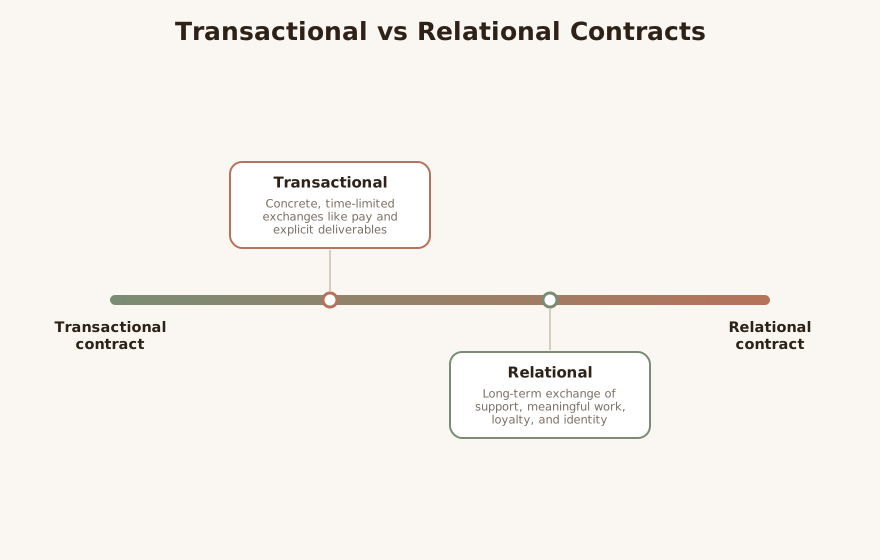
The second principle is the transactional–relational distinction, which is the theory’s most clinically useful pair of constructs LLM. Transactional contracts are “concrete, time-limited exchanges” — pay, merit increases, explicit deliverables — and are associated with “careerism, lack of trust in employer, and greater resistance to change” 35. Relational contracts are “long-term exchanges maintaining the employee-employer relationship,” involving personal support, meaningful work, loyalty, and identity, and are “associated with trust and increased acceptance of change” 35. The distinction matters because the two kinds of contract break differently and hurt differently: relational breaches “show stronger associations with job satisfaction, turnover intentions, and citizenship behavior,” whereas transactional breaches “more strongly affect organizational commitment” 3.
The third and most important principle for clinicians is the breach–violation distinction LLM. A breach is cognitive: “a breach involves cognitive recognition that an employer failed to meet expectations.” A violation is affective: it “describes the emotional response resulting from that breach” 3. In practitioner terms, the breach is the perception that a promise was broken; the violation is the outrage, resentment, anger, and loss of good faith that follow 36. This two-step structure — first a recognition, then an emotional reaction — is precisely the territory a therapist works in, because the same breach produces very different violations in different people, and the violation, not the breach, is what brings someone to therapy LLM.
Interventions & Techniques
Because psychological contract theory is an explanatory theory rather than a therapy, there are no proprietary “psychological contract techniques”; the concept shapes formulation and is then operationalized through recognized modalities LLM. The most direct application is making the contract explicit — helping a client articulate what, exactly, they believed was promised, by whom, and when, which converts a diffuse sense of betrayal into a nameable broken expectation 36LLM. This is straightforward cognitive work: surfacing an implicit belief so it can be examined LLM.
A second move is separating breach from violation in the client’s own experience LLM. Once a client can distinguish the cognitive recognition (“they said there would be a path to advancement and there wasn’t”) from the affective response (“and I feel humiliated and betrayed”), the two become separately workable: the perception can be reality-tested, and the emotion can be validated and processed rather than collapsed together 3LLM. A third move is examining the perceptual basis of the contract — gently testing whether the promise the client experienced was made, implied, assumed, or hoped for — which is delicate work, because the goal is not to invalidate the client’s pain but to understand the expectation that organized it 6LLM.
LLM-generated illustrative example (not a guideline): A client laid off after fifteen years says, “I gave them everything and they threw me away.” Rather than reassuring or problem-solving, the clinician helps him name the specific relational contract he held — loyalty and effort in exchange for stability and respect — and distinguishes the breach (the layoff itself) from the violation (the betrayal and worthlessness he now feels). Naming the contract reframes his shame as a response to a broken relational promise, and the work turns toward grieving the contract and rebuilding a sense of agency LLM.
Evidence Base
Psychological contract theory is an established theory in organizational behavior, with a lineage from Argyris’s 1960 introduction through Rousseau’s foundational 1989 work and a large subsequent literature 15. As a theory, its central constructs — the perceptual contract, the transactional–relational distinction, and the breach–violation distinction — are well characterized and widely used in workforce research 35.
The empirical relationships between breach and work outcomes are reasonably robust LLM. Psychological contract breach shows a strong negative correlation with job satisfaction and a moderate negative correlation with organizational commitment 3. It shows moderate positive correlations with intention to leave, with psychological contract violation, and with mistrust toward management, and modest negative correlations with organizational citizenship behavior and in-role performance 3. One nuance deserves emphasis because it is clinically counterintuitive: breach “correlates with intent to leave but not actual turnover” — people who feel betrayed want to leave but often do not, which describes a recognizable clinical population that stays in a job that wounds them 3LLM. Breach has also been studied in relation to employee well-being and career-related behavior, extending the construct beyond purely organizational outcomes into the territory of psychological functioning that clinicians care about 4.
The honest appraisal for clinicians is the one that applies to any organizational theory imported into therapy: an established theory is not an established therapy LLM. There is no “psychological contract therapy” with its own randomized trials, because no such modality exists; the construct’s clinical utility is entirely downstream, as a formulation lens embedded in whatever modality the therapist actually practices LLM. The evidence supports the construct — that perceived breach reliably predicts disaffection, mistrust, and intent to leave — not any specific intervention derived from it 3LLM. Held honestly, the theory is a formulation heuristic for work-related betrayal, not a treatment protocol LLM.
Populations & Indications
The clinically relevant population is narrow and specific: people whose presenting distress is organized around work, and particularly around a broken implicit promise 3LLM. The clearest indications are clients navigating layoffs, demotions, and restructuring, who are living through breach in real time and often experience it as personal betrayal rather than impersonal economics 6LLM. The theory speaks with particular force to clients reporting cynicism, disengagement, and mistrust toward an employer or, by extension, toward institutions generally, since these are the documented downstream signatures of breach 36.
Two populations deserve special mention LLM. Workers who feel betrayed but stay are exactly the group the data describe — breach predicts intent to leave but not actual turnover — and they often present with a grinding, ambivalent demoralization that makes more sense once it is framed as a continuously breached relational contract they have not been able to exit 3LLM. Clients in career transition or after job loss carry not only practical and financial stress but the grief of a relational contract that ended without acknowledgment, and naming the broken contract can give shape to a loss they have struggled to justify feeling so deeply 6LLM. The clearest indication for invoking the framework is any presentation in which a client’s pain centers on the sense that an employer promised something and did not deliver LLM.
Problems-for-Work
Psychological contract concepts give clinicians language for a recognizable cluster of work-related problems, most of which turn on the breach–violation distinction and the relational contract LLM.
- Workplace betrayal. When a client experiences an employer as having broken a perceived promise, the resulting “loss of trust and good faith” and the “outrage, resentment, and anger” are not overreactions but the predicted affective violation following a cognitive breach; naming the broken contract validates the feeling and makes it workable 36.
- Cynicism and mistrust. Breach is moderately associated with mistrust toward management and, clinically, often generalizes beyond the specific employer; reframing cynicism as a learned response to repeated breach opens it to examination rather than treating it as a fixed trait 3LLM.
- Disengagement and demoralization. The documented decline in commitment, citizenship behavior, and performance after breach maps onto the demoralized client who has quietly withdrawn effort; understanding this as contract withdrawal rather than laziness or depression alone sharpens the formulation 3LLM.
- Adjustment to layoff, demotion, or job loss. These events are breaches by definition, and framing them as the end of a relational contract helps the client grieve a loss whose intensity might otherwise feel disproportionate to “just a job” 6LLM.
- Resentment and burnout. A relational contract under chronic, unrepaired breach — effort and loyalty given, stability and respect not returned — produces resentment and the depletion of burnout; the theory locates the problem in a broken exchange rather than in the client’s resilience 36LLM.
- Staying in a wounding job. Because breach predicts wanting to leave but not leaving, clients caught in this gap can use the frame to clarify the actual contract they are still trying to honor and to make a values-based decision about whether it can be renegotiated or must be ended 3LLM.
LLM-generated illustrative example (not a guideline): A nurse passed over for a promotion she was repeatedly told was “next in line” describes feeling “stupid for ever trusting them” and has stopped volunteering for anything beyond her core duties. Through the contract lens, her withdrawal of citizenship behavior is the predicted response to relational breach, and her self-blame is reframed: the failure was the employer’s broken promise, not her trust. The work turns toward processing the betrayal and deciding, deliberately, what she is now willing to give LLM.
Contraindications, Cautions & Cultural Humility
The first caution is against using the theory to adjudicate reality LLM. Because the contract is perceptual, a clinician is never in a position to tell a client whether the employer “really” promised something; the therapeutic stance is to understand the expectation the client held, not to litigate whether it was justified 6LLM. Reality-testing the perception is legitimate clinical work, but it must serve the client’s understanding, never minimize a betrayal they genuinely experienced LLM.
A second caution concerns the limits of the construct’s reach LLM. Psychological contract theory explains work-related betrayal; it does not explain the person LLM. A client’s intense reaction to a workplace breach may draw on earlier, deeper betrayals — childhood, attachment, prior relational trauma — and treating the presentation as “only” an organizational matter would miss that history LLM. The work theory should be one lens among several, integrated with the clinician’s broader formulation, not a replacement for it LLM.
Cultural humility is load-bearing here LLM. What counts as a reasonable expectation of an employer — job security, loyalty, advancement, respect — is profoundly shaped by culture, generation, immigration status, and labor-market position LLM. A client from a context where lifelong employment and reciprocal loyalty were normative may experience a breach that a clinician from a more transactional milieu underestimates, and the reverse can also occur LLM. The structural reality of the client’s position also matters: for workers with precarious status, few alternatives, or economic dependence, a breached contract cannot simply be exited, and the clinician must attend to that constraint rather than treating “why don’t you just leave” as a solved problem 3LLM. Finally, work-related betrayal can co-occur with depression, financial crisis, and acute risk, and the contract frame must never displace assessment of safety and mood LLM.
Treatment-Plan Suggestions & SMART Objectives
| Goal | SMART objective (example) | Mechanism |
|---|---|---|
| Make the broken contract explicit | Within 3 sessions, client will articulate the specific implicit promise they believed was made and how it was broken | Converts diffuse betrayal into a nameable, examinable broken expectation 6 |
| Separate breach from violation | Within 4 sessions, client will distinguish the cognitive recognition of the broken promise from the emotional response it produced | Operationalizes the breach–violation distinction so each can be worked separately 3 |
| Validate and process the betrayal | Over 6 weeks, client will identify and name 3 emotions tied to the violation and practice tolerating them without self-blame | Treats outrage and loss of trust as a predicted response to breach, not a flaw 36 |
| Reduce work-related cynicism | Over 8 weeks, client will test 3 cynical generalizations about employers against specific evidence | Reframes mistrust as a learned response to breach, open to examination 3 |
| Grieve the ended relational contract | Within 6 sessions, client will describe the relational contract that ended and what they are mourning about it | Gives shape and permission to a loss whose intensity felt unjustifiable 6 |
| Clarify the stay-or-leave dilemma | Within 6 sessions, client will map what they still give to and expect from the job and make a values-based decision about it | Addresses the gap in which breach drives intent to leave but not leaving 3 |
| Rebuild agency after job loss | Over 8 weeks, client will identify 2 domains where they can act on their own values independent of any employer | Restores a sense of authorship after a contract was broken without consent 6 |
Common Misconceptions
The most consequential misconception is that the psychological contract is about what the employer objectively promised; in fact it is “essentially formed by the worker,” and its terms are the individual’s perceptions, which is precisely why a breach can occur even when the employer believes it kept its word 6. A second misconception is that breach and violation are the same thing; the theory carefully separates the cognitive recognition that a promise was broken from the emotional response that follows, and clinically the violation, not the breach, is usually what brings the client in 3LLM. A third is that breach simply makes people quit; the data show it predicts intent to leave but not actual turnover, which describes the very common client who feels betrayed yet stays 3.
A fourth misconception is that all breaches are equivalent; relational breaches more strongly damage satisfaction, turnover intention, and citizenship behavior, while transactional breaches more strongly damage commitment, so the kind of contract that broke shapes the fallout 3. A fifth is that the psychological contract is rigid; in fact it forms and revises across the working life, through socialization and ongoing experience, which is what makes renegotiation and repair conceivable 5. A final error is treating the theory as a clinical protocol rather than a formulation lens — it explains the shape of work-related betrayal but supplies no validated treatment of its own LLM.
Training & Certification
There is no certification in psychological contract theory, and none would be appropriate, because it is a conceptual model from organizational behavior rather than a credentialed treatment LLM. Clinicians typically encounter it, if at all, through organizational psychology, management, or human-resources coursework, where Argyris and Rousseau are standard reading 15. The applied competence that matters for a therapist is not in the theory itself but in the modalities through which work-related betrayal is actually treated — cognitive and behavioral approaches, grief and adjustment work, and trauma-informed practice for clients whose workplace betrayal connects to deeper history LLM. A generalist therapist can legitimately use psychological contract theory for formulation, provided they represent its evidentiary status honestly and deliver care through modalities in which they are trained LLM.
Key Terms
- Psychological contract: an individual’s beliefs about the terms of an exchange agreement with their organization — the unwritten, perceived promises beyond pay and benefits 36.
- Breach: the cognitive recognition that an employer failed to meet the worker’s expectations 3.
- Violation: the emotional response — outrage, resentment, loss of trust — resulting from a perceived breach 36.
- Transactional contract: a concrete, time-limited exchange (pay, merit increases) associated with careerism and lower trust 35.
- Relational contract: a long-term exchange involving loyalty, support, and meaningful work, associated with trust and acceptance of change 35.
- Perceptual basis: the principle that the contract is formed by the worker, so its terms are the individual’s perceptions 6.
- Reciprocity: the implicit mutual obligation between worker and employer that the contract encodes 5.
- Contract formation: the process by which the contract develops and revises across pre-employment, recruitment, socialization, and later experience 5.
Resources & Further Reading
▶ Watch — a video introduction to this concept:
- Rousseau, D. M. (1989). Psychological and Implied Contracts in Organizations
- Psychological Contract Breach — QIC-WD Umbrella Summary
- Psychological contract breach and well-being and career behavior — Journal of Organizational Behavior
- Psychological Contract — Wikipedia
- The Psychological Contract — MindTools
Reflective / Supervision Questions
- When this client describes a workplace betrayal, am I helping them separate the breach (the broken promise they recognize) from the violation (the emotional response), or am I collapsing the two into a single unexaminable wound? 3LLM
- Am I tempted to adjudicate whether the employer “really” promised what the client believes, and if so, am I serving the client’s understanding or quietly invalidating their experience? 6LLM
- For a client who feels betrayed but has not left, am I reading their staying as the predicted gap between intent-to-leave and turnover rather than as weakness or contradiction? 3LLM
- Have I checked whether this client’s intense reaction to a workplace breach is drawing on earlier, deeper betrayals that the organizational frame alone would miss? LLM
- Am I attending to the structural reality of this client’s labor-market position — precarity, status, dependence — rather than treating “why not just leave” as a solved problem? 3LLM
- Am I using the contract frame as a useful formulation lens for this client’s work-related pain, or am I over-applying an organizational theory to a person whose distress runs wider than work? LLM