
Type & Discipline
Positioning theory is a theory rather than a free-standing treatment model: it is a conceptual and analytic framework drawn from social psychology and discourse studies that clinicians borrow and apply within other modalities 8. It belongs to the family of discursive approaches to identity, sitting alongside discursive psychology and social constructionism, and treats selfhood as something produced moment to moment in conversation rather than as a fixed internal trait 8. The framework is most commonly catalogued among social psychology theories of meaning, identity, and interaction 1. Its native home is qualitative discourse analysis, where it provides a vocabulary for examining how people are situated — and situate themselves and one another — in talk 8.
For the practicing therapist, the most useful way to classify positioning theory is as a lens, not a protocol LLM. It does not prescribe a sequence of sessions or a manualized technique; it supplies a way of hearing the rights-and-duties structure beneath what a client says, which can then be put to work inside narrative, systemic, or other established therapies LLM.
Creators & Lineage
Positioning theory emerged from gender studies in the 1980s, with Bronwyn Davies developing early formulations grounded in feminist scholarship 8. Rom Harré, Luk van Langenhove, and Fathali Moghaddam subsequently expanded and refined the framework through the 1990s, giving it the architecture clinicians recognize today 8. Harré, a philosopher of social science, is most closely associated with its systematic development and with the broader “second cognitive revolution” that relocated mind into discourse and social practice 8.
The theory’s intellectual lineage runs through several streams LLM. It draws on speech act theory’s insight that utterances do things — they assign and claim entitlements — and it extends Lev Vygotsky’s zone of proximal development by emphasizing the variability of positions a group makes available to a learner 8. It is kin to discursive psychology and social constructionism, sharing their premise that identity is jointly constructed in interaction rather than residing inside the individual 8. Reference treatments of the theory situate it as a general account of social episodes applicable across education, anthropology, communication, peace psychology, and the study of conflict and identity 56.
Core Principles
The central unit is the position: “a cluster of short-term disputable rights, obligations and duties” that a person holds in a given social context 8. Positions are malleable and contestable — unlike fixed social roles, they shift with context and can be claimed, refused, or imposed within a single conversation 8. This distinction between fluid positions and static roles is the conceptual heart of the theory and the source of its clinical utility LLM.
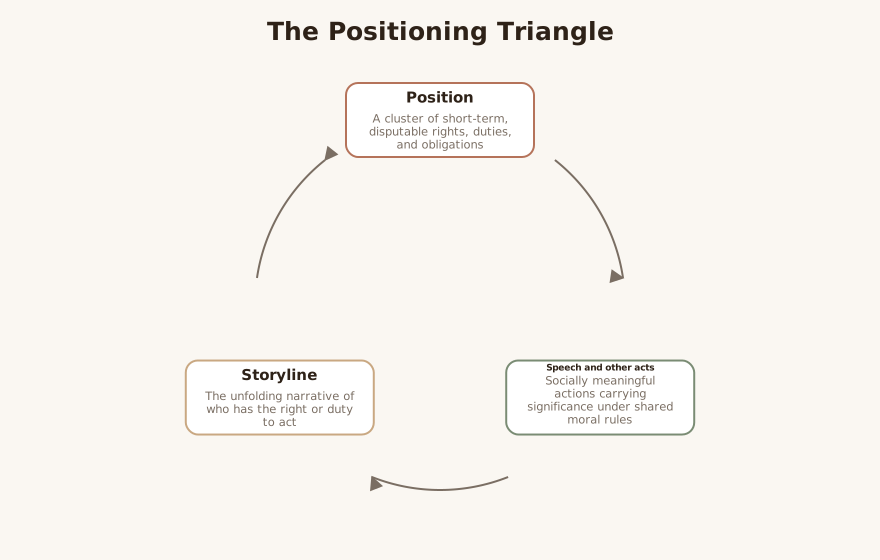
Positions are organized by the positioning triangle (or triad), three mutually constituting elements 8:
- Position — the beliefs about one’s rights, duties, and obligations in the situation 8.
- Speech and other acts — socially meaningful actions and utterances that carry significance within shared moral rules 8.
- Storyline — the unfolding narrative that establishes who has the right or duty to act, and how 8.
A foundational principle is that changing any one element alters the others: shift the storyline and the available positions change; refuse a position and the storyline must be rewritten 8. Reference works describe this as the basic dynamic that makes positioning analysis a tool for understanding both stability and change in social episodes 4.
The theory specifies several further distinctions clinicians find diagnostically useful LLM. First-order positioning is an individual’s initial assumption of a position; second-order positioning arises when that positioning is questioned or renegotiated within the interaction; third-order positioning occurs when an outside observer characterizes the episode afterward 8. Interactive positioning is positioning another through one’s words and conduct, while reflexive positioning is positioning oneself — including the act of refusing a position others have assigned, as when a student rejects being cast as “rebellious” 8. Moral positioning flows from role-based rights and duties (parent–child, clinician–patient), whereas personal positioning flows from an individual’s particular experiences and attributes, exceeding generic role expectations 8. The framework also names tacit (unintentional, everyday) versus intentional positioning, and warns of malignant positioning — discourse that situates a person so as to license their mistreatment 8.
Interventions & Techniques
Positioning theory does not come with a branded technique set; clinicians operationalize it as a set of moves layered onto an existing therapy LLM. The most direct application is positioning analysis of the client’s account: listening for the storyline, identifying which positions it makes available, and tracking the rights and duties attached to each 8. Because changing one corner of the triangle changes the others, the working hypothesis is that altering the storyline or the speech acts can free a client from a constraining position 8.
Practically, this resembles and overlaps with narrative-therapy moves LLM. A clinician can help a client name the position a problem narrative assigns them, question who authored it (interactive versus reflexive positioning), and reposition by deliberately refusing an imposed position and co-authoring a new storyline 8. The reflexive-positioning move — supporting a client to decline a position such as “the difficult one” or “the one to blame” — is a concrete intervention the theory directly licenses 8.
LLM-generated illustrative example (not a guideline): A client says, “I’m the family scapegoat — everyone agrees it’s always my fault.” The clinician maps the storyline (“the family crisis narrative”), the position it assigns (“the one at fault, with the duty to absorb blame”), and the speech acts that maintain it. Together they explore second-order positioning — what happens when the client questions that assignment — and rehearse a reflexive repositioning (“I am someone who can name a problem without owning all of it”). LLM
Empirical applications model the analytic technique well. In a study of hospital morning reports, researchers used video observation and positioning analysis to show how physicians positioned themselves and colleagues simultaneously as an equal “collegial ‘we’” and within a hierarchy, revealing two competing storylines running in the same episode 2. In a study of Indian social workers responding to domestic violence, interview-based positioning analysis surfaced four self-positions — challenger of gendered oppression, advocate of women’s rights, facilitator of empowerment, and self-reflector of personal emotions — and showed that the worker’s self-positioning simultaneously fixed the survivor’s position 3. Both illustrate the core clinical technique: make the implicit positioning explicit, then work on it LLM.
Evidence Base
The honest appraisal is that positioning theory is established as a conceptual and analytic framework, not as an outcome-evaluated treatment LLM. Its maturity lies in decades of theoretical development and widespread use across social psychology, education, communication, and peace psychology, documented in multiple encyclopedia and handbook treatments 4567. As a theory, it is well-specified, internally coherent, and broadly adopted 1.
What it does not have is a body of randomized controlled trials demonstrating that positioning-based therapy improves clinical outcomes LLM. The empirical literature is overwhelmingly qualitative and descriptive: studies use positioning analysis to interpret interaction — morning reports among clinicians 2, professional self-positioning among social workers 3 — rather than to test an intervention against a comparator LLM. These studies are methodologically sound for their aims (qualitative, discourse-analytic) but were not designed to measure symptom change 23.
For the clinician, the implication is straightforward: positioning theory is best used as an adjunctive lens whose value is conceptual clarity and case formulation, and should be paired with an evidence-based modality (such as narrative or systemic therapy) when measurable outcomes matter LLM. Claims of efficacy beyond “it usefully organizes how we understand a conversation” are not supported by the cited literature LLM.
Populations & Indications
Because it is content-agnostic, positioning theory can in principle be applied to any client whose difficulty has an interactional or identity dimension LLM. The cited applications span clinical and professional teams, where it illuminated how members negotiate equality and hierarchy 2, and frontline practitioners working with survivors of domestic violence, where it clarified how professional stance shapes the survivor’s position 3.
In the therapy room, the framework is most indicated when a client’s distress is bound up with how they are positioned by others or by a dominant narrative — in family and couple conflict over rights and duties, in role strain, in internalized stigma, and in identity questions LLM. It is well suited to adults able to engage reflectively with language, and to couples and families where the unit of analysis is the shared storyline rather than one person’s pathology LLM. Its peace-psychology heritage makes it a natural fit for conflict, where parties’ positions and the storylines that justify them are precisely the thing to be renegotiated 5.
Problems-for-Work
Positioning theory targets problems that live in the rights-and-duties structure of relationships and self-stories rather than in discrete symptoms LLM.
- Rigid or oppressive self-narratives. When a client speaks as if a single demeaning position were simply the truth, positioning analysis separates the position from the person and opens it to revision 8.
- Relational and family conflict over rights and duties. Conflicts often turn on contested entitlements — who has the right to decide, who has the duty to care — which the positioning triangle names directly 8.
- Internalized stigma and blame. The concept of malignant positioning gives a precise vocabulary for discourse that situates a person so as to justify their mistreatment, including blame they have turned inward 8.
- Role strain and professional identity stress. As the morning-report and social-work studies show, the framework clarifies how people hold competing positions (equal colleague and subordinate; advocate and emotionally affected person) and where the strain comes from 23.
- Power imbalances in couples. Moral versus personal positioning helps a couple see which entitlements they assume from role and which they negotiate as individuals 8.
LLM-generated illustrative example (not a guideline): A couple repeatedly fights about chores. Positioning analysis reveals the recurring storyline (“one of us is responsible, the other is supervised”), the rights and duties each partner reads into it, and the speech acts (“you always have to remind me”) that keep both locked in. Reworking the storyline — from “supervisor and supervised” to “two co-managers” — shifts the available positions for both. LLM
Contraindications, Cautions & Cultural Humility
Positioning theory is a lens, and lenses can be misapplied LLM. Its constructionist stance — that identity is produced in discourse — should not be used to imply that a client’s suffering is “just talk” or that reframing a storyline dissolves real material harm; the social-work study explicitly notes that survivor safety also requires structural change by funders and policymakers, not discursive work alone 3. Treating positioning as a substitute for safety planning, risk assessment, or evidence-based symptom-focused care would be a misuse LLM.
Caution is warranted with clients in acute crisis or with limited capacity for abstract, reflective language, for whom abstract analysis of positions may feel invalidating or inaccessible LLM. The framework also has no established evidence for serious psychopathology where directive, structured treatment is indicated, and should not displace it LLM.
Culturally, positioning theory is itself a tool of humility when used well: the morning-report study shows that each setting carries its own implicit positioning patterns, reminding clinicians that rights and duties are locally and culturally defined rather than universal 2. The social-work study, conducted in India, underscores that the “positions” available to a survivor or a helper are shaped by gendered and systemic context 3. Clinicians should resist importing their own assumptions about who holds which rights and duties, and instead elicit the client’s own storyline and moral order LLM.
Treatment-Plan Suggestions & SMART Objectives
The objectives below treat positioning work as adjunctive to an established modality; mechanisms reference the positioning triangle and its dynamics LLM.
| Goal | SMART objective (example) | Mechanism |
|---|---|---|
| Externalize a problem self-narrative | Within 4 sessions, client will name one storyline and the position it assigns them, in their own words, in 2 consecutive sessions | Separating position from person via the positioning triangle 8 |
| Identify imposed positions | Within 6 sessions, client will identify 3 instances of being interactively positioned by others and describe the attached rights/duties | Interactive vs. reflexive positioning awareness 8 |
| Practice reflexive repositioning | Over 8 sessions, client will rehearse and report 2 real-world instances of declining an imposed position and stating an alternative | Refusing a position rewrites the storyline 8 |
| Renegotiate relational rights/duties | Within 5 conjoint sessions, partners will jointly rewrite 1 recurring conflict storyline into shared positions, rated as fairer by both | Changing one triangle element shifts the others 8 |
| Reduce internalized blame | Within 6 sessions, client will recognize and label 2 instances of malignant positioning and reattribute responsibility more accurately | Naming malignant positioning 8 |
| Clarify role strain | Within 4 sessions, client will distinguish moral (role-based) from personal positions contributing to their stress in 1 key relationship | Moral vs. personal positioning 8 |
| Strengthen authored identity | Over 10 sessions, client will articulate and act from 1 preferred self-position across 3 contexts | Reflexive positioning and storyline revision 8 |
Common Misconceptions
- “Positions are the same as roles.” They are not; positions are short-term, contestable clusters of rights and duties that shift within a conversation, whereas roles are comparatively fixed — this distinction is the theory’s core 8.
- “Positioning theory is a therapy.” It is a theory/analytic lens borrowed into therapy, with no manualized protocol or outcome-trial evidence of its own 18.
- “It’s only about individuals.” The unit of analysis is the interaction — the triangle of position, act, and storyline — so it is inherently relational and well suited to couples, families, and teams 82.
- “Reframing the story fixes the problem.” Discursive repositioning can change available positions, but the literature is explicit that real-world harm may still require structural and safety-focused action 3.
- “Positioning is always conscious.” The theory distinguishes tacit, everyday positioning from intentional positioning; much of it operates outside awareness 8.
Training & Certification
There is no certifying body, credential, or licensure pathway specific to positioning theory; it is an academic framework transmitted through the social-science and discourse-analysis literature rather than a regulated clinical modality LLM. Clinicians typically encounter it through graduate coursework in social psychology, qualitative methods, or discourse analysis, and through the encyclopedia and handbook treatments that codify it 4567.
Practically, a therapist builds competence by studying the primary and reference literature, reading worked positioning analyses such as the morning-report and social-work studies, and integrating the lens into a modality in which they are already trained and, ideally, supervised 23. Because the clinical application overlaps heavily with narrative and systemic practice, training in those evidence-based modalities is the most direct route to using positioning theory responsibly LLM.
Key Terms
- Position — a cluster of short-term, disputable rights, obligations, and duties held in a social context 8.
- Positioning triangle/triad — the mutually constituting set of position, speech/other acts, and storyline 8.
- Storyline — the unfolding narrative that establishes who has the right or duty to act 8.
- First/second/third-order positioning — initial assumption of a position; its renegotiation within the episode; later characterization by an observer 8.
- Interactive vs. reflexive positioning — positioning another through one’s conduct vs. positioning (or repositioning) oneself 8.
- Moral vs. personal positioning — entitlements derived from role vs. from individual experience and attributes 8.
- Malignant positioning — discourse that situates a person so as to license their mistreatment 8.
- Discursive psychology / social constructionism — the broader traditions holding that identity is produced in interaction, within which positioning theory sits 8.
Resources & Further Reading
▶ Watch — a video introduction to this concept:
- Positioning theory (Wikipedia)
- List of social psychology theories: Positioning theory (Wikipedia)
- How doctors build community and socialize into a clinical department through morning reports. A positioning theory study (PLoS One, 2023)
- Professional Self-Positioning of Indian Social Workers in Response to Domestic Violence (J Interpers Violence, 2022)
- Positioning Theory — handbook chapter (Wiley)
- Positioning Theory — Encyclopedia of Peace Psychology (Wiley)
- Positioning Theory — Springer reference entry
- Positioning Theory — Springer reference (living edition)
Reflective / Supervision Questions
- When a client describes a problem, can you hear the storyline and the positions it assigns — and could you say those out loud in the client’s own language? LLM
- Whose rights and duties are being asserted, contested, or quietly imposed in this client’s account, and which of those have they internalized as identity? LLM
- Where in your own practice do you interactively position clients — and might any of that positioning be malignant rather than helpful? 8
- For a couple or family on your caseload, what single storyline, if rewritten, would change the positions available to everyone in the system? 8
- Are you using positioning work as a genuine adjunct to an evidence-based modality, or as a substitute for symptom-focused care, risk assessment, or structural advocacy the situation actually requires? 3
- How do this client’s cultural and systemic context shape which positions are even available to them — and are you eliciting their moral order rather than importing your own? 23