
Past-life regression therapy (PLR) is a practice clinicians will encounter more often as a topic raised by clients than as a service they themselves provide. This article exists not to teach you to deliver it, but to help you respond to it competently — understanding its lineage, what the evidence actually shows, and the memory risks that make it a cautionary case study in iatrogenic harm. LLM
Type & Discipline
Past-life regression is a hypnosis-based technique in which a practitioner uses guided induction and suggestive questioning to elicit narratives that the client interprets as memories of previous incarnations. 3 It sits within hypnotherapy and the broader transpersonal-practice tradition rather than within any evidence-based clinical discipline, and the mainstream medical and psychological community treats it as discredited pseudoscience. 3 A 2006 survey of doctoral-level mental health professionals rated past-life regression among interventions “certainly discredited” for treating mental disorders. 3 For the purposes of a clinical knowledge base its evidential maturity is best labeled metaphorical: any therapeutic value it produces flows from generic hypnotic and narrative processes, not from access to literal prior lives. LLM
Creators & Lineage
The idea of recovering prior-life experience has deep roots in Hindu, Jain, and Chinese religious traditions, and entered Western practice through the 19th-century spiritualism movement. 3 Edgar Cayce described reincarnation in trance during the 1920s, A. R. Martin published early hypnotic-regression work in 1942, and the 1952 “Bridey Murphy” case popularized the practice before investigation revealed it to reflect false memory rather than genuine recall. 3 Modern PLR was driven most forcefully by psychiatrist Brian L. Weiss. 4 Weiss earned his bachelor’s degree from Columbia and his medical degree from Yale, completed psychiatric residency at Yale, and became Head of Psychiatry at Mount Sinai Medical Center in Miami — credentials that lent the practice an aura of legitimacy. 4 In 1980 a patient he called “Catherine” began describing past-life experiences under hypnosis, and Weiss, initially skeptical of reincarnation, reported becoming convinced after believing he had verified details from her accounts. 4 His 1988 book Many Lives, Many Masters documented this case and helped move past-life therapy into mainstream popular culture. 5 Weiss claims to have regressed more than 4,000 patients since. 4 Other lineage figures clinicians may hear named include Morris Netherton, an early past-life therapy proponent, and psychiatrist Ian Stevenson, whose separate research program collected children’s reincarnation claims — though Stevenson’s case-study work is distinct from hypnotic regression practice. 3
Core Principles
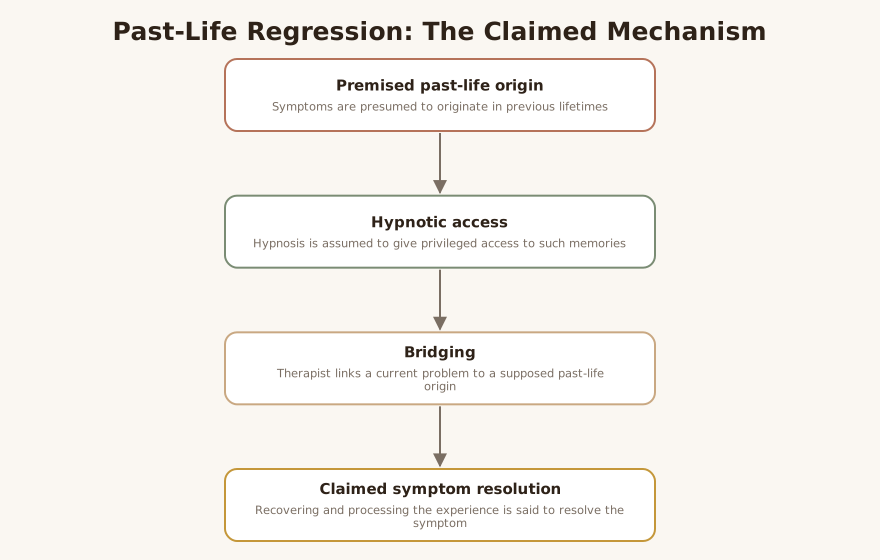
The central premise of PLR is that present-day symptoms — phobias, pain, relationship patterns — originate in unresolved experiences from previous lifetimes, and that recovering and processing those experiences resolves the symptom. 3 Practitioners assume that such memories are stored and retrievable through altered states of consciousness, and that hypnosis provides privileged access to them. 3 A common procedural principle is “bridging,” in which the therapist links a current problem to a supposed past-life origin and guides the client back to it. 3 Critically, the practice presupposes a continuity of memory across death and rebirth — a claim for which current science provides no plausible mechanism, since there is no understood way for memories embodied in the brain of a deceased person to migrate to a living one. 1 From an experimental-psychopathology standpoint, past-life “memories” are a more compelling instance of false autobiographical memory than even alien-abduction reports, because abduction is at least physically possible whereas past-life recall is not. 1
Interventions & Techniques
A typical session combines hypnotic induction with suggestive, leading questions, with sessions often lasting roughly 15 to 45 minutes during the regression itself. 3 The client, in a relaxed and absorbed state, is prompted to describe clothing, surroundings, names, and identities belonging to an alleged prior life. 3 Guided imagery and visualization are routinely used to deepen the experience, and these imaginative procedures are precisely the ones most likely to generate vivid content that becomes confusable with memory. 1 In the controlled study of past-life experiencers, reported phenomena included déjà vu episodes, vivid sensory “flashbacks,” out-of-body experiences, daydreams, somatic pain attributed to past-life injury, and recurrent dreams, with previous lives ranging from a Viking to a Druid priestess to a polar bear. 1 The combination of an induction that heightens suggestibility, leading questions that supply content, and a cultural script about reincarnation is the engine that produces these narratives. 6
Evidence Base
The honest summary is that there is no evidential support for the literal claims of PLR, and good evidence that its products are false memories. 1 The strongest single study recruited 15 adults reporting past-life memories and 15 controls reporting only their current life, and tested both groups on the Deese–Roediger–McDermott (DRM) false-memory paradigm. 1 The past-life group falsely recalled significantly more non-presented critical words (M = .44 vs .30, r = .31) and, on pooled recognition testing, falsely recognized far more critical items (M ≈ .76 vs .48 on the confounded test; pooled r = .54), while the groups did not differ on correct recall, correct recognition, or intelligence. 1 In other words, the difference was specific to errors of commission — generating “memories” of things that never occurred — not a general memory deficit. 1 The past-life group also scored higher on the Tellegen Absorption Scale (M = 24.5 vs 16.8) and the Magical Ideation Scale (M = 13.0 vs 6.7), traits the authors link to a sociocognitive model in which rich imaginative capacity and unconventional beliefs make a person prone to confusing imagination with memory. 1 Notably, the six past-life participants who had undergone hypnosis scored substantially higher on magical ideation than those who had not (M = 18.5 vs 9.3), consistent with the view that the most fantasy-prone individuals are also the most drawn to hypnotic regression. 1 McNally’s broader experimental-psychopathology program situates past-life and alien-abduction reports together as false autobiographical memories arising from the same mechanisms of absorption, magical ideation, suggestion, and source confusion. 2 The authors are careful to note the DRM paradigm does not by itself prove any individual memory false — like a cardiac stress test, it flags propensity rather than diagnosing the event — but the convergence of findings is decisive against PLR’s literal claims. 1
Populations & Indications
Clients drawn to PLR tend to share an identifiable profile: high absorption, high fantasy proneness, and strong belief in reincarnation, with belief in reincarnation — not hypnotizability per se — being among the strongest predictors of reporting past-life memories. 3 In practice these are often adults seeking an explanatory narrative for distress that has resisted other accounts: unexplained phobias, chronic pain without medical basis, intense relationship dynamics reframed as “soul connections,” or fear of death and existential unease. LLM There is no clinical indication for PLR as a treatment, because no disorder responds to it specifically and no mechanism supports it. 6 What clinicians should recognize is the demand: clients who request it are usually seeking meaning, relief, and a sense of agency over suffering, and that underlying need is legitimate even though the proposed method is not. LLM
Problems-for-Work
While PLR itself is not a recommended intervention, the presenting problems clients bring to it are real and treatable through evidence-based means. LLM A client requesting regression for a lifelong, origin-less fear of water is describing a specific phobia, best served by graded exposure within a cognitive-behavioral frame rather than a search for a drowning in a prior life. LLM
LLM-generated illustrative example (not a guideline): A client says she “knows” her chronic shoulder pain comes from a sword wound in a past life and wants regression to heal it. The clinician validates her wish for relief, screens for and addresses untreated medical and trauma contributors, and reframes the work toward present-day pain coping and the meaning she is making of her body. LLM
Relationship patterns framed as karmic or fated can be worked as attachment and schema material; grief and death anxiety can be met with existential and acceptance-based approaches; and the desire for a coherent life narrative can be honored through legitimate narrative work without endorsing literal reincarnation. LLM In each case the clinician treats the problem-for-work, not the past-life premise. LLM
Contraindications, Cautions & Cultural Humility
The principal caution is iatrogenic: the procedures PLR relies on are the same ones memory researchers warn against. 6 Hypnosis increases the sheer volume of recall, producing both more correct and more incorrect material while inflating confidence without improving accuracy. 6 Age regression yields “contextually-dependent and expectancy-driven social constructions” rather than veridical memories, and past-life reports specifically contain historical details that are “invariably incorrect.” 6 Lynn, Loftus, and Lilienfeld conclude there is no empirically supported psychotherapy that depends on recovering forgotten events, and they warn that evoking intense emotion without coping structure can itself harm clients. 6 Critics argue the practice can violate clinical ethics by implanting false memories without scientific justification. 3 These risks are sharpest for exactly the high-absorption, high-magical-ideation clients most likely to seek PLR. 1 At the same time, cultural humility matters: reincarnation is a sincerely held tenet across major world religions, and the clinician’s task is to disambiguate respect for a client’s spiritual worldview from endorsement of a memory-recovery technique that the evidence does not support. 3 A therapist can honor a client’s belief in rebirth as meaningful without representing hypnotic regression as a valid route to literal prior-life facts. LLM
Treatment-Plan Suggestions & SMART Objectives
| Goal | SMART objective (example) | Mechanism |
|---|---|---|
| Reduce a specific phobia the client attributes to a past life | Client will complete a graded exposure hierarchy and report SUDS ≤ 3 for the feared stimulus within 10 sessions | Exposure-based extinction learning, not memory retrieval 6 |
| Decrease reliance on past-life narrative to explain present distress | Client will identify 3 present-day contributors to a target symptom in 4 sessions | Reattribution and source monitoring 1 |
| Improve coping with chronic unexplained pain | Client will use 2 self-regulation skills daily and log pain-interference weekly for 6 weeks | Pain-coping and self-efficacy building 6 |
| Process grief and death anxiety without reincarnation claims | Client will articulate a personal meaning framework for mortality across 6 sessions | Existential and acceptance-based processing LLM |
| Build psychoeducation about suggestion and false memory | Client will describe how hypnotic suggestion can create confident-but-false memories by session 3 | Memory-science literacy reduces uncritical recovery-seeking 6 |
| Reframe “soul connection” relational patterns | Client will map 2 recurring relationship patterns to attachment history in 5 sessions | Attachment and schema reattribution LLM |
| Strengthen distress tolerance before any depth work | Client will demonstrate 3 grounding skills under mild distress within 4 sessions | Affect-regulation scaffolding prevents harm 6 |
Common Misconceptions
A frequent misconception is that a clinician verifying details of a regression account proves the memory genuine — yet historical details in past-life reports are characteristically anachronistic or factually wrong, and apparent “verification” is vulnerable to cryptomnesia, where forgotten information resurfaces as seemingly novel recall. 3 A second is that hypnosis functions like a video recorder that unlocks buried truth; in fact it raises suggestibility and confidence while degrading accuracy. 6 A third is that vivid emotional intensity authenticates a memory — but absorption and fantasy proneness generate exactly such vivid, affect-laden imagery in the absence of any real event. 1 A fourth is that only highly hypnotizable people produce these reports; belief in reincarnation predicts them more strongly than hypnotizability alone. 3 Finally, a credentialed advocate does not make the claims scientific: Weiss’s psychiatric standing has not been matched by controlled evidence for reincarnation-based therapy. 4
Training & Certification
There is no recognized, accredited clinical credential for past-life regression; “certifications” are issued by private hypnotherapy and transpersonal organizations outside mainstream licensure and carry no standing in evidence-based practice. 3 Weiss’s own training is in psychiatry, not in any validated past-life modality, and his influence derives from his popular writing rather than from a credentialing pathway. 4 5 For licensed clinicians, the relevant “training” is in the science of memory, suggestion, and hypnosis so that they can recognize and avoid the pitfalls these techniques introduce. 6
Key Terms
DRM paradigm — a laboratory task measuring false recall and recognition of non-presented words; elevated DRM errors index a propensity to form false memories outside the lab. 1 Absorption — the trait of becoming deeply immersed in imaginative experience, correlated with hypnotic susceptibility and elevated in past-life experiencers. 1 Magical ideation — endorsement of unconventional causal beliefs, a facet of schizotypy elevated in this population. 1 Cryptomnesia — mistaking forgotten, previously encountered information for an original memory, a key source of “verified” past-life detail. 3 Sociocognitive model — the account in which personality traits, suggestion, and cultural scripts jointly produce implausible memory reports. 1 Iatrogenic harm — clinician-caused harm, here the implantation of false memories through recovery techniques. 6
Resources & Further Reading
▶ Watch — a video introduction to this concept:
- Meyersburg, Bogdan, Gallo & McNally (2009), False Memory Propensity in People Reporting Recovered Memories of Past Lives
- McNally (2012), Explaining ‘Memories’ of Space Alien Abduction and Past Lives: An Experimental Psychopathology Approach
- Lynn, Loftus & Lilienfeld, Memory Recovery Techniques in Psychotherapy: Problems and Pitfalls
- Past life regression — Wikipedia
- Brian Weiss — Wikipedia
- Many Lives, Many Masters (Brian L. Weiss)
Reflective / Supervision Questions
- When a client requests past-life regression, what underlying need — meaning, relief, agency, spiritual coherence — is the request expressing, and how can I meet it without endorsing a discredited method? LLM
- How do I distinguish respect for a client’s sincere belief in reincarnation from clinical validation of hypnotic memory recovery as a route to literal facts? 3
- Where in my own practice do I use guided imagery or relaxation in ways that could inadvertently shade into suggestive memory work, and how do I safeguard against it? 6
- If a client arrives describing a vivid past-life “memory” already produced by another practitioner, how do I respond in a way that neither shames the client nor reinforces a false belief? LLM
- What is my plan for psychoeducation about suggestion and false memory when a client is actively seeking recovery-oriented techniques? 6