
Type & Discipline
The Medicine Wheel, also called the Sacred Hoop, is a traditional framework drawn from North American Indigenous cosmology rather than a Western psychotherapy modality 1. It is most accurately understood as a sacred symbol and orientation system that organizes life, health, and the person into a circular set of relationships 2. For the practicing clinician, the central translation is this: where biopsychosocial-spiritual models describe domains of functioning, the Medicine Wheel is itself a holistic cosmology that names the physical, emotional, mental, and spiritual aspects of a person as interdependent parts of one balanced whole 3. LLM It belongs to the family of Indigenous cosmologies and traditional healing practices, and it predates and stands outside the clinical taxonomy of evidence-based interventions LLM. Treating it as a discipline-equivalent to a manualized therapy would be a category error; it is a worldview within which healing is understood, not a protocol to be administered LLM.
Creators & Lineage
The Medicine Wheel has no single author, founder, or originating clinician, and that fact is clinically and ethically important LLM. It arises from collective oral tradition across many Indigenous nations of North America and is described as an ancient orientation system, with physical stone medicine wheels potentially dating back thousands of years 2. The term “medicine wheel” itself was coined by non-Native observers in the early 1900s; the older Indigenous name for these forms was “sacred circles” 3. Its lineage in a contemporary care context sits alongside holistic and biopsychosocial-spiritual models, cultural and traditional healing practices, and wellness and recovery frameworks LLM. Because the teachings are transmitted within communities and ceremony, authority over them rests with Elders, knowledge keepers, and the nations who hold them, not with academic or clinical institutions LLM. Any clinician integrating the framework should treat its knowledge as belonging to those communities and seek their guidance rather than claiming expertise LLM.
Core Principles
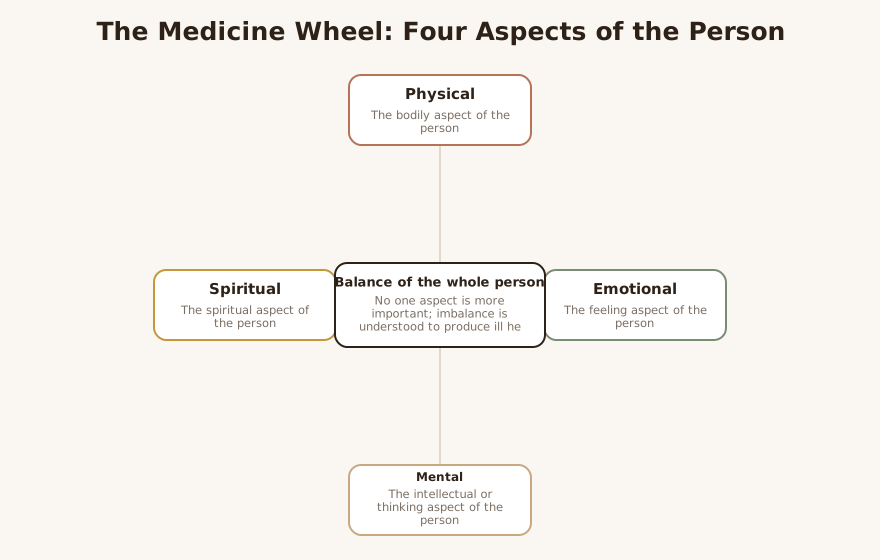
At its center, the wheel embodies the Four Directions—East, South, West, North—each typically associated with a color and a cluster of meanings 1. Across many teachings, the four quadrants map onto four aspects of the person: physical, emotional, mental (intellectual), and spiritual 3. The same fourfold structure extends to the seasons (spring, summer, autumn, winter), to life stages (birth, youth, adulthood/elderhood, death), and to natural elements such as fire, earth, water, and air 1. A foundational principle is balance: “no one aspect of ourselves or stage of our lives is more important than the others,” and imbalance among them is understood to produce ill health 2. In Ojibwe Anishinaabe teaching this balanced life is named mino bimaadiziwin, the good life, toward which individuals strive each day 4. The circle is not incidental but essential—Aboriginal peoples are described as viewing the world “in a circular fashion” because “all things are connected” 3.
Movement around the wheel is cyclical and clockwise, or “sun-wise,” aligning the person with natural forces such as gravity and the rising and setting of the sun 1. This cyclical structure carries a developmental teaching: the infant becomes the child, the adult, and finally the elder, who returns to the beginning so the process renews again 4. Interdependence is explicit—if one direction falters, such as physical illness, the others are affected, so harmony depends on tending all four together 5. Many teachings also frame the wheel around choice and responsibility, holding that “life is a matter of choice” and that the framework’s power depends on how its gifts are used 5. Crucially, the spiritual dimension is not optional decoration; one teaching holds that “without Spirit, and personal commitment, it is unlikely that any teaching or any strategy” will help a person attain and maintain balance 4.
Interventions & Techniques
The Medicine Wheel is best understood as an organizing framework that informs practices rather than a discrete technique applied in a session LLM. In community and public-health applications, its teachings have been operationalized by addressing several domains at once instead of a “siloed and one size fits all approach” to behavior change 2. One published example is the Okla Achokma (“healthy people” in Choctaw) model, which translates the wheel into four health domains: intellectual (knowledge about diet–disease relationships), physical (diet and activity behaviors), spiritual (removing existential barriers such as fatalism through re-alignment with traditional values), and social (family and community support) 2. The framework is frequently paired with culturally grounded practices such as talking circles and storytelling, which some interventions classify as “enhanced cultural adaptations” beyond simply representing Indigenous people in materials 2.
For a clinician, the practical move is to use the four directions as a relational map of a client’s life—asking how each aspect is faring and where balance has been lost—while keeping ceremony-bound and sacred elements in the hands of those authorized to carry them LLM. The teachings are described as strongest in communities that actively practice sweatlodges and ceremonies and as less accessible in urban settings, which has direct implications for what a non-Indigenous practitioner can responsibly offer versus what should be referred 5. A clinician can hold the wheel as a shared lens for assessment and goal-setting; the deeper ceremonial and spiritual work is appropriately led by Elders and knowledge keepers LLM.
LLM-generated illustrative example (not a guideline): A clinician working with an Indigenous client in early recovery introduces the four directions as a way to talk about wellbeing, noting that the client’s physical health is improving but the emotional and spiritual directions feel “empty.” With the client’s consent and a referral to a community Elder for ceremony, the dyad uses the wheel to track balance across all four aspects rather than focusing on sobriety alone. LLM
Evidence Base
Honesty about maturity matters here, because “established” carries two very different meanings LLM. As traditional and cultural knowledge, the Medicine Wheel is long-established and continuously transmitted across generations and nations 2. As a structured clinical intervention evaluated by Western research standards, the evidence is emerging and limited 2. The strongest current literature frames the wheel as a public-health approach to lifestyle intervention rather than as a tested psychotherapy 2. In that body of work, behavior-modification programs such as the National Diabetes Prevention Program showed efficacy, and their translation to 80 Indigenous tribes (SDPI-DP) produced similar cardiometabolic improvements—but with large dropout rates linked to lack of family support and disinterest 2.
The specific question of what the cultural components add remains largely unanswered 2. A systematic review identified only five culturally-informed type 2 diabetes interventions among U.S. Indigenous populations between 2009 and 2021, with outcomes that “varied widely,” and the authors concluded that results “did not indicate what cultural adaptations could add to standard lifestyle management interventions” 2. Heterogeneity across studies, minimal rigorous research on under-represented populations such as Deep South tribal nations, and few completed trials of culturally-enhanced programs all limit confidence in effect sizes 2. At the same time, signal exists for individual domains—family social support predicted both lower dropout and greater weight loss, and spirituality was negatively correlated with baseline weight 2. The clinically honest summary: the framework is culturally authoritative and clinically promising, but it is not yet supported by the kind of randomized, replicated outcome data that anchors a first-line evidence-based therapy LLM.
Populations & Indications
The framework is most directly relevant to Indigenous and Native American clients, and to First Nations and Aboriginal peoples for whom it is a living part of cultural and spiritual life 1. Published applications focus on Indigenous populations across North America, including under-represented groups such as tribes in the Deep South 2. It is frequently invoked in contexts of substance use recovery, where balance across physical, emotional, mental, and spiritual aspects offers an alternative to a symptom-only frame LLM. It also resonates with clients seeking holistic or spiritually integrated care, with Indigenous youth navigating identity, and with communities carrying the weight of historical and intergenerational trauma LLM. The indication is less about a diagnosis and more about fit: the wheel suits clients for whom wellbeing is understood relationally, cyclically, and spiritually rather than as the absence of a disorder LLM.
Problems-for-Work
The wheel’s strength is its capacity to reframe presenting problems as expressions of imbalance across the four aspects, which can open work that a narrow diagnostic frame might miss LLM.
- Historical and intergenerational trauma: the cyclical, life-stages structure lets clinician and client locate disruption across generations and situate present distress within a longer continuity of life 2. LLM
- Substance use disorders: recovery can be framed as restoring balance among all four directions rather than abstinence alone, with the spiritual aspect treated as central rather than peripheral 4. LLM
- Identity and cultural disconnection: re-engaging with the wheel’s teachings can support reconnection to traditional values, which one model treats as removing “existential barriers such as fatalism” 2. LLM
- Depression, anxiety, and spiritual distress: these can be explored as imbalance—where one direction has been neglected—because imbalance is understood to produce “disease” 4. LLM
- Grief and loss: the cycle of birth, growth, elderhood, and return offers a culturally meaningful container for mortality and bereavement 4. LLM
- Holistic wellness and life balance: the daily striving toward mino bimaadiziwin gives clients a concrete, values-based target for everyday balance 4. LLM
Contraindications, Cautions & Cultural Humility
The single most important caution is that there is no universal Medicine Wheel 3. Teachings, the order of the colors, and the attributes assigned to each direction differ across nations, and sources warn explicitly “against making sweeping generalizations across Indigenous nations” 3. Different tribes interpret the wheel distinctly, and one Elder notes that “many people have different interpretations in their medicine wheel and they are all right” 15. Pan-Indigenous generalization is therefore not a stylistic flaw but a genuine clinical error that can alienate the very clients the framework is meant to serve LLM.
Because the wheel is sacred and tied to ceremony, non-Indigenous clinicians should not lead, perform, or improvise these practices LLM. The appropriate stance is partnership: collaborating with and referring to Elders and knowledge keepers, who hold the authority over the teachings, rather than positioning oneself as the expert LLM. The term itself was applied by outsiders, a reminder that naming and framing this tradition has a colonial history worth holding with humility 3. Appropriation is a real risk—using the wheel as a decorative motif or a quick “cultural” overlay, detached from community and ceremony, can do harm LLM. Clinicians should also recognize that the teachings are more accessible in communities actively practicing ceremony than in urban contexts, and calibrate accordingly 5. Finally, Indigenous populations consistently prefer interventions designed for their specific culture and tribe, with their participation in the process, which argues against any standardized or imported template 2.
Treatment-Plan Suggestions & SMART Objectives
| Goal | SMART objective (example) | Mechanism |
|---|---|---|
| Restore balance across the four aspects | Client will, with the clinician, complete a four-directions self-review naming one concern in each aspect by session 4 | Holistic assessment surfaces neglected domains beyond presenting symptom 2 |
| Strengthen the spiritual aspect (in recovery) | Client will, in partnership with a community Elder, identify and attend one culturally meaningful spiritual practice within 8 weeks | Spiritual re-alignment addresses fatalism and supports balance 24 |
| Reconnect with cultural identity | Client will name three traditional values they wish to live by and take one concrete action toward each over 6 weeks | Reconnection removes existential/cultural barriers to wellbeing 2 |
| Mobilize family and community support | Client will identify two supportive relationships and initiate contact with at least one within 2 weeks | Family social support predicts engagement and better outcomes 2 |
| Address physical-aspect health behavior | Client will set and track one specific diet or activity behavior weekly for one month | Physical domain is one interdependent quadrant of balance 2 |
| Process grief within a cyclical frame | Client will use the life-stages cycle to narrate a loss across three sessions, identifying continuity and meaning | Cyclical renewal offers a culturally meaningful container for loss 4 |
| Reduce distress framed as imbalance | Client will rate balance in each of the four aspects weekly and discuss the lowest-rated direction | Imbalance is understood to produce “disease”; tracking targets it 4 |
Common Misconceptions
A frequent misconception is that there is one authoritative Medicine Wheel that can be looked up and applied; in reality the colors, attributes, and teachings vary by nation 3. LLM Another is that the wheel is essentially a Western holistic-health diagram with spiritual flavoring; in its own terms the spiritual aspect is foundational, not ornamental 4. LLM A third is that it is an ancient relic; it is a living, actively practiced framework, strongest in communities maintaining ceremony today 5. LLM Some assume a non-Indigenous clinician can simply adopt and deliver wheel-based practices; sacred and ceremonial elements belong with Elders and knowledge keepers LLM. Finally, clinicians sometimes assume it is “unproven and therefore unusable,” when the more accurate position is that it is culturally established and clinically promising, with formal outcome evidence still emerging 2. LLM
Training & Certification
There is no formal certification in the Medicine Wheel, and the absence of one is by design rather than oversight, because the teachings are transmitted through community, oral tradition, and ceremony rather than through accredited training programs LLM. The appropriate path for a clinician is relational: building respectful, sustained relationships with Indigenous communities, Elders, and knowledge keepers, and learning from them on their terms LLM. Public-health and academic literature can orient a clinician to how the framework has been operationalized, but it cannot confer authority to teach or lead the practices 2. LLM Many clinicians appropriately limit their role to using the four-directions structure as a shared assessment and goal-setting lens, while referring ceremonial and spiritual work to those who hold it LLM. Ongoing cultural humility, not a credential, is the relevant qualification LLM.
Key Terms
- Sacred Hoop: another name for the Medicine Wheel, reflecting its circular, sacred nature 1.
- Four Directions: East, South, West, and North, each linked to colors and meanings around the wheel 1.
- Four aspects of the person: physical, emotional, mental (intellectual), and spiritual dimensions held in balance 3.
- Mino bimaadiziwin: Ojibwe Anishinaabe term for “the good life,” the balanced life toward which one strives 4.
- Sun-wise / clockwise movement: the cyclical direction of travel around the wheel, aligning with natural forces 1.
- Enhanced cultural adaptation: interventions that incorporate Medicine Wheel concepts, talking circles, and storytelling, beyond surface representation 2.
- Okla Achokma: a Choctaw-named (“healthy people”) model translating the wheel into intellectual, physical, spiritual, and social health domains 2.
Resources & Further Reading
▶ Watch — a video introduction to this concept:
- The Medicine Wheel and the Four Directions — U.S. National Library of Medicine, Native Voices
- The Medicine Wheel as a public health approach to lifestyle interventions for Indigenous populations — PMC
- What is an Indigenous Medicine Wheel? — Indigenous Corporate Training Inc.
- Medicine Wheel Teachings — Movement Towards Reconciliation, eCampusOntario Pressbooks
- The Medicine Wheel — Windspeaker
Reflective / Supervision Questions
- Whose teachings am I drawing on, and do I know the specific nation and Elder/knowledge keeper they come from—or am I reaching for a generic, pan-Indigenous version? LLM
- Where is the line between using the four directions as a respectful assessment lens and crossing into ceremonial or sacred practice that is not mine to lead? LLM
- Have I built genuine relationships with the community whose framework I am invoking, or am I applying it from the outside? LLM
- How do I hold the tension between an “established” cultural tradition and an emerging clinical evidence base when documenting and planning care? LLM
- Am I prepared to refer to and collaborate with Elders, and to step back when the work calls for it? LLM
- How might my own cultural assumptions about health, balance, and spirituality shape—or distort—how I hear this client? LLM