
Type & Discipline
Mediation and restorative justice (RJ) practices form a framework rather than a single manualized therapy, drawn from the fields of conflict resolution and criminology rather than clinical psychology LLM. At its center is a simple reframe: harm is understood as a violation of people and relationships, and the central questions become who was hurt, what they need, and whose obligation it is to make things right 4. This stands in contrast to a purely retributive lens, which asks what law was broken and what punishment is deserved 4. The UNODC describes restorative justice as a process in which those affected by an offense participate actively, usually with the help of a facilitator, to resolve matters arising from the harm 3. For clinicians, the relevance is that these processes operate on mechanisms therapists already recognize — narrative, validation, accountability, and relational repair — applied to interpersonal and community conflict LLM.
Creators & Lineage
The contemporary framing is most associated with Howard Zehr, often called a grandfather of restorative justice, whose work crystallized the shift from a punishment paradigm to a repair-of-harm paradigm 4. Zehr’s accessible primer codified the field’s guiding principles for practitioners and laypeople alike 4. The lineage also draws on older traditions of community and Indigenous dispute resolution, on the broader conflict resolution and mediation movement, and on practices such as nonviolent communication that emphasize needs and dialogue LLM. More recently, restorative work has converged with trauma-informed care, recognizing that both victims and those who cause harm often carry significant trauma histories that shape how dialogue must be structured LLM. International bodies have institutionalized the framework, with the UNODC issuing a practitioner handbook to standardize program design across jurisdictions 3.
Core Principles
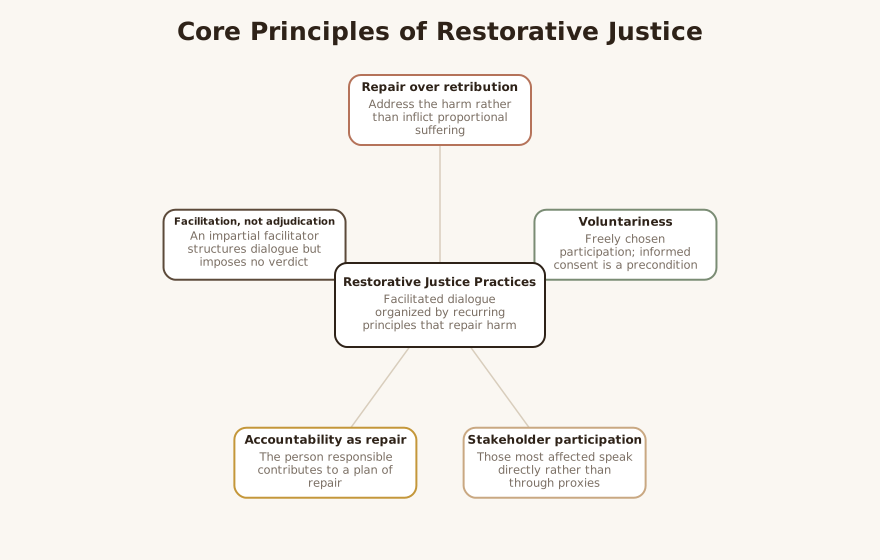
Several principles recur across restorative models LLM. First, repair over retribution: the goal is to address the harm and its consequences rather than to inflict proportional suffering 4. Second, voluntariness: genuine participation by all parties, freely chosen, is foundational, and informed consent is a precondition for any process 3. Third, active stakeholder participation: those most affected — the person harmed, the person responsible, and often their support people and community — speak directly rather than through proxies 3. Fourth, accountability as meaning-making: the person who caused harm takes responsibility and contributes to a plan of repair, which is distinct from passive submission to a sentence 4. Fifth, facilitation, not adjudication: a trained, impartial facilitator structures safety and dialogue but does not impose a verdict 3. These principles map cleanly onto therapeutic values of agency, validation, and relational accountability LLM.
Interventions & Techniques
The framework is delivered through several distinct process types 3. Victim-offender mediation brings the harmed party and the responsible party into structured dialogue, often after separate preparation meetings 3. Conferencing widens the circle to include family members, support people, and sometimes affected community members, and is heavily used with justice-involved youth 3. Circles — including peace circles, community-building circles, and sentencing circles — use a structured, turn-based format, frequently with a talking piece, to distribute voice equitably 3. In school settings, circles are the most commonly implemented practice, followed by conferences and peer mediation 6. Across formats, careful pre-process preparation, screening for safety, and a facilitator-held structure are the active ingredients 3.
LLM-generated illustrative example (not a guideline): In a school conference following a bullying incident, the facilitator meets each student and their parents separately first, then convenes a circle where the harmed student names the impact, the responsible student listens and responds, and the group co-authors concrete repair steps — an apology, a changed seating plan, and a check-in date LLM.
Evidence Base
The evidence base is established — the field is mature, with multiple systematic reviews and meta-analyses — but its strength varies sharply by outcome LLM. For victims, a systematic review of 35 studies covering nearly 4,700 victims found consistent psychological benefit: significant reductions in post-traumatic stress symptoms (notably avoidance and intrusion), reductions in anger, fear, and anxiety, and high rates of victims reporting their emotional needs for validation and information were met 5. Effects on victim wellbeing appeared durable over time, though the authors flagged that no included study controlled for crime severity, mediator quality, or concurrent psychological treatment 5. For reoffending, a Campbell systematic review specifically examined whether RJ conferences reduce repeat offending 1, and a 2025 meta-analysis synthesized recidivism and other outcomes across many programs 2; the honest reading is that recidivism effects tend to be modest and heterogeneous rather than uniformly large LLM. In schools, a review of 34 studies found reductions in bullying and suspensions and improved climate, but the authors emphasized that direct causal evidence remains limited and most studies were qualitative 6. Clinicians should therefore treat victim-recovery and satisfaction claims as well-supported and behavioral-change claims as promising but variable LLM.
Populations & Indications
Restorative practices were developed primarily for victims and offenders of crime and for justice-involved youth and adults, where conferencing and mediation are best studied 3. The school evidence supports use with students and broader school communities for conflict, bullying, and disciplinary harm 6. By extension and clinical adaptation, the framework is applied to families and couples in conflict, to workplace and organizational disputes, and to communities affected by collective harm LLM. Indications are strongest where there is an identifiable harm, a person willing to take responsibility, and a harmed party who wishes to be heard and to participate voluntarily 3. The victim-impact literature suggests the practice is particularly indicated when a survivor’s recovery is stalled by unanswered questions, lack of acknowledgment, or a need for a sense of closure that adjudication did not provide 5.
Problems-for-Work
The framework targets a recognizable cluster of clinical and relational problems LLM. Trauma related to victimization is addressed by giving survivors voice, validation, and information, with documented reductions in post-traumatic stress symptoms 5. Anger, fear, and unresolved resentment respond to structured dialogue, with measured decreases in these emotions among participating victims 5. Bullying and school conflict are addressed through circles and conferences that reduce repeat incidents and improve peer relationships 6. Recidivism and reintegration after offending are targeted through conferencing that builds accountability and community connection, with modest measured effects on reoffending 12. Interpersonal, family, and workplace conflict are worked through facilitated mediation that surfaces needs and co-creates repair 3.
LLM-generated illustrative example (not a guideline): A clinician working with an adult survivor of a burglary notes that the client’s hypervigilance is fueled by not knowing “why me.” With the client’s full consent and through a vetted RJ program, a facilitated dialogue with the responsible party answers that question, and over subsequent sessions the clinician observes a drop in intrusion symptoms LLM.
Contraindications, Cautions & Cultural Humility
Restorative processes are not universally appropriate LLM. Voluntariness and informed consent are non-negotiable; coerced participation undermines both safety and outcomes 3. Power imbalances — including those present in intimate partner violence, sexual assault, and abuse of children — require extreme caution, robust screening, and specialized facilitation, because an unprepared face-to-face process can re-traumatize the harmed party LLM. The victim-impact review itself cautioned that almost no studies examined racial, ethnic, or sociocultural variation, so generalizing outcomes across populations is not yet warranted 5. Cultural humility is therefore essential: facilitators and referring clinicians must attend to how culture shapes apology, shame, family involvement, and the meaning of harm LLM. Clinicians should also avoid presenting RJ as a substitute for needed clinical treatment; it is best positioned as adjunctive to, not a replacement for, evidence-based trauma care LLM.
Treatment-Plan Suggestions & SMART Objectives
| Goal | SMART objective (example) | Mechanism |
|---|---|---|
| Reduce trauma-related distress after victimization | Within 8 sessions, client reports a 30% decrease on a PTSD symptom measure after completing a prepared restorative dialogue | Voice, validation, and information reduce intrusion/avoidance symptoms 5 |
| Decrease anger and resentment toward the person who caused harm | Over 6 weeks, client identifies and verbalizes unmet needs and reports reduced anger ratings on a session-by-session scale | Structured expression and acknowledgment lower anger and fear 5 |
| Build accountability in a person who caused harm | Within 4 sessions, client articulates the impact of their actions and co-authors a concrete repair plan | Accountability-as-meaning-making replaces passive punishment 4 |
| Repair a specific family or relational conflict | Within 5 sessions, parties complete a facilitated dialogue and agree on 3 observable behavior changes, reviewed at follow-up | Active stakeholder participation and needs-based dialogue 3 |
| Reduce recurrence of school or peer conflict | Over one term, the harmed and responsible students complete a conference and report no repeat incidents at 6-week check-in | Conferencing/circles reduce repeat incidents and improve relationships 6 |
| Support reintegration and reduce reoffending risk | Within 12 weeks, client completes a conference, names support people, and meets agreed repair commitments | Community connection and accountability modestly reduce reoffending 12 |
| Restore a sense of agency and closure | Within 8 sessions, client reports increased sense of control and “closure” on a self-report scale post-dialogue | Empowerment and resolution of unanswered questions 5 |
Common Misconceptions
A frequent misconception is that restorative justice is “soft on offenders” or avoids accountability; in fact, the model centers accountability, asking the responsible party to face the harm and contribute to repair rather than passively serving a sentence 4. A second is that RJ is primarily for offender rehabilitation; the strongest evidence is actually for victim psychological recovery and satisfaction 5. A third is that any harm can be brought to dialogue; in reality, voluntariness, careful screening, and power-balance considerations gate appropriateness 3. A fourth is that RJ reliably and dramatically cuts reoffending — the recidivism evidence is real but modest and heterogeneous, not a guaranteed large effect 12. Finally, some assume the school evidence is conclusive; reviewers caution that direct causal evidence there is still limited 6.
Training & Certification
There is no single global license for restorative practice, and standards vary by jurisdiction and setting LLM. The UNODC handbook functions as a foundational practitioner reference, outlining program design, facilitator roles, and safeguards that training programs commonly adopt 3. Facilitator training typically covers preparation meetings, screening for safety and suitability, managing power imbalances, and structuring dialogue and agreements 3. For clinicians, Zehr’s primer is a widely used entry point into the framework’s philosophy and language 4. In practice, therapists most often refer to or collaborate with trained RJ facilitators rather than facilitate formal conferences themselves, reserving their role for clinical preparation and integration LLM.
Key Terms
- Restorative justice (RJ): A framework treating harm as a violation of people and relationships, prioritizing repair, accountability, and restoration over punishment 4.
- Victim-offender mediation: A facilitated, voluntary dialogue between the harmed and responsible parties 3.
- Conferencing: A widened process including family, support people, and community, common with justice-involved youth 3.
- Circle: A structured, turn-based group process, often using a talking piece; the most common school practice 6.
- Facilitator: A trained, impartial party who structures safety and dialogue without adjudicating 3.
- Accountability: Active responsibility-taking and contribution to repair by the person who caused harm 4.
- Voluntariness: Freely chosen, informed participation by all parties, a precondition for any process 3.
Resources & Further Reading
▶ Watch — a video introduction to this concept:
- Are Restorative Justice Conferences Effective in Reducing Repeat Offending? (Campbell Systematic Review)
- The effectiveness of restorative justice programs: A meta-analysis of recidivism and other outcomes (Fulham et al., 2025)
- Handbook on Restorative Justice Programmes (2nd ed.) — UNODC
- The Little Book of Restorative Justice — Howard Zehr
- The Psychological Impact of Restorative Justice Practices on Victims of Crimes — a Systematic Review (PMC)
- Use of Restorative Justice and Restorative Practices at School: A Systematic Literature Review (PMC)
Reflective / Supervision Questions
- When a client has been harmed, how do I distinguish a genuine desire for restorative dialogue from a wish for confrontation or revenge, and how does that distinction shape my recommendation? LLM
- What screening would I want completed before supporting a client’s participation in a process involving the person who harmed them, especially where a power imbalance exists? LLM
- How do I hold the honest evidence picture — strong for victim recovery, modest for recidivism — when a client or referrer has inflated expectations of what a process will accomplish? LLM
- In what cultural contexts might apology, shame, or family involvement carry meanings that change how I prepare a client for restorative dialogue? LLM
- Where is the boundary between my clinical role (preparation and integration) and the facilitator’s role, and how do I avoid overstepping it? LLM
- For a client who caused harm, how do I support authentic accountability without inducing shame that derails their own treatment? LLM