
Type & Discipline
Restorative justice (RJ) is a framework for responding to conflict and harm that centers the repair of relationships and the restoration of community rather than the assignment and administration of punishment 3. Peacemaking circles — also called talking circles or peace circles — are one of its signature structured processes: a facilitated gathering in which participants sit in a circle and speak one at a time, often using a talking piece, to address a shared concern, conflict, or harm 4. The discipline sits at the intersection of criminology, Indigenous practice, and community-based conflict resolution, and it draws explicitly on Indigenous traditions in which the circle is a long-standing form of communal decision-making and dialogue 2.
For practicing therapists, the relevant point is that circles are not a psychotherapy in the clinical-modality sense, but a relational and procedural framework that can be braided into trauma-informed, family, group, and community work LLM. The circle is best understood as a container — a set of structures and values that shape how a group talks — rather than as a technique aimed at a discrete symptom 1. Clinicians most often encounter circles in schools, justice-diversion programs, community organizations, and family-conflict settings rather than in the standard outpatient office LLM.
Creators & Lineage
The contemporary circle process has a dual lineage: Indigenous communal practices and the late-twentieth-century restorative justice movement that adapted them within Western criminal-justice and community systems 2. Peacemaking circles in their current restorative form were notably developed and articulated through collaborations involving Indigenous communities and justice practitioners, and the model is frequently traced to work that brought Native American and First Nations sentencing and healing circles into dialogue with mainstream justice systems 2.
Kay Pranis is among the most influential figures in disseminating and systematizing circle practice for non-Indigenous practitioners, through The Little Book of Circle Processes and the Circle Keeper’s Handbook, which translate circle values and steps into a teachable format 15. Her work emphasizes that the approach is “a new/old” one — old in its roots, new in its application to schools, workplaces, and justice settings 1. The broader lineage includes conflict resolution and mediation, trauma-informed care, and narrative and community approaches, all of which share the circle’s emphasis on voice, story, and collective meaning-making LLM.
Core Principles
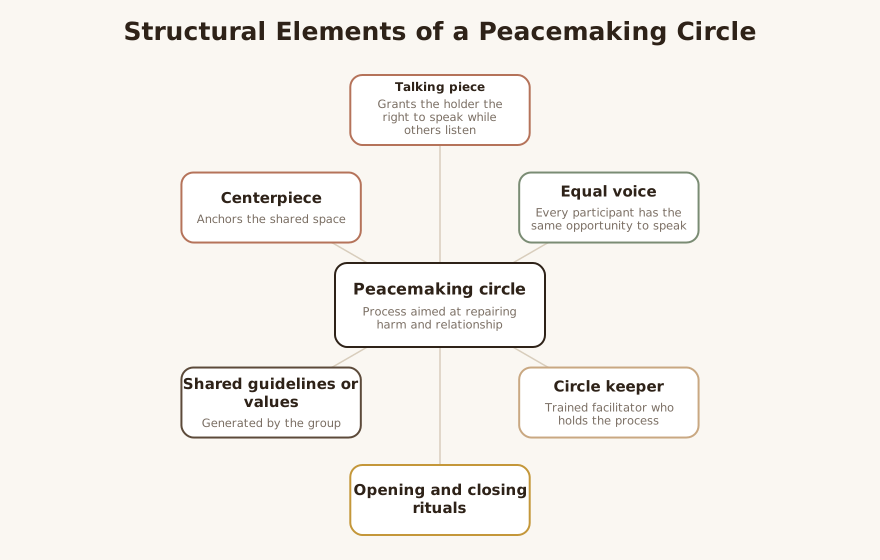
The circle rests on a small set of structural commitments that distinguish it from ordinary group discussion. The most recognizable is the talking piece: an object passed around the circle that grants the holder the right to speak while everyone else listens, which slows the conversation, equalizes participation, and reduces interruption and dominance 5. Equal voice follows from this — every participant, regardless of role or status, has the same opportunity to speak, and the physical circle removes the head-of-table hierarchy 4.
A trained circle keeper (facilitator) holds the process rather than controlling content, opening and closing the space, posing questions, and tending to the agreed-upon guidelines 5. Circles typically include opening and closing rituals, shared guidelines or values generated by the group, and the use of a centerpiece that anchors the space 5. The orienting aim is repair of harm and restoration of relationship — addressing who was harmed, what they need, and whose obligation it is to make things right — rather than determining guilt and dispensing punishment 3. Underlying all of this is a stated value base of respect, equality, and the dignity and interconnectedness of participants 6.
Interventions & Techniques
In practice, a circle is convened around a clear purpose — building relationships, making a decision, resolving a conflict, or responding to a specific harm 6. The keeper prepares participants individually beforehand, especially when serious harm is involved, so that no one is ambushed and consent is informed LLM. Sessions commonly move through phases: an opening, a relationship- and trust-building round, exploration of the issue, development of a plan or agreement, and a closing 6.
Core techniques include sequential talking-piece rounds, the use of storytelling and personal narrative to humanize participants and surface the impact of events, and guided questions that move the group from facts toward feelings, needs, and obligations 5. When a circle addresses harm, it works toward a concrete, consensus-based agreement about how repair will occur and how accountability will be carried out 3.
LLM-generated illustrative example (not a guideline): In a school re-entry circle for a student returning after a suspension for a fight, the keeper opens with a values round, then passes the talking piece for each person — the student, the peer who was harmed, a parent, and a teacher — to describe how the incident affected them. Later rounds move to “what would help repair this?”, and the circle closes with a written agreement about restitution and check-ins LLM.
For therapists, the transferable techniques are the deliberate slowing of dialogue, the egalitarian turn-taking, and the explicit separation of understanding impact from negotiating repair LLM. These can be adapted within family sessions, process groups, and community-based work without adopting the full justice apparatus LLM.
Evidence Base
The maturity of circles is best described as established as a practice but uneven in outcome research LLM. Circles are widely implemented and well-documented procedurally, with extensive practitioner literature and institutional adoption across justice and education systems 16. The evaluation literature, however, is more cautious: a formal evaluation of peacemaking circles as a Native American restorative justice practice examined implementation and outcomes and underscored both the promise of the approach and the methodological challenges of studying it rigorously 2.
Common limitations in this body of work include small samples, self-selection of motivated participants, heterogeneity of circle formats, and a relative scarcity of randomized designs 2. As a result, claims about effects on recidivism and other hard outcomes should be made carefully and provisionally rather than presented as settled 2. What the literature and practice sources more consistently describe are process-level benefits — participant satisfaction, perceived fairness, voice for victims, and relationship repair — alongside the stated healing aims of the model 3. Clinicians should therefore treat circles as a promising, values-aligned practice with a robust experiential base and a developing, mixed empirical record, not as an evidence-based treatment in the narrow clinical-trial sense LLM.
Populations & Indications
Circles have been applied across a broad range of populations. In justice contexts they involve justice-involved individuals and offenders as well as crime victims and survivors, often bringing the two together with community members to address a specific harm 23. In education they are widely used with adolescents and school populations, both proactively for community-building and responsively for discipline and conflict 6. The model originates with and remains deeply tied to Indigenous communities, whose traditions inform its structure and values 2.
Beyond these, circles are used with families in conflict and with communities addressing harm more broadly, where the goal is collective repair and the rebuilding of trust 46. Indications cluster around situations involving relational rupture, a need for accountability, and a desire to give voice to people affected by an event — circumstances in which adversarial or punitive processes tend to silence rather than restore 3.
Problems-for-Work
Circles map onto a recognizable set of clinical and relational problems-for-work, though always as a relational framework rather than a symptom-targeted treatment LLM.
- Interpersonal conflict and harm and relationship rupture and repair are the most direct fits: the circle exists to surface impact and negotiate repair between parties 3.
- Aggression and conduct problems in adolescents can be addressed through school and diversion circles that build accountability and connection rather than relying solely on exclusionary discipline 6.
- Trauma and victimization can be approached in victim-centered circles that prioritize the survivor’s voice, needs, and sense of safety — with appropriate preparation and screening 3.
- Guilt and shame and moral injury may be engaged through the circle’s emphasis on responsibility-taking and reintegration, which can offer a path to accountability that does not collapse into degradation LLM.
- Grief and loss can be held in community circles convened to mourn and make meaning collectively LLM.
- Recidivism risk is an aspirational target of justice circles, but one where the evidence is mixed and should be framed cautiously 2.
LLM-generated illustrative example (not a guideline): A family-conflict circle is convened after an adult sibling’s substance use led to a theft from a parent. Rather than a single confrontation, the keeper structures rounds on impact, on what each person fears and needs, and finally on a repair agreement — addressing the relationship rupture without forcing premature reconciliation LLM.
Contraindications, Cautions & Cultural Humility
The most important caution is one of cultural humility and appropriation: circle practice is rooted in Indigenous traditions, and adapting it without acknowledging that lineage, or extracting techniques while stripping their values, risks disrespecting the communities from which it comes 2. Practitioners are encouraged to approach circles as inheritors of a living tradition, attending to its value base of respect and interconnection rather than treating it as a neutral toolkit 6.
Clinically, circles are not appropriate when participation is coerced or unsafe, when there is an ongoing power imbalance or risk of intimidation, or when a victim does not freely consent to engage with the person who harmed them LLM. Careful pre-circle preparation and screening are essential, particularly in cases of serious or interpersonal violence, to avoid re-traumatization LLM. The talking-piece structure does not, by itself, neutralize abusive dynamics, and a poorly prepared circle can reproduce harm LLM. Facilitator competence matters: an untrained keeper may mismanage disclosures, escalation, or acute distress 5. Circles also do not replace mandated reporting, safety planning, or clinical treatment where those are indicated LLM.
Treatment-Plan Suggestions & SMART Objectives
The table below offers example goals; circle work is most defensibly framed as a relational adjunct within an established psychotherapy rather than as a standalone clinical treatment LLM.
| Goal | SMART objective (example) | Mechanism |
|---|---|---|
| Reduce reactive aggression in conflict | Within 8 weeks, participate in 4 structured circle rounds without interrupting, using the talking-piece norm, in 3 of 4 sessions | Turn-taking and equal voice slow reactivity and build self-regulation 5 |
| Repair a specific relational rupture | Within 6 sessions, co-create and verbally affirm one repair agreement addressing the identified harm | Naming impact and obligations supports accountability and restoration 3 |
| Increase victim voice and sense of fairness | By session 4, articulate impact and stated needs in at least 2 circle rounds | Centering the harmed party’s narrative supports perceived fairness 3 |
| Address shame through accountability | Over 8 weeks, take verbal responsibility for one’s part in the harm in 2 separate rounds | Reintegrative accountability separates the act from the person LLM |
| Strengthen family communication | Within 5 family circles, each member completes a feelings round without cross-talk in 4 of 5 sessions | Structured rounds reduce dominance and increase mutual listening 4 |
| Build classroom/community connection | Over a semester, attend weekly relationship-building circles, contributing in ≥80% of opening rounds | Repeated proactive circles build trust and belonging 6 |
| Process collective grief | Within 4 community circles, share one memory or meaning of the loss in a closing round | Communal storytelling supports shared mourning and meaning-making LLM |
Common Misconceptions
A first misconception is that the circle is soft on accountability or a way to “let people off.” In fact, the model centers accountability — naming the harm, its impact, and the obligations of repair — while declining the punitive frame 3. A second is that circles are merely a discussion format; the talking piece, prepared keeper, rituals, and values base are integral, and removing them yields an ordinary meeting rather than a circle 5.
A third misconception is that circles are an evidence-based clinical intervention with strong outcome data; the more accurate picture is a richly practiced model with promising but methodologically mixed evaluation evidence 2. A fourth is that they are generic facilitation techniques with no cultural origin — overlooking their Indigenous roots and the obligations that come with using them 2. Finally, some assume circles can be dropped into any high-conflict situation without preparation; safe practice requires screening, individual preparation, and voluntary participation, especially where serious harm is involved LLM.
Training & Certification
There is no single licensing body for circle keeping; competence is developed through experiential training, mentorship, and practice rather than a unified credential LLM. Foundational learning is widely supported by practitioner texts and handbooks, notably Pranis’s Little Book of Circle Processes and the Circle Keeper’s Handbook, which lay out values, structure, and the keeper’s role 15. Organizations focused on restorative justice, mediation, and peacebuilding offer trainings and frameworks that situate circles within broader conflict-resolution and restorative practice 46.
For clinicians, the responsible path is to obtain dedicated circle-keeping training before facilitating, to work alongside experienced keepers, and — given the practice’s origins — to seek learning that honors and credits its Indigenous lineage 2. Therapists should also keep their use of circles within their scope of clinical competence and, where harm involves violence or legal exposure, coordinate with justice and victim-services systems rather than improvising LLM.
Key Terms
- Circle / peacemaking circle: a facilitated, equal-voice gathering in which participants speak in turn to address a shared concern, conflict, or harm 4.
- Talking piece: an object passed around the circle that confers the right to speak while others listen, equalizing participation 5.
- Circle keeper: the trained facilitator who holds the process, opens and closes the space, and tends the guidelines without controlling content 5.
- Centerpiece: a shared focal object placed at the center of the circle to anchor the space and its values 5.
- Repair of harm: the orienting aim of identifying who was harmed, what they need, and whose obligation it is to make things right 3.
- Restorative justice: the broader framework prioritizing repair and relationship over punishment, within which circles operate 3.
Resources & Further Reading
▶ Watch — a video introduction to this concept:
- Pranis, K. — The Little Book of Circle Processes (Skyhorse Publishing)
- Peacemaking Circles: Evaluating a Native American Restorative Justice Practice — Center for Justice Innovation (full report PDF)
- How Restorative Justice Circles Help People Heal / What Is an RJ Circle? — Center for Justice Innovation
- Circle Process — Mediators Beyond Borders International
- Circle Keeper’s Handbook (Kay Pranis, hosted by Edutopia)
- Restorative Justice Peace Circles — OISE, University of Toronto
Reflective / Supervision Questions
- When I am drawn to use a circle, am I honoring its Indigenous lineage and values, or extracting a technique stripped of its roots? 2
- Have all participants genuinely consented, and have I adequately prepared and screened each one — especially the harmed party — before convening? LLM
- Am I framing circle work honestly with clients and referrers, given that the outcome evidence is promising but mixed? 2
- How do I hold the tension between accountability and reintegration without sliding into either punishment or premature reconciliation? 3
- Is a circle the right container for this conflict, or would an individual, dyadic, or safety-focused intervention better serve the people involved? LLM
- Where are the edges of my competence as a facilitator, and when should I bring in a trained circle keeper or refer out? 5