
Libet’s readiness potential is one of the most cited and most contested findings in the science of volition. For clinicians, its value is not as a proven mechanism but as a vivid, neuro-informed frame for the gap between an impulse arising and a behavior being enacted. This article lays out what was actually found, what remains genuinely uncertain, and how the metaphor of “free won’t” can be used responsibly in psychoeducation with impulse-driven presentations. LLM
Type & Discipline
This is a philosophical and cognitive-neuroscientific construct, not a therapy modality or a technique. LLM It sits at the intersection of experimental neuroscience and the philosophy of mind, specifically the long-running debate over free will and conscious agency. 4 The “intellectual history” literature locates the paradigm at the conjunction of three nineteenth-century traditions: philosophical interest in volition, physiological measurement of neural timing, and the mental-chronometry method of timing inner events. 8 Clinically, it functions as a conceptual lens rather than an intervention, and any therapeutic use is analogical. LLM
Creators & Lineage
Benjamin Libet (1916-2007) was an American neuroscientist at the University of California, San Francisco, who pioneered the experimental study of consciousness and received the 2003 “Virtual Nobel Prize in Psychology” for that work. 5 His paradigm built directly on the Bereitschaftspotential (readiness potential), the slow rising electrical signal preceding voluntary movement first described by Kornhuber and Deecke in 1964. 6 Libet’s landmark 1983 paper in Brain combined EEG (to record the readiness potential), EMG (to mark the moment of muscle activation), and a rotating-dot oscilloscope clock that let participants report when they first became aware of the intention to move. 51
The most consequential modern figure in the lineage is Aaron Schurger, whose reinterpretation reframed the readiness potential as a product of spontaneous, subthreshold neural fluctuations rather than a goal-directed unconscious “decision” signal. 43 The conceptual family also includes critics such as Daniel Dennett (on the validity of the clock-timing method) and Alfred Mele (on whether participants can reliably distinguish an urge from a true intention). 4 For clinicians, the relevant downstream lineage is not within neuroscience at all but within the separately-evidenced behavioral traditions the metaphor resonates with: Marlatt’s urge surfing and relapse prevention, exposure and response prevention, dialectical behavior therapy distress tolerance, and mindfulness-based interventions. LLM
Core Principles
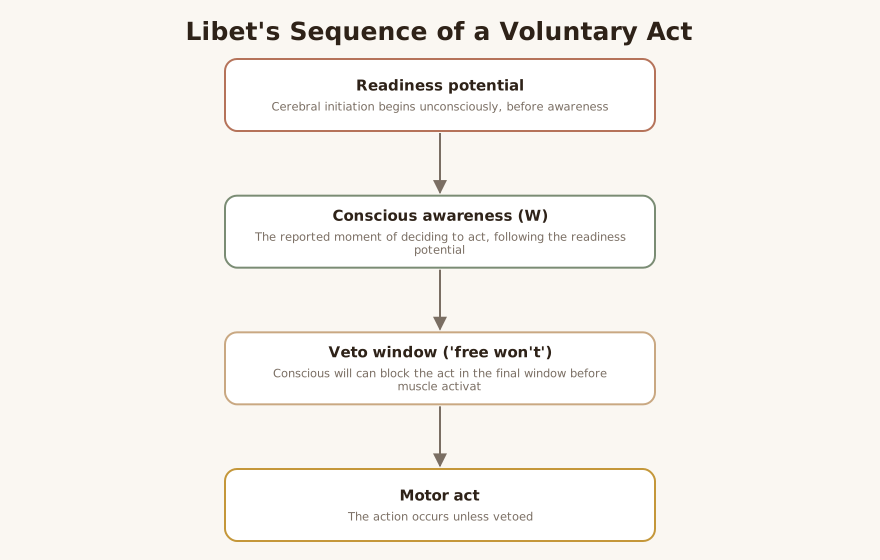
The first principle is temporal precedence: in Libet’s data, the readiness potential began well before participants reported conscious awareness of deciding to act. 1 In the original report, the onset of the readiness potential preceded the reported moment of conscious intention (the “W” judgment) by an average of about 350 ms, and by a minimum of about 150 ms, for the more common type of trial; for the other type, the lead time averaged roughly 500-800 ms depending on how onset was defined. 1 Libet concluded that “cerebral initiation of a spontaneous, freely voluntary act can begin unconsciously,” before any recallable awareness that a decision had been made. 1
The second principle is the conscious veto, or “free won’t.” Libet did not conclude that free will was an illusion. Instead he argued that, although the impulse to act is initiated unconsciously, conscious will retains the power to block or veto the action in the final window before muscle activation, roughly the last 100-150 ms. 56 In his own words, conscious will could let the volitional process complete, or it could “veto” it so that no motor act occurs. 6 This recasts conscious agency as primarily inhibitory rather than initiatory. 5
A third, often overlooked principle, emphasized in the intellectual-history account, is the distinction between positive volition (generating an action) and negative volition (inhibiting one); these are functionally different and should not be treated as equivalent. 8 This distinction maps almost perfectly onto the clinical task of inhibiting an urge-driven behavior. LLM
Interventions & Techniques
The construct itself prescribes no intervention; Libet ran a measurement paradigm, not a treatment. LLM What it offers clinically is a psychoeducational frame that can be folded into existing, evidence-based work. The frame is simple: the appearance of an urge in awareness is downstream of brain activity you did not consciously start, so the urge’s arrival is not the same as a decision, and there is a window in which you can decline to act. 5 This is a neuro-informed restatement of the core move in urge surfing, where the person observes a craving rising and falling without acting on it. LLM
Concrete techniques that the “free won’t” frame can support, all drawn from established modalities rather than from Libet’s work, include: labeling the gap between urge and action and rehearsing a deliberate pause; mindfulness exercises that train noticing-without-reacting; distress-tolerance skills used to ride out a craving or self-harm urge; and response prevention, in which a person experiences a compulsion’s pull and deliberately does not perform the ritual. LLM In each case the neuroscience supplies a motivating story for why a pause is possible, not the active ingredient of treatment. LLM
LLM-generated illustrative example (not a guideline): A clinician introduces the frame to a client with alcohol cravings: “Your brain starts revving toward the drink before ‘you’ even notice the craving. By the time you feel it, the craving is already announcing itself, not commanding you. The skill we are building is the veto, your ‘no’ in that last moment.” This is offered as a metaphor to scaffold urge surfing, not as a claim that the client’s neurons were measured. LLM
Evidence Base
Honesty here requires separating three claims that are frequently collapsed. LLM
The finding is established. That the readiness potential reliably precedes the reported time of conscious intention is a foundational, much-replicated result, originating in the 1983 Brain study and reproduced across many laboratories and methods, including single-neuron recordings. 14 In that sense the paradigm earns the label “established.” 4
The interpretation is contested. Whether the readiness potential represents an unconscious decision that causes the action is disputed. Schurger and colleagues argued that the readiness potential may largely be an artifact of averaging spontaneous, subthreshold neural fluctuations, an accumulation of ongoing noise toward a threshold rather than a dedicated “decide-to-move” command. 43 A 2021 review described the rise and, in its title, the “fall” of this paradigm, cataloguing how baseline-correction choices and the imprecision of the clock-based W judgment undercut the strong causal reading. 2 Critics have also questioned whether participants can validly report the timing of an internal intention at all. 48
The veto is, at best, unproven. Libet’s “free won’t” was a theoretical proposal, and the intellectual-history literature characterizes it as speculative and lacking direct empirical support. 8 So “established” applies to the phenomenon of the readiness potential, not to the conclusion that unconscious processes fully initiate action, and certainly not to the existence of a conscious veto. Clinicians should present the veto as an interesting hypothesis, not a demonstrated brain mechanism. LLM
Crucially, none of this literature tests whether Libet-based psychoeducation improves clinical outcomes. The bridge to addiction, OCD, ADHD, eating disorders, or self-harm is analogical, and the active treatments (urge surfing, ERP, DBT skills, mindfulness) are evidenced on their own terms, not by the Libet paradigm. LLM
Populations & Indications
The frame tends to land best with people whose distress centers on the felt distance between an impulse and an action. LLM Plausible fits include people with addictions, where cravings present as urgent and “automatic”; people with ADHD struggling with behavioral impulse control; people with OCD facing the pull of compulsions; people with eating disorders contending with binge urges; and people who self-harm and experience non-suicidal self-injury urges. LLM Adolescents, in particular, may find a brain-based story de-shaming, reframing impulsivity as a timing problem in the brain rather than a character flaw. LLM
Indication for use of the frame is essentially psychoeducational: when a client over-identifies with their urges (“the craving means I have already decided”) and would benefit from inserting a deliberate pause, the veto metaphor can create cognitive distance. LLM It is not indicated as a stand-alone treatment for any of these populations. LLM
Problems-for-Work
The construct maps onto urge- and impulse-related problems-for-work. Brief application examples:
LLM-generated illustrative example (not a guideline): Cravings (addiction). A client learns to name the moment a craving enters awareness as “the readiness potential showing up,” then practices the veto-as-pause within urge surfing, watching the craving crest and recede. LLM
LLM-generated illustrative example (not a guideline): Compulsions (OCD). During response prevention, a client reframes the compulsive pull as an unconsciously initiated impulse they are not obligated to complete, exercising their “free won’t” by declining the ritual. LLM
LLM-generated illustrative example (not a guideline): Non-suicidal self-injury urges. An adolescent uses a distress-tolerance skill in the gap between urge and action, framed as “buying time for the veto,” to ride out a self-harm urge without acting. LLM
Other apt problems-for-work include impulsivity, binge eating, behavioral impulse control, and urge dysregulation, each treated within its own evidence-based modality while the Libet frame supplies motivation for the pause. LLM
Contraindications, Cautions & Cultural Humility
The central caution is overclaiming the science. Presenting “free won’t” as a proven brain mechanism misrepresents a contested literature and can erode trust if a client later reads that the readiness potential may be statistical noise. 84 Use tentative language. LLM
A second caution is the determinism risk. The same finding that can empower (“there is a gap you can use”) can, if framed carelessly, fuel hopelessness or a sense that behavior is preordained, “my brain already decided.” LLM This is especially relevant for clients with depression, low agency, or trauma histories, and for anyone for whom a deterministic reading might license giving up or reduce accountability in ways that are clinically counterproductive. LLM
There are also boundaries of the paradigm itself: Libet studied simple, arbitrary, spontaneous movements and explicitly did not study deliberate decisions involving prior conscious thought, so generalizing to complex real-world choices overreaches. 5 Culturally, a hyper-individualist “your brain, your veto” frame may not resonate across worldviews that locate agency in relationships, community, or spiritual life; clinicians should hold the metaphor loosely and let clients reshape it. LLM Finally, neuro-language can be wielded coercively (“your brain is the problem”); use it to expand agency, not to pathologize. LLM
Treatment-Plan Suggestions & SMART Objectives
The construct is not a billable modality; the table below shows how the frame can be embedded in established treatment toward measurable goals. LLM
| Goal | SMART objective (example) | Mechanism |
|---|---|---|
| Increase the pause between craving and use | Client will use a 90-second urge-surfing pause on at least 4 of 5 logged cravings per week for 4 weeks | Inserts a deliberate veto-window between impulse onset and action LLM |
| Reduce compulsion completion | Client will decline at least 2 identified compulsions per day using response prevention over 6 weeks | Exercises negative volition (inhibition) against an automatic pull LLM |
| Tolerate self-harm urges without acting | Client will apply one distress-tolerance skill within 2 minutes of an NSSI urge on 100% of logged urges for 30 days | Buys time within the urge-to-action gap LLM |
| Improve behavioral impulse control (ADHD) | Client will use a “name-it, pause, choose” sequence before 3 target impulsive behaviors daily for 4 weeks | Converts reflexive action into a deliberated choice LLM |
| Reduce binge frequency | Client will surf binge urges using a written pause protocol, reducing binges from baseline by 50% over 8 weeks | Decouples urge arrival from automatic eating LLM |
| Decrease shame about impulsivity | Client will reframe 3 impulsive episodes per week using neuro-informed (timing, not character) language for 4 weeks | Reduces self-blame to support skill use LLM |
| Strengthen mindful noticing of urges | Client will complete daily 10-minute urge-observation mindfulness practice 5 days/week for 6 weeks | Trains noticing-without-reacting that supports the veto LLM |
Common Misconceptions
“Libet disproved free will.” He did not claim this; he explicitly argued his findings were compatible with free will via the veto. 54 “The readiness potential is the brain’s decision.” This is the contested interpretation, not an established fact; it may reflect spontaneous fluctuations rather than a decision signal. 32 “Free won’t is a proven brain mechanism.” It is a theoretical proposal that lacks direct empirical support. 8 “This applies to all our choices.” The paradigm concerned simple spontaneous movements, not deliberated decisions. 5 “Neuroscience here validates urge surfing or ERP.” It does not; those interventions are evidenced independently, and the link is analogical. LLM
Training & Certification
There is no certification in “Libet’s veto,” because it is a construct, not a credentialed modality. LLM Clinicians who want to use the frame responsibly should instead be trained in the actual delivery vehicles: relapse prevention and urge surfing, exposure and response prevention, dialectical behavior therapy distress tolerance, and mindfulness-based interventions, each with its own training pathways. LLM Familiarity with the primary and review literature is the relevant “training” for accurate psychoeducation. 12
Key Terms
Readiness potential (Bereitschaftspotential): a slow buildup of electrical brain activity preceding voluntary movement, first described by Kornhuber and Deecke in 1964. 6 W judgment: the participant’s reported time of first awareness of the intention to move, read off a rotating-dot clock. 5 The gap (RP-to-W lead time): in Libet’s data, the readiness potential preceded W by roughly 350 ms on average (minimum ~150 ms) in the common trial type. 1 The veto / “free won’t”: Libet’s proposal that conscious will can inhibit an unconsciously initiated action in the final ~100-150 ms. 6 Positive vs. negative volition: generating an action versus inhibiting one, treated as functionally distinct. 8 Stochastic-fluctuation account: the view that the readiness potential reflects accumulating spontaneous neural noise rather than a discrete decision. 3
Resources & Further Reading
▶ Watch — a video introduction to this concept:
- Libet et al., 1983, Brain (original readiness-potential study)
- Review: rise and fall of the readiness potential and Libet’s clock (Consciousness and Cognition, 2021)
- Schurger et al., What Is the Readiness Potential? (Trends in Cognitive Sciences, 2021)
- Neuroscience of free will (Wikipedia overview)
- Benjamin Libet (Wikipedia biography)
- Libet Experiments (The Information Philosopher explainer)
- The Libet Experiment & the Question of Free Will (Sprouts video)
- An intellectual history of the ‘Libet experiment’ (PIAS)
Reflective / Supervision Questions
- When I use a neuro-informed metaphor like “free won’t,” am I representing the science honestly, including its uncertainty, or am I overselling a contested finding?
- How do I notice whether a deterministic frame is empowering this particular client versus feeding hopelessness or reduced accountability?
- Am I clear with myself that the intervention (urge surfing, ERP, distress tolerance) is what is evidenced, and the Libet frame is only motivational scaffolding?
- Does this client’s cultural or spiritual understanding of agency fit an individualist “veto” story, or do I need to co-create a different metaphor?
- How would I respond if a client returned and said, “But I read the readiness potential is just noise, so none of this matters”?
- Where in my own clinical practice do I conflate “an urge arrived” with “a decision was made,” and how does that show up in how I coach pauses?