
Type & Discipline
Interpersonal process group psychotherapy is a standalone treatment modality within clinical psychology and psychiatry, situated in the interpersonal / group-dynamics family of therapies LLM. It is distinguished from psychoeducational, skills-training, and support groups by its central wager: that the group itself is the primary therapeutic instrument, not merely a setting in which individual therapy is delivered to several people at once LLM. The defining mechanism is that the small group becomes a social microcosm — a contained world that comes to mirror each member’s habitual ways of relating outside it 2. Because members eventually behave in the group as they behave in life, their interpersonal difficulties are not just described but enacted, observed, and worked with in real time 2.
The canonical reference text is Yalom and Leszcz’s The Theory and Practice of Group Psychotherapy, now in its sixth edition, which has been the standard text in the field for decades and frames group treatment within an interpersonal model 1. The current edition integrates contemporary developments including online and virtual groups, ethnocultural diversity, trauma-informed approaches, and managed-care realities 1.
Creators & Lineage
The intellectual taproot is Harry Stack Sullivan’s interpersonal theory of psychiatry, which held that personality and psychopathology are products of interpersonal relationships rather than intrapsychic drives alone LLM. From this premise it follows that distress is relational in origin and therefore most directly addressable in a relational field — a logic that group treatment realizes more fully than the dyad LLM. The modality also draws on psychodynamic traditions, retaining attention to recurring relational patterns and to what members unknowingly recreate LLM.
Irvin Yalom, working with Molyn Leszcz in later editions, synthesized these lineages into the modern operational model of group psychotherapy, organized around a defined set of therapeutic factors and an explicit here-and-now methodology 12. Yalom’s articulation of interpersonal learning and the social microcosm is the conceptual core that distinguishes interpersonal process groups from other group formats 2.
Core Principles
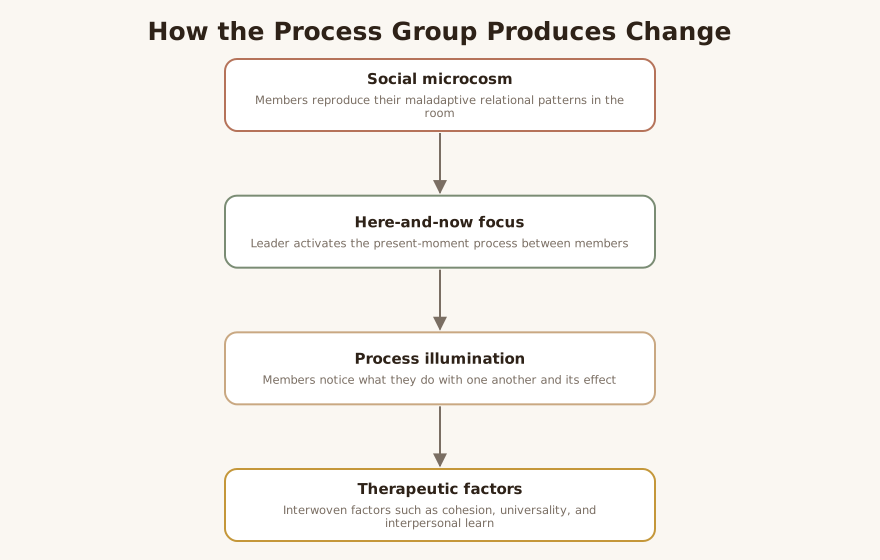
The first principle is the social microcosm: given enough time and freedom, members will reproduce in the group the same maladaptive relational patterns that generate distress in their outside lives, making those patterns available for direct observation and modification 2.
The second is the here-and-now focus: the most potent material is what is happening between members in the room, in the present moment, rather than narrated history from outside the group 2. The leader’s task is to activate this immediate process and then to illuminate it — to help members notice what they are doing with one another and what effect it produces 2.
The third principle is that change is mediated by a set of therapeutic factors that operate in interplay rather than isolation 2. Yalom enumerated eleven: instillation of hope, universality, imparting information, altruism, corrective recapitulation of the primary family group, development of socializing techniques, imitative behavior, interpersonal learning, group cohesiveness, catharsis, and existential factors 2. These factors are described as intricately interwoven and partly sequential — hope enables engagement, engagement yields a sense of universality, universality fosters cohesion, and cohesion makes the riskier work of interpersonal learning and catharsis possible 2.
Among these, interpersonal learning and group cohesiveness carry particular weight: interpersonal learning is considered one of the most significant factors because members inadvertently enact dysfunctional patterns that the therapist and other members can reflect back, while cohesion — the sense of belonging and solidarity — is identified as a core mechanism of action that makes self-disclosure and risk-taking possible 2.
Interventions & Techniques
The work of an interpersonal process group is less about discrete scripted interventions and more about the leader’s disciplined cultivation of process LLM. Core techniques include:
- Activating the here-and-now. The leader steers conversation away from outside narrative and toward what is occurring among members in the moment, on the premise that immediate interaction is where change-producing learning lives 2.
- Process illumination / feedback. Once an interpersonal event occurs, the leader and members reflect it back, helping a member see the pattern they enacted and its interpersonal consequences 2. This is the engine of interpersonal learning 2.
- Building cohesion. Deliberate attention to belonging, safety, and solidarity, because cohesion is the precondition for deeper work and is itself curative 2.
- Harnessing universality. Surfacing shared experience so members move out of isolation and into felt solidarity, which counters shame and the conviction of being uniquely defective 2.
- Mobilizing altruism and modeling. Members benefit from helping one another, and from observing and imitating how peers manage emotion, feedback, and conflict 2.
- Working with catharsis within a holding structure. Emotional release is encouraged but must be paired with cognitive understanding and the safety of cohesion to be useful rather than destabilizing 2.
LLM-generated illustrative example (not a guideline): A member who chronically over-functions and gives advice is gently asked by the leader, “I notice you’ve answered three people tonight but haven’t told us how you’re doing — what happens in you when the attention turns to you?” The here-and-now move converts a relational habit into shared, examinable data LLM.
Evidence Base
The maturity of this modality is best characterized as established LLM. It rests on a decades-long clinical and research tradition codified in the field’s standard text, which has been revised across six editions to incorporate accumulating research 1. Meta-analytic summaries reported in the literature indicate that group therapy produces large effects in reducing anxiety, depression, and obsessive-compulsive symptoms, and can achieve outcomes equivalent to individual therapy while working through different mechanisms 2.
The therapeutic-factor framework has demonstrated cross-setting reach, which speaks to its robustness. In an interdisciplinary application to animal-assisted group interventions with trauma survivors, qualitative analysis organized around Yalom’s factors accompanied substantial reported effect sizes for depressive symptoms, PTSD symptoms, and anxiety 5. In a 2025 computational study of online mental-health communities, eight of Yalom’s eleven factors were identifiable in asynchronous peer discussion, suggesting the factor model captures something general about how groups help 3.
Honest qualification is warranted LLM. That same online study found that the factors most specific to live process work — interpersonal learning, corrective recapitulation of the family group, and development of socializing techniques — were virtually absent in asynchronous text, precisely because they require real-time interaction 3. This is corroborating rather than undermining: it confirms that the modality’s distinctive ingredients depend on the live, reciprocal group field LLM. Much of the supporting evidence is also clinical-observational and qualitative rather than from large head-to-head randomized trials of the process format specifically LLM.
Populations & Indications
Interpersonal process groups are applied across adults and adolescents, and across inpatient and outpatient settings LLM. They are most clearly indicated when the presenting difficulty is itself interpersonal — that is, when a person’s suffering is bound up in how they relate to others LLM. This includes people with interpersonal difficulties, social anxiety, loneliness and isolation, relationship conflict, low self-esteem, and the maladaptive interpersonal patterns characteristic of personality disorders LLM. Mood and anxiety disorders respond as well, given meta-analytic evidence of large symptom effects 2.
The factor model has also been carried into populations once considered marginal to group process work. Facilitators of Hearing Voices Groups have applied Yalom’s therapeutic factors with people who hear voices, drawing on universality, instillation of hope, and cohesion to counter isolation and stigma 4. Trauma survivors have been served through Yalom-organized group interventions with meaningful symptom reduction 5. The general indication is breadth of relational engagement: a member must be able to tolerate and participate in live group interaction LLM.
Problems-for-Work
- Interpersonal difficulties and maladaptive patterns. The group surfaces the pattern in vivo — for example, a member who experiences others as rejecting may discover they pre-emptively withdraw, a sequence the group can name and interrupt 2.
- Social anxiety and avoidance. The group is a graduated, real exposure to being seen, with feedback that disconfirms catastrophic predictions LLM.
- Loneliness, isolation, and shame. Universality directly targets the conviction of being uniquely defective, moving members into solidarity 2.
- Depression. Addressed through hope, altruism, cohesion, and reduced isolation, with meta-analytic support for symptom reduction 2.
- Trauma sequelae. Worked within trauma-informed group structures organized around the therapeutic factors 15.
- Grief and existential distress. Engaged through existential factors and shared confrontation with loss and limitation 2.
Contraindications, Cautions & Cultural Humility
Group process work is not universally appropriate LLM. Acute crisis, active suicidality, severe agitation, or states in which a person cannot tolerate interpersonal feedback typically call for stabilization before, or alongside, process group participation LLM. Members who would monopolize, who cannot maintain basic safety with others, or who are too symptomatic to engage reciprocally may both deteriorate and impede the group; careful pre-group screening and preparation are part of competent practice LLM.
Catharsis warrants specific caution: emotional release without cohesion and cognitive integration can destabilize rather than heal, so the leader must titrate intensity against the group’s holding capacity 2. There is also a documented hazard in less-structured peer settings — the same exchanges that reduce isolation can, when unmoderated, transmit harm through emotional contagion, which underscores the necessity of skilled facilitation 3.
Cultural humility is essential and is now treated explicitly in the field’s standard text, which addresses ethnocultural diversity in group settings 1. The therapeutic factors are not culture-neutral: norms around self-disclosure, direct feedback, emotional expression, hierarchy, and what “belonging” means vary across cultures, and a leader must hold their model lightly enough to adapt it rather than impose it LLM. Applying the factors with marginalized or stigmatized populations — for instance, people who hear voices — requires attending to power, stigma, and the meaning members make of their experience rather than pathologizing it 4.
Treatment-Plan Suggestions & SMART Objectives
| Goal | SMART objective (example) | Mechanism |
|---|---|---|
| Reduce sense of isolation | Within 6 sessions, member will name at least two experiences shared with peers and report decreased feeling of being “uniquely defective” | Universality 2 |
| Increase awareness of relational pattern | Within 8 sessions, member will identify, with feedback, one recurring interpersonal pattern they enact in the group | Interpersonal learning / here-and-now process 2 |
| Build capacity for connection | Within 10 sessions, member will report increased sense of belonging and disclose a previously withheld concern to the group | Group cohesiveness 2 |
| Restore hope | Within 4 sessions, member will articulate one peer’s progress that increases belief in their own capacity to change | Instillation of hope 2 |
| Strengthen interpersonal skills | Within 12 sessions, member will practice giving and receiving direct feedback in at least three sessions | Development of socializing techniques 2 |
| Counter shame and self-criticism | Within 8 sessions, member will offer support to a peer and notice the effect on their own self-worth | Altruism 2 |
| Tolerate and integrate affect | Within 10 sessions, member will express a long-withheld emotion in group and link it to understanding rather than only discharge | Catharsis with cohesion 2 |
Common Misconceptions
A frequent misconception is that group therapy is a cheaper, diluted substitute for individual therapy LLM. The evidence cited in the literature instead frames it as achieving equivalent outcomes through different mechanisms — the interpersonal field is not a compromise but the active ingredient 2. A second misconception is that the leader’s job is to deliver content or facilitate turn-taking; in the interpersonal process model the leader’s central task is to activate and illuminate the here-and-now, treating live interaction as the curative material 2. A third is that catharsis alone heals; release without cohesion and understanding is not reliably therapeutic 2. A fourth, exposed by online-community research, is that the helpful elements of group transfer wholesale to asynchronous text platforms — the process-dependent factors largely do not, because they require real-time reciprocity 3.
Training & Certification
Competent practice begins with the field’s standard text, Yalom and Leszcz’s The Theory and Practice of Group Psychotherapy, which is written for both beginning and experienced clinicians and presents foundational principles alongside contemporary interventions within an interpersonal frame 1. Beyond reading, developing competence in leading process groups conventionally requires supervised group leadership, experiential participation in a process group, and ongoing consultation, given how much the work depends on the leader’s real-time reading of group dynamics LLM. Specific certification pathways are not specified by the provided sources and vary by jurisdiction and professional body LLM.
Key Terms
- Social microcosm — the principle that the group comes to mirror each member’s outside relational world, making their patterns observable and workable in the room 2.
- Here-and-now — the focus on present-moment interaction among members as the primary therapeutic material 2.
- Therapeutic factors — Yalom’s eleven mechanisms of change, operating in interplay 2.
- Interpersonal learning — change produced when members enact their patterns and receive reflective feedback 2.
- Group cohesiveness — the solidarity and belonging that function as a core mechanism enabling deeper work 2.
- Universality — the recognition that one is not alone in one’s distress 2.
- Process illumination — the leader’s act of helping members see what they just did interpersonally and to what effect 2.
Resources & Further Reading
▶ Watch — a video introduction to this concept:
- The Theory and Practice of Group Psychotherapy, 6th ed. (Yalom & Leszcz; Basic Books)
- Core Principles of Group Psychotherapy: Yalom’s Therapeutic Factors (Psychology Town)
- Identifying Yalom’s group therapeutic factors in online mental health discussions (Frontiers in Psychiatry, 2025)
- Yalom’s therapeutic factors in Hearing Voices Groups: a facilitator’s perspective (Psychosis, 2023)
- Interdisciplinary application of Yalom’s group therapy factors (PMC / NIH)
Reflective / Supervision Questions
- When a member describes an outside conflict, how reliably do I redirect toward the here-and-now, and what stops me when I don’t? LLM
- Which therapeutic factors am I actively cultivating in this group, and which am I neglecting? 2
- How do I read cohesion in my group, and how does its current level shape what depth of work is safe right now? 2
- Whose cultural norms around disclosure, feedback, and emotion am I treating as the default, and how might that disadvantage some members? 1
- For a given member, is live process work the right modality, or do they need stabilization first? LLM
- How do I balance encouraging catharsis with protecting members from destabilization or contagion? 23