
Type & Discipline
Inner Healing Prayer is best understood not as a single, manualized treatment but as a family of prayer-guided practices that sit within Christian counseling and pastoral care rather than within secular clinical psychology 1. The shared method involves deliberately re-entering an emotionally painful memory and inviting an experienced sense of divine presence — usually framed as Jesus — to address the distressing beliefs attached to that memory 4. It is most associated with charismatic and Pentecostal (“Spirit-filled”) Christian traditions, where the conviction that God acts experientially in the present is theologically central 3. The best-known contemporary expression, Theophostic Prayer Ministry (later renamed Transformation Prayer Ministry), formalized this into a repeatable session structure with defined roles 2. Because most facilitators operate within a lay-ministry or pastoral context rather than a licensed clinical one, the practice straddles the boundary between spiritual care and psychotherapy, which has direct implications for scope of practice and ethics that any clinician engaging with it must hold clearly 4.
A useful framing for clinicians is the one advanced by Christian psychologist Fernando Garzon, who studied inner healing prayer as a culturally and religiously embedded healing practice — a Christian analogue to the imagery-based methods already used in mainstream psychotherapy 1. Viewed through that lens, the practice is less an alien import and more a faith-language version of techniques therapists already recognize, which is part of why it warrants thoughtful clinical attention rather than reflexive dismissal LLM.
Creators & Lineage
The movement’s foundational figure is Agnes Sanford (1897–1982), widely described as “the mother of the inner healing movement,” who founded the Agnes Sanford School of Pastoral Care in 1958 and popularized the idea that God could heal painful memories, not only physical illness 3. The broader Inner Healing Movement that grew from her work is a grassroots lay-counseling movement spanning many Christian denominations, with other prominent figures including Ruth Carter Stapleton, Francis MacNutt, and Leanne Payne 3. The Methodist pastor David Seamands extended this lineage in the 1980s through widely read writing on the “healing of damaged emotions,” bringing the language of inner healing to a large evangelical readership and bridging it toward more psychologically informed pastoral counseling LLM.
The most systematized descendant is Theophostic Prayer Ministry, developed by Ed M. Smith, a Southern Baptist minister, in the mid-1990s — the Christian Research Institute dates its founding to 1996 24. The name combines the Greek roots for “God” and “light” 5. Smith reportedly developed the approach after finding that abuse survivors could understand intellectually that they were now safe yet remain unable to feel it, and sought a method to reach that emotional layer directly 4. Fernando Garzon then studied these practices academically, positioning inner healing prayer within the literature on integrating traditional and cultural healing into counseling and psychotherapy and calling for empirical evaluation 1.
Core Principles
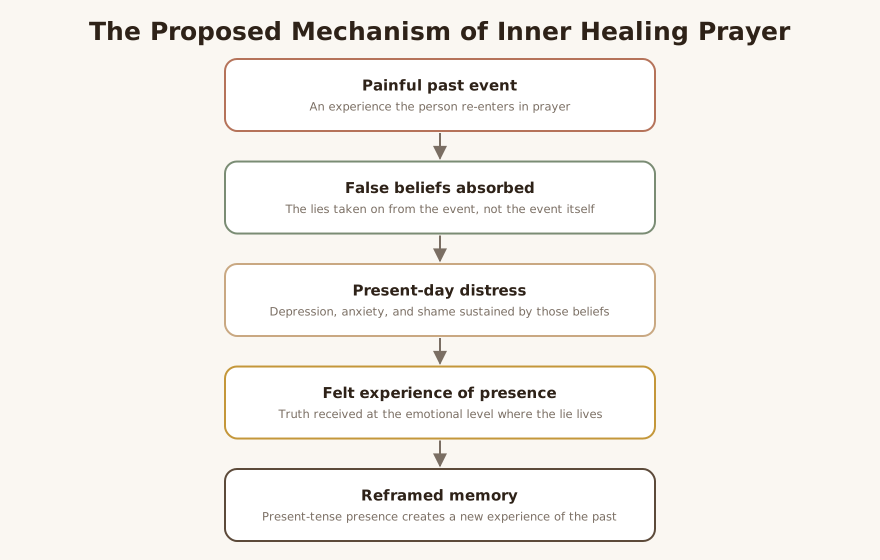
The organizing theory across inner healing prayer variants is that much present-day emotional distress is driven not by the original events themselves but by the false beliefs — Theophostic practitioners call them “lies” — that a person absorbed from those events 2. In this account, problems such as depression, anxiety, and shame are sustained by falsehoods a person came to believe based on others’ comments, errant teaching, or painful experiences 5. The corrective is held to be experiential rather than purely cognitive: the aim is to lead the person to receive truth at the felt, emotional level where the lie lives, not merely to recite a correct doctrine 4.
A second principle is the priority of divine agency over facilitator technique. The facilitator’s role is explicitly framed as non-directive — inviting Jesus into the memory and then waiting on what the person receives, rather than supplying the content of the new belief 4. Smith’s own summary of the intended mechanism is that “Jesus brings present-tense experience into a past-tense experience creating a new experience,” reframing the old memory with a felt sense of presence and safety 4. A third principle, at least in the more careful formulations, is a deliberate guardrail against suggestion: practitioners are instructed to avoid guided imagery, directed visualization, and leading questions, precisely because the method works with autobiographical memory 42.
Interventions & Techniques
A typical Theophostic-style session involves three parties — a recipient, a facilitator, and an optional prayer partner — and unfolds in a recognizable sequence 2. The recipient first focuses on a current emotional pain and is invited to let that feeling lead backward to earlier associated memories 2. Within the surfacing memory, the recipient and facilitator try to identify the specific false belief — the “lie” — that the memory still carries, such as I am to blame or I am unsafe 2. The facilitator then prays, asking Jesus to bring the relevant truth, and the recipient attends to whatever arises — an image, a felt sense, a remembered scripture, or a spontaneous realization 2. The reported outcome is that, when a genuinely felt truth replaces the lie, the associated emotional pain diminishes or lifts 4.
The mainstream-therapy parallel is hard to miss: this is close in structure to imagery rescripting, in which a client revisits a distressing memory and reworks its meaning and felt outcome 1. Garzon’s contribution was to make that parallel explicit and to argue the practice deserves the same kind of empirical study any imagery technique would 1. The crucial procedural difference from discredited memory work is the insistence on non-direction: careful protocols forbid suggesting memory content, using guided imagery, or asking leading questions, so that the facilitator does not author either the memory or the resolution 42.
LLM-generated illustrative example (not a guideline): A devout client carrying shame about childhood neglect might, in such a session, locate the felt belief I was unlovable inside a specific memory, and report experiencing a sense of compassionate presence in that scene; the clinician’s role within a secular frame would be to track affect, avoid suggesting content, and process the shift cognitively afterward LLM.
Evidence Base
The honest summary is that the evidence base is emerging and thin 1. The strongest empirical work cited is Fernando Garzon’s, who reported clinically significant changes in case studies of inner healing prayer — but who himself recommended that randomized controlled trials be conducted, signaling that the case-study level was a starting point rather than a verdict 21. There are, in addition, numerous testimonial accounts of lasting emotional healing, which are meaningful to participants but do not substitute for controlled outcome data 4. Even sympathetic reviewers state the matter plainly: the Christian Research Institute, while finding the core theory theologically acceptable, concluded that “much more scientific research needs to be done” before efficacy claims can be validated 4.
For practitioners, this means inner healing prayer currently sits well below the evidentiary bar of established trauma treatments. It should not be presented to clients as an evidence-based therapy, and any claims that it reliably treats conditions such as PTSD, OCD, or sexual addiction — claims that have circulated in promotional contexts — outrun the data 2. The defensible position is that it is a religiously meaningful practice with promising case-level signals and a plausible mechanistic kinship to imagery techniques, awaiting the controlled research its own proponents have called for 1.
Populations & Indications
Inner healing prayer is, by design, for people for whom Christian faith is central; the practice is unintelligible and inappropriate apart from a sincere shared belief framework, since the entire mechanism turns on inviting and experiencing divine presence 4. Within that population, it has been directed at survivors of abuse and trauma — the clinical problem that originally motivated Smith’s work — and at people whose distress is organized around shame, self-blame, or difficulty receiving forgiveness 45. Promotional descriptions extend the indications to phobias, depression, anxiety, OCD, PTSD, and sexual addiction, but clinicians should treat that breadth as aspirational rather than demonstrated given the evidence base 2.
The more measured indication is as an adjunct or culturally congruent option for Christian clients who specifically want their faith integrated into how they process painful memories, and who already have, or can access, appropriate clinical care for any diagnosable condition 1. It is not a substitute for first-line treatment of a serious disorder, and framing it as one would be both clinically and ethically problematic LLM.
Problems-for-Work
The practice is organized around belief-laden painful memories rather than discrete symptoms, which maps onto several recurring clinical problems 5.
- Shame and false self-beliefs. The model’s central target — beliefs such as I am worthless or it was my fault — is reframed as a “lie” to be met with a felt experience of truth 2. Application: a clinician using a secular frame might track such a belief, then process the client’s faith-based reappraisal cognitively rather than supplying it LLM.
- Guilt and difficulty receiving forgiveness. GotQuestions describes typical work around misplaced shame regarding forgiveness and false responsibility for others’ actions 5. Application: distinguishing accurate moral responsibility from over-globalized self-blame is the clinical leverage point LLM.
- Trauma-related emotional pain. The original use case was helping abuse survivors close the gap between knowing they are safe and feeling it 4. Application: stabilization and pacing must precede any memory re-entry, as with any trauma work LLM.
- Persistent anxiety and depression. These are framed by proponents as downstream of sustaining false beliefs 5. Application: the construct should be held loosely, since not every mood or anxiety problem is belief-driven 5.
Contraindications, Cautions & Cultural Humility
The most serious caution is the well-documented risk of iatrogenic memory contamination. Because the method works directly with autobiographical memory, critics have linked it to discredited recovered-memory therapy and the creation of false memories 2. Smith strongly repudiates that comparison and lists explicit distinctions, and careful protocols forbid guided imagery and suggestion — but the burden remains on the facilitator to avoid leading the recipient toward memory content that was never there 2. Psychologist David Entwistle’s critique names exactly these vulnerabilities: insufficient grounding of the theory, “inadequate and often flawed explanations of basic psychological processes,” and “the failure to sufficiently appreciate the possibility of iatrogenic memory contamination” 3. A further structural caution is that many facilitators lack formal psychological training, so vulnerable clients with trauma histories may receive intensive memory work from practitioners not equipped to manage decompensation 2.
Several theological and integrity concerns also bear on clinical use. Even partially sympathetic evaluators warn against importing “unbiblical psychology, such as repressed memory therapy,” and against the inverse error of merely “attaching Scripture references here and there” to secular technique 5. Clinicians should also resist the model’s tendency to assume that every emotional problem results from a false belief — a real over-reach that the explainer literature itself flags 5. From a cultural-humility standpoint, the practice is appropriate only with clients for whom it is genuinely congruent; offering it to clients who do not share the belief framework, or subtly steering a client toward a religious interpretation of their distress, would breach both informed consent and respect for autonomy LLM. For licensed clinicians, the cleanest stance is to keep clear which hat one is wearing — spiritual care versus psychotherapy — and to document and consent accordingly LLM.
Treatment-Plan Suggestions & SMART Objectives
The table below illustrates how a clinician might frame faith-integrated work for a consenting Christian client, using established psychotherapy mechanisms while respecting the limits of the evidence 1.
| Goal | SMART objective (example) | Mechanism |
|---|---|---|
| Identify a core shame belief | Within 4 sessions, client will name one recurring negative self-belief and the memory it attaches to, in 3 of 4 sessions | Cognitive identification of belief-memory links 2 |
| Reduce felt shame intensity | Over 8 weeks, client will report a 3-point drop (e.g., 8/10 to 5/10) in distress on a target memory | Imagery-based reappraisal of the memory 1 |
| Strengthen self-forgiveness | Within 6 sessions, client will articulate an accurate division between their responsibility and others’ in a guilt-laden event | Correcting over-globalized self-blame 5 |
| Stabilize before memory work | Before any memory re-entry, client will demonstrate two grounding skills to criterion across 2 sessions | Affect regulation and pacing LLM |
| Process trauma-linked beliefs | Within 12 weeks, client will revisit one distressing memory and report a revised felt meaning, documented in session | Imagery rescripting parallel 1 |
| Integrate faith without coercion | Throughout treatment, clinician will confirm consent for faith content at each phase, documented each session | Informed-consent and autonomy safeguard LLM |
| Avoid suggestion artifacts | In every memory-focused session, clinician will use only open, non-leading prompts, peer-reviewed in supervision monthly | Guarding against memory contamination 2 |
Common Misconceptions
A frequent misconception is that inner healing prayer is simply recovered-memory therapy in religious clothing; its more careful protocols explicitly forbid guided imagery, suggested memory content, and leading questions, and Smith strongly repudiates the comparison 2. A second misconception runs the opposite direction — that it is purely “spiritual” and bears no relation to psychotherapy; in fact, scholars such as Garzon analyze it as a close analogue of mainstream imagery techniques 1. A third is that it is an evidence-based treatment for the long list of conditions sometimes advertised; the actual research stands at the case-study level, with proponents themselves calling for controlled trials 24. Finally, some assume that because a sympathetic body found the core theory theologically acceptable, efficacy is thereby established — but the same evaluators stressed that “much more scientific research needs to be done” 4.
Training & Certification
There is no licensure or unified clinical credential for inner healing prayer; it is propagated largely through ministry organizations, lay-counseling networks, and the literature of its founders rather than through accredited clinical training 3. Theophostic/Transformation Prayer Ministry has historically offered its own training materials and facilitator instruction, and the foundational texts of the broader movement — from Agnes Sanford’s writings forward — serve as primary references 23. This informal training landscape is itself a noted concern, since intensive memory work may be delivered by facilitators without formal psychological education 2. Licensed clinicians who wish to integrate faith-based memory work responsibly are better served by grounding themselves in the empirical imagery-rescripting literature and in spiritually integrated psychotherapy competencies, using the inner healing prayer literature for cultural and theological literacy rather than as a clinical curriculum 1.
Key Terms
- Inner healing prayer — a family of prayer-guided practices that re-enter painful memories to invite an experienced divine presence to address attached beliefs 1.
- Healing of memories — the foundational practice associated with Agnes Sanford, applying prayer for healing to emotionally painful memories 3.
- Theophostic / Transformation Prayer Ministry — Ed Smith’s systematized method; the name combines Greek roots for “God” and “light” 25.
- “Lie” — a Theophostic term for the false belief a memory carries, which the practice aims to replace with felt truth 2.
- Limited reparenting parallel / imagery rescripting — the mainstream psychotherapy analogue Garzon used to make sense of the practice’s mechanism 1.
- Iatrogenic memory contamination — the risk, central to critiques, that memory-focused techniques can generate false or distorted memories 3.
Resources & Further Reading
▶ Watch — a video introduction to this concept:
- Garzon, F. L. (2005) — Inner Healing Prayer in ‘Spirit-Filled’ Christianity (Liberty University Digital Commons)
- Theophostic Prayer Ministry — Wikipedia
- Healing of Memories / Inner Healing Movement — Wikipedia
- Theophostic Prayer Ministry (Part One) — Christian Research Institute
- What is theophostic counseling, and is it biblical? — GotQuestions.org
Reflective / Supervision Questions
- When a client requests faith-integrated memory work, how do you confirm and document ongoing consent without subtly steering them toward a religious interpretation of their distress? LLM
- How do you keep clear, for yourself and the client, whether you are acting as a psychotherapist or providing spiritual care, and how does that distinction shape your scope and documentation? LLM
- Given the documented risk of iatrogenic memory contamination, what concrete safeguards do you use to ensure you are not suggesting memory content during memory-focused work? 3
- How do you represent the evidence honestly to a client — conveying that case-level signals exist while controlled trials called for by proponents have not been done? 4
- Where might the assumption that “all emotional problems stem from false beliefs” lead you to miss a biological, situational, or systemic driver of a client’s distress? 5
- If you refer a client to a lay inner healing prayer facilitator, what do you need to know about that facilitator’s training and safeguards before doing so? 2