
Information theory is the mathematical study of how information is quantified, stored, and communicated, and it was set out in a single 1948 paper by the engineer Claude Shannon at Bell Labs 126. It is not a psychotherapy and was never meant to be one; it is an engineering theory of messages, channels, and noise 26. For practicing clinicians its value is twofold and modest: it offers a precise vocabulary for problems we already treat—communication breakdown, cognitive overload, the discomfort of uncertainty—and it underpins measurement traditions in cognitive and neuropsychological assessment LLM. This article explains what information theory actually claims, where the clinical mapping is genuine and where it is metaphor, and how to fold its concepts into recognized, billable work LLM.
Type & Discipline
Information theory belongs to mathematics and electrical engineering, not to clinical psychology 12. Its home discipline is the analysis of communication systems: a source produces a message, a transmitter encodes it, it travels through a channel that may add noise, and a receiver decodes it for a destination 26. The defining move of the theory is to treat “information” as a measurable physical quantity—divorced from meaning—so that the amount of information in a message can be calculated regardless of whether the message is profound or trivial 24. In this wiki it sits as a cross-disciplinary framework: a body of mathematics whose core ideas (uncertainty, redundancy, channel capacity, noise) map onto clinical phenomena by analogy, and which historically helped seed the cognitive revolution in psychology 4LLM. It is conceptually adjacent to cybernetics and general systems theory, which likewise treat behavior and regulation in terms of signals, feedback, and information flow LLM.
Creators & Lineage
The field has an unusually clean origin: Claude Shannon’s “A Mathematical Theory of Communication,” published in the Bell System Technical Journal in July and October 1948, is regarded as the founding work and effectively created the discipline in a single stroke 16. Shannon built on earlier Bell Labs work by Harry Nyquist and Ralph Hartley on signaling and the transmission of information, generalizing it into a complete mathematical framework 12. He introduced the term “bit” (binary digit) as the fundamental unit of information, a usage credited in the paper to his colleague John Tukey 1. The intellectual lineage then branches widely: information theory became foundational to digital communication, data compression, and cryptography, and it fed directly into cybernetics (Norbert Wiener’s parallel program) and, through the metaphor of the mind as an information-processing channel, into cognitive psychology and communication theory 24. For clinicians, the relevant inheritance is that branch—the cognitive and communication sciences that borrowed Shannon’s vocabulary of channels, capacity, and noise 4LLM.
Core Principles
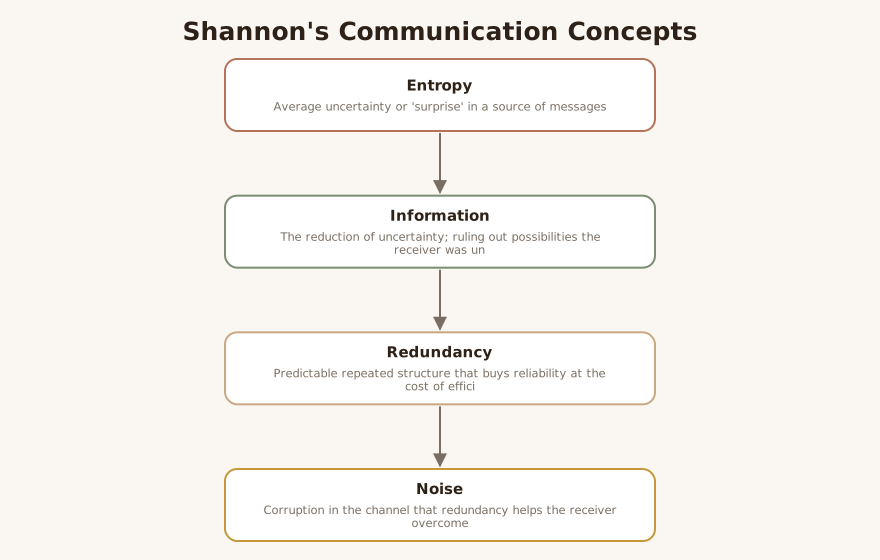
A small set of formal ideas carries the theory, and each has a recognizable everyday shadow 2. The central quantity is entropy, which measures the average uncertainty or “surprise” in a source of messages: a source whose output is highly predictable has low entropy, while one whose output is unpredictable has high entropy 3. Entropy is, in effect, the average amount of information you gain when you learn the outcome of an uncertain event—the more uncertain you were, the more you learn 35. A fair coin flip carries exactly one bit of information; a coin you already know is two-headed carries none, because there was no uncertainty to resolve 35.
Information itself is defined as the reduction of uncertainty: a message is informative to the degree that it rules out possibilities the receiver was unsure about 45. Redundancy is the predictable, repeated structure in a message that is not strictly necessary to convey the content—the reason you can read text with letters missing, and the reason languages tolerate typos 24. Redundancy reduces efficiency but buys reliability, because it lets a receiver reconstruct a message even when parts are lost 2. Channel capacity is the maximum rate at which information can be transmitted through a given channel with arbitrarily low error; Shannon proved that as long as you stay below capacity, reliable communication is possible even over a noisy channel, using enough redundancy and clever coding 12. Noise is anything that corrupts the signal in transit, introducing uncertainty at the receiving end that was not present at the source 26. Together these yield the canonical picture: source → encoder → channel (+ noise) → decoder → destination 26.
Interventions & Techniques
Information theory supplies no standalone clinical techniques in the way that exposure or cognitive restructuring do; it supplies a map and a measurement language that can inform interventions delivered inside established modalities LLM. In practice the translational moves are conceptual LLM. First, treat communication as a channel with finite capacity: when a client is overwhelmed, the clinician can deliberately lower the information rate—fewer items per session, one instruction at a time—so that the message stays below the receiver’s effective capacity 2LLM. Second, add redundancy on purpose: repeating, summarizing, writing things down, and asking for teach-back are redundancy in Shannon’s exact sense, trading efficiency for reliability so the message survives noise 24LLM. Third, reduce noise in the channel: minimizing distractions, ambiguity, and competing signals improves the fidelity of what the client actually receives 26LLM.
Fourth, frame uncertainty explicitly as entropy: naming that a situation is genuinely high-uncertainty—and that some information cannot be obtained—can be used within cognitive work to separate solvable uncertainty (gather information) from irreducible uncertainty (build tolerance) 3LLM. Fifth, on the assessment side, use information-theoretic measures where they already exist: reaction-time and choice paradigms in cognitive and neuropsychological testing have long drawn on the idea that processing more “bits” of uncertainty takes more time and capacity 4LLM.
LLM-generated illustrative example (not a guideline): A client with attention difficulties reports leaving sessions unable to recall the plan. Reframing the session as a noisy channel, the clinician slows the information rate to one action step at a time, adds redundancy (a written one-line summary and a teach-back), and removes noise (turns off notifications, drops jargon). The change is delivered as standard psychoeducation and skills work within the client’s existing therapy, not as a separate treatment LLM.
Evidence Base
Honesty about maturity is essential here LLM. The mathematical theory itself is firmly established: it is a mature, rigorously proven branch of mathematics and engineering, founded on Shannon’s 1948 paper and now underpinning essentially all digital communication and data compression 126. What is not established is “information-theory therapy” as a validated, manualized psychotherapy with outcome trials; no such treatment exists, and clinicians should present the theory accordingly LLM. Its clinical relevance is of two honest kinds LLM. First, historical and conceptual: information theory was one of the intellectual currents (alongside cybernetics) that helped launch the cognitive revolution and the mind-as-information-processor metaphor that still structures cognitive psychology 4. Second, measurement-oriented: information-theoretic constructs inform real assessment paradigms—choice reaction time scaling with the number of bits to be resolved, and quantification of uncertainty and redundancy in language and signal data—which is genuine applied science rather than analogy 4LLM. Beyond that, most clinical “applications” are best understood as useful metaphors: entropy as felt uncertainty, channel capacity as cognitive load, noise as distraction 23LLM. The metaphors can sharpen formulation and psychoeducation, but they are not evidence of a treatment effect, and they should never be dressed up as one LLM.
Populations & Indications
The framework is most useful as a lens in a few specific contexts LLM. For researchers and clinicians working in an assessment context, information-theoretic measures bear directly on quantifying cognitive load, processing capacity, and the structure of language or signal data 4LLM. For people with communication disorders and the broader neuropsychology populations, the source–channel–noise model gives a concrete way to localize where communication is breaking down—encoding, transmission, noise, or decoding—and the redundancy principle motivates compensatory strategies such as repetition, multimodal cues, and written backup 24LLM. Across the general clinical population, the ideas of finite capacity and noise are most relevant where information overload, divided attention, or memory limits are degrading what the client can take in and act on 2LLM. In all of these, information theory is a way of thinking about the problem, not an indication for a specific “information-theory” treatment LLM.
Problems-for-Work
- Communication problems: Diagnose where the breakdown sits in the source → channel (+ noise) → destination chain, then add redundancy and reduce noise to raise fidelity 26LLM.
- Cognitive load: Treat the client’s processing capacity as a finite channel and deliberately lower the information rate so input stays below capacity 2LLM.
- Information overload: Distinguish signal from noise, prune low-value inputs, and chunk what remains so the meaningful information is not buried 24LLM.
- Uncertainty intolerance: Use entropy as a frame to separate reducible uncertainty (gather the missing information) from irreducible uncertainty (build tolerance rather than seek impossible certainty) 3LLM.
- Decision-making difficulties: Frame a decision as resolving uncertainty, identify which information would actually reduce it, and stop seeking information that cannot lower the entropy of the choice 35LLM.
- Attention difficulties: Reduce competing signals (noise) and increase redundancy so the intended message survives lapses in attention 2LLM.
- Memory difficulties: Lean on redundancy—repetition, written summaries, teach-back—to make encoding and later retrieval more robust against loss 24LLM.
LLM-generated illustrative example (not a guideline): A client paralyzed by a job decision is endlessly researching, hoping more data will make the choice obvious. Using the entropy frame within CBT, the clinician helps them list which facts would genuinely reduce uncertainty versus which searches add only noise, caps further information-gathering, and reframes the residual unknown as irreducible uncertainty to be tolerated rather than eliminated LLM.
Contraindications, Cautions & Cultural Humility
The chief risk is category error: mistaking a powerful metaphor for a validated mechanism and implying to clients or colleagues that “information theory” is a treatment with its own evidence base, which it is not 1LLM. A second risk is reductiveness: human communication carries meaning, emotion, relationship, and context, while Shannon’s theory deliberately excludes meaning and measures only quantity—so a model that ignores semantics is a poor master, however useful as a servant 24LLM. Clinically, the most consequential losses in a conversation are usually about meaning and attunement, not bits, and the channel metaphor can obscure that LLM. There is also a subtler caution: framing distress as “noise” or a client as a “low-capacity channel” is dehumanizing language and should never reach the client; the model describes the message-transmission problem, not the person LLM.
Cultural humility matters because what counts as redundancy, noise, or an acceptable information rate is culturally and linguistically shaped: indirect or high-context communication styles may look “inefficient” or “noisy” through an engineering lens while being precisely appropriate in the client’s frame 2LLM. Apparent “communication breakdown” may instead be a clash of communication norms, language proficiency, or interpreter dynamics, and should be assessed as such before being treated as a capacity or noise problem LLM. The model is a simplification to be held lightly, complementing—not replacing—attuned clinical formulation LLM.
Treatment-Plan Suggestions & SMART Objectives
| Goal | SMART objective (example) | Mechanism |
|---|---|---|
| Reduce in-session information overload | Within 4 sessions, clinician and client agree on a “one action step per session” rule, with the step written down each time | Keeps input below channel capacity 2LLM |
| Improve retention of the treatment plan | Over 6 weeks, client correctly teaches back the week’s plan in ≥80% of sessions | Redundancy (repetition + teach-back) buffers against noise/memory loss 24LLM |
| Reduce information-seeking driven by uncertainty intolerance | Over 8 weeks, client caps decision-related research to a pre-set limit and logs reducible vs. irreducible uncertainty for 3 decisions | Distinguishes uncertainty that information can resolve from entropy that cannot 35LLM |
| Lower environmental noise during focused tasks | Within 3 weeks, client implements a “single-channel” work block (notifications off, one task) ≥5 days/week | Reduces competing signals corrupting attention 2LLM |
| Clarify a recurring couple/family miscommunication | Within 6 sessions, the dyad locates where messages break down (sending, noise, or receiving) and adds one redundancy practice (summarize-back) | Targets the failing stage of the source–channel–destination chain 26LLM |
| Tolerate residual uncertainty in a major decision | Over 6 weeks, client makes one values-based decision while explicitly accepting a defined zone of irreducible uncertainty | Reframes high-entropy choices as tolerable rather than solvable 3LLM |
| Support communication-disorder compensation | Over 8 weeks, client uses ≥2 redundancy strategies (written backup, multimodal cues) in daily high-stakes exchanges | Adds redundancy to preserve the message over a degraded channel 24LLM |
Common Misconceptions
A frequent error is treating information theory as a recognized psychotherapy with its own outcome evidence; the theory is established, but a manualized “information-theory therapy” does not exist 16LLM. Another is assuming “information” in Shannon’s sense means “meaning”—it does not; the theory deliberately measures the amount of information independent of whether the content is meaningful, which is exactly why it can quantify a coin flip and a Shakespeare sonnet on the same scale 24LLM. People also misread entropy as “disorder” in a loose, pejorative sense; in information theory entropy is precisely the average uncertainty or expected surprise of a source, a neutral and computable quantity 35LLM. A further misconception is that redundancy is simply waste to be eliminated; redundancy is what makes communication robust to noise, and stripping it out makes messages fragile 24LLM. Finally, many assume a noisy channel makes reliable communication impossible, when Shannon’s key result is the opposite—reliable transmission is achievable below channel capacity given sufficient coding and redundancy 12LLM.
Training & Certification
There is no clinical credential, license, or certification in “information-theory therapy,” and any program implying otherwise should be treated with skepticism, because this is an interdisciplinary mathematical theory rather than a regulated clinical practice LLM. Foundational fluency is best gained from primary and reference sources—Shannon’s original paper and high-quality encyclopedic and instructional treatments—rather than from clinical workshops 126. Accessible introductions, including short video explainers of entropy and bits, are a reasonable on-ramp before the formal mathematics 5. The appropriate path for therapists is to develop competence in the actual billable modality (for example, evidence-based individual, couples, family, or assessment practice) and to use information-theoretic concepts as a supplementary formulation and psychoeducation tool within that scope LLM.
Key Terms
- Bit: The fundamental unit of information, the amount needed to resolve a choice between two equally likely possibilities 13.
- Entropy: The average uncertainty (expected “surprise”) of a source; higher entropy means less predictable messages and more information per outcome 35.
- Information: The reduction of uncertainty achieved when a message rules out possibilities the receiver was unsure about 45.
- Redundancy: Predictable structure beyond the minimum needed to convey content; it lowers efficiency but raises reliability against noise 24.
- Channel capacity: The maximum error-free transmission rate a channel can support; reliable communication is possible below it 12.
- Noise: Any corruption added in transit that introduces uncertainty at the receiver not present at the source 26.
- Source–channel–destination model: Shannon’s schematic of communication—source, encoder, channel (with noise), decoder, destination 26.
Resources & Further Reading
▶ Watch — a video introduction to this concept:
- A Mathematical Theory of Communication (Shannon, 1948) — Wikipedia
- Information theory | Definition, History, Examples, & Facts — Encyclopaedia Britannica
- Entropy (information theory) — Wikipedia
- Information theory — Communication and Mass Media Research Starters (EBSCO)
- What is information theory? — video introduction
- A Mathematical Theory of Communication — original Bell System Technical Journal printing (Sophia Rare Books)
Reflective / Supervision Questions
- When I describe a client’s struggle as “overload,” am I using information theory as a precise, helpful frame—or as a label that reduces a person to a faulty channel LLM?
- In this communication breakdown, where in the source → channel (+ noise) → destination chain is the failure, and am I intervening at the right stage 26LLM?
- Is the uncertainty distressing my client reducible (more information would help) or irreducible (the work is tolerance), and does my plan honor that distinction 3LLM?
- Where am I stripping out “redundant” repetition that the client actually needs to retain and act on the plan 24LLM?
- Am I treating a difference in cultural or linguistic communication style as “noise” when it is simply a different, valid signal 2LLM?
- Have I been clear with myself and colleagues that this is an explanatory metaphor and measurement lens, not a standalone evidence-based treatment 1LLM?