
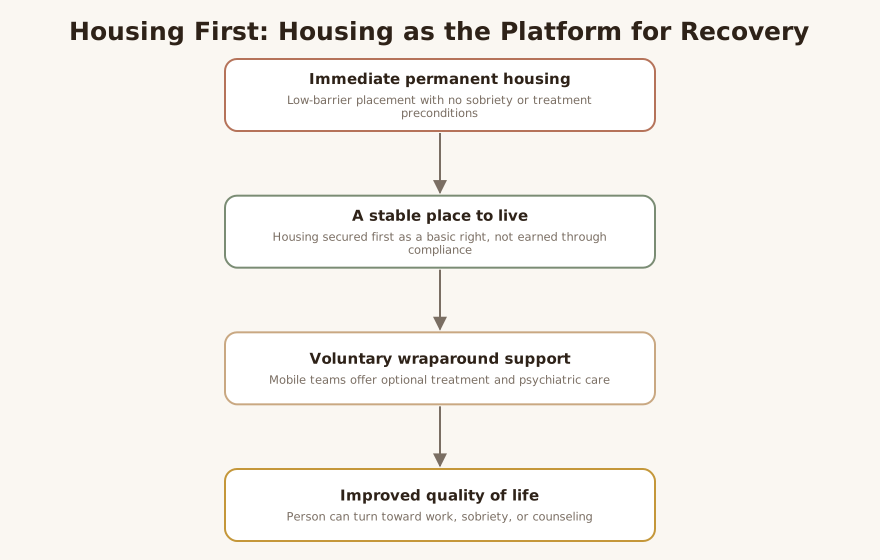
Housing First inverts a sequence that most homelessness services took for granted for decades: instead of requiring a person to first get sober, stabilize psychiatrically, and prove “housing readiness” before earning a permanent home, it provides the home immediately and offers everything else afterward 6. For clinicians who work at the intersection of serious mental illness, substance use, and poverty, understanding this framework matters — many clients who appear “treatment-resistant” or “non-compliant” in conventional systems are simply people for whom a stable place to live was never on the table LLM.
Type & Discipline
Housing First is best understood as a service-delivery philosophy and program model rather than a discrete psychotherapy LLM. It sits within community mental health and homelessness services, and it operationalizes a specific sequencing principle: permanent housing is provided first, and treatment or other support services are offered afterward and voluntarily 6. In the United States it is typically delivered through two program structures — permanent supportive housing, which provides long-term rental assistance for people with severe disabilities and chronic homelessness, and rapid re-housing, which provides shorter-term rental assistance to foster independence 5. Both structures share the defining feature that participants sign a standard lease with no requirements beyond the lease itself 5.
Because it is a framework rather than a clinical technique, Housing First is usually paired with clinical interventions a therapist would recognize — assertive community treatment teams, harm-reduction approaches, and individualized case management — that are delivered into the housing rather than gating access to it 6. The model explicitly rejects “housing readiness” as a prerequisite and instead treats stable housing as the foundation from which interconnected needs such as healthcare, employment, and family stability can be addressed 6.
Creators & Lineage
The formal Housing First model was developed by Sam Tsemberis, a psychologist and faculty member in the Department of Psychiatry at New York University School of Medicine, in the early 1990s 6. He founded the agency Pathways to Housing in New York City in 1992 to operationalize the approach 6. Tsemberis built it in direct partnership with people who were themselves experiencing homelessness, mental illness, and addiction, an origin the Pathways Housing First Institute still emphasizes today 1.
The model emerged as a deliberate alternative to the prevailing “continuum of care” or “staircase” model, which moved people through emergency shelters and transitional housing while requiring them to resolve behavioral issues before reaching permanent housing 6. Tsemberis observed that participants in staircase programs frequently became “stuck,” unable to meet the stringent behavioral standards each step demanded 6. Earlier “supported housing” initiatives in North America during the same decade laid some groundwork, but Tsemberis formalized the low-barrier, consumer-choice version that the field now recognizes 6. The approach gained national traction in the United States when it was adopted as federal policy in the mid-2000s 5. Tsemberis has since articulated the philosophy in a practitioner-facing manual and in public talks, including a widely viewed TEDx presentation 2 7.
Core Principles
Several foundational commitments distinguish Housing First from conventional homelessness services LLM. First is the premise that housing is a basic right rather than something earned through demonstrated “worthiness” or compliance 6. Second is rapid placement into permanent, affordable housing, typically with rent set near 30% of the participant’s income 6. Third is low-barrier access: there is no requirement to abstain from substances or to accept treatment as a condition of getting or keeping housing 6. Fourth, support services are delivered through flexible, mobile teams and are genuinely voluntary — substance use treatment and psychiatric care are available but optional 6 5. Fifth, assistance is individualized, time-unlimited, and adapted to the person rather than to a program timetable 6.
A separation of housing from treatment runs through all of these LLM. The operating theory is that “people must first have a place to live before they can get a job, become sober, or partake in counseling,” and that once housing is secured the person can turn toward improving overall quality of life 5. Consumer choice is central: participants help select where they live, and scattered-site models intentionally place people in ordinary apartments across diverse neighborhoods rather than concentrating them in a single facility 6.
Interventions & Techniques
In practice, Housing First is delivered through a recognizable set of components LLM. Programs aim for rapid placement timelines, offer consumer choice in housing selection, and provide individualized case management alongside voluntary treatment engagement 6. Two delivery models predominate: the scattered-site approach, which integrates participants into ordinary community housing, and the project-based approach, which houses participants within a single development to ease coordination of services 6. Both typically include weekly staff visits, standard lease agreements, and voluntary access to health and rehabilitation services 6.
The clinical work that happens inside the housing is what a therapist contributes LLM. Mobile support teams bring services to the person, and the model’s harm-reduction orientation means a clinician continues to engage a client who is actively using substances rather than discharging them for it 6. Maintaining the housing requires nothing beyond honoring the lease — no sobriety, no mandated program attendance — which removes the behavioral contingencies that traditionally severed people from care 6.
LLM-generated illustrative example (not a guideline): A client with schizophrenia who had been barred from a shelter for intoxication is placed in his own scattered-site apartment through a Housing First program. His therapist meets him there weekly. For the first two months the sessions are mostly about the apartment itself — sleep, food, keys, neighbors — and only later, once survival stops dominating, does the work turn toward medication and his estrangement from his sister. The housing was not the goal of therapy; it was the precondition that made therapy possible LLM.
Evidence Base
The maturity of this evidence base is best described as established, with an important asymmetry: the evidence for housing outcomes is strong, while the evidence for downstream clinical health outcomes is more limited and mixed 3. Randomized trials consistently show that people assigned to Housing First or permanent supportive housing spend substantially more days stably housed than control groups 3. In Canada’s At Home/Chez Soi study, scattered-site participants with intensive case management spent 33–50% more days stably housed over 24 months 3. Observational studies report retention rates of 60–86% over two-year periods, and Housing First reliably outperformed “treatment first” approaches that required sobriety before housing 3. The largest accommodation-focused meta-analysis, covering 28 studies and 8,390 participants, confirmed that Housing First produces significantly better housing stability than models with less tailored support 6.
The clinical picture is more sobering LLM. A National Academies committee found no substantial evidence that permanent supportive housing improves health outcomes for people with mental illness or substance use, despite intuitive expectations 3. Randomized trials found no significant improvements in self-rated physical health, no significant differences on psychiatric symptom measures, and no improvement in substance use — though, importantly, housing did not worsen substance use either 3. A notable exception is HIV/AIDS, where two randomized trials demonstrated better CD4 counts, reduced viral loads, and improved survival, suggesting some conditions are genuinely “housing-sensitive” in a medical sense 3. Evidence for quality of life, community functioning, and social integration is somewhat stronger, with trials showing improvements at 12 months 3. Healthcare utilization also shifts measurably, including a 54% reduction in emergency department visits in one study and a shift from acute toward outpatient care 3.
These findings carry real limitations a clinician should weigh LLM. Most studies followed participants for only one to two years, several had “contaminated” control groups that also received substantial services, and many relied on self-report rather than clinical measures 3. The most severely affected individuals may also be underrepresented because they could not consent to longitudinal study 3. The honest synthesis is that Housing First robustly ends homelessness but is not, by itself, a reliable engine of psychiatric or medical improvement 3.
Populations & Indications
Housing First was designed for, and is best evidenced in, adults experiencing chronic homelessness who have serious mental illness, substance use disorders, or both 6. The At Home/Chez Soi demonstration specifically served people with serious mental illness experiencing homelessness across five Canadian cities and housed over 1,000 participants 6. Permanent supportive housing within the model targets people with severe disabilities and chronic homelessness, while rapid re-housing extends to a broader range of homeless populations seeking to regain independence 5.
The approach is particularly relevant for clients who have repeatedly disengaged from or been excluded by conventional “treatment-first” systems, since the absence of behavioral preconditions removes the very barriers that pushed them out 6. It is also indicated for people whose homelessness drives high use of emergency departments, hospitals, and jails, where stable housing can interrupt costly cycling 3 5.
Problems-for-Work
The central problem Housing First addresses is homelessness and housing instability itself, and on this it is most effective 3. For a clinician, however, the framework opens up adjacent problems-for-work once the housing is in place LLM.
One is disengagement from care: clients who were labeled non-compliant in contingency-based systems can be re-engaged precisely because services are now voluntary and unlinked from housing 6. Another is the “survival mode” that homelessness imposes; qualitative research describes residents appreciating the move out of survival mode and gaining routines, privacy, and identity once housed 3.
LLM-generated illustrative example (not a guideline): A woman who had been doubled-up and periodically on the street describes being unable to think past her next safe place to sleep. After three months in her own unit, sessions shift from crisis triage to grief about the children she lost custody of years earlier — material that was inaccessible while she was unhoused LLM.
For women specifically, the At Home/Chez Soi analysis of 653 women found Housing First dramatically improved residential stability — women in the intervention spent 74.8% of days stably housed versus 37.9% in the control group — yet it did not, on its own, address psychological safety, trauma recovery, or peer support, which are central problems-for-work the clinician must hold 4.
Contraindications, Cautions & Cultural Humility
Housing First has no clinical “contraindication” in the pharmacological sense, but several cautions belong in any honest account LLM. The most consistent critique is that because treatment is optional, the model may not adequately address underlying substance use or mental illness, and traditional continuum-of-care models — while achieving lower housing retention — have been argued to produce better treatment engagement on some measures 5. A systematic review found that Housing First did not consistently improve health or mental health outcomes, though it also did not increase substance misuse 6.
Real-world safety concerns deserve attention LLM. San Francisco data noted that a large majority of unsheltered people approached during outreach refused shelter, underscoring how hard the most disengaged populations remain to reach, and that a meaningful share of the city’s overdoses occurred within government-provided single-room-occupancy housing despite placement 6. This is a caution against assuming that housing alone resolves overdose risk LLM.
Cultural humility is essential because homelessness is not racially neutral LLM. Black Americans experience homelessness at sharply disproportionate rates — roughly 32% of homeless individuals against about 12% of the general population — and EBSCO’s account names systemic racism among the structural drivers 5. The framework’s own scholars note it implicitly asserts a fundamental right to housing that challenges welfare ideologies built on individual deservingness, a tension clinicians should recognize rather than treat as settled 6. The model’s effectiveness is also bounded by structural conditions outside any clinician’s control, including affordable-housing shortages and inconsistent mental health provision, which UK evaluations flagged as limiting factors 6.
Treatment-Plan Suggestions & SMART Objectives
| Goal | SMART objective (example) | Mechanism |
|---|---|---|
| Attain and sustain stable housing | Client will maintain tenancy in a self-selected unit for 6 consecutive months, verified by case-manager contact | Rapid, low-barrier permanent placement 6 |
| Re-engage with voluntary care | Client will attend at least 2 of 4 monthly in-home support visits over 90 days | Mobile, non-contingent service delivery 6 |
| Exit “survival mode” toward routine | Client will establish 3 daily living routines (sleep, meals, medication) within 8 weeks of housing | Privacy, safety, and stability of own home 3 |
| Reduce acute-service cycling | Client will reduce emergency department visits by 50% over 6 months relative to prior 6 months | Stable housing reduces crisis-driven utilization 3 |
| Address trauma once safe (esp. women) | Client will begin trauma-focused work after 60 days of housing stability, at her own pace | Material stability creates psychological space for trauma recovery 4 |
| Engage harm-reduction goals | Client will identify 1 self-chosen substance-use goal within 90 days, without abstinence as a housing condition | Voluntary, non-coercive harm reduction 6 |
| Build social integration | Client will participate in 1 community or peer activity per month for 3 months | Improved community functioning and social integration with housing 3 |
| Sustain quality-of-life gains | Client will report improved living-situation satisfaction on a brief measure at 12 months | Quality-of-life benefits observed in trials at 12 months 3 |
Common Misconceptions
A persistent misconception is that Housing First is “soft on” treatment because it makes services voluntary; in fact it separates treatment from housing by design, on the theory that a person must first have a place to live before sobriety, work, or counseling become achievable 5. A related error is conflating the program’s purpose with broader social goals — critics fault it for not consistently improving substance use, but defenders note this misreads a model whose primary aim is ending homelessness, not curing addiction 6.
Another misconception is that Housing First means simply handing someone keys with no support; in reality it pairs housing with flexible, person-centered, ongoing services delivered by mobile teams 1 6. Finally, some assume that because Housing First “works,” homelessness should be falling — yet rates have risen amid affordable-housing shortages, inflation, and the end of pandemic-era programs, which reflects structural failure rather than a failure of the model’s housing-retention performance 5.
Training & Certification
The Pathways Housing First Institute is the organization most directly associated with disseminating the model, describing itself as partnering with organizations, municipalities, states, and countries to deliver person-centered Housing First programs through strategic planning, program development, implementation guidance, workforce training, and practical tools 1. The Institute frames Housing First as an evidence-based approach and offers workforce training, though its public materials do not detail a formal individual certification track 1.
For clinicians and program leaders seeking grounding, Tsemberis’s practitioner manual lays out the Pathways model in operational detail, and his TEDx talk offers an accessible introduction to the philosophy 2 7. Fidelity to the model’s core components — rapid placement, consumer choice, individualized case management, voluntary services, and no sobriety or behavioral requirements — is what distinguishes a genuine Housing First program from a renamed conventional one 6.
Key Terms
Housing First: A framework providing immediate permanent housing without preconditions, with voluntary support offered afterward 6. Treatment-first / staircase / continuum-of-care model: The contrasting approach requiring people to progress through shelters and transitional housing and to demonstrate readiness before earning permanent housing 6. Permanent supportive housing: Long-term rental assistance for people with severe disabilities and chronic homelessness 5. Rapid re-housing: Shorter-term rental assistance aimed at restoring independence 5. Scattered-site model: Placement in ordinary apartments distributed across the community 6. Project-based model: Placement within a single development to coordinate services 6. Housing-sensitive condition: A health condition, such as HIV, for which stable housing appears medically necessary rather than merely beneficial 3.
Resources & Further Reading
▶ Watch — a video introduction to this concept:
- Pathways Housing First Institute — official organization website 1
- Tsemberis, S. — Housing First: The Pathways Model to End Homelessness for People with Mental Health and Substance Use Disorders 2
- National Academies — Evidence of the Effect of Permanent Supportive Housing on Health (NCBI Bookshelf) 3
- Women experiencing homelessness and mental illness in a Housing First multi-site trial (PMC) 4
- Housing First — EBSCO Research Starters 5
- Housing First — Wikipedia 6
- Housing First: Sam Tsemberis at TEDxMosesBrownSchool (YouTube) 7
Reflective / Supervision Questions
- When a client of yours has been called “non-compliant” or “not ready,” how much of that judgment rested on conditions — sobriety, attendance — that a Housing First lens would treat as barriers rather than prerequisites LLM?
- Given that the evidence shows strong housing stability but mixed clinical improvement, how would you set honest expectations with a newly housed client and with yourself about what housing alone will and will not change 3?
- For women and other clients carrying trauma histories, where does psychological safety belong in your plan once material stability is achieved, since the housing model itself does not supply it 4?
- And how do you hold the structural reality — that affordable-housing shortages and systemic racism shape who becomes and stays homeless — without sliding into either fatalism or false reassurance in the therapy room 5 6?