
Type & Discipline
The Five Ps is a case-formulation framework used in clinical psychology, psychiatry, and counseling to organize a client’s presentation into a structured, treatment-relevant understanding.12 It is not a treatment modality in its own right; it is a pantheoretical scaffold — a way of arranging information — that sits between diagnosis and intervention.2 Its premise is that a diagnostic label alone is insufficient to guide care, and that clinicians must also account for causal, lifestyle, and personal factors to build a multidimensional picture of the person and their problem.2 In this sense the Five Ps belongs to the broader tradition of biopsychosocial case formulation: the five factors are most often crossed with biological, psychological, and sociocultural domains so that each “P” is examined across the whole of a person’s life rather than in a single register.1
The framework “does not adhere to any particular theoretical orientation, thus allowing for a greater repertoire of strategies to draw from.”2 Because of this, it functions as a flexible container that lets a clinician hold biological explanations, cognitive-behavioral concepts, and psychodynamic insights side by side within a single, coherent summary.5 It is described as trans-theoretical and idiographic — tailored to the individual rather than applied as a generic template.5
Creators & Lineage
The Five Ps draws on a multiperspective tradition of formulation. Priyanthy Weerasekera (1996) is credited with popularizing the Five Ps as part of a multiperspective formulation model.5 The framework was further developed and articulated for general clinical practice by Craig Macneil and colleagues (2012), who argued that diagnosing alone was insufficient and that it was critical to include other factors — causal, lifestyle, and personal — to conceptualize clients and their problems “systematically and holistically.”2 Gintner’s clinical teaching materials likewise attribute the modern Five Ps formulation to Macneil and colleagues (2012) and integrate it directly with DSM-5 assessment.1
The framework’s lineage is therefore less a single founding text than a convergence of formulation scholarship into a portable, teachable grid.LLM Its sibling is the broad biopsychosocial model, which supplies the vertical axis (biological, psychological, sociocultural factors) that the five temporal/functional factors are crossed against.1 It is now embedded in clinical training and supervision, and many services have adopted a “five Ps + Plan” format as a standard documentation structure.5
Core Principles
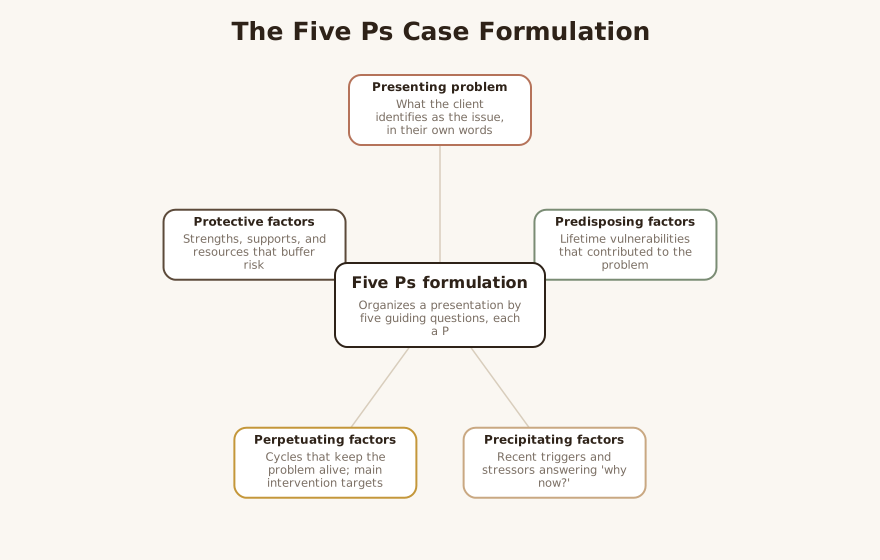
The framework rests on five organizing questions, each a “P.”1 Presenting problem is what the client identifies as the issue, in their own words, together with the symptom picture and any DSM diagnoses and problem list.14 Predisposing factors are the vulnerabilities accumulated over the person’s lifetime that contributed to the development of the problem — family history, early adversity, temperament, chronic conditions, and structural inequities; here the clinician is prompted to “think biopsychosocial.”14 Precipitating factors answer the question “why now?” — the recent triggers, stressors, or life changes that brought about or exacerbated the problem.14 Perpetuating factors are the cycles that keep the problem alive — rumination, avoidance, sleep disruption, isolation — and are typically the primary intervention targets.14 Protective factors are the strengths, supports, values, coping skills, and community resources that buffer risk and can be drawn upon in treatment.14
Several principles govern how the grid is used.5 A formulation explains a client’s difficulties rather than merely labeling them, providing context that a diagnosis cannot.5 It is fundamentally collaborative — best practice requires that the client see the formulation and agree that it “rings true,” so that the account is built with the client rather than about them.5 It is a dynamic hypothesis, a living document to be revised as new information emerges rather than a fixed verdict.45 And it is idiographic and systematic at once, holistic in scope yet flexible enough to allow clinical creativity in how each cell is filled.25
Interventions & Techniques
The Five Ps is applied as a structured interview-and-synthesis procedure, usually during intake and revisited after significant changes.4 In practice the clinician gathers history across the five questions, sorts each finding into biological, psychological, or sociocultural domains, and then writes the formulation as a short integrative narrative.1 Gintner offers a concrete writing template that links the five Ps in a single paragraph: the client presents with …, which appears to be precipitated by …; factors that seem to have predisposed her include …; the current problem is maintained by …; however, her protective and positive factors include ….1
The framework also drives the move from understanding to action.4 Because perpetuating factors are what currently sustain the problem, they become the most direct intervention targets, while protective factors are deliberately built up and precipitating stressors are addressed.4 A central clinical advantage in some settings — particularly substance use counseling — is that the Five Ps “permits counselors to both assess and intervene essentially simultaneously,” because mapping the maintaining and protective factors immediately suggests where to act.2 The framework does not replace any specific intervention; it is “another way to address the multifaceted and complicated nature” of a presentation, sequencing other modalities rather than competing with them.2
LLM-generated illustrative example (not a guideline): A clinician completing a Five Ps grid notes that a client’s perpetuating factors are nightly rumination and daytime social withdrawal. Rather than treat the diagnosis generically, the clinician targets rumination with a cognitive technique and re-engages activity through scheduling, while explicitly recruiting the client’s supportive sibling as a named protective factor. LLM
Evidence Base
The Five Ps is best described as established in the specific sense that it is widely taught, standard in many services, and entrenched as a default formulation structure — not in the sense of a strong randomized-controlled efficacy literature.51 Honesty about this gap is important.LLM The substance-use application paper states plainly that “this particular framework has not been empirically tested with client substance use and misuse,” and presents the Five Ps as an idiographic, flexible means of organizing care rather than an empirically validated treatment.2 More broadly, “empirical evidence linking formulation directly to better outcomes is still developing,” and many of the assumptions behind case formulation rest on clinical wisdom and patient feedback rather than robust outcome data.5
There is, nonetheless, a defensible case for its value.1 Gintner’s clinical teaching notes that “case formulation is a skill and has been tied to better outcome,” positioning the discipline of formulating — not any single grid — as the thing that improves care.1 The British Psychological Society has emphasized formulation as best practice, and the framework’s holistic, systematic organization of complex information is repeatedly cited as its core strength.5 At the same time, reliability is a known limitation: two clinicians may formulate the same case somewhat differently, and more experienced clinicians tend to produce higher-quality formulations, which makes formulation “as much an art as a science.”5 The maturity verdict, then, is established-as-standard-practice with outcome evidence still maturing — clinicians should value the Five Ps for the disciplined thinking it scaffolds, not as a treatment with proven efficacy of its own.LLM
Populations & Indications
Because it is pantheoretical and transdiagnostic, the Five Ps applies broadly across populations and presentations.25 It is used with adults and adolescents, across a wide range of settings — multidisciplinary team meetings, school counseling, community support, and substance use treatment among them.52 It is especially well suited to complex or multi-factor presentations, where a single diagnosis fails to capture how biological vulnerability, recent stressors, maintaining cycles, and existing strengths interact.12 The substance-use literature highlights a further indication: incorporating the framework “may prove attractive to clients and counselors,” potentially increasing engagement by centering the person and their context rather than reducing them to a label.2
It is also indicated whenever a clinician needs to move efficiently from diagnosis to a treatment-relevant picture, or to communicate a case cleanly across a team.4 The framework “maps risk and safety cleanly, making handoffs and documentation faster,” which makes it a practical choice at intake and at any major clinical transition.4 DSM-5 assessment can be folded directly into it — diagnostic criteria populate the Presenting problem, while development-and-course and risk-and-prognostic information feed the Predisposing, Perpetuating, and Protective cells.1
Problems-for-Work
The Five Ps does not target a fixed symptom list; it reorganizes whatever the client brings so that the maintaining and protective mechanisms become visible.4 Representative applications drawn from the sources:
- Major depressive disorder — In a worked depression example, predisposing factors include family history of depression and perfectionism; precipitating factors include a recent breakup, work deadlines, and winter onset; perpetuating factors include rumination, social withdrawal, and irregular sleep; protective factors include a supportive sibling and valued activities — directing treatment toward rumination and activity scheduling.41
- Substance use disorders — Predisposing biological, environmental, or personality vulnerabilities; precipitants that proximally bring about use; perpetuating factors that sustain and reinforce use; and protective factors that moderate its impact are mapped so interventions can be personalized and targeted.2
- Risk and safety formulation — The grid surfaces suicide-risk and functional-consequence information (perpetuating and presenting-problem cells) and the supports that buffer it, supporting cleaner risk documentation and handoff.14
- Complex, multi-factor presentations — When biological, psychological, and social contributors are entangled, crossing the five Ps with biopsychosocial domains prevents premature narrowing to one explanation.1
LLM-generated illustrative example (not a guideline): For a client with a substance use concern, the clinician maps chronic pain and a family history of addiction as predisposing, a job loss as the precipitant, “drinking to sleep” as the central perpetuating cycle, and a committed partner plus prior period of sobriety as protective — then sequences psychoeducation and a relapse-prevention plan accordingly. LLM
Contraindications, Cautions & Cultural Humility
The Five Ps has few hard contraindications, but several real cautions.2 It is not a substitute for medical care: it “may not be particularly beneficial” where there is significant substance withdrawal, which may require medical stabilization and detoxification before formulation-driven work begins.2 It also presumes a degree of readiness — “there may be clients who are simply not ready or able to address some or most of the dimensions,” and mandated clients may have service plans that conflict with the framework.2 The formulation process itself can be affectively difficult; some clients find confronting their predisposing and precipitating history “saddening, upsetting and worrying,” which calls for adequate support around the exercise.5
The framework’s most discussed weakness is cultural and systemic blindness when applied mechanically.5 The five Ps “might lead to underemphasising broader cultural, social, or systemic factors” because the grid “doesn’t explicitly prompt the clinician about cultural factors unless they intentionally fold those into one of the Ps.”5 Used as a superficial checklist, it loses its integrated meaning — and this is “a limitation of the user, not the model per se.”5 The corrective is to treat sociocultural factors as a first-class domain across every P, to keep the formulation collaborative so it does not become “the therapist’s story about the client rather than with the client,” and to remember that what looks like a predisposing deficit may be an adaptive response to discrimination or material constraint.5LLM
Treatment-Plan Suggestions & SMART Objectives
Goals center on building a shared, multidimensional formulation and then translating its perpetuating and protective cells into action.4LLM
| Goal | SMART objective (example) | Mechanism |
|---|---|---|
| Complete an initial Five Ps formulation | By session 2, clinician and client co-produce a written five-factor formulation covering all five Ps | Systematic case conceptualization |
| Identify the primary perpetuating cycle | Within 3 sessions, client names ≥1 maintaining cycle (e.g., rumination, avoidance) to target | Mechanism identification |
| Map biopsychosocial contributors | By session 3, each P is examined across biological, psychological, and sociocultural domains | Biopsychosocial integration |
| Recruit protective factors | Within 4 weeks, client identifies and re-engages ≥2 existing supports or strengths weekly | Strength-based intervention |
| Address a key precipitant | Over 6 weeks, client develops a concrete plan for the identified “why now” stressor | Stressor-focused intervention |
| Establish the formulation as collaborative | By session 2, client reviews the formulation and confirms it “rings true,” with revisions noted | Collaborative validation |
| Revise the formulation as a living document | At each major transition, the formulation is reviewed and updated with new information | Dynamic hypothesis-testing |
| Translate formulation into treatment targets | By the end of assessment, ≥2 measurable goals are linked to specific Ps | Formulation-to-plan linkage |
These objectives are illustrative; tailor each to the individual client and track with a validated outcome measure. LLM
Common Misconceptions
- “The Five Ps is a therapy you deliver.” It is a formulation framework that organizes understanding and sequences other interventions; it “is not meant to replace any other” treatment.2LLM
- “A diagnosis and a formulation are the same thing.” A diagnosis labels; a formulation explains, adding the causal, lifestyle, and personal context a label omits.52
- “It’s a one-time checklist.” It is a dynamic hypothesis and living document, meant to be revised as new information emerges.45
- “It captures culture automatically.” It does not prompt for cultural and systemic factors unless the clinician deliberately folds them into each P.5
- “It’s empirically validated as a treatment.” Direct outcome evidence is still developing, and at least one application has “not been empirically tested.”52
- “Any two clinicians will formulate identically.” Formulations vary by clinician and experience, making it partly “an art as a science.”5LLM
Training & Certification
The Five Ps is taught within graduate clinical and counseling training and is a standard component of case-conceptualization teaching and clinical supervision.5 There is no certification specific to the framework; it is practiced by licensed psychologists, counselors, social workers, and psychiatrists as part of general formulation competence.LLM Competence is built through supervised practice, multidisciplinary case discussion, and structured teaching — and is reinforced by the observation that formulation quality rises with clinician experience, so deliberate, supervised repetition matters.5 Practical adoption is supported by resources such as collaborative, accessible formulation templates designed to be completed with clients, and by integration with DSM-5 assessment workflows that show how diagnostic information populates each P.31
Key Terms
- Presenting problem — the client’s stated concern and symptom picture, including any diagnosis and problem list.1
- Predisposing factors — lifetime vulnerabilities (biological, psychological, social) that contributed to the problem’s development.1
- Precipitating factors — the recent triggers or stressors that answer “why now?”1
- Perpetuating factors — the cycles that maintain the problem and serve as primary intervention targets.14
- Protective factors — strengths, supports, values, and resources that buffer risk and can be drawn upon.1
- Biopsychosocial domains — the biological, psychological, and sociocultural axis crossed against the five Ps.1
- Formulation — a structured, explanatory summary of a person’s problems and their contributing factors, distinct from a diagnostic label.5
- Dynamic hypothesis — the principle that a formulation is provisional and revised as understanding deepens.5
Resources & Further Reading
▶ Watch — a video introduction to this concept:
- Using DSM-5 in Case Formulation — Gintner (PDF)
- Application of the Five Ps Framework in Substance Use Counseling — The Professional Counselor (NBCC)
- Friendly Formulation — Psychology Tools
- 5 Ps Case Formulation Framework: A Clinical Guide for Therapists — Supanote
- The 5Ps of Counselling — UKEssays
Related wiki articles: Cognitive Behavioral Therapy · Schema Therapy · Structural Family Therapy. Explore in the graph: Motivational Interviewing · or filter by Major depressive disorder and Substance use disorders.
Reflective / Supervision Questions
- When I complete a Five Ps grid, am I genuinely building it with the client, or am I writing my own story about them and presenting it as fact?
- Where in my formulations do cultural, structural, and systemic factors actually appear — or do they quietly drop out unless I force them into a P?
- Am I treating the formulation as a living hypothesis I revise, or as a verdict I filed at intake and never reopened?
- Which “P” am I weakest at eliciting, and is that gap shaping the treatment plans I produce?
- When I label something a predisposing vulnerability, could it instead be an adaptive response to adversity that deserves respect rather than correction?