
Type & Discipline
Espiritismo (Spiritism) is a folk-healing and religious-spiritual tradition rather than a profession-bound psychotherapy, situated within the family of Indigenous and folk healing practices of the Caribbean and Latin America 5. It is best understood as a culturally embedded system in which mediums communicate with discarnate spirits to diagnose and address emotional and physical distress 5. For the clinician, the relevant frame is not “Is this a treatment that works?” but “How does this meaning-system shape how a patient experiences, names, and seeks help for suffering?” LLM. Espiritismo overlaps with, but is distinct from, neighboring traditions such as Santería and curanderismo, and it frequently coexists with formal mental health care rather than replacing it 15. Throughout this article it is treated as an emic explanatory framework to be engaged respectfully, not as a clinical mechanism to be endorsed or debunked LLM.
Creators & Lineage
The doctrinal taproot is the work of Allan Kardec, the pen name of the French educator Hippolyte Léon Dénizard Rivail (born in Lyon in 1804), who codified Spiritism in the mid-19th century 4. Kardec’s foundational text, The Spirits’ Book (1857), compiled philosophical questions posed to mediums and framed Spiritism as a “science” concerned with the nature, origin, and destiny of spirits, aligning it rhetorically with the positivism of its era 4. His doctrine grew out of, and reorganized, the broader Spiritualist movement associated with American mediums such as the Fox sisters 4. Kardecist Spiritism then spread widely across Latin America, flourishing especially in Brazil, Cuba, and Puerto Rico 5. Puerto Rican adoption accelerated in the early 19th century, tied in part to resistance to Spanish colonial authority and to Catholic condemnation of the practice 5. As it took root in the Caribbean, Espiritismo absorbed elements of Roman Catholicism, curanderismo, Santería, Vodou, and other folk traditions, producing syncretic variants such as Santerismo, which merges spirit communication with the orishas of Santería 5. The lineage thus runs from European spiritist healing traditions, through Caribbean folk healing and curanderismo, into hybrid forms alongside Santería, and finally into the contemporary conversation about culturally adapted psychotherapy where it now sits as a cultural-engagement resource 51.
Core Principles
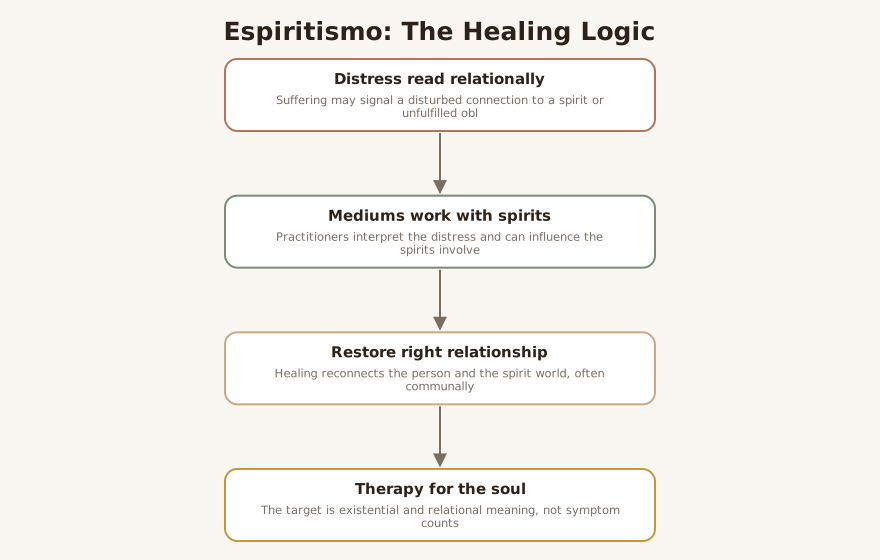
Spiritists hold that a spirit world exists alongside material reality and that humans are incarnate spirits progressing morally and intellectually across multiple lifetimes 4. Core tenets include belief in a supreme God, the moral exemplarship of Jesus, reincarnation toward spiritual improvement, and an intermediary “perispirit” linking the material and spiritual realms 4. A defining premise of Espiritismo specifically is that more-evolved and less-evolved spirits can affect a person’s health, luck, and circumstances, and that practitioners can in turn influence those spirits 5. Within this logic, suffering is frequently read relationally: distress may signal a disturbed connection to a spirit, an unfulfilled spiritual obligation, or interference requiring intervention 5. Healing is therefore framed as restoring right relationship between the person and the spirit world, often within a communal rather than purely individual context 3. The tradition has been described in the scholarly literature as a “therapy for the soul,” underscoring that its target is existential and relational meaning, not symptom counts 3.
Interventions & Techniques
The central ritual setting is the misa (spiritual mass), a séance in which mediums attempt to contact spirits for guidance and healing 5. These sessions typically center on an altar or table dressed with a white cloth, glasses of water, candles, flowers, and sometimes photographs of ancestors 5. The medium, or espiritista, serves as the working agent who perceives, interprets, and negotiates with the spirits implicated in a person’s distress 5. Healing acts described across spiritist practice include “passes” (a channeling of energy by trained practitioners), psychography or automatic writing, and study and charitable activity organized through community centers 4. Regional variants carry distinct techniques: the urban, intellectual Mesa Blanca tradition is Kardec-focused, while Espiritismo de Cordón is healing-centered and involves circle dancing and trance 5. Across these forms, the consistent therapeutic ingredients from a clinical standpoint are ritual structure, an authoritative interpreter, communal witnessing, and a narrative that locates the cause of suffering outside the patient’s sole control LLM.
LLM-generated illustrative example (not a guideline): A bereaved client describes attending a misa where the espiritista told her that her late mother’s spirit was “unsettled” and guided the family through a candle-and-water ritual to bring peace. In session, the clinician does not adjudicate the spirit claim; instead they note that the ritual gave the client a structured, communally supported way to continue a bond with her mother and to externalize unbearable guilt LLM.
Evidence Base
Honesty about maturity requires distinguishing two senses of “established.” As a cultural and religious healing tradition, Espiritismo is well-established, with a long history and a mature ethnographic and anthropological literature documenting its practices and meanings 23. As a clinical intervention with demonstrated efficacy, however, it is effectively untested: there is no meaningful randomized controlled trial base establishing that Espiritismo treats psychiatric disorders, and clinicians should not represent it as an evidence-based therapy LLM. The strongest health-services finding comes from the Boricua Youth Study, a longitudinal study of 2,491 Puerto Rican children (ages 5–17) followed across three annual waves in San Juan/Caguas and the South Bronx 1. In that cohort, after controlling for demographics and psychiatric diagnoses, children whose families engaged with Espiritismo and Santería in the South Bronx were about 2.41 times more likely to use mental health services over three years, though this association did not appear in Puerto Rico 1. The authors interpret espiritistas and santeros as potential “gateway providers” who can open doors to formal treatment by prompting or initiating referral 1. The defensible clinical claim, therefore, is that Espiritismo’s documented value lies in cultural engagement, meaning-making, community support, and facilitating access to care rather than in direct symptom remission 13.
Populations & Indications
Espiritismo is most salient among Puerto Rican and broader Caribbean populations, and within Latino/Hispanic communities where spiritist beliefs circulate as part of everyday cultural life 15. It is particularly relevant for religious and spiritual individuals and for immigrant populations who carry these frameworks across migration, as the South Bronx findings illustrate 1. The tradition speaks directly to people experiencing culturally bound distress, whose suffering is organized through idioms that biomedical categories may not capture 2. Bereaved individuals are a notably well-fit population, given the tradition’s central concern with ongoing relationships to the dead 5. Clinically, the indication is rarely “refer to Espiritismo” and more often “recognize and work with the patient’s existing Espiritismo framework” when it is part of their identity and coping LLM.
Problems-for-Work
Several presentations map onto Espiritismo’s explanatory territory. Culture-bound syndromes and ataque de nervios—an idiom of acute distress recognized in Latino populations—are frequently interpreted through spiritist or folk frameworks, and engaging that framework can reduce shame and increase engagement 2. Grief and bereavement fit naturally, since the tradition offers structured, ongoing communion with deceased loved ones 5. Anxiety and depression may be reframed by patients as spiritual disturbance or interference, which is clinically useful information about their explanatory model 2. Spiritual distress and existential or meaning-related suffering align closely with the tradition’s self-description as a “therapy for the soul” 3. Somatic complaints and trauma may also be narrated in spiritist terms, where bodily symptoms are read as signs of spirit-related disturbance 2.
LLM-generated illustrative example (not a guideline): A client with panic attacks frames her symptoms as a “test” sent by spirits. Rather than correcting her, the clinician validates the meaning (“it sounds like this feels spiritually significant, not random”), then collaboratively adds coping skills, positioning paced breathing as something that “helps you stay grounded while you do your spiritual work” LLM.
Contraindications, Cautions & Cultural Humility
The first caution is diagnostic, not ideological: clinicians must distinguish culturally normative experiences—mediumship, trance during a misa, or the acute presentation of ataque de nervios—from psychosis or other psychiatric emergencies, recognizing that spirit-related experiences within a sanctioned ritual context are not in themselves signs of mental illness 52. Pathologizing a believer’s normative spiritual experience is itself a clinical error and a rupture in the alliance LLM. At the same time, a real risk exists when spiritual explanations delay needed psychiatric or medical care; the clinician’s task is to hold respect for the framework while ensuring that danger (suicidality, untreated medical illness, child safety) is not deferred to spiritual remedy alone LLM. Cultural humility here means engaging Espiritismo as a coherent meaning-system without either endorsing supernatural mechanisms as clinical fact or dismissing them, and without assuming every Latino or Puerto Rican patient holds these beliefs LLM. The empirical reminder that espiritistas often act as gateway providers should encourage collaboration with, rather than competition against, trusted community healers where appropriate 1.
Treatment-Plan Suggestions & SMART Objectives
| Goal | SMART objective (example) | Mechanism |
|---|---|---|
| Elicit the patient’s explanatory model | Within 2 sessions, clinician completes a cultural formulation identifying the patient’s spiritist understanding of their distress | Explanatory-model elicitation; alliance building 2 |
| Reduce shame around culturally bound distress | Patient reports a 50% reduction in self-reported shame about ataque de nervios episodes within 8 weeks, rated each session | Normalization and validation of cultural idiom 2 |
| Integrate existing community support | Patient identifies and re-engages at least one trusted community or spiritual support within 4 weeks | Mobilizing social support and gateway resources 1 |
| Support adaptive grieving | Patient practices one continuing-bonds ritual and reports reduced acute grief intensity over 6 weeks | Structured meaning-making and continued bonds 5 |
| Add coping skills without cultural conflict | Patient uses a grounding skill during 3 of 4 anticipated distress situations weekly, framed compatibly with their beliefs | Skills acquisition embedded in patient’s worldview LLM |
| Ensure safety is not deferred to spiritual remedy | Patient and clinician complete a written safety plan that names medical/psychiatric thresholds for seeking formal care within 1 session | Risk mitigation; care-coordination LLM |
| Strengthen meaning and coherence | Patient articulates a personal narrative linking symptoms, spirituality, and recovery in their own words by week 10 | Existential meaning-making 3 |
Common Misconceptions
A first misconception is that Espiritismo is merely superstition or a barrier to “real” care; the gateway-provider findings suggest the opposite, that engagement with these practices can coincide with greater use of formal mental health services 1. A second is that Espiritismo and Santería are the same thing; they are related and often blended (as in Santerismo) but doctrinally distinct, with Espiritismo rooted in Kardecist spiritism and Santería in Yoruba-derived orisha worship 5. A third is that the practice is uniform; in reality it spans variants from intellectual Mesa Blanca to trance-based Espiritismo de Cordón 5. A fourth is that mediumship or trance is inherently pathological, when within a sanctioned ritual context it is a normative cultural role 5. A final misconception is that “established” implies clinical efficacy; the tradition is an established cultural and historical phenomenon, not an empirically validated treatment for psychiatric disorders 4LLM.
Training & Certification
There is no clinical credential in “Espiritismo” for mental health professionals, and clinicians should be wary of any product marketed as such LLM. Authority within the tradition itself is conferred by the spiritist community and accrues through apprenticeship and recognized mediumistic ability rather than through academic certification 5. For clinicians, the appropriate “training” is competence in cultural assessment and culturally adapted psychotherapy, including structured tools like the Cultural Formulation Interview, supplemented by the ethnographic literature on Puerto Rican spiritism 23. Reading primary ethnographic scholarship—such as the foundational work on Puerto Rican spiritism and on Espiritismo as a community “therapy for the soul”—builds the contextual fluency needed to engage patients respectfully 23.
Key Terms
- Espiritismo — Caribbean/Latin American spiritist tradition in which mediums communicate with spirits to address health and life problems 5.
- Allan Kardec — Pen name of Hippolyte Léon Dénizard Rivail, the 19th-century French educator who codified Spiritism 4.
- Espiritista / medium — Practitioner who perceives and negotiates with spirits during ritual work 5.
- Misa — Spiritist “spiritual mass” or séance centered on an altar with white cloth, water, candles, and flowers 5.
- Mesa Blanca — Urban, Kardec-focused, intellectual variant of the practice 5.
- Espiritismo de Cordón — Healing-centered variant involving circle dancing and trance 5.
- Santerismo — Syncretic form merging Espiritismo with the orishas of Santería 5.
- Ataque de nervios — A Latino idiom of acute emotional distress often interpreted through spiritist or folk frameworks 2.
- Gateway provider — A community healer (espiritista/santero) whose involvement can prompt or initiate referral into formal mental health care 1.
- Perispirit — In Kardecist doctrine, the intermediary between the material body and the spiritual realm 4.
Resources & Further Reading
▶ Watch — a video introduction to this concept:
- Espiritismo and Santeria: a gateway to child mental health services among Puerto Rican families? (PMC)
- Puerto Rican Spiritism (Culture, Medicine, and Psychiatry)
- Community Healing Among Puerto Ricans: Espiritismo as a Therapy for the Soul (Springer)
- Spiritism | Beliefs, Practices, & History — Britannica
- Espiritismo — Wikipedia
- Meeting the Spirits: Puerto Rican ‘Espiritismo’ as Source for Identity, Healing and Creativity (Fieldwork in Religion)
Reflective / Supervision Questions
- When a patient frames their distress in spiritist terms, how do I notice my own impulse to correct, endorse, or dismiss—and what would respectful neutrality look like instead? LLM
- How confident am I in distinguishing a culturally normative mediumistic or trance experience from a psychiatric emergency, and where would I seek consultation? 5
- Have I assumed a patient holds Espiritismo beliefs based on ethnicity, or have I actually elicited their explanatory model? LLM
- In what cases might collaborating with a trusted community healer strengthen the patient’s care, given evidence that such healers can act as gateway providers? 1
- Where is the line, for this specific patient, between respecting a spiritual framework and ensuring that safety or medical needs are not deferred to spiritual remedy alone? LLM
- How do I document this work honestly as culturally adapted, evidence-informed psychotherapy without overstating Espiritismo as a validated treatment? LLM