
Type & Discipline
The encounter group / T-group movement is a modality of intensive small-group experience that sits at the intersection of humanistic psychology and social psychology rather than within mainstream clinical psychotherapy 16. It is best understood as a family of related formats—training groups (T-groups), sensitivity-training groups, and encounter groups—all built on small, relatively unstructured groups that set their own objectives under a trained facilitator who maintains a psychologically safe atmosphere 12. The defining purpose is not symptom relief but heightened awareness of self and others, more honest interpersonal communication, and personal growth in people who are, by and large, already functioning 26.
A distinction worth holding from the outset: the field itself drew a line between therapeutic aims and educational/growth aims 6. Group psychotherapy targets individuals with psychiatric symptoms and pursues therapeutic benefit to the individual; T-groups and sensitivity groups pursue better understanding of how one functions in groups and improved interpersonal awareness in everyday “sensitive living” 6. For the modern clinician, this means the movement is a parent of contemporary process and interpersonal group therapy rather than a billable therapy in its own right LLM.
Creators & Lineage
The lineage runs through two figures named in this concept—Kurt Lewin and Carl Rogers—plus the institutions and humanistic theorists that carried the work forward 457. The first T-group emerged almost by accident in 1946, when Kurt Lewin was asked to help civic leaders in Connecticut address racial tensions; participants who overheard the staff debriefing their observations asked to join that feedback process, and the experiential “training group” was born 4. In 1947 Lewin founded the National Training Laboratories (NTL) at Bethel, Maine, to develop the method; after Lewin’s death that same year, co-founders Leland Bradford, Ronald Lippitt, and Kenneth Benne continued the institute, which institutionalized the T-group and the broader study of group dynamics 47. Wikipedia notes that NTL was established with collaboration from the Office of Naval Research and the National Education Association, and that the encounter concept itself has antecedents in J. L. Moreno’s earlier work 7.
T-groups spread rapidly through corporate and academic settings in the 1950s and 1960s 4. In the late 1960s the method branched: encounter groups and sensitivity training emerged from the T-group foundation but shifted emphasis from group dynamics toward the individual and personal expression 47. This branch fused with the Human Potential Movement of the 1960s–early 1970s, whose theorists—Abraham Maslow, Carl Rogers, Fritz Perls, Gordon Allport, and others—prized self-actualization, present-moment awareness, holistic growth, and psychological health rather than pathology 5. Carl Rogers became the movement’s most visible psychologist, calling sensitivity-training groups “the most significant social invention of the century” and documenting his approach in Carl Rogers on Encounter Groups (1970) 73. The Esalen-era growth centers and self-help publications popularized encounter formats for a wide public audience 5.
Core Principles
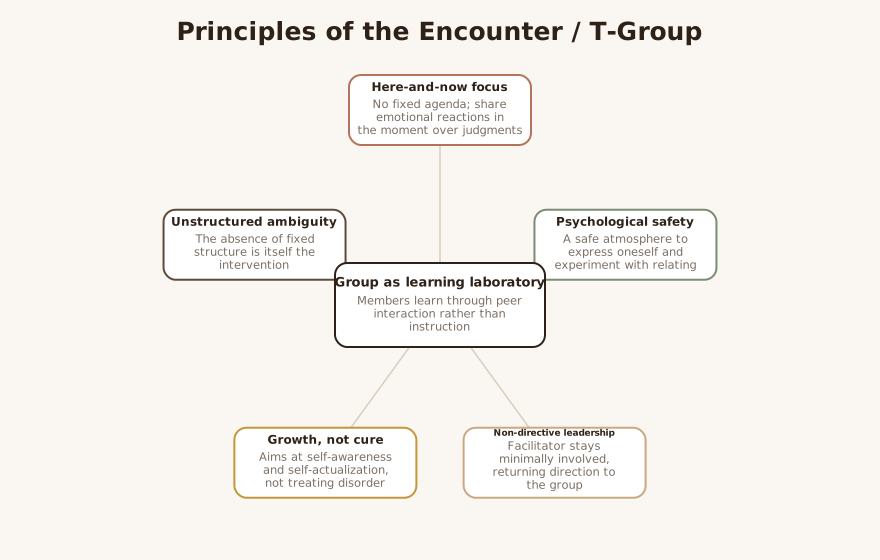
Several principles recur across the T-group, sensitivity, and encounter variants LLM.
- The group is a learning laboratory. Members learn about themselves and about group process through direct peer interaction rather than instruction, using feedback, problem-solving, and role play 7.
- Here-and-now over there-and-then. Sessions deliberately lack a predetermined agenda; the facilitator encourages members to share emotional reactions to one another’s behavior in the moment, emphasizing feelings over judgments 75.
- Psychological safety as precondition. The stated goal is a psychologically safe atmosphere in which participants feel free to express themselves and experiment with new ways of relating 12.
- Minimal, non-directive leadership. The trained facilitator maintains a supportive climate while remaining minimally involved in steering content, returning responsibility for direction to the group 2.
- Growth, not cure. The aim is increased self-awareness, authenticity, and self-actualization rather than treatment of disorder 56.
- Unstructured ambiguity as method. The absence of fixed structure is itself the intervention: it surfaces members’ habitual interpersonal patterns so they become available for feedback LLM.
Interventions & Techniques
The core “technique” is the unstructured group itself, but several characteristic moves define practice LLM. Facilitators invite members to give and receive direct interpersonal feedback—telling one another how their behavior lands emotionally—while coaching the group to favor feelings over evaluative judgments 7. Role play and live problem-solving are used to make patterns visible and rehearsable 7. Sessions are typically intensive and concentrated: formats range from a few hours to weekend “marathons” to residential labs running over days, and the technique appears to work best when sessions are concentrated and uninterrupted, such as multi-day intensives 42. Groups commonly comprise roughly 8–15 participants who begin with stated communication goals and move toward deeper interpersonal material as trust builds 74.
LLM-generated illustrative example (not a guideline): In a weekend lab, a participant who habitually deflects with humor is told by three others that his jokes leave them feeling held at arm’s length. The facilitator does not interpret or rescue; she invites him to notice what he feels right now and to try responding without the joke. The “intervention” is the group’s honest mirror plus the safety to experiment with a new response in real time. LLM
Evidence Base
Be candid with clients and supervisees: the evidence base is historical, sparse by modern standards, and mixed LLM. The most-cited supportive finding is a 1975 study by Adler and Goleman reporting that T-group participants showed significantly more change toward their selected goals 7. Against this stands a 1971 study finding that 9% of college-student participants developed psychological problems lasting six months, concentrated under authoritarian leaders who used “vicious emotional attacks and public humiliation” 7. Complicating the casualty picture, other peer-reviewed work from 1975 found no evidence that sensitivity training produced more adverse effects than other group experiences 7. A recurring caveat across sources is durability: behavioral changes often do not endure beyond the intensive itself 2.
The contemporaneous clinical literature, exemplified by Gottschalk, Pattison, and Schafer (1971), was less concerned with effect sizes than with conceptual clarity and safety—stressing that all group situations contain powerful tools that must be handled with proper respect, and that any group leader must have proper training 6. In short, the modality predates the randomized-controlled-trial era, lacks robust modern outcome data, and should be presented as a historical influence on current practice rather than an empirically validated standalone treatment LLM.
Populations & Indications
The movement was explicitly designed for relatively well-functioning people, not psychiatric patients 6. Across sources, the natural fit includes adults seeking personal growth and self-actualization 5; organizational and leadership trainees and intact teams, given the method’s heavy adoption in business and industry to strengthen interpersonal trust and communication 24; and helping professionals in training, for whom experiential learning about group process and one’s own interpersonal impact has obvious developmental value 6. Communities and teams facing communication breakdowns were also early targets, consistent with Lewin’s founding work on group tensions 4. Individuals presenting with interpersonal difficulties, emotional inhibition, low self-awareness, or communication problems are plausible candidates when otherwise stable, since these are precisely the patterns the here-and-now feedback model surfaces 17.
Problems-for-Work
The modality’s mechanisms map onto specific interpersonal targets LLM.
- Interpersonal difficulties and relationship difficulties. The group becomes a microcosm in which recurring relational patterns appear and can be named through feedback 71.
- Emotional inhibition. The premium on expressing feelings rather than withholding them directly addresses constriction 75.
- Low self-awareness. Sensitivity training’s stated aim is increased awareness of self and others, achieved by examining one’s own and others’ reactions aloud 2.
- Communication problems. Improved interpersonal communication and lasting attitudinal change are the explicit goals 2.
- Social isolation, low self-esteem. The safe, accepting climate offers corrective experiences of being seen and accepted 15.
- Group process difficulties. Understanding how one functions in groups is the literal training objective of the T-group 6.
LLM-generated illustrative example (not a guideline): A new clinical supervisee who freezes in team meetings joins a process-oriented training group. Members reflect that her silence reads as disengagement, not the anxiety she actually feels. Naming the gap between her inner state and her outward signal—and practicing speaking up while anxious—targets both emotional inhibition and group-process difficulty at once. LLM
Contraindications, Cautions & Cultural Humility
This is the section to take most seriously. The Human Potential literature is explicit that individuals with psychotic conditions, substance-abuse issues, or severe personality disorders were deemed inappropriate candidates for these methods 5. Documented harms include trauma from poorly led encounter groups and a reinforcement of self-centeredness 5. The casualty signal is real: psychological problems persisting six months in a meaningful minority of participants, concentrated under authoritarian, humiliating leadership 7. The clinical literature’s core safeguard is unambiguous—powerful group tools require proper respect and properly trained leaders 6.
Practical cautions for today’s clinician: screen out acute crisis, psychosis, active substance dependence, and fragile personality organization; never run intensive confrontational formats without trained, ethical facilitation; and be wary of the “breakthrough at any cost” ethos that produced casualties 57LLM. On cultural humility, the modality’s prizing of open emotional disclosure, direct confrontation, and individual self-actualization reflects a specific mid-century, individualist, Western frame 5LLM. Norms around directness, deference, family privacy, and the appropriateness of expressing strong feeling to relative strangers vary widely across cultures; what reads as healthy authenticity in one frame may read as boundary violation in another LLM. The facilitator’s job is to make the group safe across difference, not to impose a single template of “openness” 2LLM.
Treatment-Plan Suggestions & SMART Objectives
| Goal | SMART objective (example) | Mechanism |
|---|---|---|
| Increase self-awareness | Within 8 group sessions, client will identify and verbalize at least 2 recurring interpersonal patterns named by peers | Here-and-now feedback exposing habitual patterns 72 |
| Reduce emotional inhibition | Over 6 weeks, client will express a present-moment feeling to the group at least once per session, rated weekly | Norm favoring expressed feelings over withheld judgment 75 |
| Improve communication | Within 10 sessions, client will give direct, non-judgmental feedback to a peer in 3 separate sessions | Practice of feeling-based feedback in a safe climate 27 |
| Reduce social isolation | Over 8 sessions, client will initiate connection with a group member outside structured prompts at least twice | Corrective experience of acceptance 15 |
| Strengthen group-process skill | By session 12, client will accurately describe their own role in a group conflict on 2 occasions | Group-as-laboratory for “how one functions in groups” 6 |
| Raise self-esteem | Over 6 weeks, client will report and accept one piece of positive peer feedback per session without deflecting | Acceptance in a psychologically safe atmosphere 1 |
| Improve relationship functioning | Within 10 sessions, client will rehearse one new relational response via role play and report a real-world trial | Role play and experimentation with new behavior 71 |
Common Misconceptions
- “Encounter groups are a form of psychotherapy.” They were designed as growth/educational experiences for well-functioning people, conceptually distinct from group psychotherapy aimed at psychiatric symptoms 65.
- “More confrontation equals more growth.” The harm data point the other way: the worst casualties clustered under authoritarian leaders using emotional attacks and public humiliation 7.
- “The facilitator runs the session.” The trained leader deliberately stays minimally involved, returning responsibility to the group 2.
- “Gains last.” Sources repeatedly note that changes often do not endure beyond the intensive 2.
- “It’s safe for anyone.” People with psychosis, substance-abuse problems, or severe personality disorders were considered inappropriate candidates 5.
- “T-groups, sensitivity groups, and encounter groups are all the same.” They overlap but differ in emphasis—T-groups stress group dynamics, encounter groups stress the individual and personal expression 74.
Training & Certification
There is no contemporary clinical credential called “encounter group therapist” LLM. Historically, the National Training Laboratories (now the NTL Institute) was the institutional home for T-group and laboratory training and remains active 47. The enduring requirement that survives in the literature is competence-based rather than certificate-based: a group leader must have proper training, because all group situations contain powerful tools that must be handled with respect 6. For practicing clinicians, the responsible path is formal training and supervision in group psychotherapy and group-process facilitation through one’s licensing discipline, plus, where available, experiential T-group-style learning to understand one’s own interpersonal impact 6LLM.
Key Terms
- T-group (training group): A small, unstructured group in which members learn about themselves and group dynamics through feedback, problem-solving, and role play 7.
- Sensitivity training: Intensive group discussion and interaction used to increase awareness of self and others and improve interpersonal communication 2.
- Encounter group: A variant emphasizing the individual and personal expression more than group-dynamics analysis, often within the human potential tradition 71.
- Here-and-now: The practice of focusing on present-moment emotional reactions to one another’s behavior rather than past history 7.
- Psychological safety: The supportive group climate that allows free expression and behavioral experimentation 12.
- Self-actualization: The Human Potential Movement’s goal of integrating personality components toward maturity, self-awareness, and authenticity 5.
- Laboratory method: Experiential learning in which the group functions as a live laboratory for studying its own process 64.
Resources & Further Reading
▶ Watch — a video introduction to this concept:
- Encounter group — Encyclopaedia Britannica
- Sensitivity training — Encyclopaedia Britannica
- Carl Rogers on Encounter Groups (1970) — Internet Archive
- A Brief History of T-Groups — Ed Batista
- Human-Potential Movement — Encyclopedia.com
- Training Groups, Encounter Groups, Sensitivity Groups and Group Psychotherapy — PMC
- T-groups — Wikipedia
Reflective / Supervision Questions
- When you facilitate a group, where do you fall on the directive–nondirective continuum, and how does that choice affect members’ sense of psychological safety? 2LLM
- How do you screen for the contraindications—psychosis, active substance use, fragile personality organization—before placing a client in an intensive interpersonal group? 5LLM
- The worst historical casualties occurred under confrontational, humiliating leadership. What in your own practice guards against the “breakthrough at any cost” impulse? 7LLM
- How do you distinguish, in your charting and consent, between a growth/educational group experience and medically necessary group psychotherapy? 6LLM
- Whose cultural norms about emotional disclosure and direct feedback are you treating as the default in your groups, and how would you know if a member experiences that default as unsafe? 5LLM
- Given that gains from intensive group experiences often fade, how do you build durability—real-world practice, follow-up, integration—into your treatment plan? 2LLM